
Health Insurance for a France Long-Stay Visa: Read the Certificate and Ask Better Questions
Insurance for a French long-stay visa needs to match the instructions for your application. Compare certificates, dates and policy wording, then ask the insurer precise questions in French before relying on a document in your file.
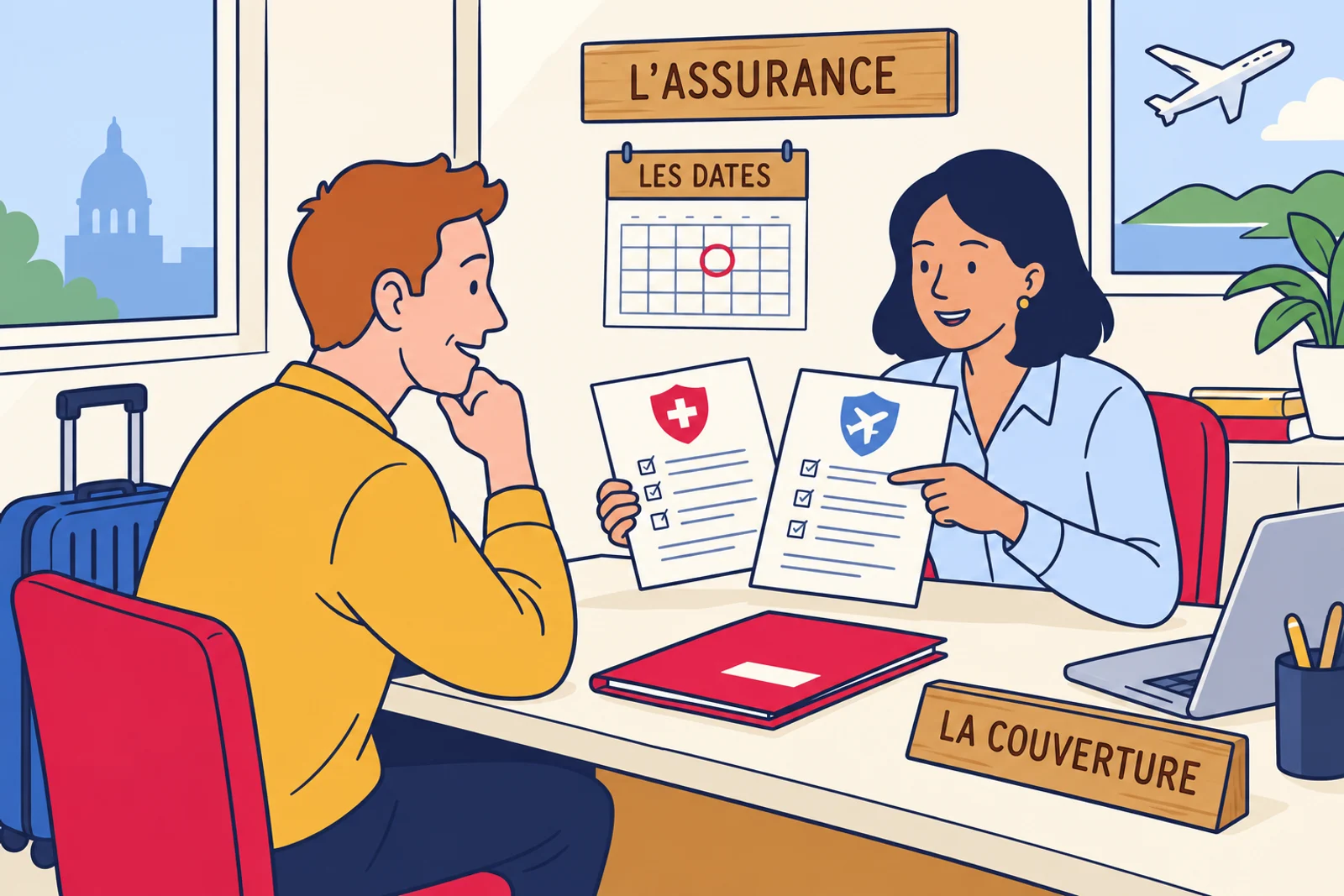
When you are preparing a visa file, an insurance question often becomes a language question. What is an attestation? Does the certificate describe the same period as the policy? What does an exclusion remove from the cover? Before comparing prices, identify what your own official instructions ask you to demonstrate.
This guide helps you read the document categories and prepare questions. It does not recommend a particular policy or promise that a purchase will satisfy an application. Your route, circumstances and actual contract matter. Use the France-Visas assistant to establish the requirements applicable to your file.
For the wider application process, return to the long-stay visa guide.
Identify the document
A devis is a quotation. A contrat sets out the insurance agreement and its terms. An attestation is a certificate confirming specified information. A payment receipt shows payment. Do not treat these as interchangeable because they share a provider's logo.
Read the document title and then its contents. Identify the insured person, dates, geographical scope and policy reference. If the official request names a particular document, ask whether you have that document or something that merely looks similar.
Ask this only when it accurately describes your situation. Obtaining a certificate may depend on completing a purchase or other conditions; your question should not imply that cover already exists if it does not.
Keep four questions separate
Ask what your application requires, what the proposed contract covers, whether your circumstances meet the contract's conditions and which document demonstrates the relevant information. These questions concern different things. A provider can explain its product, while the competent visa authority determines the evidence required for your application.
The separation prevents a common misunderstanding. A certificate can look professionally presented without resolving a question about the underlying cover. Conversely, a lengthy contract may contain relevant terms but still leave you needing the particular evidence requested for the file. Identify which question remains open before contacting someone.
Make a worksheet with one row per question and a source or recipient beside it. Keep answers with the wording that produced them. “Yes, that is included” becomes difficult to interpret later if you cannot see whether “that” referred to a date, a territory or a benefit.
Read the document title before saving it
Give each incoming file a label based on what it is. A quotation belongs with quotations. A certificate belongs with certificates. A message confirming that a change is being considered belongs with correspondence. Avoid renaming all three “insurance proof” and discovering later that you cannot distinguish their roles.
Open attachments before relying on email summaries. A message can announce that documents are available while linking to several files. Read the title and relevant details of the actual attachment you plan to use. Check that it concerns you and the arrangement under discussion.
If two files appear to conflict, preserve both and ask the issuer which is current and how the difference should be understood. Do not choose the one that seems more favourable without resolving the inconsistency. Your personal record should show the clarification and the version to which it applies.
Keep the application wording beside the evidence
Save the exact request for your case with your insurance notes. Underline the document type and conditions stated. Compare the evidence line by line. If a term is unfamiliar, record the question rather than deciding that a similar English phrase must mean the same thing.
This is useful when comparing a marketing page with a certificate. Marketing language may describe a product broadly. Your question concerns the evidence and actual contract. Look for wording that supports the specific point you need to establish, and seek clarification where it remains absent or ambiguous.
Do not use another person's accepted application as a substitute for this comparison. You may not know their complete circumstances, policy version or requested documents. Their account can suggest a question to investigate, but it does not supply the answer for your file.
Read the conditions before the headline
A large cover figure does not answer every practical question. Look for the period, territory, eligibility, exclusions, excess or deductible, and how claims are handled. If an English summary and the full contract appear inconsistent, ask which wording applies and obtain clarification from the provider.
| French term | Working meaning | Question it raises |
|---|---|---|
| garanties | cover or benefits | Which events and costs are included? |
| exclusions | exclusions | What is outside the cover? |
| franchise | excess or deductible | What amount remains payable by you? |
| date d’effet | start date | When does the cover begin? |
| échéance | expiry or due date, depending on context | Which event does this date refer to? |
| conditions générales | general terms | Where are the complete conditions? |
These translations help you ask a question; they do not replace interpreting the actual contract. Copy the specific clause into your notes with its page number so you can refer to it accurately.
Do not import a rule from a short-stay travel-insurance article into every long-stay application. Begin with the instructions for your own route and compare the proposed evidence against them.
Use a reading order that reveals unanswered questions
Start with the people and period, then the territory, benefits, exclusions and procedures described in the documents. Record where each answer appears. If you cannot find one, mark it as a question. This is a reading method, not a checklist that declares a policy suitable once every box contains text.
The French public information service ABE Infoservice recommends clarifying matters such as cover, exclusions, start date, duration, premiums, deductibles and cancellation conditions before taking out insurance. Its guidance is a useful general reference for questions to ask, while your proposed contract supplies the specific terms. ABE Infoservice: before taking out insurance.
Keep a page reference beside any clause you want explained. “Please explain page four, paragraph two, concerning the start date” is easier to answer than “Please confirm that everything is covered”. The narrower question also makes it easier to see whether the reply resolves the uncertainty.
Distinguish a start date from the date of purchase
Your personal notes should identify which date is which. The day you obtain a quotation, the day you pay and the stated start of cover may not be identical. Read the labels and ask the provider to clarify their relationship for the proposed arrangement.
In a fictional exercise, imagine a receipt dated 10 August and a certificate showing cover beginning 1 September. The receipt date alone does not say that cover began in August. Read the relevant documents and confirm the effective date instead of inferring it from whichever date appears first.
Use the same approach for the end of the period. A payment schedule, renewal date and end of stated cover can be different concepts. If the wording is unclear, quote it in your question. Avoid changing dates in your summary until you understand what they represent.
Preserve conditions attached to a benefit
A benefit label can be followed by a limit, condition or exception. When making notes, keep those attached. Writing down only the favourable headline can leave you with a summary that no longer represents the paragraph you read.
For language practice, invent a harmless example about a fictional service rather than interpreting your own policy without support. Suppose a sample sentence says a service is available after prior contact. Your summary should retain the contact condition. Removing it changes the practical instruction even though the service name remains correct.
Return to the actual contract with that reading habit. Ask the provider about any condition you do not understand and where the complete procedure is described. A short answer is useful only if it addresses the condition as well as the benefit.
Be precise about amounts and their labels
When a document contains a figure, identify its currency and what it measures. Is it a payment, a limit, an amount payable by you or an example? Copy the label with the number into your notes. A number without its label is difficult to compare meaningfully.
Do not create a personal cost prediction from wording you have not understood. Ask the provider to explain a specific example using the proposed contract. Keep the answer framed as an explanation of that example rather than a guarantee about every possible situation.
If you compare quotations, use the same question for each. Differences in the answer can reveal that the products describe different arrangements. The purpose of the comparison table is to expose those differences, not to award a winner automatically based on the lowest headline price.
Keep territory questions concrete
Write down where you intend to be and ask how the contract applies to those plans. Do not assume that a phrase such as international or worldwide answers every question about residence, travel or a visit elsewhere. Refer to the exact territorial wording and relevant conditions.
If your plans include time in several places, describe the sequence accurately to the provider. Ask which part of the policy addresses it. Avoid simplifying your plan to “France only” because that makes a comparison form easier to complete.
The same discipline applies to the certificate. If a geographical label appears there, compare it with the underlying documentation and the evidence requested for your application. Ask about an apparent discrepancy before choosing your own interpretation.
Notice the words that restrict a sentence
French words such as sauf, uniquement and sous réserve de change how a statement should be read. Sauf introduces an exception. Uniquement limits something to the stated case. Sous réserve de indicates that a condition or qualification follows. Recognising them helps you find the part of a sentence that deserves attention.
Practise with an invented service notice rather than a real policy clause: “Le service est disponible uniquement du lundi au vendredi.” The sentence limits availability to Monday through Friday. If your English summary says only “the service is available”, it has lost the restriction that answers a practical question about Saturday.
Now try “Le service est disponible, sauf les jours indiqués dans le calendrier.” You need the referenced calendar to understand the exception. The language lesson is to follow the reference, not assume which days it contains. Contractual documents can also refer to another paragraph or schedule; keep those references in your notes.
Ne… que is another structure worth recognising. In ordinary French it expresses a restriction, often translated as “only”. If you see it in a sentence you do not fully understand, avoid treating it as a simple negative. Ask for an explanation of the complete wording in context.
These language clues do not tell you the legal effect of a clause. They tell you where a condition or limit may be expressed and help you ask a more precise question. Keep the original wording available when consulting the provider or an appropriate adviser.
Keep quantities linked to their units
A figure can refer to days, months, a payment period, a person or an event. When you copy it into your comparison notes, retain the unit and the surrounding description. “Thirty” is incomplete if you have forgotten whether the document refers to thirty days, thirty euros or another measure.
For practice, write two fictional summaries with the same number but different units. Ask a partner to explain what information differs. Then repeat the exercise with the same unit but a different person or period. The task trains careful reading without making a claim about any actual insurance product.
If a provider's answer uses a number without enough context, request the missing label. Do not fill it in from a similar-looking quotation. Comparing like with like requires knowing what each figure describes.
Ask the insurer precise questions
“Is this good for France?” is too broad. State the intended stay, the document you need and the point you cannot resolve. Ask for the relevant contractual wording rather than relying only on a marketing answer.
Keep the reply with the policy version concerned. A general customer-service message may not answer a specific contractual question. If uncertainty remains, state exactly which sentence needs clarification.
Prepare a question list before a sales conversation
Write the unresolved points in order of importance to your situation. Begin with whether the proposed product and evidence correspond to what you need to establish. Then ask about the dates, terms and practical procedures you cannot resolve from the documents.
Keep a separate column for the answer and source. If the person directs you to a clause, record it. If the answer depends on information you have not supplied, note that dependency. Avoid turning “we can look at that once you provide the details” into “confirmed suitable” in your summary.
After the conversation, reread your notes while the exchange is fresh. Identify any answer that is still too broad. Follow up with a concise question and the relevant reference. A second precise question can be more useful than another general comparison search.
Ask for the wording that answers your question
When a reply sounds reassuring but does not identify the basis for the answer, ask where the relevant condition appears. You are connecting the explanation to the document you will retain and use.
Use this politely and specifically. Include the topic or question you previously asked so the recipient does not have to infer what “this question” refers to. Keep the reply with the policy version discussed.
If the response introduces a new term, add it to your vocabulary notes and ask what it means in that clause. A dictionary helps with ordinary meaning, but the effect of contractual wording depends on the document and context.
Clarify who can make a correction
If a name or date appears wrong, ask the issuer about the correction process. Do not modify a certificate yourself to make it match your application. A self-edited document would no longer be the file issued to you.
Ask whether a corrected document will be provided, what information is needed and how you will recognise the current version. If a change affects more than a spelling error, ask the provider to explain any consequences or conditions before treating it as agreed.
Save the request and reply with the replacement. This gives you a traceable record and reduces the chance of submitting an older file from an email thread because it is easier to find.
Keep health information out of casual practice materials
You can rehearse clarification questions without sharing personal medical details with a language partner. Use fictional facts for practice and ask the provider through its appropriate channel about your actual circumstances.
If the provider requests information, answer accurately through the designated process. Do not omit a relevant fact because you do not know the French for it. Ask how to communicate it clearly or whether an appropriate language-support option is available.
The examples here concern communicating questions. They do not determine eligibility, interpret a medical history or advise what to disclose in a particular contractual situation. Keep those individual questions with the relevant professional or organisation.
Compare responses without reducing them to yes or no
Imagine two fictional providers answering the same question. One says “yes” and refers to a clause with a condition. The other says the answer depends on dates you have not supplied. Neither answer should become a simple checkmark stripped of context.
Record the condition from the first and the missing information from the second. Your next action is to understand the condition or supply the facts, respectively. A table preserving those differences is more useful than a scorecard based on how positive the email sounded.
Use the same discipline with price. Record what arrangement the quotation describes, not merely the amount. If you alter dates or other relevant facts, check whether the quotation remains applicable instead of carrying the old figure into a new scenario.
Practise a certificate correction
In this fictional exercise, your certificate shows an incorrect start date. The task is to request a correction from the issuer, not edit the certificate yourself.
The names, dates and reference numbers in this spoken example are fictional. Adapt the wording to your actual situation.
The wording identifies a discrepancy without pretending that a change has already been agreed. Once you receive a reply, check any conditions and the new document. Retain the correct current version for submission.
Work through a fictional certificate review
Suppose a fictional applicant, Avery, receives a certificate and notices three points: the surname lacks one letter, the dates differ from the intended period and the accompanying email links to a newer set of documents. Avery should identify each point separately rather than ask the provider to “fix everything”.
The spelling issue concerns identity details. The date issue requires comparison with the actual request and agreed arrangement. The newer documents raise a version question. Each may have a different explanation, so a clear message lists the discrepancies and asks what is needed to resolve them.
Avery should check the facts before writing. If the original request contained the earlier date, the message should describe an intended change rather than accuse the issuer of copying it incorrectly. Accurate preparation avoids asking for a correction on a mistaken premise.
After a replacement arrives, Avery opens it and compares all three points again. A corrected surname does not establish that the date issue was resolved. A new date does not establish which accompanying terms apply. The review follows the original questions until each has an answer.
Write the correction request in a useful order
Begin with the policy or quotation reference requested by the provider. Identify the document and the point that differs. State the accurate information or ask for clarification where the interpretation is uncertain. Request the appropriate next step.
Do not attach a full set of identity records reflexively. Follow the provider's instructions for any evidence it needs and the appropriate secure channel. The practice sentence requests a process; it does not determine which supporting material must accompany it.
Check the response for an action and a condition
A reply might ask you to provide information, confirm a date or review a proposed change. Read both the action and any condition attached to it. Record whether the change is proposed, being processed or complete.
For practice, write three fictional replies: “Please confirm the intended date”; “We are reviewing your request”; “A revised certificate is attached”. The next action differs in each case. In the first you supply an answer, in the second you follow the stated process, and in the third you inspect the attachment.
This exercise helps with tense and status vocabulary without inventing a policy rule. It trains you to respond to what the message says, rather than treating every reply from the provider as confirmation that the matter is finished.
Practise reading aloud without losing the key detail
Choose one short question from the article and identify its purpose before listening. Are you asking about a clause, a date or a corrected name? Listen to the sentence, then say it with a fictional detail substituted.
If you use the slower audio, return to normal speed after becoming familiar with the phrase. The purpose is to understand and retrieve the question, not memorise a recording without knowing what each part means. Ask a partner to answer with an unexpected but simple detail and repeat it back.
For a solo variation, write three possible replies on separate cards and shuffle them. Read one after asking the question. Your response should match that reply. This provides more useful practice than reciting the same opening and confirmation in a fixed order.
Useful phrases to keep
Keep visa evidence separate from later healthcare
Evidence requested for a visa application and healthcare arrangements after moving are related questions, but they are not the same administrative step. Do not assume that a later plan to seek French health coverage eliminates a present evidence requirement or that an application automatically means active cover.
For settlement vocabulary around public coverage and complementary insurance, use the separate French health insurance guide. Confirm your actual position with the relevant organisation before changing or ending any cover.
Keep three dates visible where relevant: the policy's start, its end and any confirmed start of another arrangement. A calendar helps you spot a question; it does not establish that a transition is valid. Seek clarification before acting on an assumption.
Separate a future intention from confirmed cover
You may intend to apply for another healthcare arrangement after moving. That intention is a planning fact, not proof that the arrangement is active or that a current policy can be changed. Record what is planned, what has been requested and what has been confirmed.
Ask the relevant organisations about your position before ending or altering cover. Keep the response with the dates and conditions it concerns. A general statement about how a system works does not necessarily establish the effective date for an individual application.
The language challenge is often a small word: already, not yet, from or until. Preserve those meanings in your notes. “I have applied” and “my rights are confirmed from a particular date” are different statements, even when both relate to the same future plan.
Keep contact and claim instructions accessible
After choosing an arrangement, read how the provider says to contact it and where the relevant procedures are documented. Save that information securely with the policy reference. Do not wait until you need an answer urgently to discover that your only copy is in an inaccessible email account.
This is document preparation, not medical guidance. For a real health situation, seek appropriate medical or emergency help and follow the relevant professional instructions. For a question about the contract or reimbursement process, use the organisation responsible for that question.
When taking language notes, separate ordinary expressions from individual facts. “Which document should I send?” is reusable. A claim reference or health detail should remain in the private record for that matter, not in a general vocabulary worksheet shared with others.
Review your insurance file after a change
If your dates or circumstances change, identify which documents and questions may be affected. Contact the appropriate provider or authority rather than assuming a change in your personal calendar updates the contract or application evidence.
Keep the original question, reply and any new document together. Record the date of the change and which version is current. If a later request refers to an older certificate, you can explain the sequence accurately instead of guessing which attachment the recipient has seen.
Before the next submission or appointment, open the current files again. Check that the certificate you intend to provide is the one the issuer confirmed for the relevant arrangement. Good organisation cannot decide acceptability, but it can prevent a mismatch between your understanding and the file you send.
Use a final question-and-evidence review
Return to the four questions at the start of this article. For each one, identify the answer you have, its source and any qualification. If the application requirement is clear but the contract question remains open, mark that distinction. A complete-looking folder should not conceal an unresolved issue.
Next, inspect your own notes for words that overstate certainty. “The provider has received my question” is supported by a receipt. “The provider has confirmed the change” requires a different response. “This will be accepted” is not something you should infer from either event.
Check the files as well as the notes. Does the certificate match the version discussed in the latest reply? Are the dates and names you summarised actually present? Is the relevant contract version saved with it? If you cannot connect an answer to a document, that becomes a question to resolve.
Rehearse the review with a fictional partner
One person plays the applicant and the other asks three questions: which document is this, which dates does it show and what remains unclear? The applicant answers using only the information printed on a harmless practice page. If a detail is absent, the correct response is to identify that absence.
Switch roles and add a short provider message. This time, the reviewer must distinguish a proposed correction from a completed one. Change a word such as “will” to “has” in the English practice version and explain how that changes the status reported.
The exercise builds a useful habit: answer from evidence, preserve conditions and name uncertainty precisely. You can then apply that habit when reviewing your real file privately, with the relevant provider or authority supplying the answers that the documents alone do not establish.
Before finishing, select the next action you can actually take. It might be requesting the correct certificate, asking about one clause or checking a revised date. Give it a recipient and a completion point. That is more useful than leaving a general reminder to “sort insurance” beside a folder you no longer understand.
Keep the final attachment identifiable
Give the file a name that lets you distinguish it from the earlier version without opening several similar downloads. A private naming pattern might include the issuer, document type and issue date. Avoid putting unnecessary identity numbers in filenames, especially if the folder will be shared with someone helping you practise French.
When you send a clarification question, refer to the document by its actual title and date. That gives the recipient a concrete reference. If you receive an updated attachment, check its contents before replacing your working copy: a new filename alone does not establish that the requested correction appears inside. Keep the earlier version in your private archive when it helps explain the exchange, and clearly mark which version you intend to use.
Compare two insurance certificates
Imagine two certificates naming the same traveller and dates. One summarises medical cover in a line. The other separates treatment and assistance and refers to detailed conditions. Neither layout alone establishes whether the policy meets the requirements for the application.
Make a row for each feature requested by the official checklist. Beside it, record the exact certificate wording or policy page addressing it. Leave a row unresolved when you cannot find an answer, and ask the insurer to identify the applicable clause.
Keep questions about application evidence separate from questions about claims and exclusions. A certificate summarises cover; the contract explains how it operates. Retain both documents and check the dates again if the itinerary changes. A revised journey can require another document check even when you have already paid for the policy.
Useful phrases to keep
| 🇫🇷 French | 🇺🇸 English | 💡 Context |
|---|---|---|
| la personne assurée | the insured person | Checking the named policyholder |
| la période de couverture | the cover period | Comparing cover and travel dates |
| une attestation rectifiée | a corrected certificate | Requesting a corrected certificate |
| les frais restant à ma charge | costs remaining payable by me | Asking about uncovered costs |
| une confirmation écrite | written confirmation | Keeping the insurer’s answer |
| la référence du contrat | the policy reference | Identifying the policy in a message |

Long-Stay Visa Language Pack
Know what belongs in your visa file.
For US citizens planning a long stay
Start with the route that fits your plans. Use the document checklists to organise your file, decode the French on forms and check the official instructions before you apply.
- Document checklists and a file organiser
- Useful French for forms and appointments
About 170 pages · Fillable and printable PDF
Get the Visa pack · $9 Read a preview before you buyOne payment · Instant PDF download
Practise explaining your plans in French.
Tell a tutor why you are moving and which forms or messages you find hard to understand. Rehearse the language you need for your own situation.
Find a French tutor →Paid lessons. Compare tutors and prices before booking.
Affiliate link: we may earn a commission when you book.
📚 Keep building in the Learning Center
French Self Study for Expats: Build Your Routine Around the Next Conversation
French self study for expats works best when practice follows the conversations you need next. Build a manageable…
Read →Moving to France from the US: A Practical First-90-Days Plan
Your first 90 days in France involve overlapping tasks, from housing and banking to everyday conversations. Use this…
Read →French SIM Cards and eSIMs: How to Choose and Buy
Compare prepaid SIMs, eSIMs and French mobile plans. Check phone compatibility, activation and plan terms, with phrases for…
Read →