
Updated on September 15, 2026
How to Retire in France: A Practical Moving Timeline
Plan the stages of retiring in France: research, visa preparation, housing, banking and healthcare, with a moving timeline and French vocabulary.
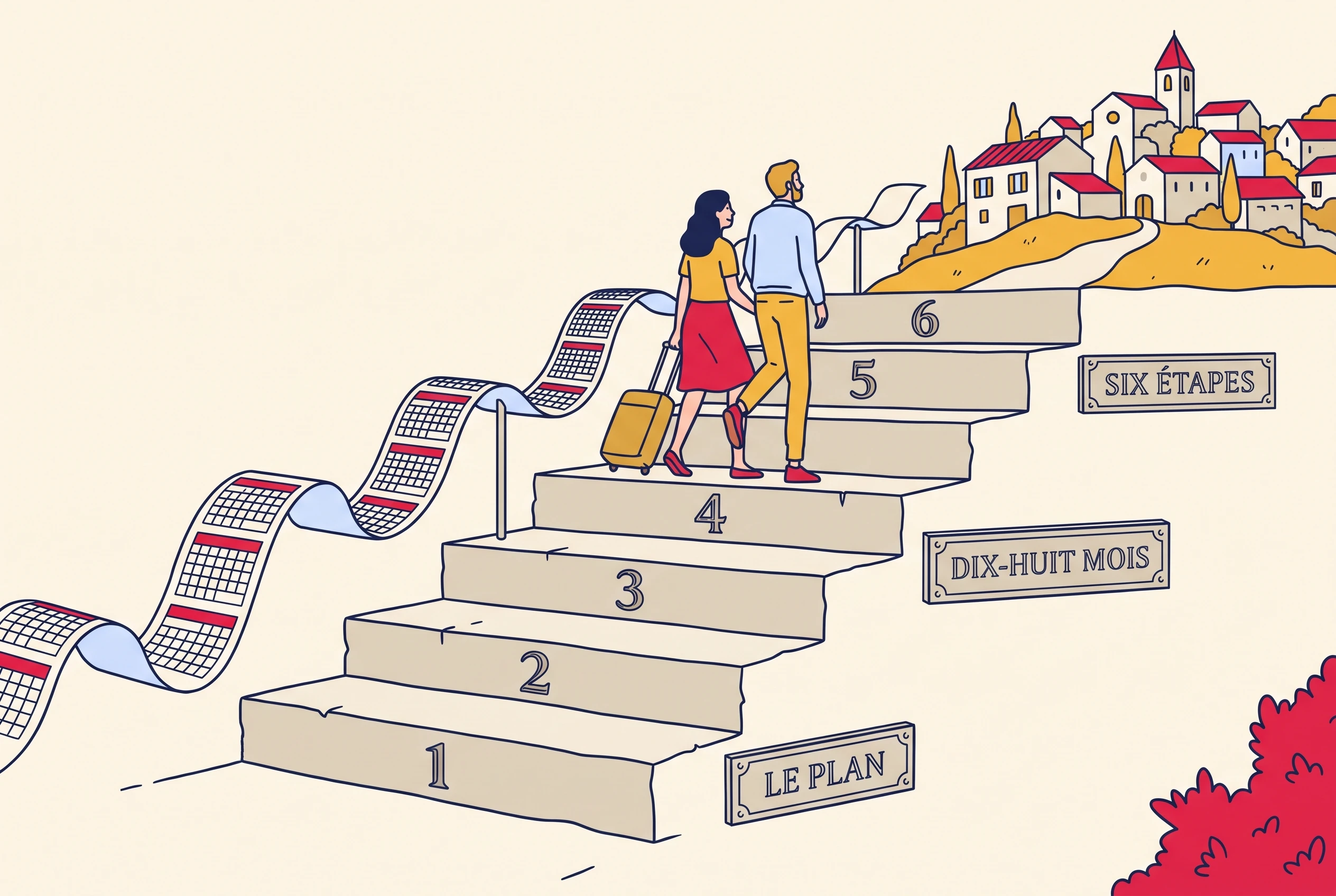
Treat the timeline as a planning aid, not a mandatory schedule. Some decisions can run together; others depend on your visa or address. Follow the stages and confirm the deadlines that apply to your status.
Everything on this page converges on a ninety day window
Retirement plans for France usually take the shape of a list. Region, visa, money, house, doctor, French, in whatever order the week allows. Lists are fine until one item has a door that opens late and closes early, and this one does.
Service-public states it inside a parenthesis, which is roughly the attention it receives: the visa application is lodged no more than three months before the planned departure. Ninety days. That is the entire opening, and no consulate will take the file before it.
Read that backwards and the whole plan reorganises itself. The file does not start when you feel prepared. It starts ninety days before a departure date that already exists, which means the date has to be chosen while the region, the money and the roof are still hypothetical. People do it the other way round and lose a season.
A second three month clock waits on the far side. Once you land, the long-stay visa has to be validated online within three months of arrival, and that portal, the categories printed on the sticker and the order the documents go in are set out in how a long-stay visa file is assembled and validated. This page stays on the sequence: what happens first, what waits, and what quietly expires while you are busy elsewhere.
Both ends of the move are measured in three month units. Neither clock takes an interest in what you have not done.
Six steps, in the order that stops you doing them twice
Nothing below is difficult on its own. Almost all of it is a form, a phone call or a signature. What costs households a year is doing step four before step one, then discovering that the village they signed a lease in has no doctor taking patients.
- 1Choose the department, then listen to itNot the region on the wine label. The department, because health cover, rents and the accent all change at that scale. Spend a week there out of season, and spend part of it in shops rather than restaurants, where nobody is being paid to understand you.
- 2Fix a departure date and build the file towards itThe date comes before the paperwork, because the ninety days hang off it. Everything the file proves, income across a full year, cover for the whole stay, an address at the other end, has to be finished before the window opens rather than during it.
- 3Set up the money in the first fortnightA French account, a plan for the pension, and one deadline nobody mentions: the driving licence. All three are ordinary tasks that turn expensive when they are attempted in month eleven instead of month one.
- 4Rent something you can walk away fromThe first lease is a base camp, not a home. What matters about it is the notice period, because the day you find the house you actually want, that clause decides whether you move in six weeks or four months.
- 5Learn the French your street uses, not the French an examiner marksRoughly forty recurring sentences carry an ordinary week in a French village. They are short, they repeat, and they are nothing like the material sold as retirement French. This is the step with the longest lead time, so it starts before any of the others finish.
- 6Open the health file the day it becomes possibleThree months of residence is the earliest date, and the private policy carries everything until the fund answers. Declaring a family doctor comes with it, which is why the doctor question belongs to step one and not to this one.
So which of the six gets done twice? Almost always the fourth. A rental chosen for its shutters, in a village chosen for its market, forty minutes from the hospital that will matter in eight years.
A bank account, a licence, and a tax year that starts on the day you land
Step three has one trap and one gift, and both are written into French law rather than into any relocation guide.
The trap first. Your American licence carries you through the first year of French residence, and the exchange has to be requested inside that same year. Miss it and the route closes: the alternative is the French test, in French, on French roads. France also exchanges licences only from states that hold an agreement, negotiated one by one, so two neighbours from different states get different answers. The consulate in Chicago publishes its own district as an example: Illinois and Iowa for all categories, Ohio for category B only.
Rehearse this one before the appointment, because the counter will ask which state issued it.
Échanger, not convertir. Convertir exists in French and means something a bank does to money, which is exactly the sort of near miss that makes a clerk pause for two seconds too long.
Six steps, eighteen months, roughly forty sentences
Count what this page asks your French to do and the total is smaller than the dread around it: one line at a town hall counter, two at a bank, four on the telephone, then the same market questions on rotation. Nine printable pages hold most of that, and they arrive as the cheat sheet pack: tu against vous, the two past tenses, figures and dates said aloud, the false friends, and week one in a village. Type an address, the download starts.
Now the gift, the other half of step three. Banks refuse foreign retirees more often than the brochures suggest, and a refusal is not the end of the conversation. Anyone residing in France has a right to an account. Ask a bank in writing, and if the answer is no, or if fifteen days pass with no answer at all, that counts as a refusal. Take the refusal to the Banque de France, which designates a bank within one working day, and the designated bank must open the account within three working days of receiving your documents. Basic banking services under that route are free.
Droit au compte is a legal term and staff recognise it instantly. Say it and the tone of the conversation changes, occasionally in the same sentence.
What most retirees do not expect is the tax calendar. Arrive in September and your first French tax year is the fragment between the arrival date and 31 December, declared the following year on form 2042. Which country taxes which pension is a separate question with a 1994 treaty behind it, answered in the conditions an American household actually has to meet. This page does not reprice any of it.
The lease you sign first decides how fast you can leave it
Almost every household rents before it buys, and almost none of them reads the notice clause before signing, because at that stage leaving is not the plan. A year later it is the whole plan.
Furnished tenancies carry one month of notice, whatever the reason, and no reason has to be given. Unfurnished tenancies carry three. That three drops to one only inside a zone tendue, a tight housing market, which the villages people retire to are not. So the same signature buys either six weeks of freedom or four months of it.
Handing in notice is a written act, and the sentence that accompanies it is short.
Better to ask before signing than to discover it afterwards, and the question is one line at a viewing.
The rest of the tenancy, the guarantor problem that foreign income creates, the inventory signed on the doorstep, the deposit and how it comes back, lives in what a French landlord asks for before handing over keys.
The French a village asks for, and the French a diploma asks for
Here is the part of the sequence with no institution behind it. Other residence statuses are enrolled in a contrat d’intégration républicaine on arrival, which pairs a civic course with a language assessment and, where the level calls for it, state-funded French lessons. The eligibility table on service-public answers the visitor card in one word: non. A retired household signs no contract, sits no assessment, and receives no timetable.
Nobody is going to schedule this for you. Which is either a relief or the reason four years pass, depending on what you put in its place. Your French should serve your life. Not a curriculum.
What a week actually demands is narrow and repetitive. The bin collection, the pharmacy queue, a parcel that went to the wrong hamlet, the garage, a neighbour at the gate holding tomatoes. Start with the town hall, where the clerk is the person who knows the order of everything on this page.
The second line matters more than any vocabulary list, because it is the one that stops the switch to English before it happens.
Say it once and people believe you. Say it twice in the same shop and they stop offering. That is the single highest return sentence on this page, and it is A2.
Politeness in French is grammatical, not warm, and the difference between wanting and would-like is the difference between a customer and a nuisance.
Then the market, which is where most retired French is actually spoken and where nobody minds a slow sentence.
Two questions in one breath, which is how the stall works. Ask them separately and you are still there when the queue behind you has doubled.
The garage produces the sentence nobody prepares, because a noise has no vocabulary until you need one.
Bizarre is not a stylistic risk here. It is what a French driver says, and reaching for something more precise usually produces something less true.
Deliveries in the countryside go astray for a reason a satellite cannot fix: two hamlets, one road name, three kilometres apart. This is the call you will make.
Then there is the line that buys you time on any telephone, at any counter, for the rest of your life in France.
Plus lentement, not encore une fois. Repetition at the same speed helps nobody, and French speakers will slow down when asked, once.
The last one arrives across a gate, usually with vegetables involved, and it is the only sentence on this list that decides whether you are a household or a holiday let.
Speaking first is the barrier, not the words, and what to do when the sentence is ready and your mouth is not is the more useful read at this stage than another vocabulary list. Rural life brings its own register, from field names to septic tanks, gathered in the vocabulary a village actually runs on, and the exchange that defeats confident readers is the first French phone call, with no face to read.
A short French text each morning gives you words to use during the day. Try the daily French Briefing, which is short enough to finish beside a first coffee.
A diploma is a different exercise with a different deadline, and it only appears if a ten-year resident card enters the plan. That is years away and it is not this article.
Registering for care in a department you have not checked yet
The dates and the money on this side belong to the pillar page: when the public scheme opens to a household, what a consultation costs, what the complementary policy adds afterwards, all in what a retirement file has to prove and what it costs to run. What belongs here is the sequencing error, and it happens in step one.
Every September the same message reaches us, always from people who signed a lease in July: three surgeries called, three refusals, and the pharmacy suggesting the next town. The lease is signed. The doctor question was never asked.
It is answerable in advance and for free. Where a department is short of doctors, care is organised through structures with names nobody teaches you: maisons de santé, centres de santé, communautés professionnelles territoriales de santé. Ameli lists them department by department, and their purpose is to get patients seen quickly, then to get a family doctor formally attached to them. Read that list before the lease, not after.
Secteur is the useful word. It means the area people here consider theirs, which is rarely the same shape as the commune.
And when the search comes to nothing, the health fund has a person for exactly that, which almost nobody uses.
Saisir here means to formally refer a matter to somebody. Its other meanings involve seizing property and searing meat, which is French for you.
Eighteen months, counted back from the flight
The same six steps, laid against a calendar that runs in reverse. Eighteen months is comfortable rather than heroic, and the households who use twelve are the ones who already know their department.
| When | What moves | What it costs if it slips |
|---|---|---|
| 18 to 12 months out | Pick the department. Visit out of season. Check the health map for that area before anything else. | Every later decision is made for a place you have only seen in good weather. |
| 12 to 9 months out | Fix the departure month. It becomes the date every other date is measured from. | Nothing downstream can be scheduled, because the visa window hangs off it. |
| 9 to 5 months out | Gather what the file proves: a full year of income, cover for the whole stay, an address in France. | The window opens on paperwork that is not ready, and it will not reopen. |
| 4 to 3 months out | Book the submission appointment. The application cannot be lodged earlier than ninety days before departure. | A later slot moves the flight. The window does not move. |
| The month you land | Validate the visa online. Sign a lease you can leave. Ask a bank in writing. | A verbal refusal from a bank is a refusal you cannot escalate. |
| Months 1 to 12 | Request the driving licence exchange inside the first year of residence. | The exchange route closes and a French driving test replaces it. |
| Month 3 onwards | Lodge the health file, chase a family doctor, keep the private policy running. | Every week before the fund answers is paid at private rates. |
Two rows on that table have hard edges and the rest are preferences. The ninety days and the licence year are the ones to write on something you will look at again.
The words this eighteen months keeps handing you
| 🇫🇷 French | 🇺🇸 English | 💡 Context |
|---|---|---|
| le droit au compte | the right to a bank account | the Banque de France route after a written refusal |
| les services bancaires de base | basic banking services | free under that route, and enough to live on |
| échanger son permis de conduire | to exchange a driving licence | within the first year of residence, agreement permitting |
| le préavis | the notice period | one month furnished, three unfurnished outside tight markets |
| l’état des lieux | the condition report | signed on the way in and again on the way out |
| le contrat d’intégration républicaine | the republican integration contract | civic course and French lessons, and not for visitor status |
| une maison de santé | a multi-professional health centre | how care is organised where doctors are scarce |
| le conciliateur | the health fund conciliator | the person to contact when no doctor will register you |
| le secteur | the local area | what people here call their patch, rarely the commune |
| la secrétaire de mairie | the town hall clerk | the one person who knows the order of every step |
| les ordures ménagères | household waste | the first errand a new arrival gets sent on |
| s’installer | to settle somewhere | the verb every counter uses for what you are doing |
Three dates on this page are fixed and none of them is the flight. A visa application cannot be lodged earlier than ninety days before departure. An American licence stops being exchangeable one year after residence begins. A health file cannot be opened before three months of it. Everything else moves around your life. Those three are counted for you, and they are counted from days you choose now.
Prefer to keep it free today? Read the French Briefing →

Long-Stay Visa Language Pack
Retiring to France? Start with the visa paperwork.
For US citizens planning a long stay
For US citizens planning retirement in France: compare the long-stay routes covered by the pack, organise your supporting documents and prepare the French used in the process. Check the official requirements for your own case.
- Document checklists and a file organiser
- Useful French for forms and appointments
About 170 pages · Fillable and printable PDF
Get the Visa pack · $9 Read a preview before you buyOne payment · Instant PDF download
Practise explaining your retirement plans.
Tell a tutor where you plan to live and what you need to arrange. Rehearse the French for an appointment or an email you need to send.
Find a French tutor →Paid lessons. Compare tutors and prices before booking.
Affiliate link: we may earn a commission when you book.
📚 Keep building in the Learning Center
Moving to France from the US: A Practical First-90-Days Plan
Your first 90 days in France involve overlapping tasks, from housing and banking to everyday conversations. Use this…
Read →French Health Insurance for Expats: The Vocabulary Behind the Paperwork
French health insurance arrangements for expats depend on status and circumstances. Distinguish eligibility, registration, evidence of cover and…
Read →French Administrative Vocabulary: Forms and Appointments
Understand French administrative vocabulary for dossiers, online applications, appointments and follow-ups. Read examples with English translations. Administrative words…
Read →