
Updated on September 26, 2026
DELF B1: Understand the Exam and Choose Your Next Practice Task
DELF B1 preparation needs practice across listening, reading, writing and speaking. Understand the official task format and scoring, identify the skill needing attention and build a study plan using checked examples, original exercises and official preparation resources.
DELF B1 preparation becomes clearer when you separate language ability from exam familiarity. You need to understand and produce French, but you also need to recognise the task, follow its instructions and use the available time. Studying only one side leaves avoidable gaps.
Begin with an official sample and a record of what was difficult. A reading error caused by an unfamiliar word is different from an error caused by overlooking a condition. A speaking pause caused by missing vocabulary is different from not knowing what the task asks you to do.
This guide focuses on DELF B1 tout public.
Know the four papers
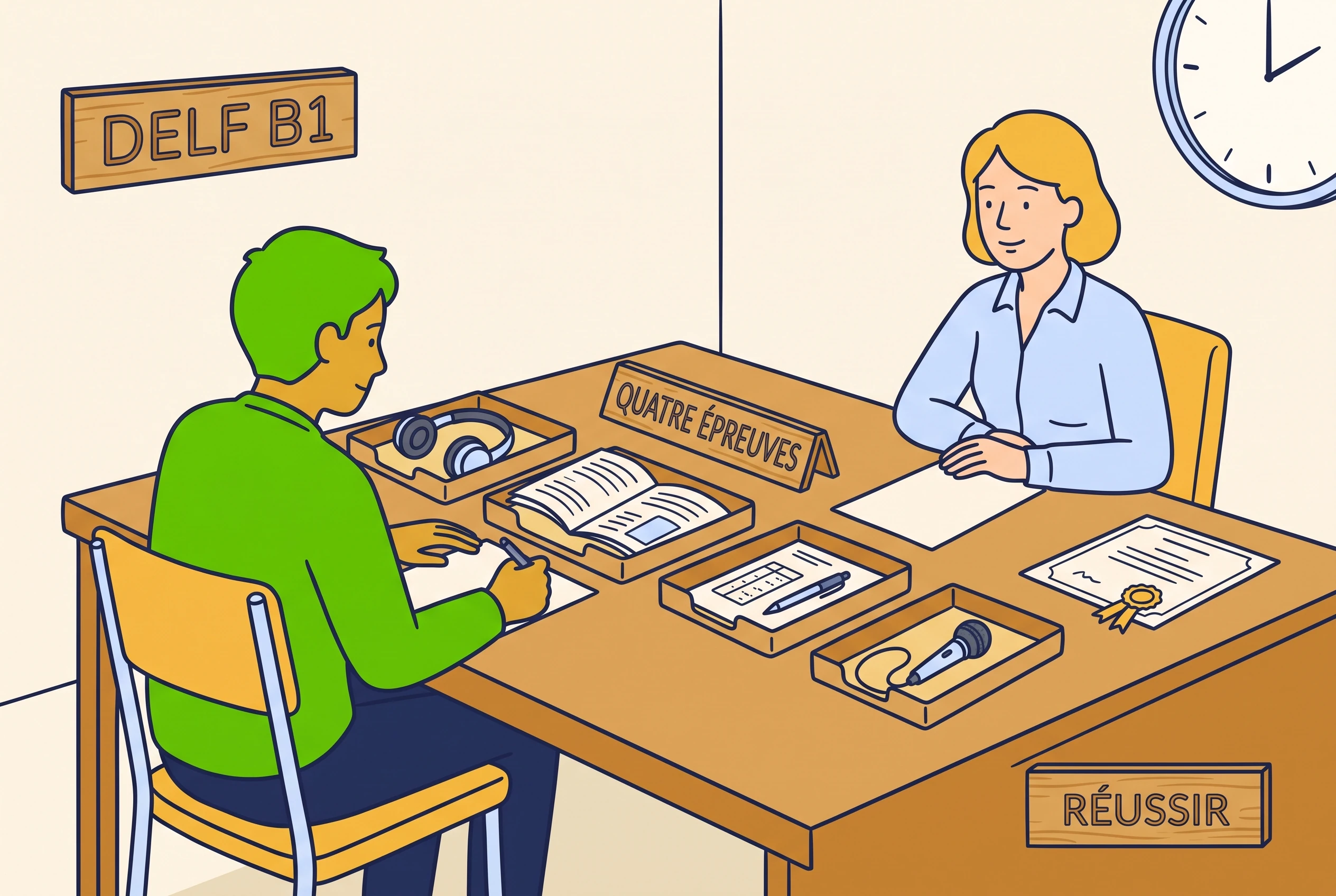
The official sample materials describe listening, reading, writing and speaking. The collective papers total approximately 1 hour 55 minutes. The table summarises their published timings; follow the instructions provided for your session. France Éducation international sample cover sheet.
| Paper | Published duration |
|---|---|
| Listening | About 25 minutes |
| Reading | 45 minutes |
| Writing | 45 minutes |
| Speaking | About 15 minutes, with 10 minutes of preparation for the point-of-view task |
The writing task requires at least 160 words. Use the official B1 overview and current candidate materials as your reference. Check your centre's arrangements for the individual speaking appointment.
Read the task before deciding how to practise
The four papers ask you to do different things with French. A listening exercise requires information from sound, a reading exercise from written material, and production tasks require you to create an appropriate response. A general grammar score cannot stand in for evidence about all of them.
Open the current official candidate material and identify the instructions attached to each task. Note what response is expected and which conditions belong to that exercise. Use the published directions rather than transferring rules from another exam or a remembered classroom quiz.
For your study notebook, create a separate page for each paper. Record a sample reference, the conditions used and the difficulty observed. This keeps a weakness in one task visible even when another task goes well. It also makes a conversation with a teacher more specific than asking whether you are generally ready for B1.
Treat listening practice as more than an answer check
During a simulation, follow the sample's stated playback instructions. Afterwards, use supported study to investigate missed information. These are different phases: a transcript or extra replay may help you learn, but the supported attempt should not be reported as an exam-condition result.
For one missed item, identify the phrase that supports the answer. Ask whether you lacked the vocabulary, missed a familiar sound or misunderstood the relationship between details. A sentence correcting a date may contain two familiar days, but only one is the final arrangement.
Choose a short follow-up based on that observation. You might practise a number contrast, identify a negation or paraphrase the speaker's intention. Keep the original audio and official correction as the reference for the sample; any new exercise you create should be clearly labelled as your own practice.
Read for evidence rather than keyword matching alone
When reviewing a reading answer, locate the passage that supports it and explain how. A word appearing in both the question and text does not automatically establish the answer. The surrounding sentence may reject, qualify or contrast the idea you noticed.
For an original mini-example, imagine a notice saying an activity has moved from Saturday to Sunday. A response that selects Saturday because the word appears in the text misses the change. The useful review focuses on the relationship between the two dates, not on memorising more weekday vocabulary.
Keep your review explanation short and tied to the text. If you cannot show why the answer follows, return to the passage or ask for clarification. This gives you a more reliable study habit than reading the key, agreeing that it looks plausible and moving on without understanding the decision.
Plan writing from the communication task
Before drafting, identify who you are writing to, why you are writing and which points the prompt asks you to address. Make a short plan that gives each required point a place. This is a proposed study method, not a claim that one planning layout is required by the exam.
Choose language you can control. An elaborate memorised opening does little if it does not fit the recipient or purpose. A clear response with connected reasons and examples is easier to revise than a collection of impressive phrases whose meaning you are unsure about.
After drafting, review the task before individual grammar. Did you answer the situation? Is a requested point absent? Does the ending fit the message? Then inspect recurring language errors. Both levels matter, and keeping them separate makes the revision more deliberate.
Practise speaking as an exchange and an explanation
Use the official task descriptions to understand the speaking activities, then practise the corresponding actions. Prepare to answer, explain and respond to another person's contribution. Do not assume that a memorised monologue will fit every question or interaction.
For a small original exercise, give an opinion about a local activity, explain one reason and add an example. Ask a partner to challenge one detail or propose an alternative. Your next response should address that contribution rather than restart the prepared opinion from the beginning.
Record a short attempt when useful and review it against the intended task. A teacher familiar with the current assessment criteria can provide feedback you may not be able to supply yourself. Keep any self-observation provisional instead of converting it into an authoritative exam mark.
Understand the scoring rule
Each paper is marked out of 25. Passing requires at least 50 out of 100 overall and at least 5 out of 25 in every paper. These are the published thresholds, not a recommended practice target. Official sample scoring information.
Use the rule to understand why a very weak skill deserves attention. Do not turn a self-estimated score into certainty about your result. Open writing and speaking tasks require judgement against criteria; checking them is different from matching a multiple-choice answer key.
For a method of reviewing your practice evidence without pretending to be an examiner, see the practice-test review guide.
Use thresholds to understand risk, not to design a minimal plan
The published pass rule means that an overall total and each individual paper both matter. A hypothetical strong total cannot erase a paper below the required minimum. Use that information to keep all four skills in your plan rather than investing only in the area that feels most comfortable.
For planning, create a four-row evidence table. Record what you have actually attempted, how it was reviewed and which difficulty remains. A self-marked comprehension sample and a teacher-reviewed writing task provide different kinds of evidence, so label them accurately.
Do not set your entire preparation around scraping past the minimum in a weak skill. Practice conditions, sample familiarity and self-marking uncertainty can affect what the result seems to show. Work on the underlying task and seek appropriate feedback rather than treating a narrow numerical margin as a guarantee.
Distinguish a mark from a useful observation
A mark summarises an assessment under particular conditions. A review observation identifies something you can change, such as omitting part of a prompt or failing to support an opinion with an example. Both can matter, but the observation is often easier to turn directly into a study task.
For a written response, “the second requested point is missing” leads to prompt analysis and planning. “The text feels weak” does not identify a next action. Ask for feedback that names the issue and, where appropriate, shows an example of how to revise it.
Keep the official criteria available when reviewing open tasks. France Éducation international publishes explanations of its writing assessment grid and speaking assessment grid. Reading them helps you understand what feedback concerns; it does not automatically make self-marking equivalent to trained assessment.
Do not add unlike scores into a false prediction
A grammar game, a repeated reading sample and a tutor's comment are not interchangeable exam-paper marks. Keep them in the evidence record under their actual descriptions. Turning each into a percentage and averaging them can create a precise-looking number without a sound basis.
Similarly, a sample you have already studied is useful for review but differs from an unfamiliar attempt. Mark that familiarity in your notes. A better result may reflect learning, memory of the answers or both, and you should not claim more certainty than the exercise supports.
Use a new appropriate task when you want additional evidence. Keep its conditions clear and seek feedback on production where needed. The purpose is to understand readiness more honestly and choose the next practice, not to manufacture a guaranteed outcome from a small collection of home exercises.
Diagnose the task that needs work
Take one sample under its stated conditions. Record not only errors but why you think they happened. Use provisional categories: vocabulary, grammar, instruction, time, attention and expression. Revisit the classification after reviewing the correction.
A missed negation suggests a different next exercise from a paragraph you could not understand at all. A written answer that does not address the requested situation needs task analysis even if its grammar is good. Keep the diagnosis specific enough to change the next session.
That sentence is a useful review observation. The next practice might be identifying audience, purpose and required points before writing, rather than learning more topic vocabulary.
Build an error log with an action column
Use four columns: task reference, observation, possible cause and next exercise. Keep the cause provisional until you inspect the correction. You might initially think you missed vocabulary, then discover that you understood the words but overlooked a condition in the question.
For example, a reading note could say that you selected the first date mentioned rather than the revised date. The next exercise might involve identifying changes and contrasts in several short checked texts. That is more focused than assigning yourself another unrelated full paper immediately.
Keep the action small enough to complete. A log full of broad goals such as “improve listening” can become a record of worries rather than a working plan. “Identify the confirmed time in three short replies” gives you something observable to try in the next session.
Analyse one writing prompt before writing anything
Take a practice prompt and highlight the recipient, purpose and requested points. Explain them in English if that helps you be precise. Then make a short plan that allocates space to each point. This exercise can be useful even on a day when you do not write the full response.
Check the plan against the prompt before drafting. If an idea is interesting but unrelated, decide whether it serves the task or consumes space needed for a requested point. Preparation is partly the ability to select relevant content, not only produce more French.
After drafting, compare the response with the plan and prompt again. A point can disappear during writing even if it appeared in the outline. Mark where each required element is actually addressed, then revise gaps before polishing isolated sentences.
Diagnose a speaking pause specifically
A pause can arise because you need a word, cannot organise the idea or did not understand the question. Those are different difficulties. After a practice exchange, identify which occurred instead of writing only that speaking was slow.
If the idea was clear but a word was missing, practise describing it with simpler language and check the word afterwards. If the idea itself was unclear, prepare a reason-and-example structure on a familiar topic. If the question was misunderstood, practise a concise clarification and responding to the reformulation.
Ask a partner or teacher to help identify the point when possible. Their observation may differ from your impression, so inspect the actual exchange or recording. Use the evidence to choose a small exercise rather than turning one difficult response into a conclusion about every part of your speaking.
Distinguish time management from missing knowledge
If you run out of time, inspect where it went. Did you reread one instruction repeatedly, spend too long on an uncertain answer or rewrite a paragraph several times? A time problem may be connected to a language gap, a task habit or both.
Try a shorter targeted rehearsal that isolates the issue. For writing, you might practise making a plan quickly from several prompts without drafting each response. For reading, you might practise locating the evidence for a particular question type. Keep the exercise tied to the difficulty you observed.
Do not simply cut every activity's time in half and hope speed appears. Accuracy and comprehension still matter. A useful rehearsal shows where support or a clearer method is needed, then checks the task again under appropriate conditions.
Choose one priority without abandoning the other papers
Select the most consequential recurring difficulty for focused work, while retaining smaller review tasks for the other skills. This gives the plan direction without allowing an entire paper to disappear for weeks because it feels less urgent.
For a hypothetical learner, writing may need the most attention because required points are repeatedly omitted. The plan can include prompt analysis and revised responses, with short listening and reading reviews and a speaking exchange elsewhere in the week. The exact distribution should follow the learner's evidence and available time.
Revisit the priority after another appropriate attempt. If the original problem improves but another becomes clear, adjust the plan. A diagnosis is a working explanation that should change when new evidence warrants it, not a permanent label attached to the learner.
Combine official samples with targeted practice
Official samples show the exam tasks. Repeatedly completing the same sample can build familiarity, so keep track of whether a paper is new to you. Reserve some material for a later check where possible.
Between samples, practise the difficulty you identified. For writing, plan and revise a short response. For speaking, answer an unexpected follow-up. For comprehension, explain which part of the source supports an answer.
The paid kit offers a six-month structure and 26 missions alongside other practice material. It is independent preparation, not an official publication; game points are not DELF marks. Audio files and individual marking are not included.
Continue with the 26-session preparation framework and the official sample-paper study method. The latter includes a suggested four-week review sequence, not a promise to reach B1 in four weeks.
Keep a register of the material you have seen
List each official sample, the date attempted and whether you have read its correction or transcript. This prevents an old paper from being treated as unfamiliar evidence later. Reusing a sample remains useful for learning, but the familiarity should be visible in the record.
Keep the candidate material, audio and correction clearly identified. Do not accidentally open the answer key during a simulation and then report the result as unsupported. For a study session, those materials can be deliberately available; label the purpose accordingly.
Where possible, preserve some suitable unfamiliar material for a later check. Do not rush through every sample simply to complete a collection. The value comes from attempting, reviewing and addressing the difficulty between checks, not only accumulating finished papers.
Alternate complete tasks with focused exercises
A complete task shows how several demands interact. A focused exercise lets you inspect one difficulty more closely. Use both in a sequence: attempt a task, identify the issue, practise it in smaller examples and return to an appropriate task to see what changed.
For listening, focused work might inspect a short contrast or the speaker's intention. For writing, it might involve improving a reason and example in one paragraph. For speaking, it might involve responding to an unexpected alternative. Keep the original goal visible so the small exercise remains relevant.
Avoid replacing every full task with drills indefinitely. You also need to see whether the skill is available when instructions, timing and other language demands combine. Conversely, repeatedly taking full tasks without review can leave the same error unexplained. The two forms of practice serve different purposes.
Use independent resources for what they actually provide
An independent preparation book can supply organisation, prompts and practice routines. Official materials remain the reference for the exam's published format and criteria. Keep those roles distinct so a commercial game's scoring or story structure does not become an invented exam rule.
The linked kit offers a written preparation structure, including a six-month route and 26 missions. Its product page states the current contents and exclusions. If you need audio or individual marking, plan for those separately rather than assuming they accompany every downloadable preparation product.
Before buying, inspect whether the format matches your present needs. A learner with recurring task-organisation problems may value a structured route. Someone who mainly needs feedback on an open speaking response may need a qualified tutor as well. The purchase should follow the gap you identified.
Bring a precise question to a teacher
Instead of asking whether your French is good enough in general, bring a response, its prompt and the conditions under which you produced it. Ask which issue most limits the task and what exercise would address it. That context makes feedback more actionable.
For speaking, provide the scenario or topic and a short recording if appropriate. For writing, include the original prompt and your uncorrected version. Do not show only the polished text after several tools or helpers have revised it if the question concerns your independent performance.
Keep the feedback with your error log and test one change in a later task. A lesson becomes more useful when it connects to the next attempt. The teacher's explanation should help you understand a pattern, not only repair one response that you will never revisit.
Build useful exam language
Learn phrases that help express a real thought. Do not memorise an impressive paragraph and force it into every topic. A simple reason linked to a concrete example is easier to adapt.
Change the opinion and example together. If the example no longer supports the claim, revise it. That is argument practice, not connector collection.
Make an opinion, reason and example agree
Choose an ordinary topic for original practice, such as extending a local library's opening hours. State a position, give a reason and add an example that actually supports it. If your reason concerns people who work late, the example should show how later opening would help those people.
An unrelated example may contain correct French while failing to support the argument. Read your three parts in English first if needed to check the logic. Then express them with language you understand. This keeps the exercise focused on communication rather than collecting connectors.
Change the position and revise the reason and example together. You cannot always keep the old support after reversing the claim. The controlled change makes you attend to meaning and prepares you to respond to the task in front of you rather than force a memorised paragraph into it.
Practise a respectful alternative
Ask a partner to propose another solution. Acknowledge it and explain a reason for your own preference, or modify your view if the alternative fits the fictional situation better. The exercise is about responding coherently, not defending a position at all costs.
Identify the condition in the sentence and supply a relevant example. Then try a different topic with checked language. If the phrase no longer fits, change it. A useful expression is adaptable because you understand its meaning, not because you can insert it into every response unchanged.
Use clarification to recover the actual question
Practise asking for repetition or reformulation when you genuinely miss a point. Then respond to the answer. A clarification phrase is useful only if it helps you recover information; using it automatically as a delay can leave the original misunderstanding unresolved.
In a role-play, ask your partner to change one detail in a familiar question. Repeat the detail you believe you heard and invite correction. This gives the exercise a concrete uncertainty rather than a scripted interruption whose answer you already know.
Afterwards, explain what changed in your response because of the clarification. If nothing changed despite a corrected detail, inspect whether you listened to the reformulation. The goal is to keep the exchange connected to the other person's contribution.
Useful phrases to keep
For practical preparation of the sitting itself, use the DELF B1 exam-day guide.
Work through a fictional preparation decision
Imagine that Taylor completes a first sample and finds reading manageable but writing difficult. The initial note says “need more grammar”. During review, however, Taylor sees that one requested point is missing and the example supports a different opinion from the one stated. Grammar may still need attention, but the task problems are now visible.
Taylor's next session therefore begins with prompt analysis rather than another full response. Taylor identifies the recipient, purpose and required points in two original practice prompts, then makes short plans. A teacher checks whether those plans answer the tasks. This is focused preparation for the observed gap.
In the following session, Taylor writes one response from a plan and highlights where each requested point appears. The draft still contains language errors, so Taylor selects one recurring pattern to review after checking the communication task. The sequence keeps organisation and language connected without trying to repair everything at once.
Later, Taylor attempts a different appropriate task under clear conditions. The comparison asks whether required points are still omitted and whether examples now support the argument. A numerical result may accompany the review, but the specific observations show what changed and what remains to practise.
Now imagine the opposite starting point: Taylor's plan is complete, but the listening sample reveals difficulty recognising familiar numbers in speech. The same writing exercises would not directly address that observation. Taylor needs a listening follow-up built around the relevant contrast and a later check in new material.
The fictional case illustrates how preparation should respond to evidence. It does not claim that a particular sequence guarantees passing or that every candidate has the same difficulty. Your own task record determines which part of the process deserves attention next.
Build a resource set with separate roles
Keep an official source for task information, appropriate samples for attempts, a reliable language reference for explanations and a place to obtain feedback on open responses. These roles can be served by different resources. You do not need to expect one book, website or tutor session to contain everything.
Add an independent preparation resource when it provides useful structure or practice for a gap you have identified. Check its current contents and format. A mission-based written kit can help organise sessions, while audio and individual assessment may need separate arrangements. Keep those distinctions visible before deciding what to buy.
Use a small index rather than a folder full of unexplained downloads. For each resource, record what it is for and whether you have used it. This makes the next session easier to start and reduces accidental exposure to a correction before an intended first attempt.
Retire resources that duplicate a role without adding practical value. More material is not automatically a better plan if you cannot identify what to do next. A manageable set with clear purposes supports the cycle of attempt, review, targeted work and recheck.
Ask practical questions before selecting an exam date
Use your centre's current information to establish registration arrangements, dates and any relevant requirements. This article does not set those local details. Keep them separate from your language-study plan so a completed exercise does not create an assumption that registration or logistics are settled.
For readiness, bring actual task evidence to a suitable teacher when possible. Explain whether the samples were unfamiliar, timed and completed without support. A discussion based on the conditions and responses is more useful than asking for a guarantee from a general impression of your French.
If the evidence shows substantial gaps, identify the work needed and adjust the preparation plan accordingly. The appropriate next step may be another study cycle, more feedback or a different practical timeline. A product purchase alone cannot settle the decision, and no home score should be represented as an official result in advance.
Finish with a one-page next-action plan
Write one priority for each paper, keeping the most pressing task at the top. For listening, the priority might be identifying a corrected detail. For reading, it might be locating evidence before selecting an answer. For writing, it might be covering every requested point. For speaking, it might be responding to an alternative.
Give each priority a next exercise and a way to check it. “Practise speaking” is too broad; “respond to three different proposals in a short role-play, then review whether each answer addressed the proposal” is actionable. Keep the amount of work proportionate to the time you actually have.
Add the source or model you will use and any feedback you need. This prevents the next session from beginning with another search for resources. If an explanation is unresolved, record the complete example so the question can be answered accurately.
Review the plan after the next appropriate attempt. Keep priorities supported by the new evidence and change those that no longer describe the main difficulty. The aim is a preparation route that becomes more specific as you learn, with official information supplying the exam framework and your own performance guiding the daily work.
Before beginning the next session, check that its task answers an observation in your log. If it does not, decide whether it is useful general practice or whether a more targeted exercise belongs first. Both can have a place, but labelling the purpose helps you interpret the result. Preparation becomes easier to manage when the next action is clear, the model is reliable and the conditions of each attempt remain visible.
Useful phrases to keep
| 🇫🇷 French | 🇺🇸 English | 💡 Context |
|---|---|---|
| Je voudrais préciser un point. | I would like to clarify one point. | Clarifying an oral response |
| Je comprends cet argument, mais… | I understand that argument, but… | Qualifying an argument politely |
| Prenons un exemple concret. | Let us take a concrete example. | Supporting a viewpoint |
| Une autre solution serait de… | Another solution would be to… | Suggesting another option |
| Pourriez-vous reformuler la question ? | Could you rephrase the question? | Requesting clarification |
| la convocation | the exam summons | Emailed by the centre. It carries your room, your times and your candidate number. |
| le centre d'examen | the examination centre | Your Alliance française or Institut français. It sets the fee and the calendar. |
| une épreuve | a test, a paper | Four of them, each marked out of twenty-five. |
| les épreuves collectives | the group tests | Listening, reading and writing, run back to back in one room. |
| l'entretien dirigé | the guided interview | Part one of the oral. No card, no preparation. |
| l'exercice en interaction | the role play | Part two. You and the examiner settle a small everyday problem. |
| tirer au sort | to draw at random | Two cards offered, one kept. It happens twice in the oral. |
| la note éliminatoire | the eliminatory score | Below five out of twenty-five on any test and the level is failed. |
| le relevé de notes | the score report | Sent with the result. It shows the four marks separately. |
| une pièce d'identité | photo identification | Required on the day, matching the name you registered under. |
| la session | the sitting | Three a year in most American centres. |
| le surveillant | the invigilator | Runs the collective room. Not the person who marks you. |
DELF B1 Adventure Prep Kit
Open your B1 plan. Start a mission.
For learners with A2 foundations aiming for B1
Follow a six-month plan with 26 missions, 156 practice questions and speaking and writing challenges. Try a task, check the explanation and use your next session to work on what needs another go.
- 26 missions across a six-month plan
- 156 practice questions + speaking and writing challenges
About 300 pages per edition · Interactive + Print A4 included
Get the B1 kit · $9 Read a preview before you buyOne payment · Instant PDF download
Rehearse your B1 speaking task aloud.
Choose a tutor who prepares candidates for DELF B1. Bring a speaking prompt, try it under a time limit and ask for feedback on your response.
Find a French tutor →Paid lessons. Compare tutors and prices before booking.
Affiliate link: we may earn a commission when you book.
📚 Keep building in the Learning Center
DELF B1 Exam Preparation: A 26-Session Framework You Can Adapt
A DELF B1 preparation plan should connect your available time with the four exam skills. Use a flexible…
Read →DELF B1 Practice Test: Find the Next Task Behind the Score
A DELF B1 practice test is most useful when you know what it measures and how to review…
Read →DELF A1 Exam: Format, Scoring and an 8-Week Plan
Prepare for DELF A1 with the four papers, scoring rules, task strategies and an eight-week study plan. Find…
Read →