French Learning Games for Adults: Pick a Format That Fits Your Life
French games for adults work best when the task feels useful and everyone can participate. Plan cooperative or competitive practice, adapt the language demand and give feedback that keeps the session enjoyable while making the learning goal clear.
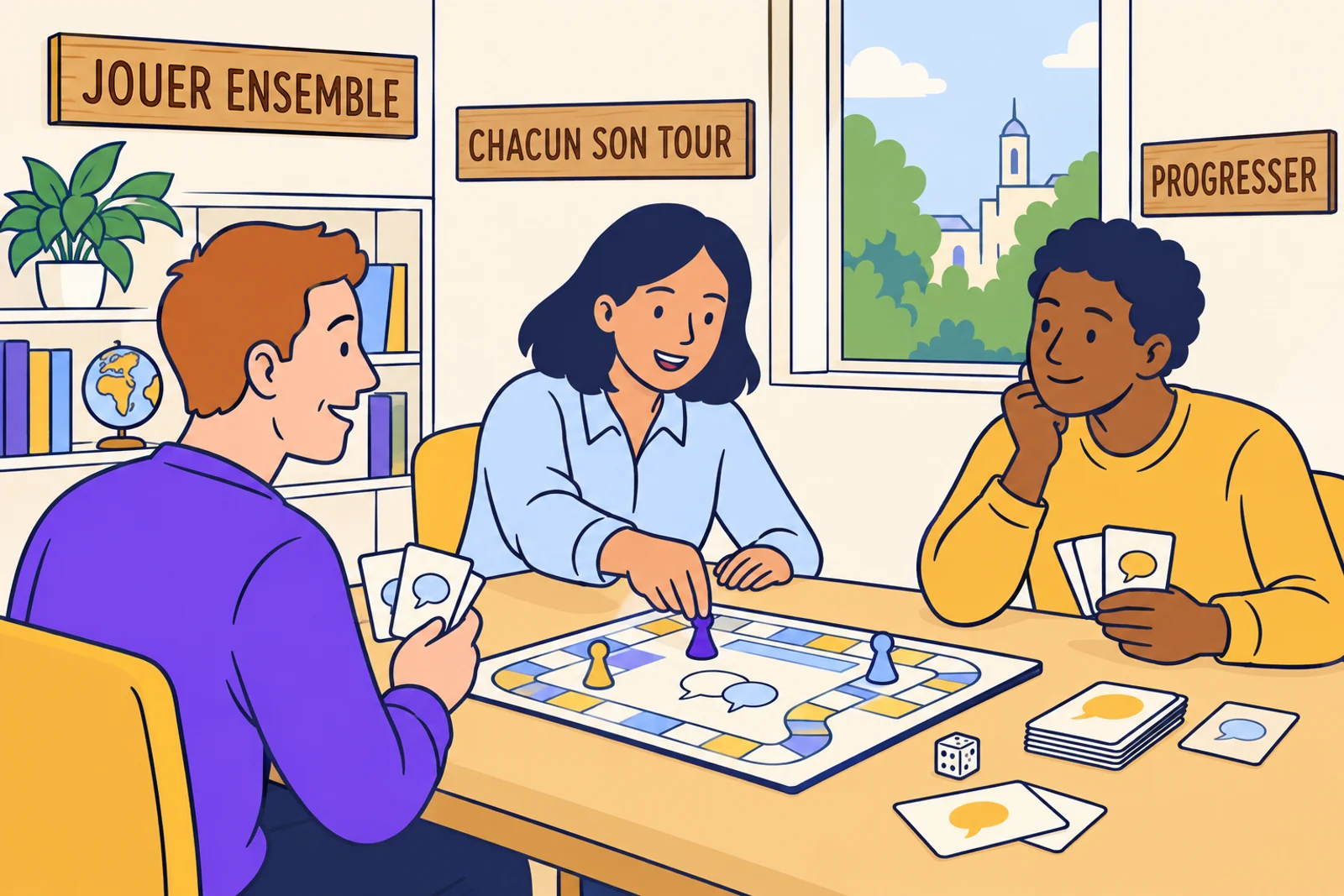
An adult-friendly French game does not need to look serious. It needs to respect your time, give you an understandable task and make its feedback useful. A playful design can do that; a plain worksheet can fail to do it. Choose by the practice, not by whether the resource looks sufficiently grown-up.
Your goal matters more than the label. Preparing for a move, improving everyday conversation and revising for an exam call for different situations and feedback. Start with the French learning games overview if you are unsure which format matches the difficulty.
Choose by the task you want to perform
Name a useful result. “Ask for clarification in a conversation” suggests a role-play. “Stop confusing two forms” suggests a focused grammar choice followed by sentence production. “Retrieve everyday nouns” suggests recall practice with phrases.
Do not ask one game to meet every need. If you enjoy written puzzles but struggle with listening, keep the puzzles and add listening practice. Enjoyment helps you return; it does not make the practice identical to a different skill.
That statement points toward retrieval and interaction. Practise a short response, then vary the prompt so you are listening for meaning rather than delivering a memorised line regardless of context.
Start with a real constraint and a real purpose
Write two sentences before choosing a game: what you want to do in French and when you can practise. “I want to ask a follow-up question in conversation, and I have fifteen quiet minutes after work” suggests a different activity from “I want to recognise written forms during a short break without audio”.
Neither arrangement is inherently more adult or serious. The useful format is the one that fits the task and the conditions. You can change it when your schedule changes. A routine should not depend on having an ideal uninterrupted hour every day if that rarely happens in your life.
Keep the purpose small enough to check. A goal such as “understand every French conversation” is too broad for one game session. “Identify the alternative appointment day and confirm it” gives you a concrete result. The larger ambition can remain, while the immediate activity has a manageable job.
Match a written difficulty to written practice
If you repeatedly confuse two forms on the page, a focused choice game can make the contrast visible. Use checked examples with enough context, then inspect why each answer fits. After the round, remove the options and produce a related sentence to add a different demand.
For an original simple example, compare “Elle parle bien” with “C'est un bon livre”. Explain what the target word describes in each sentence. Then use a checked variation. Do not assume that choosing bien correctly establishes every use of bon and bien; keep the explanation within the examples you understand.
Record the actual difficulty. You may know the distinction but read too quickly, or you may lack the explanation. Those observations call for different follow-ups. A useful game helps you identify the issue instead of treating every incorrect answer as the same kind of failure.
Match a recall difficulty to production
If you recognise a phrase but cannot find it when speaking, practise producing it before you reveal the model. Use an English intention, a picture with clear context or a short French clue. Start with a small checked set and say the whole useful expression rather than only the most memorable noun.
For example, practise an appointment request and two possible replies. Hide the opening and retrieve it, then respond to a changed day. This makes you use the phrase for its purpose. Repeating the same line while ignoring the reply would practise a different, narrower skill.
You can do the first stage alone, but another person can introduce manageable uncertainty. Ask them to choose one of a few prepared replies. Keep the task within language you can review so the exercise reveals a useful gap rather than becoming an overwhelming conversation about anything.
Match a listening difficulty to sound
If written material is easy but spoken details disappear, include audio or a speaking partner. A silent word puzzle may remain enjoyable, but it does not directly reproduce the listening task. Choose a short recording where you need the sound to identify a meaningful detail.
Listen, answer and note the support used. Then inspect the transcript or model if available. If you needed slow playback, record that without treating it as a reason to abandon the exercise. Return to ordinary speed when ready and see which part remains difficult.
Keep the first contrast small, such as two days or times in familiar sentences. Add complexity gradually. This makes it easier to distinguish an unfamiliar word from a sound you know in writing but miss in speech. The next exercise can then address the specific observation.
Keep exam, travel and settlement goals distinct
A general grammar game can support language practice, but an exam goal also needs the relevant official task formats. A settlement conversation needs the actual facts and procedures for your situation. A travel exchange may call for a short practical question. One game should not be presented as a substitute for all three.
Choose the language task within the larger goal. For an exam, you might practise giving a reason and example before using that skill in an official-style task. For settlement, you might rehearse asking which document is needed while obtaining the real requirement from the responsible organisation.
This distinction helps you evaluate a paid resource honestly. A general question collection may suit recurring language mistakes without containing every official exam exercise or personal administrative answer. Buy it for the support it offers, then add other resources where the goal requires them.
Fit practice into a short session
Choose a stopping point before you begin. Play a small set, review one uncertain answer and produce one new example. If the activity expands indefinitely, you may finish with little energy for the review.
Keep a place to record the next task. Tomorrow's session should not begin with searching through several resources to remember what was difficult. A note such as “practise three examples with depuis” is enough to restart.
| Available time | Suggested focus |
|---|---|
| Five minutes | Recall two phrases and change one detail |
| Fifteen minutes | Play a short set and review one pattern |
| Half an hour | Add a spoken exchange and delayed review |
These are planning examples, not minimum doses that guarantee progress. Adjust the session to your attention and the difficulty of the material.
Prepare a minimum session you can repeat
Choose one tiny sequence for busy days: retrieve two phrases, check them and change one detail. Have the prompts ready in a place you can find. The minimum should be a complete useful cycle rather than a rushed fragment of a much larger plan.
If even that session is not practical on a particular day, resume at the next opportunity without creating a large debt of missed exercises. A schedule that becomes more demanding every time life interrupts it may be difficult to maintain. Adjust the plan to the time and attention actually available.
Keep the learning claim modest. Five minutes is an example of a manageable slot, not a guaranteed dose that produces a fixed result. What matters in the record is the task you attempted, the support you needed and the next useful review.
Protect time for the correction
Stop the game before your entire session is consumed by new questions. Leave a few minutes to inspect one uncertain item. If the explanation takes longer than expected, review fewer items rather than skipping the part that tells you what to practise next.
For a mixed round, select a recurring difficulty instead of chasing every isolated error. You can record other questions for later. Today's review might focus on a subject change or a phrase you guessed correctly. A narrow correction is easier to turn into a new example.
Write the next action before closing the resource. “Try three new examples with this expression” is useful only if you name the expression and know where its model is. A precise note prevents the next session from beginning with another long search through tabs and downloads.
Choose a format for your actual setting
If you practise somewhere quiet, reading and writing tasks may be easiest. If you have privacy and audio available, add listening or speaking. If a device is distracting or uncomfortable, a printed exercise may fit better. These are practical choices, not statements that one medium is best for every learner.
Check any technical requirements before relying on an interactive feature. The Gamebook's current product page describes automatic scoring intended for desktop Adobe Acrobat Reader. A browser preview or phone viewer may behave differently, so use the stated compatible workflow if that feature matters to your session.
Separate setup from study when possible. Open the file, test the controls or prepare the paper before the short practice window. This reduces the chance that a ten-minute session becomes ten minutes of finding the correct page or troubleshooting a viewer.
Make the stopping point visible
Use a small set of cards, a marked group of questions or a clear time boundary. An open-ended activity can be enjoyable, but it may leave no natural moment to review. A visible stopping point helps you finish with a result you can describe.
If you want to continue for enjoyment after the planned cycle, you can. Keep the additional play distinct from the structured review if that helps your record. There is no need to turn every minute of leisure into measured study, and there is also no need to claim that all play practises the same skill.
At the end, ask what you can take away from the interface. One phrase, one explanation or one checked sentence is a concrete outcome. A score can accompany it, but the portable language gives the session a connection to what you want to do outside the game.
Use a restart note after an interrupted session
If someone interrupts, leave the exact item and question you were working on. “Check why this sentence uses avoir” is clearer when it includes the sentence or page reference. You can then resume the review without reconstructing the whole round from memory.
Do not mark an unfinished exercise complete simply to keep the log tidy. Use a status such as “answer attempted, explanation to check”. This tells you what remains and prevents an uncertain model from becoming part of your active practice set by accident.
When returning, begin with the unresolved point before opening a new large activity. If it requires outside help, record the question and move to a checked item meanwhile. The routine can remain productive without pretending that every uncertainty must be solved immediately or ignored entirely.
Make solo practice active
Say or write the answer before revealing it when the format permits. Mark guesses. After checking, explain one decision in plain language. If you cannot explain it, consult the relevant lesson rather than inventing a reason.
Then remove support. Hide the choices, change the subject or use the phrase in a new context. The game-session method gives a detailed sequence.
Say the answer before revealing it
When the format allows, produce a response aloud or in writing before checking. This creates an observable attempt. If you only read the answer and feel that it looks familiar, you have less information about whether you could retrieve it independently.
Use a checked prompt with a clear intended meaning. For a phrase such as “Je voudrais poser une question”, hide the French and express the English intention. Then compare the whole sentence, not only the keyword question. Note the exact part you could not retrieve.
If the exercise is multiple choice, add this production step afterwards rather than pretending the original question lacked value. Recognition can help you inspect a contrast. The follow-up simply asks whether you can use the same language with less visible support.
Mark guesses without judging them
A guess is information about the attempt. Mark it before seeing the answer and review one uncertain item afterwards, even if the game awarded a point. A correct guess does not necessarily mean the explanation is understood, while a wrong guess can identify a useful question.
Use a simple notation such as sure, unsure and guessed. Avoid a complicated system that takes longer than the activity. The marks exist to guide the review, not to create another performance target or a measure of how confident you ought to feel.
Compare confidence with the correction. A confidently incorrect answer may reveal an inaccurate rule you have been using. Write the rule as you understood it, then check the explanation in context. This can lead to a more useful correction than simply replaying until the right option looks familiar.
Explain one decision in ordinary language
Choose one item and say why the answer fits. The explanation can be in English if that lets you be more precise. You do not need advanced grammatical terminology to identify a useful pattern, but you should avoid inventing a broad rule from one sentence.
For “J'ai faim”, you can explain that French uses avoir in this expression. Then change the subject in a checked variation. Do not conclude that every feeling or state takes avoir. The explanation should remain as narrow as the evidence you have actually studied.
If you cannot explain the answer, consult the relevant lesson or a reliable reference. Keep the complete sentence and intended meaning in your note. Isolated words often have several uses, so context matters when asking for help.
Record a short spoken attempt when useful
You can record yourself answering a prompt or completing a short exchange with pauses. Listen for the task outcome first: did you express the intended request or explanation? Then choose one feature to inspect, such as a missing word or a form you know you need to check.
Self-recording does not make you an infallible pronunciation judge. Use a reliable spoken model or teacher when you need feedback you cannot provide yourself. The recording's practical value is that it preserves what you actually said instead of leaving you with only a vague memory of the attempt.
Use fictional details and keep the file private if it contains anything personal. You do not need real administrative references or sensitive information to practise an ordinary appointment exchange. The language task remains the same with harmless invented facts.
Use a new prompt for the same pattern
After practising a model, change the cue. Instead of translating the same English sentence again, describe a situation that calls for the phrase. This tests whether the expression is available beyond one fixed prompt. Keep the situation clear enough that the intended response remains appropriate.
If the new cue is too difficult, add support and note it. You might supply the first word or offer two choices, then try another unsupported attempt later. Supported practice can be useful as long as you do not confuse its result with independent production.
Finish the solo session with one checked variation and one next task. That gives you a practical bridge to another session or a lesson with a tutor. The notes should make your uncertainty easier to explain, not conceal it behind a high game score.
Play with a partner without turning it into an exam
Agree on the purpose and correction style. One session might prioritise keeping an exchange going, with corrections afterwards. Another might focus on one grammar pattern and pause whenever it appears. Both can be useful when everyone knows the rule.
Use cooperative goals: finish a short role-play, explain a clue clearly or create three accurate examples together. Competition is optional. If speed makes the language less accurate or the session unpleasant, remove the timer.
Agree on the correction style before starting
Ask whether you want interruptions during the exchange or a review afterwards. For a focused form exercise, stopping at the target pattern may be useful. For a short role-play whose purpose is to keep communication going, brief notes followed by review may fit better. The rule should be shared rather than assumed.
Choose one or two feedback priorities. Correcting every feature of every sentence can make it hard to see what the session was meant to practise. You can note other questions for later without ignoring the main task. The review should leave both players with a manageable next step.
If a correction is uncertain, check it together. A fluent partner may offer useful feedback without being right about every explanation. Keep the full example and intended meaning so a reference or teacher can address the actual issue.
Use cooperative scoring
Set a shared goal such as agreeing on the same appointment time, solving three clear clues or producing two checked sentences. Both players succeed when the task is completed accurately. This can make clarification part of the game rather than something that feels like losing a point.
For an appointment role-play, give each person different information. One wants a meeting; the other has two available slots. At the end, compare the notes. If the times differ, identify where a confirmation question would have helped and replay that part.
Competition can still be enjoyable if both players want it. Keep the scoring aligned with the learning goal. A timer that rewards guessing may be a poor fit for a session intended to practise careful explanations. Change the rule when the score starts rewarding the opposite of what you want to learn.
Let different levels contribute different tasks
One player may retrieve a noun and article while another gives a French definition. Both can work with the same word set without pretending their tasks are identical. Agree on the difference openly and rotate roles where appropriate.
The more experienced player can read checked prompts or provide a limited set of replies. They should not introduce unlimited unfamiliar language simply to make the game harder. A manageable challenge gives the other player a chance to listen, adapt and learn from a clear correction.
The less experienced player can also create clues with support or judge whether the final practical information matches the scenario. This keeps the game cooperative and gives each person a meaningful role beyond either answering everything or correcting everything.
Practise a polite challenge to an answer
If you think another answer could fit, ask about it with the complete sentence and reason. This turns disagreement into language work. The host should inspect the possibility rather than defend the private key automatically, especially when a clue is broad.
Use the question sincerely, then check the explanation. Sometimes the alternative is valid with a different meaning; sometimes a condition in the prompt rules it out. The useful result is a clearer understanding of the context, not winning the argument.
End with one shared review
Each player names one successful action and one point to revisit. Keep the observations concrete: a date confirmed correctly, an article missed or a clue made clearer. Avoid broad judgements about who is naturally good at languages.
Select a short follow-up that can be done independently. One person may review a phrase while the other checks an explanation. At the next session, begin with a changed example rather than repeating the entire old game without purpose.
This review can take only a few minutes. Its role is to connect the enjoyable activity with future practice. It does not need to turn a social session into a formal examination or produce a numerical ranking of the players.
Useful phrases to keep
Decide whether a paid resource fits
Look for a usable preview, clear contents, compatible format and accessible corrections. Compare the resource with the task you identified, not with an imagined perfect course. A focused practice book can be useful without containing live conversation or individual marking.
Read the current product page for what is included. Do not assume that audio, teacher feedback or mobile scoring accompanies a downloadable file. For browser formats, see French games online; for word recall, see vocabulary games.
Inspect the preview with a specific question
Before buying, choose one thing you need to know: whether the level is suitable, whether explanations are accessible or whether the format works on your device. Use the actual preview and product description to answer it. A large page count alone does not establish that the resource fits your task.
Try a sample item if one is available. Make an attempt, inspect the correction and ask what follow-up you could do with it. This gives you more concrete information than comparing products only by the number of questions advertised.
Where a feature is not stated, do not assume it is included. Audio, personal marking, live lessons and mobile interactive scoring are distinct features. Check the current offer and choose according to what you actually need, rather than a broad label such as complete or interactive.
Understand the Gamebook's role in a routine
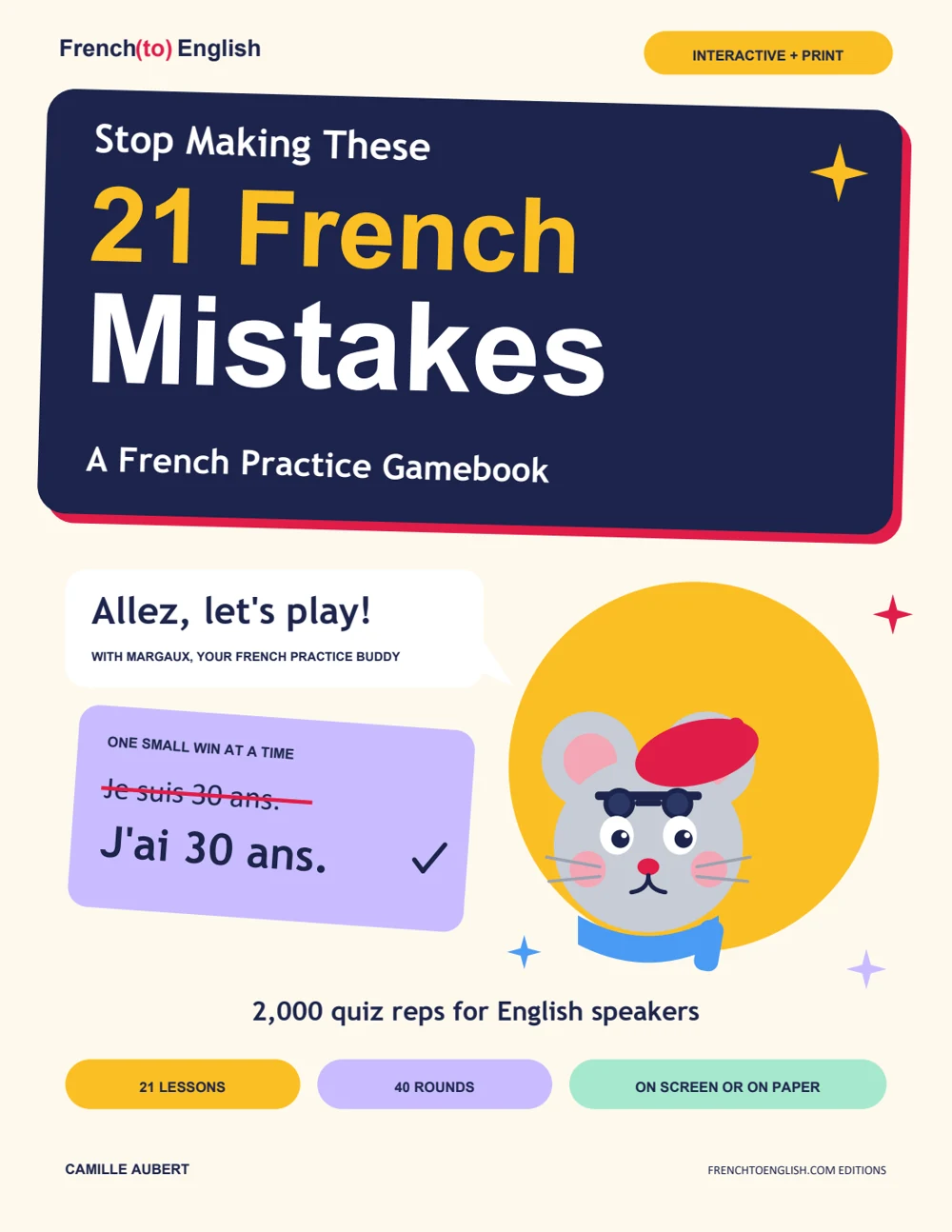
The current product page describes a PDF with 21 lessons and 2,000 questions across 40 rounds, intended for repeated practice of common mistakes. Its automatic scoring is designed for desktop Adobe Acrobat Reader, with printing as another way to use the material. Consult the product page for the full current details.
That format can provide a convenient source of written questions for the play-review-produce routine. It does not by itself supply the unpredictability of a live conversation or certify a language level. Add those other forms of practice when they are part of your goal.
If you prefer a downloadable collection and the preview suits your level, the resource may fit. If your immediate need is individual feedback on speech, a different kind of support may be more useful first. The purchase should fill the gap you identified rather than create another unused resource in your folder.
Compare the cost in terms of intended use
Ask how you expect to use the material over the next few sessions. A resource can be inexpensive and still be unnecessary if it does not match your task or device. Conversely, a focused collection may be convenient if it supplies the checked practice you were spending time assembling yourself.
Avoid calculating an impressive cost per question and treating that as the whole decision. Questions you cannot use or review do not automatically become valuable because there are many of them. Contents, explanations, compatibility and your own routine all matter to the practical fit.
You can begin with the free examples on these Learning Center pages. Try the routine, identify what remains difficult and decide whether additional material or feedback would help. A completed small session gives you evidence for that decision without requiring a purchase first.
Work through three realistic planning examples
Imagine a learner who has ten minutes during a quiet lunch break and wants to stop confusing two written forms. A small grammar-choice set with a saved explanation is a practical fit. The learner finishes with one new written sentence and leaves a note about the remaining uncertainty. Audio and live interaction can wait for a setting where they are available.
Now imagine a learner preparing for a routine conversation after moving to France. The target is asking for clarification when an appointment time changes. A short role-play with two possible replies fits that task more closely than a spelling puzzle. The learner can still enjoy puzzles later, while giving the upcoming conversation its own focused preparation.
A third learner wants a social activity with a partner whose French is stronger. They choose a cooperative clue game using a checked word set. One gives a simple description, the other asks a question, and both improve an unclear clue. Their shared result is a clearer explanation rather than a ranking of who answered fastest.
These are planning examples, not evidence that one format always works best for a particular type of adult. They show how purpose, setting and feedback can guide a choice. Your own constraints may suggest another combination, and you can revise it after observing what the first session actually required.
Keep a one-week experiment small
Choose one game format and one follow-up for the coming week. Use a short session size you can reasonably attempt. At the end of each session, record the task, one useful correction and what you could do without the model. Avoid adding several new resources before you have tried the first routine.
At the week's end, review practical fit as well as language results. Could you start easily? Did the format work on your device? Was the correction understandable? Did the follow-up address the difficulty you chose? These questions help you decide whether to keep, adjust or replace the activity.
If the week was unusually busy, interpret the evidence cautiously. A missed session does not prove that the resource is unsuitable, just as one enjoyable round does not prove it meets every need. Make the next adjustment specific: reduce the set, prepare the material earlier or choose a format compatible with the setting you actually have.
Leave with a usable next action
Before closing the page, name the next exercise in one sentence. It might be retrieving three noun-and-article pairs, explaining a grammar contrast or confirming a changed time in a role-play. Include where the checked model is saved so you can begin without another search.
If the next action requires help, make the question equally precise. Bring a complete sentence and its intended meaning to a tutor or reliable reference. “I do not understand this use in this sentence” is easier to answer than “my grammar is bad”. The game has then done useful diagnostic work by helping you identify the point.
An adult learning routine can be playful, modest and purposeful at the same time. Choose an activity you can use, inspect what it reveals and connect the result to another real language task. The product decision can follow from that evidence rather than from pressure to collect every available learning tool.
Give everyone a useful role
Choose a small task every player can attempt. Give each person time to prepare, answer and ask for clarification. If one player knows much more French, assign a supporting role that does not involve answering on everyone else's behalf.
Try a cooperative round where the group agrees on an answer and explains its reason. Allow a checked reference after an initial attempt. Different interpretations of the task can reveal what needs explaining before another round begins.
Ask each player to select one expression to reuse and rehearse a short exchange with it. Keep a checked version. Avoid equating a fast response with stronger overall French: familiarity with the rules and confidence also shape the experience. At the next session, change the format while retaining the same language goal, and compare which arrangement helps each person participate.
Useful phrases to keep
| 🇫🇷 French | 🇺🇸 English | 💡 Context |
|---|---|---|
| À toi de choisir la situation. | Your turn to choose the situation. | Sharing control of the round |
| Prenons un exemple plus simple. | Let us take a simpler example. | Reducing a task’s difficulty |
| Je préfère vérifier cette expression. | I would rather check this expression. | Checking unfamiliar wording |
| On peut essayer sans chronomètre. | We can try without a timer. | Removing time pressure |
The French Gamebook
Give your study routine something to practise.
For English speakers practising French
Pick a lesson, play a round and note the mistakes you want to revisit. The Gamebook gives your next session a concrete task and answers to check.
- 21 lessons with explanations
- 40 practice rounds · 2,000 questions
300 pages · Play on your computer or print
Get the Gamebook · $9 Read a preview before you buyOne payment · Instant PDF download
Try the French with someone who can reply.
Bring a sentence you found difficult. Ask a tutor to help you say it naturally, then try it in a short conversation.
Find a French tutor →Paid lessons. Compare tutors and prices before booking.
Affiliate link: we may earn a commission when you book.
📚 Keep building in the Learning Center
French Word Games: Five Ways to Practise More Than Spelling
French word games can help you notice spelling, word relationships and sentence choices. Explore activities for solo and…
Read →Learn French with a Game: Turn One Round into a Useful Study Session
To learn French with a game, choose one small language goal and make the rules serve it. Build…
Read →French Vocabulary Games: Remember the Word and Know What to Do with It
French vocabulary games can practise more than matching words to translations. Use sorting, recall and short exchanges to…
Read →