
Learn French with a Game: Turn One Round into a Useful Study Session
To learn French with a game, choose one small language goal and make the rules serve it. Build a useful round, give feedback and repeat the language with enough variation to check whether you understand the pattern.
The end of a game round is a good place to begin studying. You have just made decisions, seen a result and discovered where you hesitated. A short review can turn that information into something more useful than a score you forget tomorrow.
The method here works with many question-based games. It is a proposed study routine, not a claim that every game produces the same learning result. For help choosing a format, begin with the French learning games guide.
Set one target before playing
Choose what you want to notice. It might be noun gender, a tense contrast or polite requests. If the game mixes topics, keep your review focused on one recurring difficulty instead of trying to repair every error at once.
Write a small goal: “After this session, I want to make three polite requests without a model.” This does not guarantee the session will achieve it. It gives you a clear check at the end.
Read the sentence, hide it, then retrieve it. Change question to another noun you know. The exercise prepares production before the round even begins.
Prepare a session sheet with four spaces
Divide a page into target, decisions, corrections and next attempt. The target names what you want to practise. The decisions space records a few items that caused hesitation. The corrections space contains checked explanations, and the last space states what you will try without the game afterwards.
Keep this sheet deliberately small. You are not transcribing the whole resource. If a round contains fifty questions, choose a manageable number for detailed review rather than copying every item. The session should leave time to use the language, not only document what appeared on screen.
At the top, write the date and the round or page reference. This lets you return to the original context when a note later seems unclear. A correction such as “use avoir” may be too broad by itself; a reference to the expression you were studying keeps the explanation connected to its actual scope.
Choose a target that you can check afterwards
“Get a higher score” describes a game result. “Make three polite requests without a model” describes a language task. Both can be recorded, but the second tells you what follow-up to prepare. Choose a task small enough to attempt at the end of the session.
Other possible targets include changing the subject in three familiar expressions, supplying the article for five nouns or identifying the day in a short spoken reply. These are examples of practice goals, not requirements for every learner. Select the one connected to a difficulty you have actually noticed.
Avoid combining several new demands in the first target. If you want to practise a request, use vocabulary you already know. You can add new nouns or unexpected replies later. A narrow target makes it easier to understand why the final attempt succeeded or where it became difficult.
Select a round that contains the relevant language
Inspect the topic or sample before beginning. If you want to practise polite requests, a spelling puzzle may not provide enough relevant material for this particular session. It can still be enjoyable, but you may need a different round or an additional exercise to address the chosen target.
When a game mixes topics, decide how you will handle unrelated mistakes. You can mark them for later without allowing every one to expand today's review. This is a planning choice, not a claim that those errors do not matter. It keeps one session from becoming a list too large to finish.
Check that you have access to the answer key or explanation you will use. If a correction remains uncertain, mark it as a question for a reliable reference or teacher. Do not plan a production exercise around a rule you have just guessed from one unfamiliar item.
Set a stopping point before playing
Choose a number of questions or a short time window that leaves room for review. A round can be engaging enough that you keep starting another one and never examine the errors. A stopping point protects the part of the session that turns the score into a next task.
If the game uses a timer, decide whether speed is relevant to today's target. You may first need an untimed attempt to understand a contrast. A timed round and an untimed round ask different things of you, so compare their results cautiously rather than treating them as identical measurements.
At the stopping point, save the result if the format permits and move to the review. You can play again later. The purpose of this session is not to finish every available question but to investigate one difficulty and see whether you can use the language in a changed task.
Record uncertainty as well as mistakes
A correct guess and a confident answer can receive the same game point. Mark uncertain answers separately in your notes. They deserve review because the result alone does not show whether you understood.
Use three simple marks: knew it, hesitated, guessed. After the round, choose one item from the last two categories. Ask what information would have helped you decide: the meaning of a word, a grammar pattern or a contextual clue.
Do not punish uncertainty by making the next session enormous. A small accurate review is easier to repeat. Keep the unanswered question visible until you check a reliable explanation.
Use a confidence mark before seeing the correction
Write K for an answer you believe you know, H for hesitation and G for a guess, or choose any equally simple marks. Add the mark before revealing the result. Afterwards, compare your confidence with the answer key. This gives you information the score alone may not contain.
A correct guess belongs in the review because you may not be able to make the same decision again. A confident error also deserves attention because the underlying explanation may be wrong. An incorrect answer with hesitation may simply identify a gap you already recognised. These patterns can lead to different next questions.
Do not turn the marks into a complicated psychological assessment. They are practical notes about a particular item on a particular attempt. Their value is that they help you select what to inspect, not that they measure your confidence perfectly or predict your future performance.
Record the reason you considered the wrong option
For one selected item, write a short explanation of your original reasoning. Perhaps you translated the English structure directly, confused two words or overlooked the subject. Comparing that reasoning with the correction can reveal the actual source of the error.
Use your own words, even if the explanation is incomplete. “I chose est because English says is hungry” is a useful note. It shows why the expression needs to be learned as a French pattern with avoir. “Wrong answer” would not tell you what to change in your approach.
If you cannot remember your reasoning, say so. Do not invent a neat explanation after seeing the key. You can examine the item again in a later round and notice what you attend to before answering. An honest gap in the record is more useful than a confident story that does not describe the attempt.
Distinguish a reading slip from an unfamiliar pattern
Suppose you know the plural form but answer as though the subject were singular because you read too quickly. The follow-up may involve slowing down and identifying the subject before choosing. If you do not know the plural form, you need to study and practise that form as well.
Neither observation excuses the error; it makes the next exercise more specific. Repeating a grammar lesson may not address a consistent habit of skipping a crucial word. Conversely, telling yourself to concentrate will not supply a form you have never learned.
For a small review, underline the clue in a checked example and explain how it affects the answer. Then try a similar item without the underline. This gives you a manageable way to check whether noticing the clue changes the decision.
Keep unresolved explanations visible
If a correction is unclear, place it in a question list with the complete sentence and intended meaning. Include the answer you considered and why. That context helps a teacher or reference answer the actual issue instead of guessing which use of a word you meant.
Do not repeatedly practise an uncertain sentence as though its explanation were settled. You can move to another checked item while seeking clarification. This keeps the session productive without reinforcing a rule you may later need to undo.
When you obtain a reliable explanation, update the note and make a new example within its scope. If the explanation depends on context, preserve that context. A useful correction should become more precise as you understand it, not grow into a universal shortcut that ignores the original conditions.
Explain and change an answer
Consider this original practice item: “She is hungry” is Elle a faim, not Elle est faim. The useful explanation is that this expression uses avoir. Now change the subject: Nous avons faim. Then change the expression: Nous avons soif.
This sequence asks you to retrieve a pattern with a changed subject and a changed meaning. If you get stuck, return to the smallest step you can explain accurately. Avoid inventing a broad rule that every feeling uses avoir.
Use a six-item original practice round
Try these items before reading the explanations below. They are original examples for this article and are not presented as excerpts from the paid Gamebook. Mark confidence for each answer and keep the prompt visible when checking the reason.
- “I am hungry”: Je ___ faim. Choose ai or suis.
- “We are thirsty”: Nous ___ soif. Choose sommes or avons.
- “She speaks well”: Elle parle ___. Choose bien or bon.
- “A good book”: Un ___ livre. Choose bien or bon.
- “I am at home”: Je suis ___ moi. Choose chez or dans.
- “I would like to ask a question”: Je voudrais ___ une question. Choose poser or pose.
The intended answers are ai, avons, bien, bon, chez and poser. If you selected another answer, use the full prompt to understand the intended meaning. The next paragraphs explain these examples narrowly; they are not a complete grammar course covering every use of the words involved.
Review the two expressions with avoir
French uses avoir in avoir faim and avoir soif. For these prompts, the subject determines the verb form: je takes ai and nous takes avons. If you selected suis or sommes by translating the English “am” or “are”, note that the complete French expression differs from the English structure.
Change only the subject first. Produce “Tu as faim” and “Vous avez soif”, then check the forms. After that, change the meaning between hunger and thirst while keeping the subject stable. This separates the conjugation task from recalling the expression.
Do not infer that all states or feelings use avoir. The useful result is knowledge of these expressions and their checked variations. If you want to study another expression, verify it separately. A game review should make your explanation more accurate, not encourage a broad rule unsupported by the examples.
Review bon and bien through their roles
In “Elle parle bien”, bien describes how she speaks. In “un bon livre”, bon describes livre. The English word “good” can tempt you into choosing by translation alone, so inspect the job the French word is doing in the specific sentence.
Now try a controlled variation: “Il parle bien” keeps the same adverb with another subject. “C'est un bon livre” keeps the noun phrase in a complete sentence. Explain why the target word remains the same in each variation. Then check a new example with a reliable model before adding it to your practice set.
Avoid making a claim that bon and bien never have other uses. These two prompts illustrate a useful contrast in simple contexts. If a later sentence does not fit your current explanation, bring the full example to a reliable source rather than forcing it into the first rule you learned.
Review chez moi as a complete location phrase
For the intended meaning “at home” in this item, “chez moi” is the appropriate phrase. Learn it as an expression you can use in a short exchange. Ask “Tu es chez toi ?” and answer “Oui, je suis chez moi” when that matches the fictional situation.
Change the person carefully. The phrase should still express whose home or place you mean. If you are uncertain about a variation, verify it before repeating it. The English word “at” has many uses, so chez is not a replacement to insert into every sentence containing it.
Add a simple context to make the phrase useful: someone asks where you are during a fictional phone call. Answer, then ask a follow-up suited to the exchange. This moves the item from a location choice into a small conversational task without requiring a complicated scene.
Review the verb after je voudrais
In the model “Je voudrais poser une question”, poser is an infinitive following voudrais. The prompt asks for the action “to ask a question”, so the sentence uses that complete expression. If you chose pose, identify that the following verb is not being conjugated as a separate main statement here.
Practise another checked request such as “Je voudrais parler à quelqu'un”. Keep the structure and change the action only when you know the appropriate expression. If you replace the verb with a noun, inspect the resulting sentence rather than assuming every word can occupy the same slot without another change.
Say the request aloud, then hide it and retrieve it from the English intention. Ask a partner to reply with a short question so you must continue. Producing the opening is one useful skill; understanding the response remains another task to practise.
Make a variation ladder for one item
Choose one corrected item and write four steps: repeat the checked model, change one detail, remove the choices and use it in a short exchange. Stop at the first step where you become uncertain. That is the part to inspect before making the exercise more complex.
For avoir faim, the ladder might move from “J'ai faim” to “Nous avons faim”, then an English prompt with no options, then a fictional conversation about taking a break to eat. Keep the language of the exchange simple enough to verify.
The ladder is a proposed practice device, not a formal test. Its advantage is that it makes the change in task visible. You can say exactly where the phrase remained available and where you needed support, which is more useful for planning than a single impression that the whole session was easy or hard.
Build a replay session
Replay has two possible purposes: practising the original questions and checking whether you can handle a changed example. Keep them distinct. You may remember which option was correct without being able to explain it.
| Replay stage | What to do |
|---|---|
| Recall | Answer without looking at the correction |
| Explain | State the relevant reason briefly |
| Vary | Change one detail in the sentence |
| Produce | Say or write an example without options |
Try the review after a gap rather than immediately repeating until every answer feels familiar. Choose a schedule you can maintain. The important record is which pattern remains difficult and what you will try next.
Separate an immediate correction from a later review
Immediately after an error, check the model and practise the corrected phrase. This helps you leave the session with an accurate version. A later review begins differently: first attempt the item without opening the correction, then compare. The two activities have different purposes, so keep their results distinct.
Choose a later time that fits your schedule. You might revisit the material in the next session and again after another gap. This article does not prescribe an optimal interval for every learner. The practical aim is to notice what you can retrieve without the answer freshly in view.
If you forget the phrase, use the result to choose the next exercise. There is no need to turn a missed review into a judgement about your ability. Check the specific difficulty, practise it and keep the next attempt manageable.
Change the order before changing the language
If you remember answers by their position in the round, shuffle the items. Keep the sentences unchanged at first so you can see whether the order was supplying a cue. Then introduce a checked variation. This sequence avoids changing every part of the exercise at once.
For paper practice, use separate cards with a prompt on one side and the checked answer on the other. For a digital resource, use whatever review features it actually provides and supplement with private notes if needed. Do not assume that every game supports custom shuffling or saved error lists.
After the shuffled round, inspect uncertain answers as well as mistakes. A correct response may still have relied on recognising the shape of the sentence rather than understanding it. Ask for a short explanation and a new example when you want to investigate that distinction.
Replay fewer items with a clearer purpose
Select two or three items that share a difficulty. If they involve subject changes, practise that contrast. If they involve vocabulary you only recognise, use recall prompts. A short focused replay can be easier to interpret than another large mixed round whose errors come from many unrelated sources.
Keep one easy checked item in the set if it helps you establish the task. Then add the target contrast. The exercise should be challenging enough to reveal something without making every response a guess. Adjust the amount of language before assuming you need a completely different method.
At the end, write what changed. Perhaps you can now explain the choice but still hesitate when speaking. That result suggests a production task next. It is more precise than treating a better score as proof that every aspect of the pattern is now automatic.
Decide when to stop reviewing the same item
When you can recognise, explain and use a checked pattern in the intended task, reduce how often it appears in your active review. Keep it available for occasional revisiting, but make room for another difficulty. Endless repetition of the easiest item can preserve a satisfying score without addressing new needs.
If the item remains difficult, change the support rather than only increasing the repetitions. Read a clearer explanation, ask a teacher about the full sentence or simplify the variation. The difficulty may concern meaning, a sound or a conjugation, and each needs a slightly different follow-up.
There is no universal number of successful attempts that proves a phrase is mastered in every situation. Use the task evidence and your practical goals. A phrase needed for tomorrow's conversation may deserve another rehearsal even if it worked well today.
Useful phrases to keep
Check transfer beyond the game
Return to your opening target. Can you now make three requests without reading? Ask a partner to give a reply you did not prepare. If the conversation stalls, identify whether the problem was forming your sentence or understanding theirs.
A game score is evidence about performance on those questions. Use a different task to check a different skill. For vocabulary, try recall games. For written word play, try French word games.
Record one success as precisely as one difficulty. “Used je voudrais with three different requests” is useful evidence. “French was good today” is pleasant but does not help plan tomorrow's session.
Test the phrase in a small new context
Take the request from the original target and place it in a fictional exchange. You want to ask a question at a desk, speak to someone or confirm an appointment. Use the phrase without seeing the model, then respond to a simple reply. Keep the context close enough that the language remains appropriate.
If the opening works but the reply causes difficulty, record that distinction. Your next practice may need listening or clarification phrases rather than more repetitions of the opening. A different task can expose a different gap even when it uses some of the same words.
Afterwards, check any new sentence you produced. The purpose is to use the pattern flexibly while keeping the language accurate. If you are unsure, retain the checked model and mark the variation for review rather than adding an uncertain sentence to a permanent flashcard set.
Use a partner to introduce manageable uncertainty
Give your partner two or three possible replies and ask them to choose one without warning. This creates uncertainty without turning the exercise into an unrestricted conversation. Your task is to understand the selected reply and make an appropriate next move.
For an appointment, the replies might offer a time, propose an alternative or ask for a missing detail. Practise all three before mixing them if needed. Once you can handle the set, add one new reply. The difficulty grows through a visible change rather than through random unfamiliar language.
Ask your partner to note the task outcome and one language issue. Too much correction at once can make it difficult to identify a useful next step. You can return to other points in later sessions, keeping today's review focused on the target you chose.
Keep the score as one piece of evidence
A game result tells you how you performed on that round under those conditions. Record whether you used hints, saw the answers recently or changed the timing. These details help you compare attempts fairly without pretending that a score is independent of the way you obtained it.
Add the production result next to it: one request made without a model, one changed sentence checked or one reply understood. The combined record is richer than a percentage alone. It remains a small sample of your French, not a formal evaluation of every skill.
Use that record to decide whether more of the same question format is useful. If the main remaining difficulty lies outside it, add the appropriate task or support. Buying more questions may be convenient, but the purchase should serve a known practice need rather than replace the review that identifies it.
Walk through a fictional learner's complete session
Alex, a fictional learner, begins with a narrow target: use two familiar expressions with a plural subject. Alex plays the six-item round above and answers the first two correctly, but marks the second as a guess. The score therefore looks better than the confidence record, which identifies a useful place to review.
During the review, Alex explains that “nous avons soif” uses avoir but cannot immediately retrieve avons without the choices. The next exercise is not another large mixed round. Alex reads the checked model, hides it and retrieves the phrase from its English meaning. Then Alex changes soif to faim while keeping the subject stable.
After two controlled attempts, Alex introduces vous. This creates a new conjugation demand. If the form is uncertain, Alex checks it rather than guessing repeatedly. The note now distinguishes two observations: the expressions are understood, but some subject changes still need practice. That is a clearer result than simply writing “avoir is difficult”.
At the end, a partner asks a simple fictional question that invites one of the phrases. Alex responds without options, then records whether the phrase was available in the exchange. If the reply is slow but accurate, the note says that. If Alex uses the wrong form, the note identifies it and points to the next short review.
The following session begins with a fresh attempt before Alex opens the old correction. A successful answer shows what is available at that moment. An error shows what to revisit. Neither result requires a dramatic conclusion about Alex's overall ability; the session was designed to inspect a small, useful task.
Adapt the routine when you have only ten minutes
Use the first two minutes to state the target and select a few questions. Spend the next few minutes answering and marking uncertainty. Keep enough time to examine one correction and produce one changed example. These timings are a practical suggestion, not a measured formula for learning efficiency.
If you cannot complete the review, leave a precise restart note: the item, your original choice and the explanation you need to check. That is better than opening a new round tomorrow and losing the unresolved question. The short version should preserve the connection between playing and using the language.
Do not compress the session by skipping verification of an uncertain rule. Reduce the number of items instead. One checked expression used accurately gives you a clearer result than several unverified sentences added to a growing notebook.
Decide whether the next step needs more material
After several sessions, ask what is limiting progress. If you understand the routine but need more varied questions at an appropriate level, a larger collection may be useful. If you repeatedly cannot explain the corrections, you may need a clearer lesson or teacher feedback. If you struggle mainly with spoken replies, add listening or interaction.
This decision keeps the purchase connected to evidence. The Gamebook provides a question-based PDF format described on its product page. It does not turn a game score into an official qualification or replace every other kind of practice. Choose it for the format and content it actually offers.
You can continue using the original exercises here without buying anything. Save your target, confidence marks and checked variations, then return after a gap. The useful habit is the complete cycle: make a decision, understand the correction, change the example and see what you can do beyond the round.
Before starting the next round, read the final line of your session sheet. It should name an action you can perform: retrieve a particular expression, explain a contrast or respond to a changed reply. If it only says “play more”, make it more specific. That small preparation keeps the game connected to your learning purpose and gives tomorrow's session a clear beginning, even if you have only a few minutes available.
Change one game rule
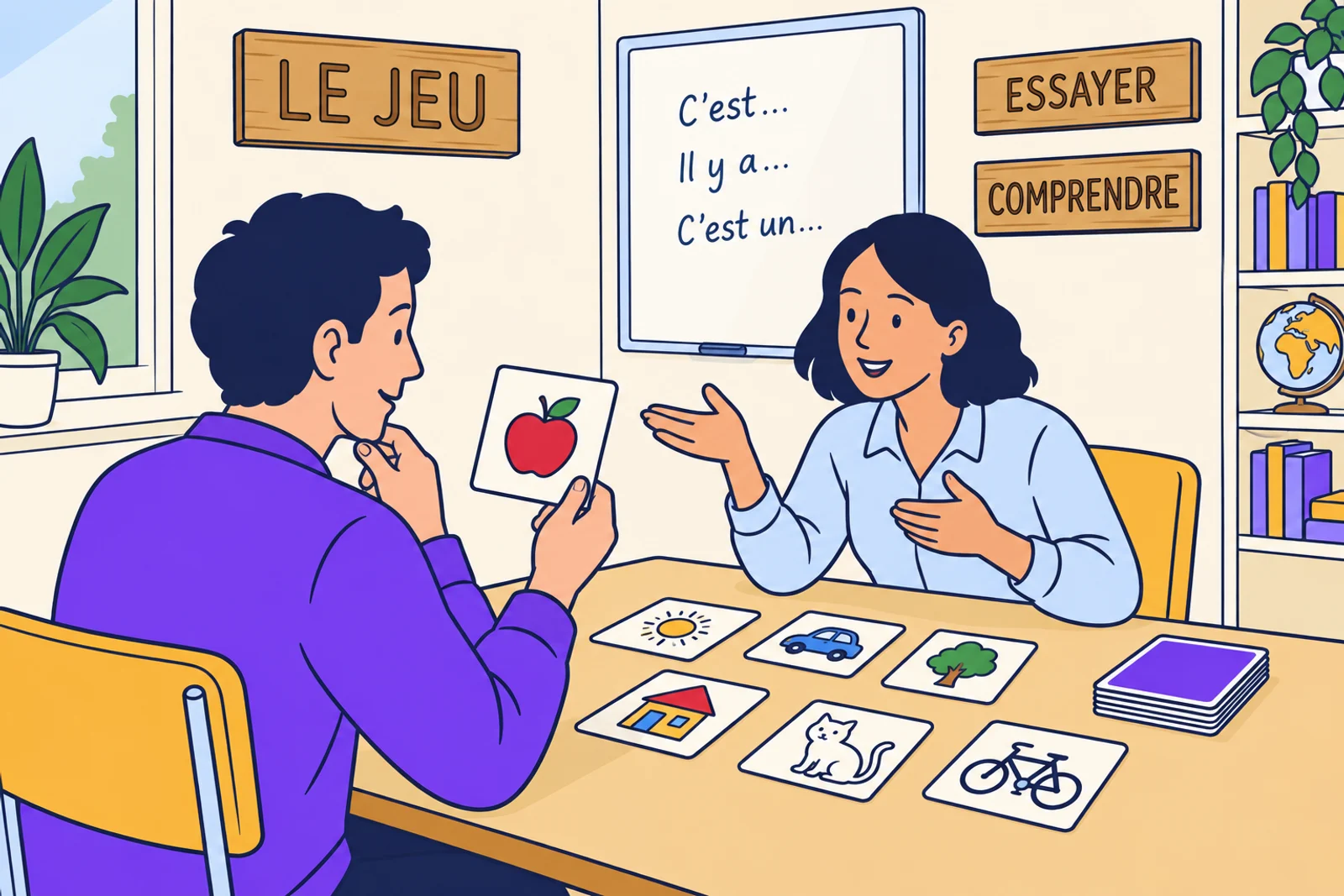
Take a picture-card activity and play it twice. First choose the French word from three options. Then hide the options and name the picture. Keep the pictures and time available similar so the effect of the rule change is easier to notice.
Record the items that needed an option before you could answer and check their pronunciation and spelling. Use them in a later round. The first score describes performance under the first set of rules, not every way you can use that vocabulary.
For a conversational version, ask a partner to request an object in a short situation. Respond with a sentence, then change the request. The cards now support a different task. Choose the version matching your session goal, explain that goal to the other player and keep one checked example for your next review.
Useful phrases to keep
| 🇫🇷 French | 🇺🇸 English | 💡 Context |
|---|---|---|
| J’ai hésité entre les deux réponses. | I hesitated between the two answers. | Discussing a difficult choice |
| Cette fois, je peux expliquer mon choix. | This time, I can explain my choice. | Explaining improved understanding |
| Je change seulement le sujet. | I am changing only the subject. | Changing one sentence element |
| Je vais refaire cet exercice plus tard. | I will do this exercise again later. | Scheduling a later review |
The French Gamebook
Give your study routine something to practise.
For English speakers practising French
Pick a lesson, play a round and note the mistakes you want to revisit. The Gamebook gives your next session a concrete task and answers to check.
- 21 lessons with explanations
- 40 practice rounds · 2,000 questions
300 pages · Play on your computer or print
Get the Gamebook · $9 Read a preview before you buyOne payment · Instant PDF download
Try the French with someone who can reply.
Bring a sentence you found difficult. Ask a tutor to help you say it naturally, then try it in a short conversation.
Find a French tutor →Paid lessons. Compare tutors and prices before booking.
Affiliate link: we may earn a commission when you book.
📚 Keep building in the Learning Center
French Learning Games for Adults: Pick a Format That Fits Your Life
French games for adults work best when the task feels useful and everyone can participate. Plan cooperative or…
Read →French Games Online: Seven Formats and What to Do After Playing
Online French games vary in what they practise and how they handle feedback. Assess a browser activity, check…
Read →Speaking French as a Shy Beginner: Practical Steps
Practise speaking French through small, manageable exchanges. Find starter phrases, rehearsal methods and a gradual plan for shy…
Read →