
French Word Games: Five Ways to Practise More Than Spelling
French word games can help you notice spelling, word relationships and sentence choices. Explore activities for solo and group practice, learn what each format can test and connect a successful answer with meaning through short follow-up tasks.
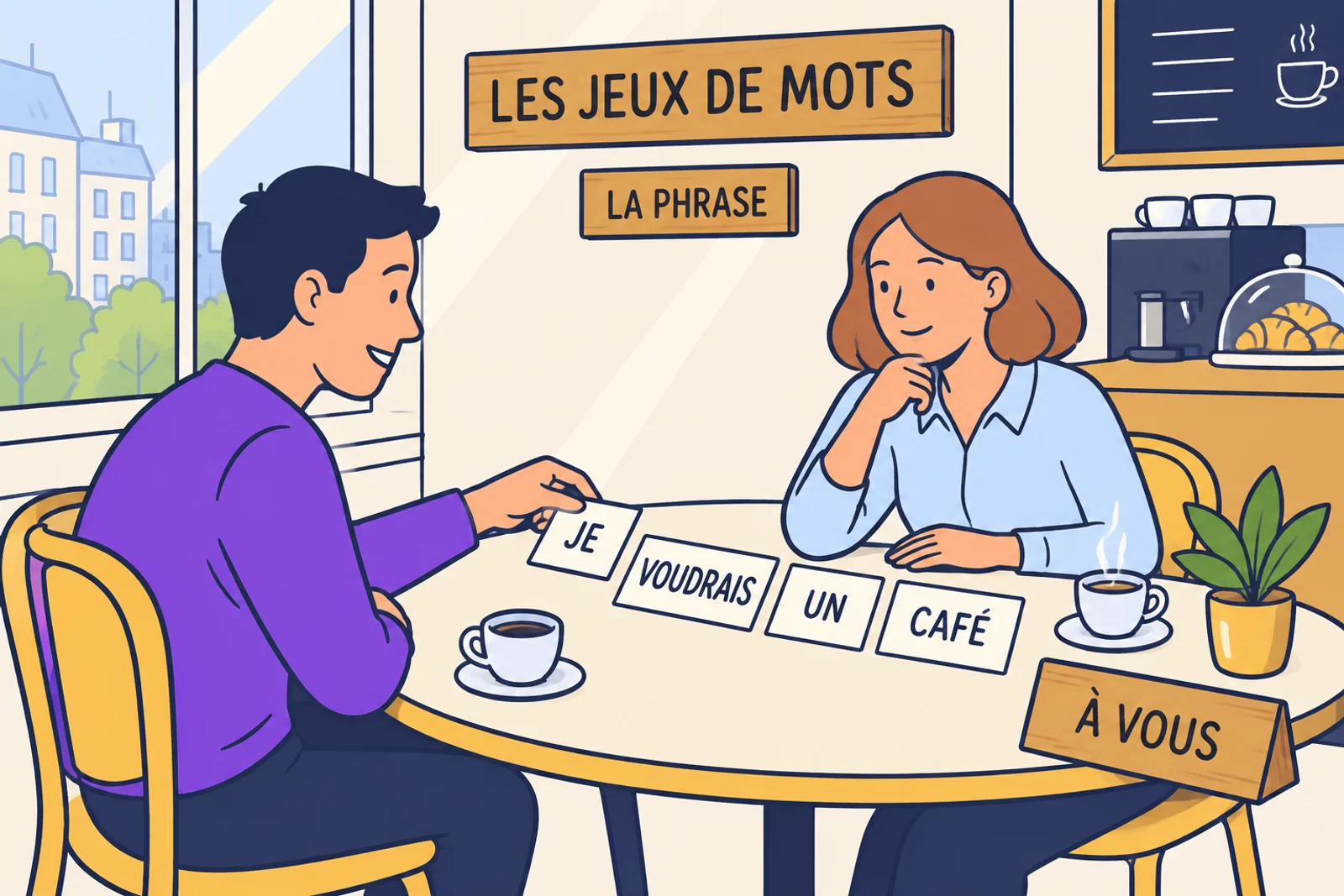
A word game can ask you to recognise letters, retrieve a meaning or explain an idea. Those are related skills, but they are not identical. If you solve a puzzle with an unfamiliar word, take the extra moment to learn how that word is used.
The five activities here need only a small word list, paper and a way to verify uncertain answers. They are original learning suggestions, not rules for a particular branded game. For a broader comparison of formats, read the French learning games guide.
Build clues instead of memorising lists
Choose five words you already partly know. Write a French clue for each without using the word itself. Keep the clue short enough that you can explain it aloud. The act of writing the clue makes you examine meaning rather than merely copy a translation.
For bibliothèque, an original clue might be a place where you can borrow books. For parapluie, describe an object used when it rains. Check that your wording does not accidentally describe several equally plausible answers unless you intend to accept them.
Have a partner explain why they chose an answer. If the clue was ambiguous, improve it together. That discussion can be more useful than the point itself.
Choose a small, coherent starter set
For the first clue game, use five familiar words: un livre, une bibliothèque, un parapluie, une fenêtre and une chaise. You can replace them with another checked set, but avoid starting with words nobody can explain. The task is to practise descriptions, not guess unfamiliar vocabulary from equally unfamiliar clues.
Write each target with its article on a private answer sheet. On separate cards, write the clues without the targets. Keep the answer sheet available for checking after an attempt. If you play alone, prepare the cards in advance and shuffle them so the order does not reveal the solution.
Agree whether players must produce one exact target or may offer a reasonable alternative. The rule affects how precise the clue must be. If several answers fit, the problem may be the clue's breadth rather than the responder's vocabulary. Leave room to discuss and improve it.
Use original clues with clear intended answers
Try these practice clues in French. The intended answers come from the starter set, which keeps the possibilities manageable. Read each clue, make an attempt and explain which words helped you decide.
- On peut y emprunter des livres.
- On l'ouvre parfois pour faire entrer de l'air dans une pièce.
- On s'assoit dessus.
- On l'utilise pour se protéger de la pluie.
- On peut le lire, et il contient des pages.
The intended answers are une bibliothèque, une fenêtre, une chaise, un parapluie and un livre. Some descriptions could fit other objects outside this set, so the set is part of the exercise's context. Do not present these broad clues as definitions that uniquely identify one word in every situation.
After checking, choose one clue and make it more specific without saying the target. You might add a location or a feature. Verify that the added information is accurate for the intended example rather than a claim about every possible object in the category.
Make the explanation part of the answer
Ask the responder to identify the clue that led to the solution. For bibliothèque, the phrase about borrowing books is useful. For parapluie, protection from rain is the central clue. This explanation shows whether the response came from meaning or from remembering the card's position.
The explanation can begin in English if French would make the task too difficult. Then build a short French version with checked language. You are practising both understanding and expression, but you do not need to increase both demands at the same pace in the first round.
If the answer was a guess, record it as such. A lucky correct answer still provides an opportunity to examine the clue. The point is to learn how the description connects to the word, not to preserve the appearance of a perfect round.
Repair an ambiguous clue together
Take “On peut le lire” as a clue. It could describe a book, a message or a newspaper. Instead of rejecting every answer except the one you intended, identify what information is missing. Add a checked detail that narrows the target within your chosen set.
For a cooperative round, give points for improving the clue rather than only guessing the word. One player proposes a clearer version and the other tests it. If another reasonable answer remains, discuss whether the game should accept it or provide additional context.
This activity trains a useful communication habit: when someone misunderstands, examine the explanation as well as the listener. A clearer description may solve the problem. The game becomes more than vocabulary recall because it asks you to design language another person can use.
Change from written to spoken clues
Once the written clues are familiar, read one aloud without showing it. The listener identifies the target and repeats the important part of the clue. Keep the first spoken round slow enough to understand, then use a more natural pace when the wording is manageable.
Record whether the difficulty concerned the word's meaning or hearing the clue. If the learner solves it easily on paper but misses it aloud, more written copying may not address the exact gap. Use the audio or a reliable spoken model to inspect the phrase that caused difficulty.
Do not label the spoken round a formal listening test. It is a small practice task with familiar material. Its value is that it helps you notice which support was needed and choose a sensible next exercise.
Play an article-and-spelling round
Give an English meaning or a French definition. The responder writes the noun with an article. Award separate practice marks for meaning, article and spelling so you can see what needs work.
Try: a window, a ticket, a chair and a newspaper. Answers: une fenêtre, un billet, une chaise, un journal. Then use each in a short phrase. If the target word has more than one meaning, specify the context in the clue.
Do not let typing convenience erase accents from the learning task. If your device makes an accent difficult, note the correct spelling and practise it another way. The word-recall guide provides additional context-based variations.
Separate the three checks
Use three columns for meaning, article and spelling. A response can succeed in one and need work in another. If the learner writes fenetre without the accent but clearly identifies the window, record the spelling issue without pretending the meaning was unknown.
Decide before playing how the written answer will be checked. For a learning exercise, accurate accents and letters are worth inspecting even if a particular digital interface accepts an approximate entry. The software's acceptance rule does not automatically define the full spelling you want to learn.
Keep the answer model visible after the attempt and compare carefully. Circle the exact difference rather than copying the whole word repeatedly without attention. Then hide the model and try again later from a prompt. This gives the correction a specific focus.
Use a four-word dictation variant
Ask a partner to read the checked noun-and-article pairs: une fenêtre, un billet, une chaise and un journal. Write what you hear, then compare with the model. If the pronunciation or recording is unclear, resolve that before interpreting the result as a spelling problem.
For the next round, supply a French definition instead of reading the word. The responder must now retrieve and spell it. That is a different task, so do not compare the scores as though only spelling changed. Meaning and recall have become part of the demand.
Use invented contexts where necessary to clarify a word's sense. Billet can appear in different situations, so a prompt about a travel ticket should establish that context. A fair exercise gives the learner the information needed to choose the intended word.
Add a short phrase after the spelling check
After writing une chaise, use it in a checked phrase such as “une chaise dans la cuisine”. For un journal, use a simple reading sentence you understand. The follow-up connects the written form to use rather than ending at a sequence of letters.
Inspect any grammar introduced by the phrase. If you change the subject or number, agreement and verb forms may also change. Keep the first variations controlled and verify unfamiliar constructions before treating them as answer-key examples.
The follow-up does not need to be long. One accurate phrase can show a different kind of knowledge from the spelling task. Record whether you needed the model and choose the next review according to the part that remained difficult.
Use an accent repair round
Write a checked word correctly, then prepare a practice version with an accent missing. Ask the learner to restore the full spelling and name the word's meaning. Make clear that the altered version is an exercise error, not an acceptable model to copy into the vocabulary notebook.
For fenêtre, the target includes the circumflex. After correcting it, write the whole noun-and-article pair and use a short phrase. Do not turn one example into a universal rule about where accents appear in French; check each target and any broader pattern through a reliable reference.
If a device makes typing difficult, write the answer on paper or use an appropriate input method. Keep the technical obstacle separate from knowledge of the spelling. You can know the correct form while still needing to learn how to enter it on a particular keyboard.
End with a mixed check
Shuffle the prompts and ask for the article, word and one short use. Keep the set small enough to review. Compare the result with the earlier round and identify which category changed. Perhaps spelling improved while the article still causes hesitation; that is a clear next target.
Avoid adding a speed requirement merely because the untimed round went well once. If speed is relevant to your chosen game, introduce it as a separate condition and note the change. An untimed careful answer and a rushed answer under a timer provide different information.
Store the checked forms with their context. Later, use a different prompt for one word to see whether the answer remains available beyond the original card. The purpose is flexible knowledge of a useful word, not only a perfect score on a familiar order.
Find the intruder and defend your answer
Write four words and ask which one does not belong. Make the explanation the main task. With pomme, poire, carotte and pêche, carotte is the obvious category answer because the others are fruits in ordinary culinary classification.
A more interesting set can allow several defensible answers. With train, vélo, voiture and avion, a learner might choose vélo because it is propelled by the rider, or avion because it flies. Accept a clear explanation that matches the rule you set.
This is argument practice as well as vocabulary. Keep the factual claim appropriately qualified rather than rejecting alternatives just because they differ from your private answer key.
State whether there is one intended rule or several possible rules
An intruder game can work in two ways. In a closed round, you announce a category and players find the word outside it. In an open round, players propose a rule and defend a choice. Both are useful, but confusion arises if the host silently changes between them.
For the food example, specify ordinary culinary categories if that is the intended rule. This keeps the game from turning into an accidental debate about another classification system. The learner should understand what kind of explanation the round asks for before being judged against it.
For an open round, accept a clear, accurate explanation that fits the examples. The purpose becomes reasoning in French, so an unexpected answer may be valuable. Ask the speaker to explain the condition or qualification that makes the statement true.
Try a closed round with everyday objects
Use chaise, table, fenêtre and pomme, with the instruction to identify the item that is food. The intended choice is pomme. Ask the learner to explain the choice in a short sentence, then name the other items. The category is explicit enough that the task is fair.
For a second set, use lundi, mardi, janvier and jeudi with the instruction to identify the month. The intended answer is janvier. If the learner does not know a word, check its meaning after the attempt and keep that vocabulary gap separate from the classification task.
Now let the learner create a set using words they can verify. Test it together before sharing it with another person. A self-made game should receive the same accuracy check as a published exercise; inventing the cards does not make every intended answer automatically valid.
Try an open round with transport
Return to train, vélo, voiture and avion. Ask each player to choose an intruder and state the rule. Avion may stand out because it flies in the ordinary examples intended here. A conventional bicycle may stand out because the rider propels it. The qualification matters because electric bicycles exist.
Require the explanation to identify the relevant example or assumption. This prevents a broad factual claim from being accepted merely because it supports the chosen word. The language game can be playful while still rewarding precise reasoning.
After hearing two answers, compare them. Which words were needed to explain the difference? Which phrase would make the qualification clearer? The review can focus on because, in this example and unlike the others rather than collecting more transport nouns you already know.
Build an explanation frame
Use “Je choisis…” to name the item and “parce que…” to give the reason. Keep the explanation short enough to check. If a player needs a word they do not know, let them describe it or consult a reliable source rather than inventing a French-looking term and treating it as correct.
Read the sentence, hide it and explain the same choice in simpler language if needed. The meaning matters more than reproducing the exact model. Then create another checked set and use the same reasoning frame with the new words.
Review the reasoning as well as the French
After a round, ask whether the category was clear, the factual claim accurate and the explanation understandable. A grammatical sentence can still give an invalid reason. A good idea may also need a clearer French expression. Keeping these questions separate makes feedback more useful.
If players disagree, inspect the stated rule and examples. Do not settle the issue only by who speaks more fluently. You may need to accept two answers, qualify a claim or revise the set. That process is part of the activity rather than a failure to produce one neat answer.
Choose one phrase from the discussion to keep. A useful result might be a clearer way to express contrast or limit a statement to the example. The game then contributes language you can use in other explanations, not only knowledge of the original four words.
Build a sentence chain
Begin with a short sentence and let each player add or change one element. Start with “Je lis un livre.” Add a place, change the subject or specify the time. Keep the sentence coherent and check any agreement affected by the change.
If the chain becomes too complex, start again. The purpose is controlled variation, not a sentence so long nobody can follow it.
Begin with a sentence everyone understands
Use “Je lis un livre” as the base. Ask each player to explain its meaning before changing it. The chain works best when the starting structure is clear; otherwise, later additions may conceal an error nobody noticed at the beginning.
Allow one change per turn. A player may change the subject, add a location or add another appropriate detail. They must say the complete new sentence so everyone can hear how the change affects the structure. Keep a written record if the chain becomes hard to remember.
Check a changed verb when the subject changes. Moving from je to nous requires lisons in this example. The game therefore provides grammar practice as well as vocabulary. Do not treat the subject as an interchangeable label while leaving the rest of the sentence untouched.
Use a checked sample chain
Start with “Je lis un livre”. Add a place: “Je lis un livre dans le jardin”. Change the subject: “Nous lisons un livre dans le jardin”. Then return to a shorter version and change the object using language you can verify.
Discuss what changed at each step. Adding the place did not require changing the verb, while changing the subject did. This comparison makes the grammar visible without asking players to recite a long abstract explanation during the game.
Keep the model's meaning in view. If a new sentence becomes awkward or no longer expresses the intended scene, pause and revise it. A chain is not successful merely because it grows longer. It should remain a sentence that players understand and can check.
Add a removal rule
Allow a player to remove a detail as well as add one. This prevents the sentence from becoming too long and gives practice in identifying its core. The player must preserve a coherent sentence and explain which information was removed.
For example, remove the location from the longer model while keeping the subject and verb aligned. Another player can then add a different checked location. The chain becomes a series of controlled variations rather than a memory contest about an increasingly unwieldy sentence.
If you want a memory challenge, introduce it explicitly as another round. Keep it separate from the language-accuracy task so you can interpret mistakes fairly. Forgetting an earlier optional detail is not necessarily the same as misunderstanding the French structure.
Use a short question-and-answer chain
Instead of expanding one statement, let one player ask a simple question and another answer, then change one detail in the next question. Use checked language and a narrow topic. For example, ask what someone is reading or where they are reading in a fictional scene.
The responder must attend to the changed question rather than repeat the previous answer automatically. This adds interaction while keeping the vocabulary familiar. If the reply does not fit, identify which word in the question should have changed the response.
End after a few turns and review one useful correction. The activity does not need to become a long conversation to provide evidence about listening and adaptation. A short exchange with a clear changed detail can be easier to learn from.
Create a small puzzle and review it
Make a five-word puzzle around one topic. You can use missing letters, definitions or a simple matching layout. Keep an answer key and verify every solution before sharing it. A puzzle with an incorrect clue teaches confusion efficiently.
Build the answer key before the puzzle
Choose five checked words and write their complete forms with articles and meanings. Then decide the puzzle format: definitions, missing letters or matching. Starting with an accurate key reduces the chance that a clever-looking layout will hide an incorrect spelling or ambiguous target.
Write the instructions in plain language. State whether articles belong in the answer, whether accents are required and whether alternatives are accepted. A learner should not lose points because the author forgot to explain the response format.
Test each item by solving it from the prompt without looking at the key. Ask another person to try when possible. If they produce a reasonable alternative, inspect the clue rather than defending the original answer by habit. Revise before reusing the puzzle.
Use a five-word missing-letter sample
Try these prompts with the intended meanings supplied: “une ch_ise” for a chair, “un jo_rnal” for a newspaper, “une fen_tre” for a window, “un b_llet” for a ticket and “un paraplu_e” for an umbrella. Write the complete word, including its accent where needed, rather than only the missing character.
The complete answers are une chaise, un journal, une fenêtre, un billet and un parapluie. Check meaning and spelling separately. A learner may fill the gap from visual familiarity without being able to retrieve the word from a meaning prompt, so add that different task afterwards if it matches the goal.
For a harder version, remove more support carefully. Use a definition instead of the partial spelling, or ask for a short phrase with the noun. Do not remove so much context that several answers become equally likely while keeping only one in the key.
Review two solutions beyond the puzzle
Choose two solved words and put each in a checked sentence. Then ask a partner a question that could naturally elicit one of them. This adds use and interaction beyond the original spelling task. Record which part required help.
For solo practice, hide the solutions and return to the meanings after a gap. Write the noun-and-article pairs, compare them with the key and correct the exact difference. Keep the review small enough that it remains part of the routine rather than an additional worksheet you never finish.
The puzzle is successful as a learning activity when it gives you something clear to practise next. It does not need to prove complete mastery of every word. Accurate clues, checked answers and a short follow-up provide a useful foundation for another round.
Useful phrases to keep
After solving, choose two words and use them in a new exchange. This checks something different from solving the original puzzle. For a complete session routine, follow the game-study method.
Organise a complete small game evening
Choose two activities rather than attempting all five immediately. You might start with clue cards and finish with a sentence chain. Use the same small word set so players can revisit useful vocabulary through different tasks. Prepare the checked answer sheet before anyone starts.
Agree on the purpose of the session. If the aim is speaking, allow time for explanations rather than rewarding only the fastest written answer. If spelling is the focus, make the written form part of the task and inspect it carefully. A clear purpose prevents the scoring system from pulling the game away from the practice you wanted.
Begin with an easy demonstration. Show how to answer, ask for clarification and challenge an ambiguous clue politely. This gives everyone a model of the rules. Then let players take turns writing clues or changing the sentence so one person does not control every answer.
End with a short review of useful discoveries. Each player can name one word they retrieved, one clue they improved and one expression to check. Keep the review factual and manageable. It should help the next session rather than turn a pleasant activity into a long catalogue of mistakes.
Adapt the activities for solo practice
Prepare prompts and answers on separate pages or card sides. Shuffle the prompts and make an attempt before revealing the model. If you wrote the clues yourself, return after a gap so immediate memory of the answer does not supply all the help.
For the intruder game, write two different defensible explanations for one open set. Check the factual claims and language. This turns a guessing activity into a reasoning exercise you can do alone, while preserving the need for accurate examples.
For the sentence chain, write a base sentence and make three controlled changes. Explain what each change required elsewhere in the sentence. Then return to the base and try a different sequence. Keep a reliable reference available for any form you cannot confidently verify.
Solo practice does not require pretending every self-created answer is correct. Mark uncertainties and bring a few complete examples to a teacher or trustworthy reference. The record should include the intended meaning, since an isolated word may not show what you were trying to express.
Adapt the activities for unequal experience
Players can share a word set while having different response tasks. A beginner may supply a noun and article, while a more experienced learner adds a clue or sentence. Agree on those differences in advance so the game remains cooperative and the expectations are clear.
Use roles that let everyone contribute. One player can read a checked clue, another solve it and a third explain which part helped. Rotate roles rather than assigning the less experienced learner only the role of receiving corrections. Writing or selecting a clue can be a useful task at an appropriate level.
Do not let fluency substitute for verification. A confident speaker can still produce an ambiguous clue or an inaccurate explanation. Keep the answer sheet and reference process available to everyone. The shared standard is a clear, checked task, not the authority of the quickest player.
Choose the next activity from the review
If spelling caused most difficulty, repeat a small article-and-spelling set with changed prompts. If clues were hard to understand, practise shorter descriptions and identify the words that carry the meaning. If sentences became inaccurate after subject changes, use a controlled chain that isolates that change.
Keep a successful activity in the routine when you enjoy it, but give it an appropriate role. Solving a familiar puzzle quickly can be a pleasant warm-up. It is different from retrieving new language or responding to another person, so add those tasks when they match your goals.
Before buying a larger practice collection, identify whether you need more material, clearer explanations or individual feedback. Those are different gaps. A question book may provide convenient written practice, while a teacher can help inspect an uncertain spoken example. The most useful next step is the one connected to the difficulty your game actually revealed.
Save the corrected clues and answer sheet together before the next round. If a clue changed during play, update the version you will reuse. Otherwise, the same ambiguity may return even though you already resolved it. A small set of accurate, understandable prompts is a better working resource than a larger set whose corrections exist only in someone's memory.
Go beyond the solved word
After a word puzzle, select one answer recognised mainly from its letters. Check its meaning, pronunciation and grammatical information in a reliable dictionary. Completing a grid does not show whether you understand the word in a sentence.
Write one short sentence for an ordinary situation and compare it with an appropriate example or ask a competent speaker to check it. If the word has several meanings, identify the one your sentence uses. Keep the rest of the language familiar.
For a group variation, give a clue based on meaning instead of spelling. Another player proposes a word and explains why it fits. Compare alternatives against the original constraint. The disagreement becomes a language question to investigate, rather than a contest of confidence. Record the checked answer with its context before moving to the next puzzle.
Useful phrases to keep
| 🇫🇷 French | 🇺🇸 English | 💡 Context |
|---|---|---|
| Mon indice est trop vague. | My clue is too vague. | Improving an unclear clue |
| Plusieurs réponses sont possibles. | Several answers are possible. | Acknowledging alternative answers |
| Peux-tu justifier ton choix ? | Can you justify your choice? | Asking a player for evidence |
| Il manque un accent. | An accent is missing. | Checking French spelling |
| Utilise ce mot dans une phrase. | Use this word in a sentence. | Moving from word recall to use |
The French Gamebook
Give your study routine something to practise.
For English speakers practising French
Pick a lesson, play a round and note the mistakes you want to revisit. The Gamebook gives your next session a concrete task and answers to check.
- 21 lessons with explanations
- 40 practice rounds · 2,000 questions
300 pages · Play on your computer or print
Get the Gamebook · $9 Read a preview before you buyOne payment · Instant PDF download
Try the French with someone who can reply.
Bring a sentence you found difficult. Ask a tutor to help you say it naturally, then try it in a short conversation.
Find a French tutor →Paid lessons. Compare tutors and prices before booking.
Affiliate link: we may earn a commission when you book.
📚 Keep building in the Learning Center
French Learning Games for Adults: Pick a Format That Fits Your Life
French games for adults work best when the task feels useful and everyone can participate. Plan cooperative or…
Read →Learn French with a Game: Turn One Round into a Useful Study Session
To learn French with a game, choose one small language goal and make the rules serve it. Build…
Read →French Books for A1, A2 and B1: A Minimal Study Setup
Choose a small set of French study books for your level. Compare textbooks, readers and reference tools, and…
Read →