
French Vocabulary Games: Remember the Word and Know What to Do with It
French vocabulary games can practise more than matching words to translations. Use sorting, recall and short exchanges to work on meaning, gender and context, with clear feedback and simple changes that test whether a word is becoming usable.
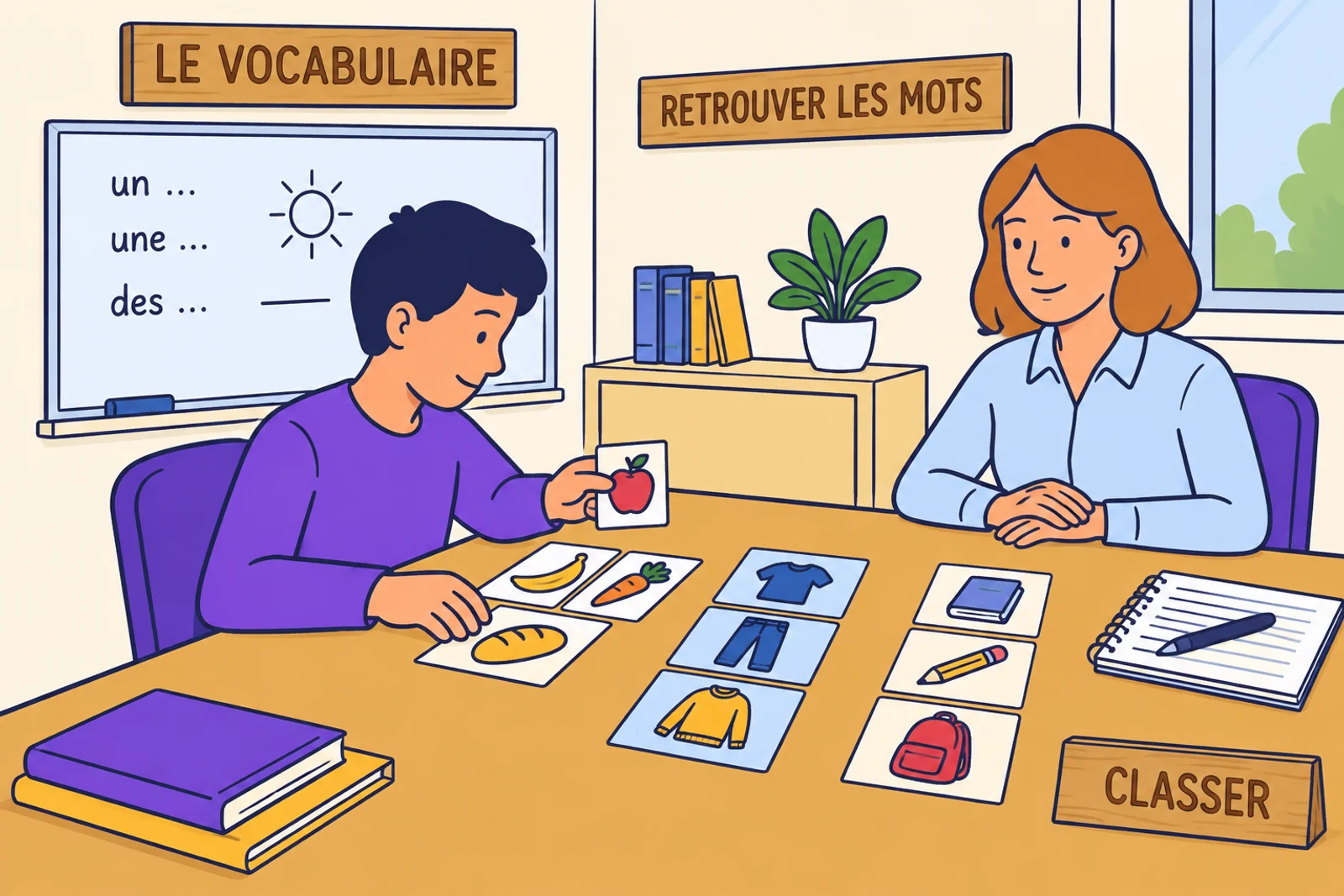
Knowing a French word can mean several things. You may recognise it on a page, retrieve it when speaking, spell it accurately or use it in a phrase. A vocabulary game becomes more useful when you decide which of those actions you are practising.
The games below use small sets of words and changed examples. They do not promise a particular vocabulary size. A claim such as “learn 2,000 words” needs a definition of learning and evidence about the learner; a count of questions is not a count of words mastered.
For the broader selection framework, read French learning games.
Play with noun-and-article pairs
Choose six familiar nouns and learn each with an article. Put the English meaning on one side of a card and the French phrase on the other. Retrieve the full pair rather than the noun alone.
Try these original prompts: a key, an address, an appointment, an invoice, a message and a question. Possible answers are une clé, une adresse, un rendez-vous, une facture, un message and une question.
Then place each in a short sentence. “J’ai une question” is a reusable unit; a bare list of nouns does not practise sentence use. Check an unfamiliar noun in a reliable dictionary instead of guessing its gender from English.
Set the scoring rule before the first card
For this first game, award separate marks for the noun and its article. If you retrieve facture but say un, you have remembered the word while missing the article. That distinction gives you a clearer next task than treating the whole answer as entirely unknown.
You can add spelling as a third category when writing is part of the goal. Keep the categories visible and simple. The marks describe performance on this small set; they are not a formal vocabulary assessment. Their purpose is to show which part of the answer needs practice.
Do one untimed round first. Read the English prompt, say the French pair and turn over the card to check. If you are unsure, mark hesitation before revealing the answer. A correct guess deserves a review even though it earns the same noun-and-article marks as a confident response.
Use a six-card starter set
Make cards for the six prompts above and shuffle them. Avoid keeping them in a fixed order, because remembering that “invoice comes fourth” can help you answer without fully retrieving the meaning. You want the prompt, not the position, to lead to the French expression.
After the first round, choose only the uncertain cards for another look. Say the complete pair, then place it in a short checked sentence. Examples include “J'ai une clé”, “Je vérifie une adresse” and “J'envoie un message”. Keep the sentence simple enough that you can focus on the target word.
If you do not know a surrounding verb, use a model you understand rather than creating an uncertain sentence. The noun practice should not quietly introduce several unchecked grammar problems. You can expand the sentence in a later round once its basic form is secure.
Change the prompt without changing the target
For une clé, replace “a key” with a short situation about opening a door. For une facture, use a fictional bill document. For un message, describe something you send to communicate a short piece of information. Make the intended meaning clear enough that the prompt is fair.
Accept a suitable alternative when the clue genuinely allows one, or revise the clue to narrow it. A learner should not be marked wrong simply because an ambiguous description produced another reasonable word. If the task requires one exact target, provide the context needed to identify it.
Compare the new prompt with the original English translation card. If you can answer only one version, that is useful information. Practise the word through another checked clue or phrase rather than assuming the original card proves you can retrieve it in every situation.
Keep the article when moving into a phrase
Use the noun in a phrase that makes sense, then inspect what happened to the article. “Une question” can appear in “J'ai une question”, while “la question” refers to a particular question in an appropriate context. The change in article has a meaning; it is not merely a different way to fill a slot.
At this stage, you do not need to study every article use at once. Keep the first game focused on learning the noun's gender through a checked pair. When a new sentence changes the article, understand that sentence through a reliable explanation before turning it into another prompt.
For a partner round, one person supplies a short situation and the other says a checked phrase containing the noun. Ask the listener to explain what the phrase means. This catches cases where the word is present but the sentence no longer expresses the intended idea.
Build a small personal set from actual needs
Choose words connected to an upcoming ordinary task, such as an appointment or a shopping question. Start with a few that you partly know and can verify. A set containing only unfamiliar items may turn every answer into a guess, making the game less useful for identifying a specific difficulty.
Keep the source or example sentence with any word whose use is unclear. A translation alone may not distinguish the meaning you need. If the word has several common senses, label the intended context on the card so you do not confuse them during review.
Do not fill the set with personal account numbers, identity details or private correspondence. You can practise the nouns and message patterns using harmless fictional examples. The useful language is portable; the real sensitive information is not needed for the game.
Retrieve words from a situation
Describe a situation without supplying the target word. “You need to agree on a time to meet a professional” can prompt rendez-vous. Accept a sensible alternative expression when the task is communication rather than one exact dictionary answer.
After retrieving the word, ask a follow-up question using it. For rendez-vous: “Puis-je changer mon rendez-vous ?” Then change the task to confirming or cancelling. You are building several actions around one useful noun.
Play in pairs by swapping clue writer and responder. The clue writer must think about meaning; the responder must retrieve language. Review ambiguous clues together instead of treating every unexpected answer as wrong.
Write a clue around a task, not a dictionary slogan
A situation clue describes what someone wants to do. For rendez-vous, the person needs to agree on a time to meet. For adresse, they need to know where to go. For message, they need to communicate a short update. These clues connect the word to an action instead of only an isolated English equivalent.
Keep the clue concise but specific. “Something useful” is too broad. “The information you check to know which building to visit” narrows the intended meaning, though a context may still be needed. Test the clue with another person and revise it if several equally plausible answers appear.
Explain the intended target after the attempt. If the learner gives a suitable phrase rather than the exact noun, decide according to the rule you set. A communication game can accept an effective alternative; an exact-word recall exercise should state that requirement and provide an adequately specific clue.
Play an appointment mini-round
Use three fictional intentions: arrange a meeting, confirm the existing meeting and ask to change it. Begin by retrieving rendez-vous, then use a checked phrase for the relevant action. “Prendre rendez-vous”, “confirmer un rendez-vous” and “changer un rendez-vous” give the noun different practical roles.
Ask a partner to choose an intention without telling you in advance. Say a short sentence that matches it. If you use the confirmation phrase when the intention was to change the appointment, the noun was retrieved but the task was not expressed correctly. Record both observations.
For a second round, add a day or time. Keep the rest stable so you can see whether the added detail affects your response. Do not introduce several unfamiliar scheduling expressions at once. The game should reveal a manageable point to practise, not create a conversation too complex to review.
Play an address-and-message mini-round
Create a fictional situation in which the meeting location is unclear. The learner must retrieve adresse and ask a question about it. The partner then explains that the information will be sent in a message. The learner responds by confirming what they will check.
Use simple checked language: “Quelle est l'adresse ?” and “Je vais vérifier le message.” The point is to connect two useful nouns to a coherent exchange. A list containing adresse and message is easier than choosing which word belongs in each turn, so keep the task difference visible.
After the exchange, ask the learner to explain in English what they would do next. If the answer does not match the French dialogue, return to the relevant sentence. Correct pronunciation of a noun does not necessarily establish comprehension of the whole interaction.
Add a choice only when it helps you diagnose the gap
If free recall is too difficult, offer two possible words and ask the learner to choose. This provides support and lets you see whether recognition is available. After checking, remove the options and try a similar clue. Do not treat the supported answer as identical to the unsupported one.
For example, an address clue might offer adresse and facture. If the learner chooses correctly but cannot retrieve adresse later, the next task concerns recall rather than learning the basic meaning from scratch. A small distinction in the exercise can make the review more precise.
Keep the options plausible enough to require attention but not misleading through false information. If a clue genuinely fits both, revise it. The purpose is to reveal knowledge, not to trap the learner with an unfair prompt and then call the result a vocabulary problem.
Let the learner ask for another clue
Add a rule that allows one clarification question. The learner might ask whether the word refers to a person, place, object or action. This turns the game into a small exchange and gives practice in recovering when the first description is insufficient.
The clue writer should answer truthfully and consistently with the target. If the question exposes an ambiguity, pause and improve the clue together. That discussion is part of the language work. A clean score is less important than understanding why the description led to a particular answer.
After the word is revealed, have the learner create a new clue for it. This switches from retrieval to explanation. Keep both tasks in the session record because they can expose different strengths and difficulties even when the target word is the same.
Build phrase families
Take a verb and combine it with appropriate objects: poser une question, prendre rendez-vous, envoyer un message, vérifier une adresse. Do not assume every English combination transfers directly to French. Verify phrases you are uncertain about.
Set a small challenge: use two target phrases in a coherent exchange. A partner then changes one detail. You might have to cancel instead of confirm, or ask about a different address.
Start from checked combinations
Choose a few combinations you can verify: poser une question, envoyer un message, vérifier une adresse and prendre rendez-vous. Learn each as a useful unit while also understanding its parts. The verb gives the noun an action you can use in a sentence.
Write the intended meaning beside each expression. Then hide the French and retrieve the complete phrase. If you remember question but choose an unsuitable verb, your note should identify the combination problem. More practice with the noun alone would not directly address it.
Do not assume that every English verb-noun pairing transfers word for word. When you want a new combination, check a reliable example. A phrase game is most useful when its models are accurate; otherwise, repeated play can make an awkward or incorrect combination feel familiar.
Create a matching round with an explanation
Put verbs in one column and possible objects in another. Use a small checked set and ask players to make combinations that express the intended meanings. Some words may combine in more than one way, so define the task clearly rather than relying on one private answer key.
After matching, require a short sentence. “Je vais envoyer un message” uses the combination in context. Then ask what the speaker intends to do. The explanation checks meaning and prevents the activity from becoming only a pattern of matching card positions.
For a second round, change the order of the cards and supply the intention in English. The learner now selects the phrase that fits the purpose. If several combinations are valid, accept them when they express that purpose and inspect any difference in meaning rather than marking alternatives wrong automatically.
Build a three-turn message exchange
Use a fictional sequence: one person wants to confirm an address, the other offers to send a message, and the first thanks them and states what they will check. Keep the language short and verified. The target phrases should serve the exchange rather than appear as unrelated vocabulary decorations.
After rehearsing once, hide the model and keep only the three intentions. Each player tries to express their turn. If a phrase is unavailable, check it and repeat that part. You do not need to restart the entire exchange every time one word causes hesitation.
Now change the first intention from confirming the address to changing an appointment. The old response may no longer fit without modification. This controlled change shows whether you are using the phrase for its meaning or simply repeating the sequence you memorised.
Add time carefully
Once a phrase is familiar, place it in a simple time context you understand. “Je vais envoyer un message” expresses an intended action. A different sentence may describe something already done. Check the verb form and meaning before adding the new version to the game.
Do not change the tense, subject and vocabulary simultaneously in the first variation. If the result is wrong, you may not know which change caused the problem. Start with one variable and inspect it, then combine changes once the simpler versions are manageable.
For a beginner, the original present or near-future model may be enough for a useful session. A more experienced learner can add reasons or conditions. The game can adapt without pretending that every player needs the same amount of language in the same round.
Make a personal phrase family card
Place one useful noun at the centre and add two or three checked expressions around it. For question, you might include “J'ai une question” and “Je voudrais poser une question”. Note the situations in which you would use them and avoid adding unverified combinations merely to fill the page.
On the reverse, write intentions rather than complete translations if you want a slightly different recall task. You can ask yourself to introduce a question politely or say that you have one. Check whether the response expresses the intended function, not only whether it contains the target noun.
Review the card after a gap using a changed situation. If you can recall only the exact wording of the first prompt, vary the cue while keeping the model available for checking. The aim is to make the language usable across appropriate contexts, with accuracy preserved.
Use a forbidden-word challenge
Choose a familiar word and explain it without saying it. For pharmacie, you might describe a place where you ask a pharmacist for advice and obtain medicines. Keep the description accurate and appropriate to your level.
This game practises working around a missing word. It is useful precisely because real conversation sometimes leaves you searching. Avoid turning the challenge into a speed contest before you can construct a clear explanation.
Ask the listener what made the clue understandable. If the explanation was unclear, revise it together. The aim is a better description, not merely awarding the point.
Choose words you can describe with language you know
Begin with familiar concrete words rather than obscure concepts. You need enough surrounding vocabulary to describe the target without saying it. If both the target and every possible clue are unfamiliar, the game becomes guessing rather than useful circumlocution practice.
Use a small set such as a key, a book, a question and an address. Choose one and explain its use or context. The listener can ask one clarification question. Keep the target hidden until the listener has made an attempt or asked for help.
After revealing the answer, compare the clue with the word's intended meaning. Did the description include the feature that made the answer identifiable? If not, revise it. The revision can be more valuable than immediately moving to another target because it shows how to make the explanation clearer.
Use a descriptive frame without making it a rigid script
Frames such as “C'est un objet qui…” or “On l'utilise pour…” give you a starting point. Choose the frame that fits the target. A person, place and action may need different wording. Do not force every target into the same grammatical structure just because it is the only one on a card.
The intended answer in this exercise is une clé. The clue remains broad enough that another reasonable answer might be discussed, so use the agreed word set if you need one exact target. Context makes a clue fairer than a hidden answer known only to the writer.
Say the description slowly enough to understand your own structure. Once it works, try it more naturally or add a useful detail. Speed can be an optional later challenge, but clarity should be established before a timer rewards rushed, incomplete descriptions.
Make the forbidden list small and purposeful
For an easier round, forbid only the target word. For a harder round, also forbid one obvious related word, while ensuring the target can still be described with language the players know. Too many forbidden words can turn the exercise into an impossible puzzle unrelated to the intended learning goal.
For example, a clue for livre might avoid the target but still use lire. In a later round, you could restrict that obvious cue and ask for another description. Check that the new clue remains accurate. Difficulty should come from finding another expression, not from accepting false or misleading statements.
After each round, ask which clue actually helped the listener. This feedback tells the speaker what was clear. If a guess was lucky, say so rather than treating the point as proof that the explanation communicated the meaning effectively.
Practise recovering when the word still does not come
If the listener cannot retrieve the target, allow them to describe what they understand. They might say that it is an object used with a door but the noun is missing. That response is useful evidence: the meaning was understood even though recall failed.
Offer a limited hint or reveal the word, then ask the learner to use it in a short phrase. Do not require a long penalty exercise for a missed item. A clear correction and a later review are more practical than making the game progressively more burdensome after each difficulty.
Record the missing word with the clue that prompted it. In the next session, use a different clue. This checks whether the word is becoming available beyond one memorised description and gives you a concrete way to revisit the difficulty.
Useful phrases to keep
Review the words you could not retrieve
Keep a short record of missed words and the situations that prompted them. Review after a gap using a different clue. If the word is always tied to one exact English prompt, change the prompt or use a French definition.
Separate problems of meaning, spelling and use. You may know what facture means but not retrieve it in a question. That calls for sentence practice, not another page explaining what an invoice is.
For spelling and clue construction, continue with French word games. For structuring the whole session, use the game-study method.
Sort the error before choosing the review
Create four categories: meaning, article, spelling and use. Put an uncertain item in whichever category describes the observed difficulty, allowing more than one when necessary. The categories are a planning aid, not an exhaustive theory of vocabulary knowledge.
If meaning is unclear, inspect examples and a reliable definition. If the article is uncertain, retrieve the noun with its checked article. If spelling is the issue, write the word from a prompt and compare carefully. If use is the problem, practise a short phrase or exchange that contains it.
This approach prevents the same review from being applied to every error. Reading the English definition again may be useful for a meaning gap, but it may do little for a noun you understand and cannot retrieve while speaking. Match the exercise to the evidence you recorded.
Review a few words after a gap
At the next session, try selected prompts before opening the answers. Record which words are available and which need support. Then check the models and practise the difficult part. Use a schedule you can maintain rather than treating one interval as a universal requirement.
Change the prompt for at least one word. You might move from an English meaning to a French clue or from a noun card to a short situation. Keep the intended target and correction clear enough that you can interpret the result.
If the word remains difficult, inspect why. The clue may be ambiguous, the meaning may be unfamiliar or the phrase may contain another word you do not understand. Adjust the exercise instead of assuming that more identical repetitions will resolve every kind of problem.
Use a small final exchange as the session outcome
Choose two words from the session and use them in a coherent exchange. For example, ask a question about an address and respond with a message-related phrase. Keep the scene fictional and the language checked. The exchange should express a purpose, not merely contain the target words somewhere.
Ask a partner to change one detail or supply a short unexpected reply. Notice whether you can adapt or need a clarification. Record that result separately from the card score. It provides another view of how the vocabulary is available when the task changes.
You do not need to claim a large number of words mastered at the end. A precise outcome—retrieved three noun-and-article pairs and used two in a new exchange—is enough to guide the next session. The value lies in knowing what you can do and what still needs work.
Run a complete fifteen-minute vocabulary session
Begin with the six noun-and-article cards from the first game. Try each once without looking and mark hesitation. Check the answers, then choose two items that need attention. The selection can include a correct guess, because the point is to identify what is not yet reliably available.
For the next stage, use a different clue for those two words. If you missed une adresse, describe a fictional situation where someone needs to know where to go. Retrieve the pair, then use it in a checked question. If you missed un message, practise a phrase about sending or checking one.
Spend the final part on a short exchange containing both words. One person asks for the location, and the other says that the information is in a message. Confirm what happens next. Keep the scene simple enough that you can tell whether the target vocabulary was used appropriately.
Record the outcome in one line. Perhaps both noun-and-article pairs were recalled, but the verb phrase still needed support. That gives the next session a specific task. These suggested timings organise practice; they do not establish a guaranteed learning rate or an official measure of progress.
Adapt the same set for solo practice
When no partner is available, prepare the clues and answers separately. Shuffle the prompts before starting and say your answer before revealing the model. Leave a brief pause if you use recordings so you have time to respond rather than simply repeat what you hear.
Use a written scenario with a missing target phrase. Complete it, check the model and explain the meaning in English. Then change one fictional detail while keeping the expression appropriate. This creates a small production task without needing another player to improvise a reply.
If you cannot judge a new sentence confidently, do not mark it correct just because it contains the target word. Keep the checked version and ask a reliable source or teacher about the variation. Solo practice can be active while still recognising the limits of what you can verify on your own.
Adapt the set for two different levels
Two learners can share a topic while using different response demands. One may retrieve the noun with its article; the other may give a complete sentence or a French clue. Agree on each person's task before playing so the difference is clear and the exercise remains fair.
The more experienced learner should not automatically become an unquestioned answer key. Verify uncertain words and expressions together. If a clue is ambiguous, revise it rather than using confidence or fluency as proof that one interpretation must be correct.
Finish with a cooperative exchange in which both contribute a manageable turn. The shared goal can be to establish an appointment detail or explain a missing word. This gives the vocabulary a practical use without requiring identical performance from players who are working on different parts of the language.
Choose what to keep in active review
Retain a small set of useful words and phrases that still need work. Move familiar items to occasional review and introduce a few new ones when the routine has room. A large collection is not automatically a useful collection if you cannot identify which items matter now.
Keep meaning, article and context attached to each retained noun. Before adding a new card, ask whether its prompt is clear and its answer checked. This simple quality check makes later games easier to trust and keeps your vocabulary practice focused on language you actually intend to use.
Sort, recall and request
Choose six checked nouns from one situation, such as preparing a meal. Put the article beside each noun in the answer key. Sort the items into two meaningful groups and explain the grouping; more than one sensible answer may be possible.
Hide the written words and use pictures or short clues. Recall each noun with its article, then check both parts. Mark a word for review when you remember the meaning but repeatedly omit or change the article. That gives the next round a specific purpose.
Finish with a request involving one item. A partner offers it, asks which one you mean or explains that it is unavailable. If the exchange stops, identify whether the missing piece was the noun, the request pattern or the reply. Change that part and try the exchange again in a slightly different situation.
Useful phrases to keep
| 🇫🇷 French | 🇺🇸 English | 💡 Context |
|---|---|---|
| C’est une personne qui… | It is a person who… | Giving a clue about a person |
| C’est un endroit où… | It is a place where… | Giving a clue about a place |
| On l’utilise pour… | You use it to… | Explaining an object’s use |
| Je cherche le mot pour… | I am looking for the word for… | Asking for a missing word |
| Cela ressemble à… | It resembles… | Comparing an unfamiliar object |
The French Gamebook
Give your study routine something to practise.
For English speakers practising French
Pick a lesson, play a round and note the mistakes you want to revisit. The Gamebook gives your next session a concrete task and answers to check.
- 21 lessons with explanations
- 40 practice rounds · 2,000 questions
300 pages · Play on your computer or print
Get the Gamebook · $9 Read a preview before you buyOne payment · Instant PDF download
Try the French with someone who can reply.
Bring a sentence you found difficult. Ask a tutor to help you say it naturally, then try it in a short conversation.
Find a French tutor →Paid lessons. Compare tutors and prices before booking.
Affiliate link: we may earn a commission when you book.
📚 Keep building in the Learning Center
French Learning Games for Adults: Pick a Format That Fits Your Life
French games for adults work best when the task feels useful and everyone can participate. Plan cooperative or…
Read →Learn French with a Game: Turn One Round into a Useful Study Session
To learn French with a game, choose one small language goal and make the rules serve it. Build…
Read →Speaking French as a Shy Beginner: Practical Steps
Practise speaking French through small, manageable exchanges. Find starter phrases, rehearsal methods and a gradual plan for shy…
Read →