
Long-Stay Visa France: What Gets Checked, and When French Starts to Count
Every guide tells you to learn French before the move to France. The long stay visa France grants to visitors asks for no level. Nobody tests you. Nobody asks. The reckoning sits at year five, and in 2026 it went up a level.
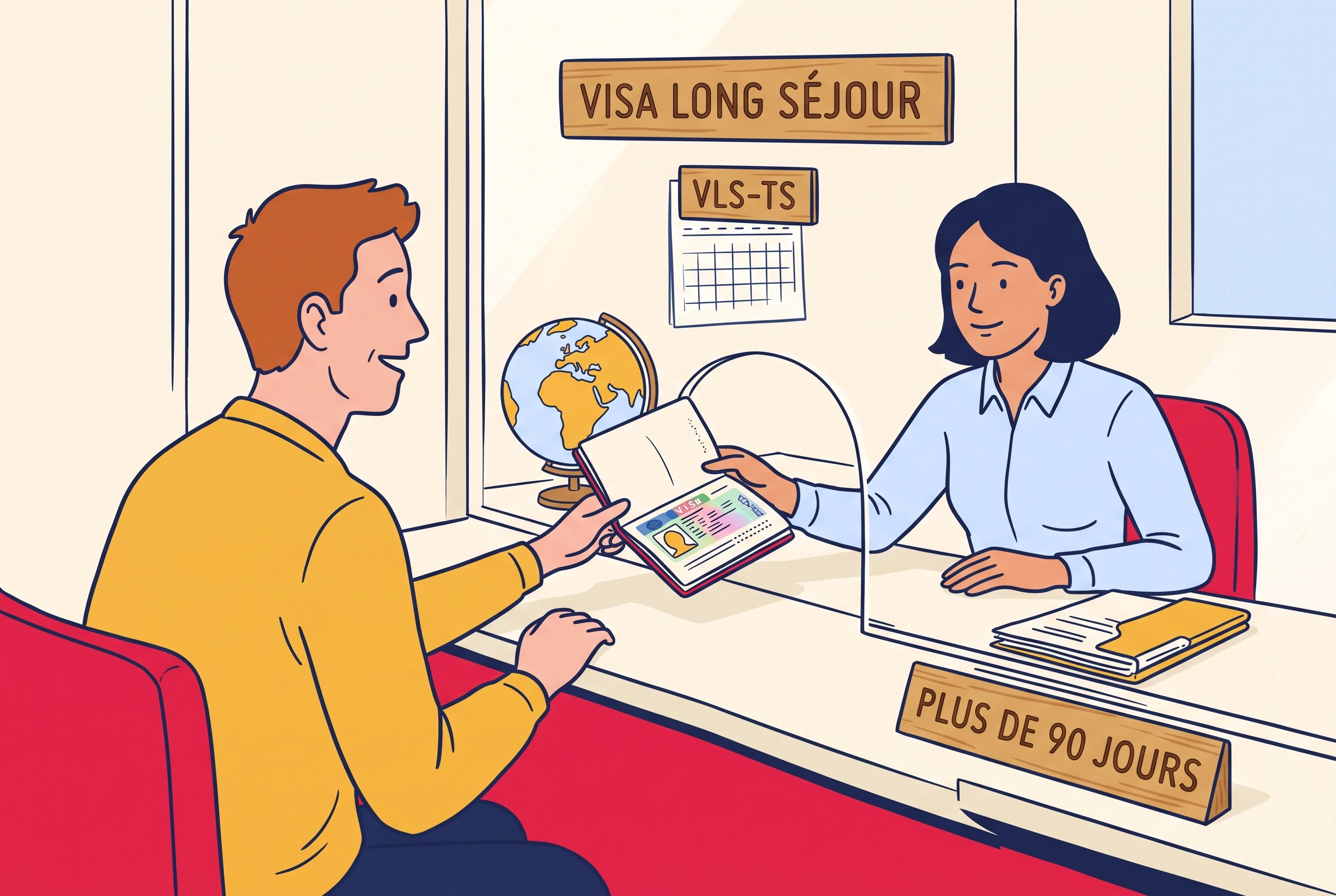
The step that voids everything happens after you land
Most people applying for a long-stay visa prepare the wrong half of the trip. They rehearse the appointment, worry about their accent, read forums about what the consular officer might ask. The officer asks nothing about French. Then they land, unpack, and find that a visa stamped in Chicago can be dead by Christmas because of a form nobody mentioned at the counter.
France-Visas states the consequence in one flat line. The holder of a long-stay visa serving as a residence permit has three months from arrival to validate it on the interior ministry portal, and if you fail to do so, you are no longer legally present in France and will be unable to re-enter the Schengen Area.
No warning letter, no reminder, no counter that catches it for you.
Every September the same message arrives from people who landed in July and assumed validation was something the border police had already done to the passport. The stamp records an entry. The portal records a resident.
The sentence that opens that process is short, and you will repeat a version of it for a year.
Validation asks for the visa details, your date of entry, a French address, and a card to pay the fee or the electronic stamp. The immigration and integration office can then call you in for its own formalities, medical check included.
That is the trap. The visa itself, strangely enough, is the more predictable half.
VLS-TS, VLS-T, and the visa that sends you to the prefecture
France requires a long-stay visa for any stay over ninety days, and no nationality is exempt. Whatever you are planning, the visa runs between three months and one year. What varies is which of three outcomes is printed on the sticker.
| What is issued | What it obliges you to do | Typical holders |
|---|---|---|
| Long-stay visa serving as a residence permit (VLS-TS) | Validate online within three months of arrival. No prefecture visit in the first year. | Visitors, students, many salaried workers, spouses of French nationals |
| Long-stay visa marked "residence card to be applied for within 2 months of arrival" | Present yourself at the prefecture within two months to obtain a residence permit. | Talent passport categories, where a multi-year permit may be issued |
| Temporary long-stay visa (VLS-T) | Nothing to validate, nothing to extend. You leave when it expires. | People certain they will not stay beyond the visa |
For a stay over three months with no work involved, France-Visas is unambiguous: you apply for a long-stay visitor visa and you are issued a VLS-TS. The same page adds that a temporary long-stay visa can be issued instead, to people certain they will not extend. Read that as a warning. A VLS-T is a door that only opens outward.
The full name is a mouthful, and you will say it out loud more than once.
Nine words to say this visa is also my permit. French administration does not abbreviate for your comfort, only for its own.
One word on the sticker decides what you may do for twelve months.
Visiteur sounds temporary and faintly touristic. It is a legal status, and it forbids paid activity of every kind, employed or self-employed. Which raises the obvious question about money.
Long-stay visa requirements: what the file has to prove
France-Visas keeps the exact list behind a wizard, because it shifts with your nationality and your country of residence. The categories do not shift. You must evidence your socio-economic situation, your resources, your accommodation and your medical cover in France, and formally agree not to engage in any professional activity during the stay.
Three of those are documents you gather. The fourth is a sentence you copy out by hand.
Handwritten, signed, dated. A small humiliation and an excellent memory aid.
One figure is published and worth knowing. The visitor residence card that follows the visa asks for monthly resources of 1,477.93 euros for a single person, according to service-public, verified there in June 2026. Pensions, rents and dividends all count toward it, which is why this route suits retirees and frustrates freelancers. If the rental income is French, what a French property costs its owner every year belongs in the same arithmetic.
Notice what is odd about that number. France publishes a hard threshold for students, raised to 877.50 euros a month for applications lodged from 1 August 2026. Visitors get no equivalent headline figure at the consular stage, and an absent number is not an absent threshold.
If the plan is to earn rather than to live on what you already have, the file changes shape from the first screen, and the route Americans take through a work visa starts with an employer.
Three sentences carry most of the appointment. The first hands over money and insurance together.
The second answers how far back the paper goes.
The third fails most often, because an address found in a hurry expires before the visa does.
The penalty is not a fine, it is a closed border
Miss the three month validation and nothing is deducted from your account. You simply stop being legally present in France, and the Schengen door shuts until you apply again from abroad. The French that keeps a file moving at a counter is short and learnable in an afternoon. Our free cheat sheet pack is nine reference sheets, survival phrases for the first week included, and it lands in your inbox the moment you type an email address.
Which leaves the part everyone worried about, and nobody was asked.
Where French actually enters a long-stay visa file
Nowhere. Not in the supporting documents, not at the appointment, not on the validation portal. The visitor card that replaces the visa after twelve months carries no language condition either, per the service-public page describing it. You can arrive with forty words of French and be entirely in order.
So why does a country that will eventually ask you for B1 not ask for A1 at the door? Leave that hanging. A visa is a border decision, a permit is an integration decision, and since 1 January 2026 the second one costs considerably more.
Decree 2025-647 of 15 July 2025 set the new scale for applications lodged from 1 January 2026. A first multi-year residence card now requires A2. The ten-year resident card requires B1, up from A2. Nationality requires B2, up from B1, in speaking and in writing. A civic exam now sits beside the language proof.
There is a wrinkle on the visitor route that most guides skip. The visitor card is issued for one year at most and renewed one year at a time, so the multi-year card, and the A2 attached to it, is not a step you pass through. Your first real wall is the resident card at B1, five years in.
One line on the service-public page about proving your French is worth the section for anyone arriving late in life: applicants aged 65 and over are exempt from the language requirement for the multi-year card and the resident card. The rest of the file is untouched.
The proof is narrower than people expect. For the residence cards the recognised tests are the TCF and the TEF, alongside French diplomas including the DELF and the DALF. For nationality, service-public lists the TCF and the TEF, valid two years. So which French exam a prefecture will actually accept stops being an academic preference, and what really costs points on the day turns out to be logistics rather than grammar.
Two sentences are worth having ready before you book anything.
One more, because the civic exam is new enough that naming it correctly marks you out.
Your French should serve your life. Not a curriculum. Year five hands you a curriculum anyway, and the people who reach it comfortably had French in their week from the start rather than in a panic at month fifty-five, which is what the French Progress Pass is built around: a weekly French routine with your level tracked, so the B1 question is answered before a prefecture asks it.
Reading something in French daily is not a virtue. It is insurance against a dated requirement. The free French Briefing exists for that, one short sitting a day at your level. None of it helps if the file never gets an appointment.
The five official steps, and the two that eat the calendar
France-Visas breaks the process into five, published in this order.
- 1Establish your situationThe portal's wizard confirms whether you need a visa and which supporting documents your nationality and country of residence trigger. Run it before you book or pay anything.
- 2Complete the application onlinePassport issued under ten years ago, two blank pages, and for a long stay a validity running three months past the visa's expiry. Two identity photographs in the international format. Documents in a language other than French or English may be asked for in French translation.
- 3Book the appointmentThe step that quietly sets your departure date. France-Visas tells you to allow time both to get the appointment and to have the file processed.
- 4Submit the fileYou arrive with the printed form and the receipt. The provider checks the file, takes the fee, collects one photograph and ten fingerprints, and keeps the passport.
- 5Track it and collect the passportFrance-Visas puts the decision at fifteen days as a rule, stretched to forty-five when a case warrants a closer look.
One detail saves a journey. If your fingerprints were taken for a biometric Schengen visa less than fifty-nine months ago, you may be exempt from appearing in person.
The fee is taken at the counter. The tax stamp comes later, paid by card on a French government site, and most arrivals are opening a French account in the same weeks. What a French bank asks a new arrival for overlaps almost perfectly with the visa file.
At the window the exchange is brief and entirely scripted.
Say complet with conviction, because the next sentence is the one you do not want.
The counter vocabulary is a dialect of its own, and the words a prefecture actually uses are worth more at that window than any amount of café French. Nobody enjoys this part.
Refusals, delays, and the appeal that runs on its own clock
A refusal arrives as a notification carrying a reason and a route. The route does not lead straight to a judge. Appeals against consular refusals go first to a commission based in Nantes, and passing through it is a precondition before an administrative court will look at the case. The time limit is short, and it is printed on the refusal itself.
France-Visas publishes no league table of refusal reasons, and inventing one would be easy and useless. Read the four requirements backwards instead and you have the shape of most of them: resources that do not read as durable, cover that stops before the visa does, an address that ends in March.
Two sentences belong to a bad week. Learn them anyway, because a refusal handled in the first fortnight is a different problem from one found in a drawer.
Recours sounds softer than it is. Not a complaint, not a request for reconsideration: a formal step in a chain that ends, if you let it, in a courtroom in Nantes. Housing is where timelines usually break first, since renting a French apartment before you hold a permit demands guarantees a foreign payslip does not satisfy. The American file has one further layer.
Long-stay visa France for US citizens, in short
Americans begin where everyone begins, on France-Visas, and then hand the file to an external provider running the consular front desk in their region. The consulate keeps full responsibility for the decision. The provider takes the biometrics, the fee and the passport.
Two things in a typical American file deserve a second look. Statements have to read as statements, not as a summary screen printed from an app. Insurance has to cover medical and hospital expenses for the whole stay plus medical repatriation, which ordinary travel policies frequently cap or exclude.
Two lines carry the friction. The first is the sentence you will hear about your American paperwork.
The second is the answer that closes the question for good.
The rest of that route, the appointment cities, the seasonal delays, the order a US file is assembled in, sits outside this page.
The vocabulary the file is written in
Twelve months after the appointment the same paperwork comes round in French only, with nobody standing between you and a prefecture employee. These are the lines that carry that year.
Start with the one you will say on the validation helpline, or at a desk if the portal refuses your visa number.
Payment happens online, but the stamp turns up in every conversation afterwards.
Then the appointment that replaces the consulate for the rest of your time in France.
Renewal has a rhythm, and the rhythm is early. These two open the file.
Asking for the document list in advance is free, and it is the most useful thing a nervous applicant can do.
Two more close the set. One states the limit of your status out loud, which saves misunderstandings with landlords.
The other is the polite way of asking someone to do their job.
Questions people send us about this visa
Do I need a DELF certificate for a long-stay visa?
No. There is no language requirement for the visa, and none for the visitor residence card that follows it. DELF and DALF diplomas count later, when a residence card or a nationality file has to evidence a level, alongside the TCF and the TEF.
Can I work on a visitor visa?
No, and you sign a handwritten undertaking saying so. That includes employment, self-employment, trade and the liberal professions. Changing status means a separate application at the prefecture.
How does renewal work after the first year?
The visitor card is issued for a maximum of one year and renewed year by year at the prefecture. The file goes in before the card expires, with the same evidence of resources, insurance and accommodation as the original.
What happens if I miss the three month validation?
France-Visas puts it plainly: you are no longer legally present in France and you will be unable to re-enter the Schengen Area. There is no published catch-up procedure, which is why the date belongs in your calendar the day the visa is issued.
The words on the forms
| 🇫🇷 French | 🇺🇸 English | 💡 Context |
|---|---|---|
| un visa de long séjour | a long-stay visa | the umbrella term used across France-Visas |
| valant titre de séjour | serving as a residence permit | the wording that means no prefecture visit in year one |
| la mention « visiteur » | the "visitor" endorsement | printed on the sticker, and it bans paid activity |
| un justificatif de ressources | proof of income | pensions, rents and dividends all qualify |
| une attestation d'assurance maladie | a health insurance certificate | must run the whole stay, repatriation included |
| un justificatif de domicile | proof of address | asked for again at validation and at every renewal |
| un timbre fiscal électronique | an electronic tax stamp | bought online while validating the visa |
| le formulaire Cerfa | the Cerfa form | printed and signed for the appointment |
| un récépissé | a receipt of application | proof your file is being processed |
| une pièce manquante | a missing document | the commonest reason a file stalls |
| la préfecture | the prefecture | handles everything after the first year |
| le renouvellement | renewal | filed before the card expires, never after |
| une carte de séjour pluriannuelle | a multi-year residence card | first card with a language condition, at A2 |
| la carte de résident | the ten-year resident card | B1 since January 2026, up from A2 |
| la naturalisation | naturalisation | B2 since January 2026, up from B1 |
| un recours | an appeal | the formal step after a refusal |
So there is a second date worth writing down, and it is already behind you. On 1 January 2026 the ten-year resident card moved from A2 to B1, and applications are judged on the scale in force the day they are lodged. Someone landing in Bordeaux this autumn and filing in 2031 will be measured against the 2026 scale, whatever the guides they packed said.
Prefer to keep it free today? Read the French Briefing →
Go further

If you only buy two French books, buy these.
Thirteen years of teaching, hundreds of books tested, ten that made the cut. These two carry most learners further than any app.
 #1 pick · Method · A0 → B1
Assimil: New French With Ease
100 short lessons with native audio. The closest thing to a complete French course in book form.
See it on Amazon →
#1 pick · Method · A0 → B1
Assimil: New French With Ease
100 short lessons with native audio. The closest thing to a complete French course in book form.
See it on Amazon →
 #2 pick · Reader · A1 → B1
Short Stories in French — Olly Richards
Eight stories with real plots, written for learners. The book that gets you unstuck at A2.
See it on Amazon →
#2 pick · Reader · A1 → B1
Short Stories in French — Olly Richards
Eight stories with real plots, written for learners. The book that gets you unstuck at A2.
See it on Amazon →
As an Amazon Associate, FrenchToEnglish earns from qualifying purchases.
📚 Keep building in the Learning Center
French Administrative Vocabulary: The Bureaucracy Guide for English Speakers
French bureaucracy is not designed to defeat you. It is designed to process a file, and the file…
Read →French Property Taxes for English Speakers: Taxe Foncière Explained
Most anglophone owners discover French property taxes the hard way: a notice arrives in late August, in administrative…
Read →French Job Interview Guide: Questions & Answers
Master French job interview success with essential questions and answers, professional vocabulary, cultural etiquette differences between American and…
Read →Keep going
You finished this one. Here's your natural next step.

Stop making the same 21 mistakes.
The errors that mark you as foreign, drilled until they're gone. No app, no battery — a pen, forty rounds, and the answers waiting upside down at the foot of every page.
Get the book · $19 → Or the instant PDF · $6.99 — 30-day guarantee Paperback on Amazon · 296 pages · 2,000 questionsRead real French today
Fresh French news, pitched at your level. A new one every morning.
See the 10 books worth your time
13 years of testing, narrowed to the 10 we'd actually hand a friend.