How to Understand French Radio Debates: Listening Guide
French radio debates combine everything hard at once: native speed, overlapping voices, political jargon, cultural references, and a debate style that sounds like controlled chaos. This guide breaks down exactly how to stop drowning in the noise and start hearing the structure underneath.
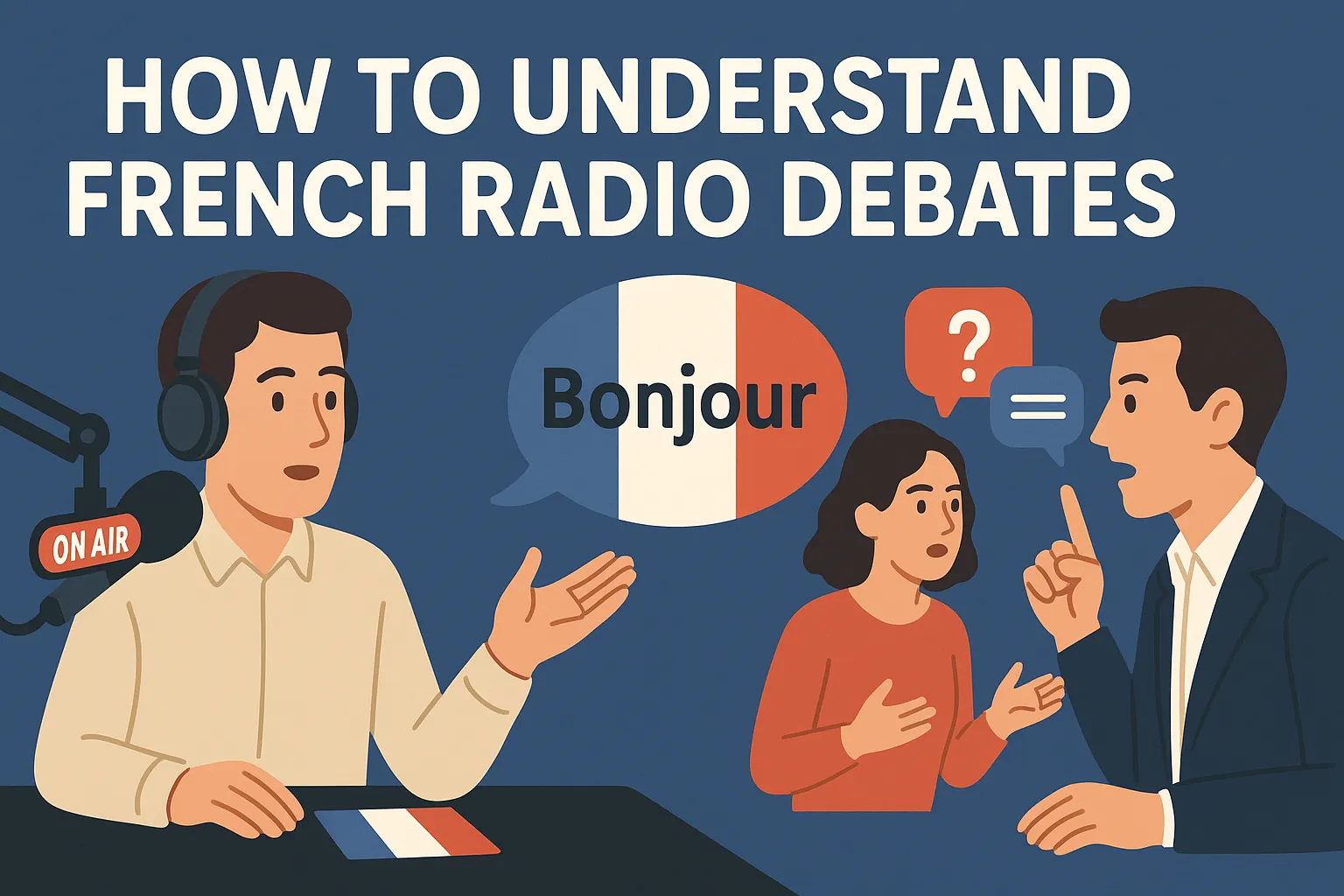
Why French radio debates feel so much harder than podcasts, films, or normal conversation
Most learners underestimate the specific difficulty of French radio debates because they imagine the problem is simply “French is fast.” That is only part of it. Debate audio is hard because the speakers are not trying to help you. In a learner podcast, the host usually articulates clearly, repeats key ideas, and keeps sentence structure reasonably linear. In a film, the visual context helps you recover lost meaning. In face-to-face conversation, you get facial expression, gesture, rhythm, and the ability to ask for clarification. In a French radio debate, all those supports disappear at once. You are left with compressed audio, zero visual anchors, rapid shifts between speakers, interrupted syntax, and background assumptions that the audience already knows the topic, the political context, and often the people involved.
That is why even a solid B2 learner can suddenly feel like a lost beginner again after turning on France Inter, France Culture, Europe 1, RFI, or a strong opinion-driven panel show. A host introduces the topic. A guest begins answering. Another person jumps in before the sentence ends. Someone says “mais justement” in a sharp tone, which means disagreement is coming. The host reframes. A third speaker throws in an ironic aside. Two names of politicians go by. A policy acronym appears. A cultural reference lands and vanishes. If you do not know how debate French works structurally, your brain starts trying to decode every word and dies in under ninety seconds.
This article exists to break that false belief. You do not need full word-by-word comprehension to understand a French radio debate. You need layered comprehension: topic, position, tone, structure, recurring vocabulary, and only then details. Once you start listening that way, debates become much more manageable, and your listening level rises faster than with almost any passive resource. If you already use podcasts, this article works especially well alongside the best French podcasts on Spotify for language learners, because radio debates are the logical next step after learner-friendly audio.
The five specific things that make French radio debate French different
1. Native-speed speech is not the same as debate-speed speech
Plenty of learners can understand interviews or documentaries and still crash in debates. That is because debate speech often accelerates under pressure. People talk faster when defending a point, interrupting, pushing back, summarizing quickly, or trying to seize airtime before the host cuts them off. French radio is full of those moments. The result is not just “normal fast French.” It is compressed argumentative French with little mercy for the listener.
2. Turn-taking is rougher than in many English-language formats
Many English-speaking learners are trained by calmer formats: NPR-style pacing, BBC moderation, one speaker finishing before another starts. French radio can be more combative. Interrupting is not always perceived as catastrophic rudeness. It can signal engagement, urgency, disagreement, or rhetorical force. If you interpret every interruption emotionally instead of structurally, the whole exchange feels chaotic. If you learn to hear interruptions as argument markers, the chaos becomes readable.
3. The discourse markers matter more than the nouns at first
Beginners and intermediates often obsess over every unknown noun or policy term. In debates, the words that save you first are not the specialized terms. They are the small connective phrases: mais justement, au contraire, cela dit, en revanche, si je peux me permettre, permettez-moi de vous interrompre, sur ce point, en réalité, autrement dit. These tell you whether the speaker is attacking, agreeing, reframing, clarifying, or moving to a new angle.
4. French public debate assumes cultural memory
French radio does not stop to explain every historical, intellectual, or political reference. It assumes the audience has at least rough familiarity with the Republic, social movements, laïcité, labor law, pension reform, the structure of the French state, and major political personalities. That means a learner is not just listening to French. A learner is often listening through missing context. This is one reason debates on public radio can feel much harder than entertainment podcasts.
5. Multiple registers can appear in a single debate
A host may speak polished journalistic French, a politician may produce well-trained rhetorical French, a caller may speak more spontaneous everyday French, and an intellectual guest may drift into dense abstract phrasing. That means you are not training one kind of listening. You are training register-switching. That is demanding, but it is also why this practice is so powerful.
The biggest mental mistake: trying to understand every sentence
The fastest way to fail with French radio debates is to listen like you are taking an exam where every word matters equally. Real listening does not work like that, and debate listening especially does not. If you try to decode everything at once, you burn working memory on the first unknown cluster and miss the entire next thirty seconds. Then you panic, and once panic enters, the audio starts sounding even faster. The better method is to decide what layer of meaning you are hunting at each pass.
First pass: what is this debate about? Second pass: who agrees with what? Third pass: which arguments repeat? Fourth pass: which phrases and vocabulary do I want to keep?
This is why radio debate training belongs in a serious listening progression, not in random heroic attempts. If your listening still collapses easily in one-on-one phone French, do not jump directly into hard political panels without a system. Work first through easier but still authentic formats like French phone-call survival phrases, slower podcasts, and structured listening content. Then step upward. Debate comprehension is not magic. It is accumulated resistance to overload.
The debate markers you must learn before anything else
If you only memorize one category of language for French radio debates, make it discourse markers. These are the little phrases that show the skeleton of the argument. Once your ear recognizes them automatically, you stop drowning in undifferentiated sound and begin hearing structure. That changes everything.
These phrases do more than help you understand French radio. They help you predict what is about to happen. If someone says certes, mais, you know agreement is only provisional and contradiction is coming. If the host says si on revient à or pour revenir à la question de, the discussion is being pulled back to the main topic. If someone says autrement dit, you are about to get a rephrase that may be easier than the original sentence. That is usable listening power.
The three levels of comprehension you should track in every debate
Level 1: Topic comprehension
This is the most basic layer. What is the debate about? Retirement reform? Immigration? Public schools? Inflation? A film release? A literary prize? The European Union? A football scandal? If you cannot name the topic clearly after five minutes, the debate is probably too hard for your current level or you started with a topic where your background knowledge is too weak.
Level 2: Position comprehension
Once you know the topic, your next goal is not details but alignment. Who supports what? Who is criticizing what? Who sounds cautious? Who sounds ideologically committed? Who is reframing the discussion? This is where discourse markers help enormously. Debate comprehension becomes much less painful once you stop hearing “French sound” and start hearing “position A vs position B.”
Level 3: Argument comprehension
Only after the first two levels should you start caring about the exact arguments. Why does one speaker oppose the reform? What evidence do they use? Which numbers or examples recur? Which metaphors appear? If you try to begin here, you often lose the whole thing. If you build upward, details start sticking naturally.
💡 Best listening question while the audio runs: not “What did I miss?” but “What are they trying to prove?” That question forces your ear toward argument, not panic.
How to choose the right French radio debate show for your level
Not all French debate audio is equally brutal. This matters because many learners sabotage themselves by starting with shows that are objectively too dense. You need a progression. A B1-B2 learner should not jump first into the most confrontational political programming and conclude that French radio is impossible. That is like trying to read a philosophical essay before you can comfortably read a good newspaper feature.
Best starting point: debates with social topics and clearer moderation
8 milliards de voisins (RFI) is one of the best bridges into debate listening because the topics are broad, human, and often internationally accessible: work, family, education, social change, digital life, health, urban life, and shared global concerns. The debate structure is often clearer, the register is less densely elite than some Parisian intellectual radio, and RFI is generally more accessible to learners than the fastest domestic formats.
Follow 8 milliards de voisins on RFI
Le téléphone sonne on France Inter is also valuable because it often mixes experts, journalists, and ordinary callers. That gives you a wider acoustic and social range. Callers are not always easier, but they often speak with less polished rhetorical compression than media professionals, which can actually make parts of the show more accessible than elite panel debate.
Follow Le téléphone sonne on France Inter
Intermediate step: analytic debates with stronger structure
L’Esprit public on France Culture is excellent when you want more depth but still need a relatively intelligible structure. The pace is not always easy, but the show is designed around analysis rather than pure verbal combat. If you are already reading French current affairs and can follow a solid B2 discussion, this show is one of the best places to build argument-listening ability.
Follow L’Esprit public on France Culture
Advanced step: intellectual and combative formats
Répliques is excellent for advanced learners because it forces you into dense ideas, philosophical framing, and high-register argumentative French. It is not where most learners should begin, but once you are strong, it becomes gold. You are not just learning listening there. You are learning how educated French intellectual disagreement sounds when compressed into radio form.
Follow Répliques on France Culture
Le Nouvel Esprit public is also worth following if you want high-level current-affairs discussion in a podcast-first environment with a more reflective tone than some harder news-radio clashes.
Follow Le Nouvel Esprit public
The best way to train: one topic, many episodes, not random sampling
The worst learning strategy is jumping randomly from pensions to cinema to artificial intelligence to football to agricultural protests to constitutional law in a single week. It feels dynamic, but it destroys your chance to build repeated vocabulary. French radio becomes dramatically easier when you stay on one topic for several episodes because debate language is repetitive. The same nouns, acronyms, verbs, and arguments come back again and again. Repetition is not boring here. It is how your ear starts locking onto meaning.
Pick one topic you already understand in English. For example: inflation, education reform, immigration, climate policy, artificial intelligence, or football. Read two or three good English summaries first. Then listen to three or four French episodes on that same issue across different programs. Suddenly the debate becomes less about decoding unknown reality and more about matching French forms to ideas you already know. That is also why The French Briefing works as a daily stepping stone. Real French news explained at a pace that builds toward debate-level listening.
The listening method that actually works for debate audio
First listen: no stopping, no dictionary, no transcript
Your first listen should be about surviving the whole thing while tracking the topic and the main positions. Do not pause every twenty seconds. Do not look up words mid-stream. Do not turn the session into a vocabulary excavation site. That interrupts the skill you are actually trying to build, which is live comprehension under pressure.
Second listen: short replay segments
Take a difficult two-minute section and replay it. Now try to identify who is speaking and what their position is. Then replay again and catch the discourse markers. Only then look at vocabulary. This order matters because it trains your ear to hear structure first. If transcripts exist, use them after at least one full audio-first pass, not before.
Third listen: transcript or notes
If the show has a transcript, summary, title, guest list, or written episode description, use it now. The goal is not to “cheat.” It is to confirm what you actually heard and correct what your brain guessed wrongly. French radio becomes much less mysterious once you realize how often the same arguments and formulae return. “For sure.”
Fourth step: active extraction
Write down ten high-value items from the episode: three discourse markers, three topic words, two argument phrases, and two expressions you could reuse in speaking or writing. This is where raw listening turns into durable French.
This same principle of repeated passes is exactly why listening improvement often accelerates when paired with more structured oral work. If you want the speaking side to keep up with the listening side, it pairs well with common French mistakes English speakers make, because debates expose weak grammar habits brutally once you start trying to summarize them aloud.
The vocabulary fields that dominate French radio debates
French radio debates repeat certain lexical ecosystems constantly. If you learn these well, your comprehension jumps. The biggest ones are politics, economics, education, society, institutional life, and culture-war vocabulary. You do not need every term. You need the high-frequency ones that keep coming back across shows.
Politics and state vocabulary
Economics and everyday pressure vocabulary
Society and public life vocabulary
These expressions matter because they do not just carry meaning. They carry ideology. When a speaker says les acquis sociaux, they are not using neutral technocratic language. They are activating a political world. When someone says le pouvoir d’achat, they are signaling everyday economic pressure in a very French media frame. Learning the vocabulary means learning the worldview embedded inside it. If you want the full political context behind these terms, the political vocabulary guide breaks down the system they all refer to.
The cultural references that silently wreck comprehension
One brutal truth about French radio debates is that sometimes your French is not the real problem. Your missing cultural background is. If speakers reference Mai 68, the Fifth Republic, laïcité, the pension age, a famous journalist, a past labor movement, a literary figure, or a constitutional procedure without explanation, your brain may hear the French clearly and still understand very little. That is not a listening failure. That is a context failure.
This is why smart learners do not only train the ear. They also build French background knowledge. Read French news summaries. Follow a few recurring public figures. Learn the basic shape of French institutions. Know the names of the major public radio stations and what they sound like. Learn the recurring national obsessions. Once the background becomes less alien, the audio becomes dramatically easier.
⚠️ Big hidden trap: trying to learn advanced French debate listening without any French political or cultural background. You end up decoding the language while still not understanding the world being discussed.
That is also why cultural reading matters. Listening never exists in a vacuum. Articles like French public holidays explained, French politeness rules, and why French people don’t smile at strangers are not “just culture.” They build the exact background that makes French media more intelligible.
The best show-by-show progression if you want real long-term results
Stage 1: RFI and accessible social debate
Start with 8 milliards de voisins on RFI. The topics are broad, human, and often internationally framed. That matters because it reduces the France-only context burden. Use the episode descriptions. Pick themes you already care about. Listen first without notes, then return with notes. Spend a full week on one theme if needed.
Stage 2: Mixed-expertise call-in and current affairs radio
Move to Le téléphone sonne once you can hold a topic across multiple speakers. This show trains you to hear different social voices, not just one polished media register. It is excellent for coping with real unpredictability. Use titles and episode blurbs before listening so you are not entering blind.
France Inter: Le téléphone sonne
Stage 3: Structured high-level analysis
Then move into L’Esprit public. By this stage, your goal is not survival but analysis. Try summarizing each speaker’s position in two sentences. If you cannot do that, replay the segment until you can. This is one of the best bridges from upper-intermediate listening into high-register comprehension.
France Culture: L’Esprit public
Stage 4: Dense idea debate
Once you can survive long-form current-affairs discussion, go to Répliques. This is where you start dealing with more compressed abstraction, stronger references, and much more “French intellectual radio” energy. Do not use this as your first battlefield unless you enjoy self-inflicted discouragement.
Stage 5: Topic specialization
After that, specialize. If you like politics, stay in politics. If you like football, train on sports radio. If you like economics, follow business radio. Topic specialization is underrated because it massively increases repeated vocabulary exposure.
| Show | What it is | Level |
|---|---|---|
| 8 milliards de voisins | RFI. Work, family, dating, education, city life. International guests, clear French, callers from everywhere. The best entry point. | B1-B2 |
| Le téléphone sonne | France Inter. Real people call in live about health, money, housing, politics. Experts answer. Raw, messy, real. | B2 |
| L’Esprit public | France Culture. Four sharp commentators dissect the week in French politics. Structured, analytical, zero shouting. | B2-C1 |
| Répliques | France Culture. Two thinkers clash on philosophy, history, literature, society. Dense. Intellectual. The deep end. | C1 |
| Le Nouvel Esprit public | Independent podcast. Geopolitics, Europe, French institutions. Calm pace, long episodes. Perfect for re-listening. | B2-C1 |
How to take notes without destroying your listening
Bad note-taking kills listening because it pulls the eyes into writing and the brain into transcription. You are not a court reporter. You are a listener building auditory argument recognition. Good notes should be light, structural, and fast. Write topic headings, speaker positions, repeated words, and only a few key expressions. Do not try to write whole sentences while the audio runs unless the show is far below your level.
A good note page for one episode might contain four things: the topic, the names or labels of the speakers, one line for each person’s main stance, and a short vocabulary box. That is enough. After the replay, expand if needed. During the first listen, less is almost always more.
The transcript question: use them, but use them late
Many learners either avoid transcripts completely or depend on them too early. Both extremes are bad. If you use transcripts before your ear has done any work, you turn listening into reading support. If you never use them at all, you may fossilize wrong guesses and waste time. The right moment is after at least one strong audio-first pass. First you struggle productively. Then you verify. Then you listen again with corrected expectations.
This also makes transcripts emotionally useful. They stop being a crutch and become proof of progress. You discover that you caught more than you thought. Or you discover that your ear kept failing on the same sound pattern, which is actionable information. If pronunciation is a recurring weakness, it also helps to reinforce the listening work with high-frequency French mistakes English speakers make and related pronunciation work from the pronunciation and listening guide.
The anti-burnout rule: debate listening should be hard, not humiliating
There is a difference between useful strain and pointless punishment. French radio debates should challenge you. They should not destroy your morale every single day. If you are understanding below roughly 20 to 25 percent across multiple listens and cannot even identify the topic, the format may be too difficult right now. That is not shameful. It just means you need a more intelligent stepping stone. A good progression might be learner podcasts, then clear native podcasts, then interviews, then moderated discussions, then real debates. There is no prize for skipping developmental steps.
💡 A very good target: aim for 60 to 70 percent functional understanding on familiar topics. That is already strong listening. Debate French does not require perfection to be valuable.
And remember the real payoff. When debate listening starts improving, everything else gets easier: interviews, documentaries, podcasts, live conversation, audio books, even noisy real-life discussion. Debate radio is not just one skill. It is a listening stress test that upgrades the whole system.
Study glossary: essential French radio debate vocabulary
| French term | English translation | Why it matters |
|---|---|---|
| mais justement | but precisely / that’s exactly the point | High-frequency disagreement marker |
| au contraire | on the contrary | Direct contradiction signal |
| certes, mais | granted, but | Partial concession before objection |
| tout à fait | absolutely / exactly | Common agreement marker |
| permettez-moi de vous interrompre | allow me to interrupt you | Classic debate interruption phrase |
| laissez-moi terminer | let me finish | Common turn-holding phrase |
| en d’autres termes | in other words | Rephrasing marker, often very useful |
| autrement dit | put differently | Another rephrasing marker |
| le pouvoir d’achat | purchasing power | Extremely common in French media debates |
| les acquis sociaux | social gains / protections | Heavy ideological and historical term |
| la réforme | reform | Appears constantly in politics and society debates |
| le débat de société | societal debate | Very common media framing phrase |
| le terrain | the reality on the ground | Used to oppose theory and lived reality |
| la laïcité | French secularism | Culturally central, often hard for outsiders |
| en revanche | by contrast | Important nuance marker |
| cela dit | that said | Common soft pivot phrase |
French radio debates are one of the fastest ways to sound less like a learner
The reason this kind of listening matters so much is not just that it improves comprehension. It changes your relationship to French. Once you can survive and then enjoy French radio debates, you stop depending entirely on learner content and start living inside real French thought, real French disagreement, real French media rhythm, and real French public language. Your vocabulary gets sharper. Your ear becomes tougher. Your sense of register improves. You stop needing perfectly clean audio and perfectly polite one-at-a-time speech to function.
And perhaps most importantly, you stop panicking when French gets messy. That alone is a massive threshold in language learning. Debate audio teaches you to keep listening under pressure, keep tracking structure when details escape you, and recover meaning without total control. That is not just radio skill. That is mature listening skill. “For sure.” 🕶️
Go further

Stop making the same 21 French mistakes. Play them away.
300 pages of games, riddles and quizzes built around the 21 mistakes English speakers actually make in French. You fix them by playing, not by memorising rules. By Camille Aubert.
📚 Keep building in the Learning Center
French Property Taxes for English Speakers: Taxe Foncière Explained
Most anglophone owners discover French property taxes the hard way: a notice arrives in late August, in administrative…
Read →Imparfait vs Passé Composé Explained: Timeline Method
Imparfait vs passé composé trips up every English speaker because English never forces the same choice. You say…
Read →How to think in French (stop translating from English) – practical guide
Stop mentally translating every French sentence from English and start thinking directly in French with proven techniques that…
Read →