Visiting Paris? The Only French Survival Phrases You Need
You do not need to speak French to survive Paris. You need about 40 phrases, the confidence to use them badly, and the understanding that Parisians are not judging your accent. They are judging whether you said bonjour. This guide gives you everything you need, situation by situation, from the moment you land to the moment you leave.
🤝 The golden rule that changes everything in Paris
Every interaction in Paris starts with the same word. Not merci. Not parlez-vous anglais. Bonjour. That single word determines whether the next 30 seconds of your life in Paris will be pleasant or frosty. Walk into a shop without saying it and the staff becomes cold. Say it first, even with a terrible accent, and something shifts. The door opens. The person behind the counter becomes a human being who wants to help you instead of a wall.
This is not a cultural quirk. It is the foundation of the entire French politeness system. Americans especially underestimate it because in the US, walking into a store and immediately asking a question is normal. In France, it is rude. Not aggressively rude. Just enough to make the interaction start wrong and never fully recover.
The real reason Parisians seem cold to tourists
It is almost never about your French level. It is almost always about skipping bonjour. A tourist who says “Bonjour, excusez-moi, est-ce que vous parlez anglais ?” with a terrible accent will receive warmer treatment than a tourist who walks up and says “Do you speak English?” in perfect pronunciation. The difference is not language. It is acknowledgment. The guide to why French people don’t smile at strangers explains the deeper cultural logic.
🚇 The Paris metro: getting around without panic
The Paris metro is one of the densest urban transit systems in the world. 16 lines, 300+ stations, trains every 2-4 minutes. It is also, once you understand the logic, one of the easiest ways to move around any major city. The system is designed for volume, not for hand-holding. Announcements are fast. Signs are in French. Ticket machines have an English option but the staff at the guichet may not. Here is what you actually need.
The train ticket vocabulary guide covers the full SNCF system if your trip extends beyond Paris to other French cities. The transaction logic is the same: bonjour, destination, s’il vous plaît, pay, merci, leave.
Download offline maps before you go. Google Maps and Citymapper both work offline for Paris metro routing. Your French SIM card will handle data, but offline maps work even in tunnels where signal drops.
🍽️ Cafés, bakeries, and restaurants: the phrases that feed you
This is where Paris happens. Not at the Eiffel Tower. At the café terrace where you sit with a coffee and watch the street go by. At the bakery where the smell of butter hits you at 7am. At the restaurant where the waiter does not rush you because dinner in France is not a transaction. It is a social event. And the French you need for all three is surprisingly small.
☕ At the café
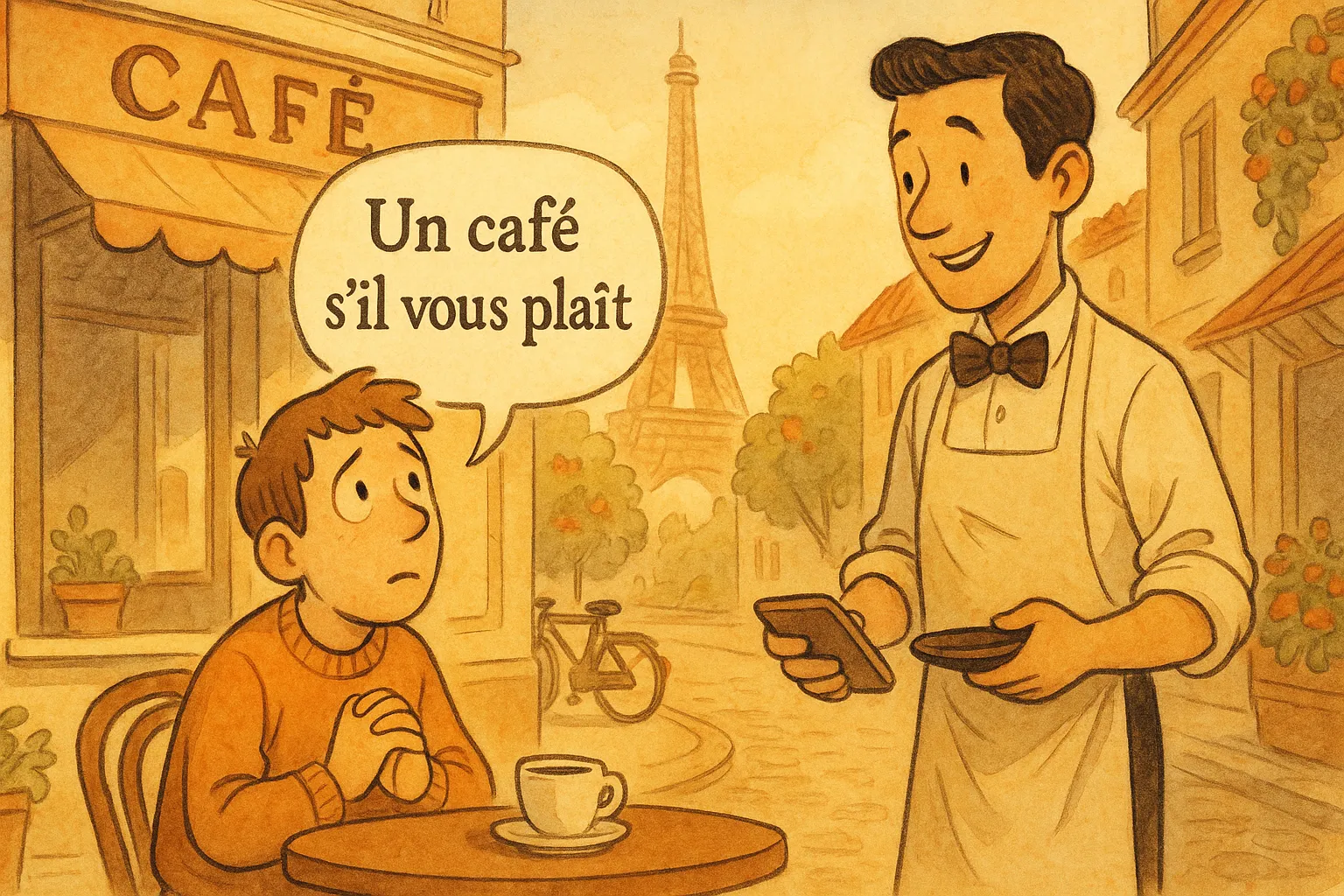
The full café culture guide covers the rules in depth. Here is the survival version: sit down, wait to be served (do not flag the waiter frantically), order with s’il vous plaît, and never rush.
🥐 At the bakery
French bakeries are the single best place to practice French as a nervous beginner. The interaction lasts 30 seconds. The script is almost always the same. And the reward is warm bread. The bakery culture guide covers the full etiquette, but here is what gets you through the door.
🍷 At the restaurant
Restaurant French is slightly more complex but still manageable. The restaurant booking and ordering guide has the full version. Here is what keeps you alive on your first Parisian dinner.
Tipping in Paris. Service is included in the price by law (service compris). You do not need to tip. Leaving 1-2€ in coins on the table for good service is a nice gesture but never obligatory. Do not tip 20% like in the US. It would be bizarre. The cheese culture guide covers the fromage plateau that might appear at the end of your meal, because yes, cheese comes before dessert in France.
🛍️ Shopping, markets, and getting what you need
🏪 In shops
🍅 At a market
Paris markets (Marché d’Aligre, Marché des Enfants Rouges, Rue Mouffetard) are some of the best experiences in the city. The vendors are fast, the displays are beautiful, and the French is surprisingly simple because the interaction follows a tight script.
🧭 Asking for directions and finding things
🆘 When things go wrong: the phrases that save you
Most Paris trips go perfectly. But sometimes your wallet disappears, your phone dies, you get lost at 11pm, you need a pharmacy, or you genuinely do not understand what is happening. These phrases exist for those moments.
Emergency numbers in France. 112 works from any phone including locked phones. 15 = SAMU (medical emergency). 17 = police. 18 = fire brigade (pompiers, who also handle medical emergencies). Operators on 112 often speak English.
✨ The phrases that turn a trip into something better than tourism
These are not survival phrases. These are the phrases that make Parisians smile, that open conversations, and that turn a visit into a story instead of a checklist. You do not need them. But if you use them, Paris feels different.
If you want your introduction to sound less like a textbook and more like a real person arriving in a real city, the register for Paris is simple: Moi, c’est [name]. Je suis américain(e). C’est ma première fois. J’adore Paris. That is enough to start a conversation that neither of you expected.
🗼 What to know before you go: practical Paris intel
Things Americans do not expect
Shops close on Sunday. Most of them. Plan accordingly. Bakeries usually open Sunday morning but close Monday instead.
Lunch is 12h-14h. Many restaurants stop serving at 14h sharp. If you arrive at 14h05, the kitchen is closed. This is not rudeness. It is the schedule.
Water is free. Ask for une carafe d’eau (a jug of tap water). It is free and perfectly drinkable. Do not order Evian unless you want to pay 5-7€ for the same water in a different bottle.
Waiters are not ignoring you. They are giving you space. In France, a waiter who hovers is annoying. A waiter who waits for your signal is professional. To get attention: make eye contact and raise a finger slightly. Do not wave, snap, or call out.
The French holiday calendar will affect your trip. May is particularly dense with public holidays. Some businesses close for an entire bridge weekend (le pont).
📋 Your Paris French cheat sheet
| French | English | When you’ll need it |
|---|---|---|
| Bonjour / Bonsoir | Hello / Good evening | FIRST word. Every interaction. Non-negotiable. |
| Au revoir / Bonne journée | Goodbye / Have a nice day | LAST word. Every interaction. Closes the loop. |
| S’il vous plaît / Merci | Please / Thank you | Attach to everything. Free politeness upgrade. |
| Excusez-moi | Excuse me | Before any question to a stranger. |
| Parlez-vous anglais ? | Do you speak English? | After bonjour. Never as opener. |
| Un café / un café crème | Espresso / coffee with milk | Café = espresso by default in France. |
| Une baguette, s’il vous plaît | A baguette, please | Bakery. Your easiest French win. |
| L’addition, s’il vous plaît | The bill, please | Waiter won’t bring it until you ask. |
| Une carafe d’eau | A jug of tap water (free) | Restaurant. Free. Always available. |
| C’est combien ? | How much is it? | Shops, markets, anywhere. |
| Où est / Où sont ? | Where is / Where are? | Metro, toilettes, pharmacie, anything. |
| À gauche / à droite / tout droit | Left / right / straight ahead | Understanding directions. |
| Je ne comprends pas | I don’t understand | Rescue phrase. Use without shame. |
| J’ai besoin d’aide | I need help | Emergencies and genuine confusion. |
| C’était très bon, merci | That was very good, thanks | End of meal. Costs nothing. Means everything. |
The only rule that matters. Bad French with bonjour beats perfect English without it. If you take one thing from this guide, take that. Paris opens for people who try. It closes for people who assume. “For sure.” 🕶️
Go further
Stop making the same 21 French mistakes. Play them away.
300 pages of games, riddles and quizzes built around the 21 mistakes English speakers actually make in French. You fix them by playing, not by memorising rules. By Camille Aubert.
📚 Keep building in the Learning Center
French Property Taxes for English Speakers: Taxe Foncière Explained
Most anglophone owners discover French property taxes the hard way: a notice arrives in late August, in administrative…
Read →Imparfait vs Passé Composé Explained: Timeline Method
Imparfait vs passé composé trips up every English speaker because English never forces the same choice. You say…
Read →French for Busy Professionals: 15-Minute Daily Routine
Busy professionals can master French with this realistic 15-minute daily routine combining active learning, passive immersion, and micro-practice…
Read →