How to Order Drinks in French Bars: Terrace Phrases, Apéro Etiquette, and Regional Drinks Explained
Ordering drinks in a French bar becomes stressful at exactly the wrong moment: the server arrives, the terrace is busy, and everyone else already knows the rhythm. The problem is not just vocabulary. It is tone, timing, regional specifics, and knowing what sounds natural in France versus what sounds like a phrasebook read aloud.
How to order without sounding abrupt
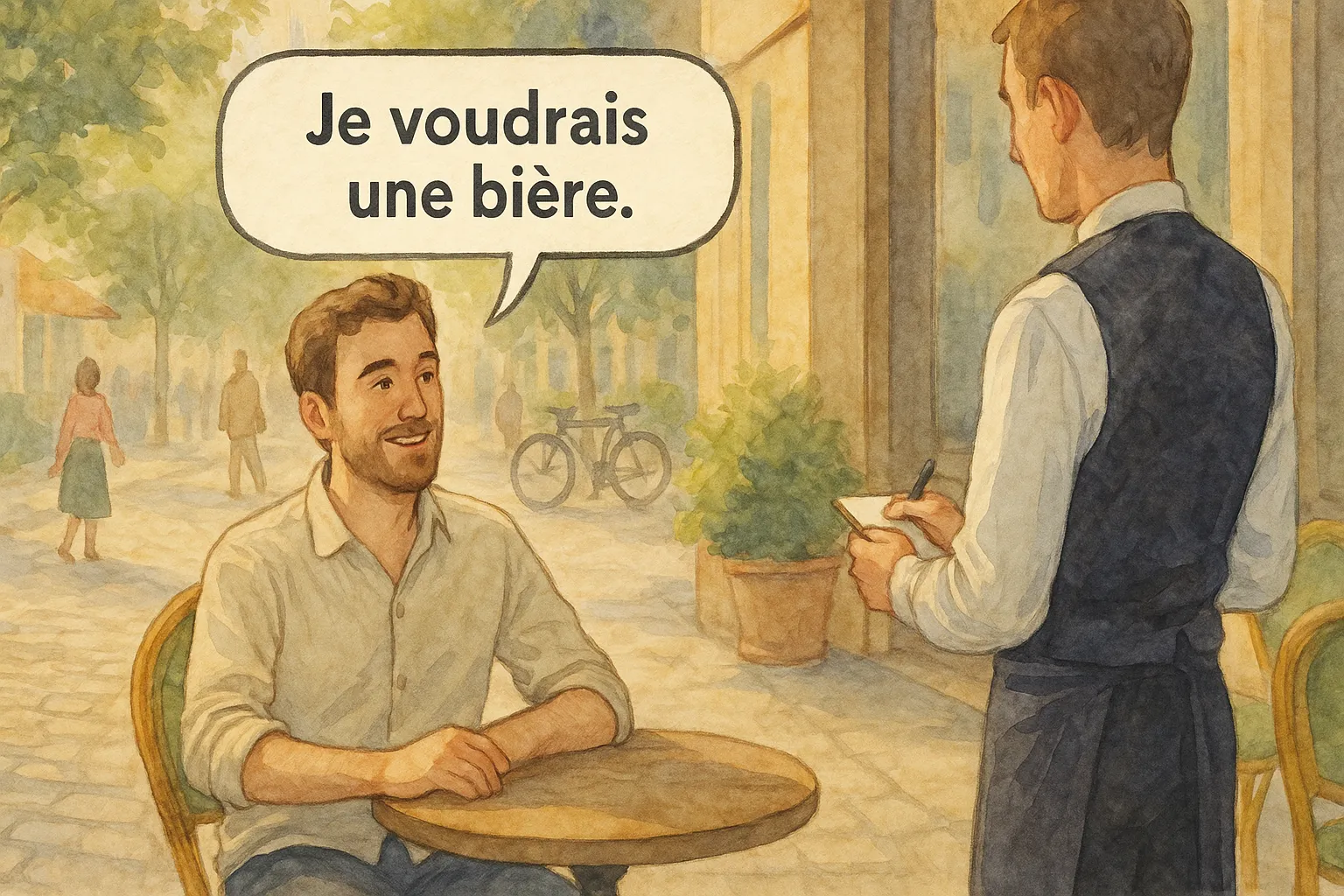
French bar service is less performative than American service and less chatty than many visitors expect. That does not mean it is rude. It means you are expected to be clear, polite, and low-drama. The politeness system applies here exactly as it does everywhere else in France: bonjour first, request second, s’il vous plaît attached. Skip that sequence and the interaction starts wrong before you have even named the drink.
If the ordering moment itself makes you freeze, that is the same nervous system response described in the shy beginners guide. Pre-decide your phrase before you sit down. Write it on your phone if you need to. The 3-second rule works at the bar exactly like it works at the bakery.
What to say on a café terrace
A French terrace has its own rhythm. You are ordering in public, within earshot of other tables, and usually under mild time pressure. The café culture guide covers the full code, but the terrace version is simpler: order in units the place already expects. Beer size, wine by the glass, standard terrace drinks. Move faster than your anxiety.
The same transaction logic applies at the bakery and the restaurant: bonjour, order, s’il vous plaît, merci, au revoir. The words change. The frame does not.
Apéro, toasting, and paying without getting the tone wrong
L’apéro is not just “drinks before dinner.” It is a social transition. People meet, settle, snack lightly, and talk before the meal begins. If you understand that, French drinking situations become less mysterious. If you treat it like a quick drink stop, you will misread the whole event. The cheese culture guide covers what often appears alongside the apéro: saucisson, olives, comté, and the fromage board that follows dinner.
Tipping at bars. Service is included (service compris). Leaving 1-2€ in coins for good service is appreciated but never expected. Do not tip 20%. The Paris survival guide covers the same logic for restaurants.
Regional drinks worth knowing: where they come from and what makes them different
You do not need an encyclopedia of French alcohol. You need a small regional map. Certain drinks carry immediate cultural associations. Ordering one at the right moment sounds natural. Ordering it blindly sounds like you read one paragraph about France on the train. Here is the map, with enough context to sound oriented rather than random.
🍸 Pastis — Marseille and the entire south
Pastis is anise-flavoured, served with water that you add yourself (it turns milky), and is essentially the social signature of Provence and the Midi. It was created in the 1930s after absinthe was banned, and it never left. Ricard and Pastis 51 are the two dominant brands. Henri Bardouin is the artisanal option. Ordering pastis in Marseille is the most natural thing in the world. Ordering it in a Parisian wine bar in January is less obvious, but nobody will stop you.
How it is served: a small glass of pastis arrives neat. A carafe of cold water arrives separately. You pour the water yourself. Ratio: roughly 1 part pastis to 5 parts water. Adding ice is optional and debated. Locals have opinions.
🍷 Kir — Burgundy origin, national drink
A kir is white wine (traditionally Bourgogne Aligoté) mixed with crème de cassis (blackcurrant liqueur). It was named after Félix Kir, the mayor of Dijon who popularized it after WWII. A kir royal replaces the white wine with Champagne. It is the most common apéro order in France after wine and beer, and it works everywhere from a village café to a Parisian brasserie.
Buy the ingredients: Crème de cassis de Dijon on Amazon. The real thing comes from Burgundy. Lejay-Lagoute and L’Héritier-Guyot are the classic producers.
🥂 Champagne — Champagne region only (legally)
Champagne can only be called Champagne if it comes from the Champagne region (northeast of Paris). Everything else is crémant or mousseux. This is not snobbishness. It is French AOC law. Ordering une coupe de champagne (a glass of Champagne) at a bar is perfectly normal for celebrations or just because it is Tuesday. France does not require a reason to drink Champagne.
🍾 Crémant — the affordable Champagne alternative from 8 regions
Crémant is sparkling wine made with the same traditional method as Champagne but from other regions: Alsace, Burgundy, Loire, Bordeaux, Jura, Limoux, Die, and Savoie. Crémant d’Alsace and Crémant de Bourgogne are the most widely available. It typically costs 8-15€ per bottle versus 25-50€+ for Champagne. Many French people drink crémant more often than Champagne for exactly this reason.
Try it: Crémant d’Alsace on Amazon — the most popular crémant in France.
🍷 Rosé de Provence — the summer default
Provence produces more rosé than any other French region. The pale, dry style (Côtes de Provence, Bandol rosé, Coteaux d’Aix) is what you see on every terrace from May to September. It is not a “light” wine or a “women’s drink” in France. It is the default warm-weather wine across all demographics. Ordering rosé in France is exactly as normal as ordering red.
🍺 Bière pression — the draft beer landscape
France is not Belgium, but French craft beer has exploded since 2015. In Paris alone there are hundreds of microbreweries. On a standard bar terrace, you will typically find Kronenbourg 1664 (the default lager, originally from Alsace, now ubiquitous), Leffe and Grimbergen (Belgian abbey beers on most French taps), and increasingly local craft options. Un demi = 25cl. Une pinte = 50cl. Un galopin = 12.5cl (rare but exists).
🍹 Monaco, Panaché, Diabolo — the light/mixed drinks
These appear constantly in casual French drinking and confuse tourists because they are not on the cocktail menu. They are standard bar vocabulary:
Un Monaco = beer + lemonade + grenadine (slightly sweet, pink, low-alcohol). Un panaché = beer + lemonade (shandy, the lightest option). Un diabolo menthe = lemonade + mint syrup (non-alcoholic, green, very common for kids and people not drinking). Un diabolo grenadine = lemonade + grenadine syrup (non-alcoholic, pink-red).
🌿 Absinthe — legal again since 2011
Absinthe was banned in France from 1915 to 2011. It is back, and it is real (wormwood-based, high alcohol, served with a sugar cube and cold water dripped slowly through). You will not find it on every bar menu, but specialist bars and some brasseries in Paris (especially around Pigalle, Belleville, and the Marais) serve it properly. If you see fontaine à absinthe on the counter, the bar knows what it is doing.
🍇 Vin chaud — winter markets only
Mulled wine appears at Christmas markets (November-December) across France, especially in Alsace (Strasbourg, Colmar, Mulhouse) where the tradition is strongest. It is red wine heated with spices (cinnamon, clove, star anise, orange peel, sugar). Ordering it outside winter market season would be strange. During market season, it is one of the most popular drinks in the country.
🥃 Calvados, Armagnac, Cognac — the digestif trio
These are after-dinner drinks (digestifs), not apéro drinks. Calvados = apple brandy from Normandy. Armagnac = grape brandy from Gascony (southwest). Cognac = grape brandy from the Cognac region (Charentes). All three are sipped slowly, usually neat, after the meal. Ordering a Cognac before dinner is technically allowed. It marks you as someone who does not know the rhythm. The restaurant ordering guide covers the full meal sequence including when digestifs appear.
Try them: Calvados Pays d’Auge on Amazon · Armagnac VSOP on Amazon
🍊 Spritz and cocktails — the new terrace default
The Aperol Spritz became the dominant French terrace cocktail around 2018-2020 and it has not left. It is now as standard as rosé on warm-weather menus. Other common cocktails on French terraces: mojito (ubiquitous), gin tonic (increasingly popular), and Moscow mule (copper mug, appearing more often). French-origin options include St-Germain (elderflower liqueur, Parisian, often mixed with prosecco or champagne) and Suze (gentian-based, bitter, very French, served on ice with tonic or soda).
The regional move that always works. Instead of memorizing every drink, learn one phrase: “Vous me conseillez quoi de la région ?” (What would you recommend from the region?). It sounds curious, adaptable, and local. It works in Provence, Burgundy, Alsace, Normandy, Bordeaux, and everywhere else. The server will do the rest.
Study glossary: drinks and bar vocabulary
| French | English | Context |
|---|---|---|
| Un verre | A glass / a drink | Wine, water, most standard orders |
| Une bière pression / un demi / une pinte | Draft beer / small (25cl) / pint (50cl) | Know the sizes before you order |
| Le vin rouge / blanc / rosé | Red / white / rosé wine | Three words that cover 80% of wine orders |
| Un pichet | A carafe (house wine) | Casual places, cheaper than bottles |
| Un pastis / un Ricard | Pastis / Ricard (brand-as-generic) | South of France, apéro classic |
| Un kir / un kir royal | White wine + cassis / Champagne + cassis | Most common apéro after wine and beer |
| Une coupe de champagne | A glass of Champagne | Celebrations or Tuesdays |
| Un crémant | Sparkling wine (non-Champagne) | 8 regions, fraction of the price |
| Un Monaco / un panaché | Beer+lemonade+grenadine / shandy | Light, common, not “lesser” |
| Un diabolo menthe | Lemonade + mint syrup | Non-alcoholic, green, kids and adults |
| L’apéro | Pre-dinner drinks ritual | Social transition, not just “drinks” |
| Un digestif | After-dinner spirit | Calvados, Armagnac, Cognac. After the meal. |
| Santé ! / À la vôtre | Cheers! / Here’s to you | Eye contact when you clink. Always. |
| L’addition | The bill | Waiter won’t bring it until you ask |
| Sans alcool | Non-alcoholic | Diabolo, jus de fruit, eau pétillante |
| Trinquer | To clink glasses / toast | French drinking ritual, look people in the eye |
If ordering drinks now feels manageable but the broader social code still feels hard to read, the next issue is usually not vocabulary. It is the rhythm of the place itself: when to sit, when to signal, when to leave. The café culture guide covers exactly that. And if your trip includes food beyond the bar, the restaurant ordering guide, the bakery vocabulary, and the Paris survival phrases complete the circuit. “For sure.” 🕶️
Go further
Stop making the same 21 French mistakes. Play them away.
300 pages of games, riddles and quizzes built around the 21 mistakes English speakers actually make in French. You fix them by playing, not by memorising rules. By Camille Aubert.
📚 Keep building in the Learning Center
French Property Taxes for English Speakers: Taxe Foncière Explained
Most anglophone owners discover French property taxes the hard way: a notice arrives in late August, in administrative…
Read →Imparfait vs Passé Composé Explained: Timeline Method
Imparfait vs passé composé trips up every English speaker because English never forces the same choice. You say…
Read →How to Describe Nature in French – Trees, Rivers, Mountains
You know "arbre" and "montagne" but your neighbour in Dordogne is talking about "le chêne centenaire" and "le…
Read →