
DELF B1 Practice Test: Find the Next Task Behind the Score
A DELF B1 practice test is most useful when you know what it measures and how to review it. Use original exercises alongside official samples, record your conditions and separate a learning activity from an official exam result.
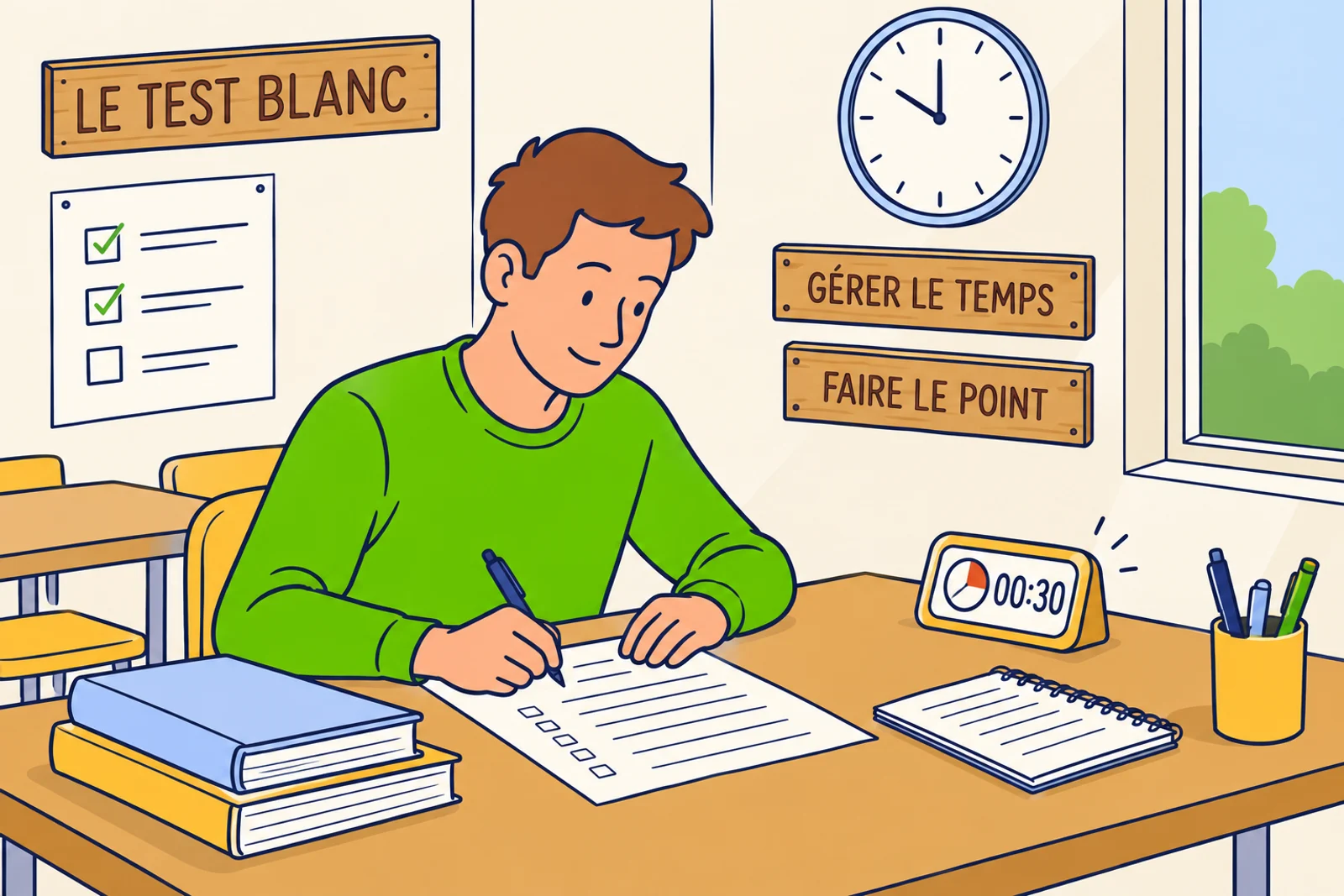
A practice-test result is most useful when it changes what you study next. A total can show that an attempt went better or worse, but it rarely explains why. Keep the conditions, task type and errors alongside the result.
This page provides a review method and short original exercises. It is not a complete official DELF paper, a certified assessment or a score predictor. Use the DELF B1 overview for the published exam structure and the sample-paper guide for official resources.
Record the conditions
Write whether the paper was new, timed, uninterrupted and completed without support. Note any transcript, dictionary or correction you consulted. These facts do not diminish the value of learning practice; they clarify what the result measures.
Keep the first version of your answers. If you later correct them, use a different colour or separate file. Otherwise you may lose the evidence of what happened during the attempt and remember only the improved version.
Use one line for the result and several for the diagnosis. “Missed the condition about advance booking” suggests a repair exercise. “Need more reading” is too broad to guide a session.
Give every result a conditions label
Use a short label such as unfamiliar timed attempt, familiar review or supported learning. Add any important details: extra replay, dictionary use, interruption or prior exposure to the answers. These labels keep different kinds of work from being compared as though they were identical.
An attempt with help can be excellent learning material. The issue is not whether it counts as work, but what conclusion it supports. If a transcript helped you understand the recording, record that learning result without claiming you understood the same information unaided during the original listening.
Keep the label beside the score or response, not in a separate note you may lose. When you return after several weeks, the conditions should be immediately visible. This makes a progress discussion with a teacher more accurate and helps you choose the next appropriate check.
Preserve the first answer before correcting
Use a separate file, colour or clearly marked section for the correction. Do not overwrite the original response and then rely on memory to reconstruct what went wrong. The difference between the first and revised versions is useful evidence.
For writing, keep the prompt with both versions. For speaking, keep the task and recording where appropriate. For comprehension, retain the item reference and your selected answer. These records help you distinguish a misunderstood instruction from a language error during review.
If you cannot save a recording or file, write a brief factual note immediately after the attempt. Do not invent exact wording you no longer remember. A limited accurate record is more useful than a detailed reconstruction presented with unwarranted certainty.
Record uncertainty before looking at the answers
Mark a few items you guessed or found ambiguous. Add the reason where you remember it. Perhaps a word had two meanings you knew, or the speaker mentioned an initial time and a revised time. The note gives the correction phase a question to investigate.
A correct guess still belongs in the review. A wrong answer you felt certain about may reveal a more persistent misconception. Scores alone can hide both distinctions, so the confidence note provides useful context without becoming a separate formal assessment.
Keep the notation simple enough to use. You do not need to assign a detailed confidence percentage to every item. A mark for hesitation and a short explanation for one consequential decision can be sufficient to choose a productive follow-up.
Define what you want the practice test to tell you
You may want to inspect timing, task understanding or a skill you have recently practised. State that purpose before the attempt. A full result can reveal other issues too, but a clear question helps you review the relevant evidence rather than react only to the total.
For example, after working on writing plans, you may ask whether all requested points appear in the new response. After listening practice, you may inspect whether corrected dates remain difficult. These questions are narrower and more actionable than asking one paper to prove complete readiness.
Use official sample material for the appropriate exam-task reference. The original exercises below are designed for targeted review. Their scores, if you choose to keep any, are not calibrated DELF marks and should not be added into an invented official total.
Review comprehension with evidence
Use the matching official correction for an official paper. Then find the source detail that supports each answer. For listening, distinguish what you understood during the permitted listening from what became clear during later replay.
Classify a few consequential errors. Did you miss a negative, confuse a number, misunderstand vocabulary or choose an answer before hearing the full condition? Treat the classification as a hypothesis and check it with another example.
That observation points toward relationships between ideas, not just a longer vocabulary list.
Build an evidence table for a few important items
Use columns for your answer, the expected answer, supporting source detail, possible cause and next exercise. Select a manageable number of items instead of writing an elaborate analysis of every question immediately. The goal is to identify patterns you can act on.
In the supporting-detail column, explain the relationship rather than merely copying a keyword. If a notice says an event is free but requires booking, the evidence for the booking answer is the stated obligation. The word free answers a different question about price.
Keep the possible cause provisional. You may initially think vocabulary was missing, then realise that you understood every word but ignored the contrast. A changed example can help test that explanation and guide the next exercise more accurately.
Inspect a tempting alternative
Ask why your original answer seemed plausible. Did it repeat a word from the source? Did it describe an earlier proposal rather than the final decision? Did it omit a condition? Identifying the attraction helps you notice the relevant distinction in another item.
Do not label every error careless. That word can hide different causes and gives little guidance for practice. A specific note such as “selected the first time mentioned before reading the correction” suggests a clearer habit to inspect.
When the key and your interpretation still seem inconsistent, preserve the full item and seek a reliable explanation. Do not manufacture a rule to make the review appear finished. You can continue with other checked examples while the uncertain question remains visible.
Separate first listening from study replay
During review, use extra replay or the transcript deliberately to understand the missed phrase. Record what became clear with that support. Then try listening again without looking. This is a useful learning sequence, but it does not change what happened during the original attempt.
Identify whether the problem concerns a sound, a word's meaning or the relationship between ideas. A familiar word in writing may be hard to recognise in speech. An unfamiliar expression may require both meaning work and listening. Choose the next exercise accordingly.
Keep the matching official audio and transcript together for an official sample. A mismatched file can make a correction impossible to understand. Check the material reference before concluding that a confusing review reveals a language problem.
Recheck the operation with a changed example
Once you identify a difficulty, use another appropriate example that requires the same operation. Change a date, condition or intention while keeping the language manageable. The purpose is to see whether you respond to the new information rather than remember the old answer.
If you create the example yourself, label it as original practice and verify the answer. Do not present a homemade question as an official calibrated item. It can still be useful for a narrow skill when its instructions and correction are clear.
Compare the explanation as well as the answer. A correct response supported by the relevant detail gives more information than a correct guess. Keep that distinction in the log and choose further practice if the reason remains uncertain.
Use an original reading exercise
The following notice is an original practice text, not an official exam item:
Before reading the translation, answer: Is payment required? Is booking required? What should participants bring? Who should be informed if someone cancels?
Answers: the notice says entry is free; booking is compulsory before Friday noon; participants need a container; the association should be informed. The important contrast is between free entry and required booking. One does not cancel the other.
Change one condition and write a new question. For example, make booking optional but require payment. Then ask a partner to explain the changed requirement. This checks whether you are reading the current text rather than recalling the first answer.
Review the cooking notice without relying on the translation
Cover the English version and answer the four questions from the French. For each response, identify the wording that supports it. The first question concerns price, the second booking, the third what to bring and the fourth whom to inform. Treat them as separate pieces of information.
If you answered that booking is unnecessary, inspect the contrast introduced by mais. Free entry does not remove the booking requirement in this fictional notice. If you missed the deadline, add it to the answer where the question requires that detail rather than assuming the word booking alone captures the whole condition.
Now use the translation to check meaning. Record which part became clear only with that support. You can then practise the relevant phrase or relationship in another original example. The purpose is learning from the discrepancy, not hiding it because the corrected answer now seems obvious.
Original exercise two: distinguish a plan from a change
Read this fictional message before its English translation. It is supplementary practice written for this page, not an official DELF item.
Answer these questions from the French: what changed, what stayed the same, when should participants confirm and what should someone do if the new time is unsuitable? Explain which part of the message supports each answer.
The starting time changed from Sunday morning to fifteen hours. The meeting place and stated price remain unchanged. Confirmation is requested before Thursday evening. Someone who cannot attend at the new time should write to the sender. The text does not say that the visit moved to another day, so do not infer a date change from the time change.
For review, write two columns headed changed and unchanged. Put each relevant detail in the appropriate column. This makes the structure of the message visible. A question asking only for a familiar noun would not test the same relationship between the old plan and the revised arrangement.
Original exercise three: read eligibility within the notice
This fictional community announcement contains several conditions. Read it without importing assumptions from a real organisation or another event.
Answer: who is the workshop intended for, is a professional camera required, is equipment supplied, where does registration happen and does attending the introductory session replace registration? Use only the information in the notice.
The intended audience is adult beginners. A professional camera is not required; a suitable phone is enough for the exercises described. Participants must bring their own equipment. Registration happens at reception. The introductory session does not replace that registration. The notice does not state the workshop's price, so the free presentation should not be treated as proof that the whole workshop is free.
This final distinction is the main review point. A free component and an unstated price for another component are different facts. If you inferred more than the text says, mark that reasoning in the log. The next exercise can focus on separating explicit information from assumptions.
Original exercise four: identify a condition attached to a request
Read this short fictional exchange and identify what must happen before the reservation is confirmed. The names and arrangement are invented for language practice.
Questions: has the reservation already been confirmed, what information is missing, how will the sender reply and should Léa collect the key immediately? Distinguish the room's availability from confirmation of the reservation.
The reservation is not yet confirmed. The number of participants is needed first. The reply will come by email after the information is supplied. Léa should not collect the key immediately; the handover will be arranged after confirmation. A correct answer should preserve that sequence rather than treating received request, available room and confirmed booking as the same event.
Use the four exercises as an evidence practice set
For each notice, choose one answer and write the supporting detail in your own words. Then identify one conclusion the text does not support. This second step helps you notice when a plausible assumption has entered the answer without textual evidence.
Change one condition in a copy of an exercise and label the version clearly. Ask a partner to answer the revised question. If they repeat the old answer, point to the changed information and review its effect. Keep the original and revised keys separate so the exercise remains fair.
Do not convert the set into a DELF score. These are original teaching examples designed to inspect contrasts, conditions and changes. Their value is the quality of the reasoning and the next practice they suggest, not a claim that four short texts represent the complete official assessment.
Review writing and speaking carefully
Use the official criteria available through France Éducation international's candidate resources. For personal review, first ask whether the response addresses the task, follows a clear sequence and gives enough relevant detail.
Then inspect language and interaction. Are recurring errors obscuring meaning? Did you respond to the other speaker's proposal? Did the example support the opinion? These observations guide practice, but they do not make an untrained self-score equivalent to an examiner's assessment.
Try this original speaking prompt: a local club wants to change its meeting time. Explain your preference, give a reason and respond to a different proposal. Ask your partner to invent the alternative so you cannot prepare every sentence in advance.
Use an original writing prompt with a clear purpose
For independent practice, imagine that a local club is considering moving its weekly meeting to a different evening. Write to the organiser, explain your preference, give reasons and suggest one workable alternative. This is an original prompt for review practice, not an official exam question or a complete substitute for a sample paper.
Before writing, identify the recipient and requested points. Make a short plan showing where each point will appear. If you choose to practise under the published writing conditions, use the official guidance as the reference and record those conditions accurately.
After drafting, highlight the preference, reasons and alternative in different ways. If one is absent, revise the task coverage before polishing isolated expressions. Then check whether the example or explanation actually supports the preference stated. A connected response is more useful than several fluent but unrelated paragraphs.
Review organisation before counting impressive expressions
Read the text as someone encountering it for the first time. Can the reader identify why you are writing and what you propose? Does each paragraph contribute to that purpose? Mark the places where a connection is missing or a detail distracts from the requested task.
Do not reward yourself merely for using many connectors. A connector should express a real relationship. Because introduces a reason; however introduces a contrast. If the ideas do not have that relationship, the word cannot create it by itself.
Choose one paragraph to revise and explain the change. Keep the original version so the improvement is visible. Then try another appropriate prompt later to see whether the organisational habit carries over beyond the response you have already polished.
Inspect language patterns with the intended meaning visible
Select a few recurring errors and keep the surrounding sentence. Ask what you intended to say, then check the appropriate form through a reliable explanation or teacher. An isolated replacement may be hard to understand if the intended meaning is missing.
Make one checked new example for the pattern. If the issue concerns an expression, practise the whole expression in a suitable sentence. If it concerns a subject change, isolate that change before adding new vocabulary. Keep the exercise small enough that you can verify the correction.
Avoid treating every stylistic alternative as proof that your original was wrong. Open responses can express an idea in more than one valid way. The relevant questions concern task fulfilment, clarity and language in context, assessed through appropriate criteria rather than exact matching to a model paragraph.
Turn the speaking prompt into genuine interaction
For the club-time scenario, give your partner two alternative times and one fictional constraint. Do not read their information beforehand. Explain your preference, listen to the proposal and respond. The exchange should require you to use the other person's contribution.
At the end, compare your summaries. Did both people understand the same proposed arrangement? If disagreement remains, did you express it clearly? The aim is coherent communication, not forcing a final agreement regardless of the facts.
Record one moment where the exchange became difficult. Identify whether you lacked a word, missed the question or could not organise a reason. Then practise a checked improvement in a changed version of the situation. This gives the feedback a specific next use.
Use official criteria without pretending to be the examiner
The official assessment resources explain what trained evaluation considers. Use them to understand feedback and organise questions for a teacher. Reading a grid does not by itself establish that your self-assigned number has the same reliability as an official mark.
For personal review, keep observations you can support: a requested point is missing, an example is unrelated or a reply does not answer the proposal. These statements can guide revision without requiring you to claim an exact score you cannot justify.
When seeking feedback, provide the prompt, original response and conditions. Ask which issue should receive priority and what exercise would address it. The more concrete the material, the more useful the feedback can be for your next independent attempt.
Useful phrases to keep
Choose the next practice task
Select one error with a clear cause and make a short repair exercise. If you missed time expressions, practise several changed dates. If your writing ignored the recipient, rewrite the opening and closing for the intended audience. If interaction stalled, rehearse responding to alternatives.
Recheck later using different material. Improvement on the same memorised item is useful familiarity, but it does not answer every question about transfer. Keep both kinds of evidence rather than choosing whichever score feels better.
Use the preparation framework to organise the next cycle and the exam-day guide for practical rehearsal.
Write a repair task with a checkable outcome
Use the pattern “Because I observed this, I will try that, and I will check it this way.” For example, because you confused availability with confirmation, you will read three short messages with different stages and identify what has actually happened. The check is whether your summary preserves the stage and condition in each text.
For writing, an omitted requested point can lead to prompt analysis before another draft. For speaking, a response that ignored the alternative can lead to a short role-play with changed proposals. The task should address the observed cause rather than simply add more study time in the same broad category.
Keep the repair small enough to complete and review. If it reveals a different difficulty, update the diagnosis. A good plan responds to evidence instead of repeating an exercise indefinitely because it was the first idea you wrote down.
Compare the next attempt fairly
Record whether the new material is unfamiliar and which support you use. Compare the target difficulty, not only the total. If you can now identify the condition but still miss a separate vocabulary item, note both observations rather than treating the result as entirely unchanged.
Do not erase the older attempt. The record of first answer, review, repair and new attempt shows the learning process more clearly than a folder containing only the best final versions. It also makes it easier to explain a persistent problem to a teacher.
Choose the next cycle from the evidence. Keep a small review of improved patterns and give more attention to the remaining gap. A practice test has served its purpose when it helps you decide what to do next accurately, without being turned into a guarantee about the official result.
Use a compact review sheet after every substantial attempt
At the top, record the material, date, familiarity and support used. Below it, write the result in the form supported by the task's actual marking instructions. Then add three observations: one thing that worked, one difficulty supported by an example and one question that remains unresolved.
The final line names the next exercise and how you will check it. This small sheet keeps the result connected to action. It also prevents a disappointing total from erasing successful parts of the attempt or an encouraging total from hiding a repeated problem that still needs attention.
Keep the sheet with the original response rather than only the corrected version. If you later seek feedback, the reviewer can see what happened and how you interpreted it. That context makes it easier to refine a diagnosis that may have been too broad or based on an incomplete understanding.
Work through a fictional review decision
Imagine that a learner answers the photography notice by saying the whole workshop is free. During review, the learner identifies that the text calls only the introductory session free. The initial cause is therefore an inference beyond the stated information, rather than failure to understand the word gratuit.
The repair task uses three short checked notices, each with a different relationship between a free component and another service. The learner lists what is explicit and what is unstated. A partner then changes one condition, and the learner explains how the conclusion changes.
In the next appropriate reading task, the learner looks for the same pattern. If the distinction is now made correctly, that is useful evidence for this reading operation. It does not prove every comprehension difficulty has disappeared, and it should not be converted into a predicted official mark.
Decide what additional support would help
If you can identify errors but cannot explain them, seek a clearer reference or teacher explanation. If you need more suitable tasks, choose material whose level and format are clear. If open writing or speaking responses are hard to judge, arrange informed feedback rather than relying only on self-scoring.
An independent written kit can provide structure and additional prompts, while official samples supply the exam-task reference. Keep those roles separate and check the product's current contents before buying. The free exercises here can already support a focused review; the next resource should answer a need revealed by that work.
Keep the next exercise beside the review sheet before closing the file. Include the material and the exact question you will investigate. That small preparation makes the next session easier to begin and keeps the score connected to a useful learning decision.
Choose a repair exercise
After a practice attempt, select an answer that seemed convincing but was wrong. Record the evidence you used and the detail missed. Was the difficulty a word, time relationship, task instruction or inference beyond the document?
Create a short repair exercise using another example of the same distinction. If you confused a free introductory session with an entirely free course, compare several checked notices and identify exactly which service is free. Keep the question narrow.
Return to a new task after that practice. Record whether the same issue appears and whether another difficulty now limits the answer. This provides a basis for choosing your next session. A series of unexplained scores gives less guidance than a small set of errors whose causes and corrections you can describe. Share that record if you later ask a tutor for feedback.
Useful phrases to keep
| 🇫🇷 French | 🇺🇸 English | 💡 Context |
|---|---|---|
| Je préférerais un autre horaire. | I would prefer a different time. | Negotiating a practical constraint |
| Cette proposition pose un problème pour… | This suggestion creates a problem for… | Explaining an objection |
| Nous pourrions essayer… | We could try… | Proposing an alternative |
| Voici un exemple qui explique mon choix. | Here is an example explaining my choice. | Supporting a choice with evidence |
DELF B1 Adventure Prep Kit
Open your B1 plan. Start a mission.
For learners with A2 foundations aiming for B1
Follow a six-month plan with 26 missions, 156 practice questions and speaking and writing challenges. Try a task, check the explanation and use your next session to work on what needs another go.
- 26 missions across a six-month plan
- 156 practice questions + speaking and writing challenges
About 300 pages per edition · Interactive + Print A4 included
Get the B1 kit · $9 Read a preview before you buyOne payment · Instant PDF download
Rehearse your B1 speaking task aloud.
Choose a tutor who prepares candidates for DELF B1. Bring a speaking prompt, try it under a time limit and ask for feedback on your response.
Find a French tutor →Paid lessons. Compare tutors and prices before booking.
Affiliate link: we may earn a commission when you book.
📚 Keep building in the Learning Center
DELF B1 Sample Papers: Where to Start and How to Use Each Attempt
DELF B1 sample papers help you understand task instructions and practise under stated conditions. Use official examples, keep…
Read →DELF B1 Exam Preparation: A 26-Session Framework You Can Adapt
A DELF B1 preparation plan should connect your available time with the four exam skills. Use a flexible…
Read →DELF A1 Exam: Format, Scoring and an 8-Week Plan
Prepare for DELF A1 with the four papers, scoring rules, task strategies and an eight-week study plan. Find…
Read →