
DELF B1 Exam Preparation: A 26-Session Framework You Can Adapt
A DELF B1 preparation plan should connect your available time with the four exam skills. Use a flexible study cycle, official task references and targeted review to choose practice that responds to your difficulties throughout the preparation period.
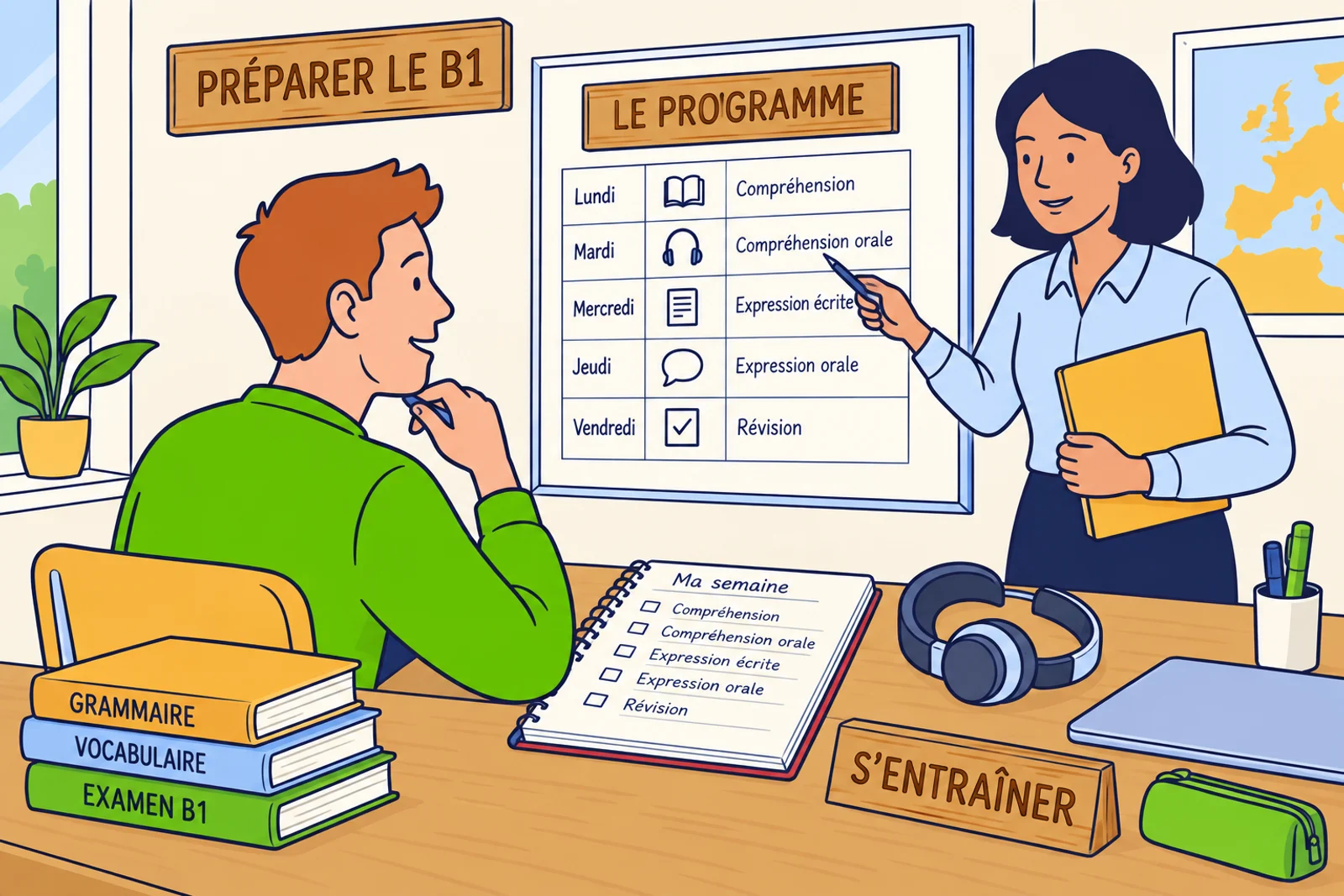
A preparation plan should respond to what you can currently do. Someone who reads comfortably but avoids speaking needs a different allocation of practice from someone who speaks readily but misses written instructions. Start with evidence from a sample task, then adjust the sequence.
The 26 sessions below are an original editorial framework. They are not the contents of the paid kit's 26 missions and do not promise readiness after a fixed number of hours. Spread, repeat or combine them according to your starting point and available support.
For the exam structure, use the DELF B1 guide.
Sessions 1–5: establish the starting point
1. Read the official task information. Identify what each component asks you to do and where the current candidate resources are located.
2. Attempt a comprehension sample. Follow its stated conditions and keep a note of any support you used.
3. Write an initial response. Preserve the first version so later comparison is possible.
4. Record a short spoken response. Use an original familiar topic and note where you stopped or lost the thread.
5. Choose priorities. Classify difficulties as language, task interpretation, timing or interaction. Select two that recur rather than trying to fix everything at once.
That goal can be checked. “Become more fluent” is harder to translate into the next exercise.
Session 1: make a four-paper map
Create one row for each paper and record the official source you will use for its instructions. Write the task in ordinary language: understand spoken information, understand written information, produce an appropriate text or respond orally. Keep published requirements separate from your own study preferences.
The output of this session is a map, not a score. Add a place to record the sample reference, conditions and review method for later attempts. If an arrangement is specific to your centre, put it in a separate logistics list and obtain the answer from that centre.
Finish by identifying what material you need for the next session. Check that the candidate paper and matching audio are available without opening the correction. This small preparation protects the intended first attempt and reduces setup work when you begin.
Session 2: preserve the first comprehension attempt
Attempt the selected material under its stated conditions. Keep your original answers and record any interruption or support used. A supported attempt remains useful for learning, but its conditions should be visible when you interpret the result.
Before checking the key, note where you guessed or felt uncertain. Then use the matching correction and inspect a few consequential errors. Do not invent partial credit where the provided marking instructions do not support it.
Choose one observation from listening and one from reading for the log. Make each specific enough to investigate: a missed corrected date, an unfamiliar word or a condition overlooked. The next sessions will use these observations, so avoid broad labels that do not suggest an exercise.
Session 3: save an uncorrected writing baseline
Use an appropriate prompt and preserve the first response before applying corrections. Record the conditions, including any reference consulted. If you later ask for feedback, supply the prompt and this original version so the reviewer knows what you produced independently.
First inspect whether the text addresses the recipient, purpose and requested points. Then note organisation and recurring language issues. This is a personal review sequence, not an official scoring formula.
The output is a baseline and a small list of questions for feedback. Avoid rewriting the entire response immediately and losing the original evidence. A later revision will be more informative when you can compare the exact changes and explain what each one improved.
Session 4: record a short original spoken task
Choose a familiar topic and explain an experience or preference in a short recording. Label it as original practice, not an official sample. If you add interaction, ask a partner to choose a manageable follow-up you cannot predict word for word.
Review whether the listener could follow the idea and whether you answered the follow-up. Note a specific difficulty: missing vocabulary, unclear sequence or misunderstanding of the question. A general impression that you sounded hesitant is less actionable.
Keep the recording with the prompt and conditions. If you seek a teacher's feedback, this context helps them address the actual task. Do not assign yourself an authoritative examination mark simply because you can count pauses or grammatical errors.
Session 5: choose two working priorities
Compare the comprehension, writing and speaking observations. Select two recurring or consequential issues and state the next exercise for each. They might concern different skills, such as identifying conditions in reading and supporting an opinion orally.
Keep the diagnosis provisional. A first attempt can reveal a useful question without establishing the cause beyond doubt. The targeted exercises in later sessions will help you test whether the proposed cause fits.
Retain some practice for all four papers even when one priority receives more attention. The plan should respond to the evidence without allowing a less comfortable skill to disappear. Write the next session's materials and task now so you can begin without another resource search.
Sessions 6–10: improve comprehension
6. Find evidence for reading answers. Identify the words supporting each choice.
7. Review a misleading alternative. Explain which condition makes it unsuitable.
8. Listen for a single detail. Use appropriate audio and distinguish the target detail from background information.
9. Compare a transcript after listening. Note a sound or phrase you failed to recognise, then replay that part for learning.
10. Try changed material. Check whether the same difficulty appears in a new context.
Use the official sample resources as a reference for exam tasks. During targeted learning, you may use replay or a transcript; record that support so you do not confuse the session with a timed simulation.
Session 6: link each answer to evidence
Choose a small set of reading items from your completed sample. For each, locate the passage that supports the answer and explain the connection in your own words. Do not rely only on a keyword appearing in both the question and text.
If you cannot explain the relationship, inspect the surrounding sentence and correction. A negation, condition or contrast may change the meaning. Mark the unresolved point and seek a reliable explanation rather than copying the key without understanding it.
Finish with one original short text or checked example containing a similar relationship. Identify the relevant condition and state what it means. This follow-up checks the reading operation, while the original sample remains the reference for its own answers.
Session 7: explain why an alternative fails
Take one incorrect option you found attractive and write the reason you considered it. Then identify the detail that makes it unsuitable under the prompt. This exposes the decision process rather than only replacing one answer with another.
For a fictional example, a notice can mention a free activity that still requires booking. Choosing an answer that says no booking is needed may confuse price with registration. Explain those two conditions separately.
Create a changed example in which the conditions differ, clearly labelled as original practice. Ask a partner to answer and justify the choice. If your new item is ambiguous, revise it. The task should test careful reading, not the ability to guess an unstated rule.
Session 8: isolate a listening detail
Use suitable checked audio and choose one target detail, such as a day or time. Make an attempt before using extra support. Record whether you heard the detail during the first permitted attempt or only during later study replay.
If the detail remains unclear, compare with the transcript after the attempt. Identify whether the difficulty is vocabulary, sound or the relationship between two mentioned possibilities. Then replay the relevant short portion for learning.
End with a changed, checked example if available. Do not assume that memorising the original recording establishes the same skill on unfamiliar audio. Keep the task narrow enough that the result tells you what changed.
Session 9: use the transcript as a study tool
Read the matching transcript only after the intended listening attempt. Mark a short phrase you failed to recognise and compare it with the audio. Focus on the specific point rather than transcribing the entire recording without a purpose.
Explain the phrase's meaning, then listen again without looking. If useful, repeat it from a reliable model. Keep comprehension and pronunciation observations separate: recognising the meaning and reproducing the sound are related but different tasks.
Write one next listening exercise based on the observation. If the issue was a number contrast, practise that contrast in short sentences. If it was an unfamiliar expression, check the expression and hear it in context before returning to a larger task.
Session 10: test the working explanation on changed material
Choose appropriate material you have not just memorised and look for the same type of difficulty. Keep the conditions clear. The purpose is to see whether your focused work is available in another context, not to produce a guaranteed prediction from one result.
Compare error types as well as totals. A better score accompanied by the same repeated misunderstanding may still suggest further work. A similar total with fewer instruction errors can also reveal a meaningful change worth investigating.
Update the priority list with the evidence. Keep the original cause if it still fits, refine it if needed and choose the next exercise. The plan should become more precise through these checks rather than simply advance because ten session numbers have been completed.
Sessions 11–16: build written responses
11. Analyse a prompt. Identify audience, purpose and required points before drafting.
12. Make a short plan. Put each required point somewhere visible.
13. Draft a response. Focus on communicating the required content clearly.
14. Review organisation. Check whether the reader can follow the sequence of ideas.
15. Review recurring language errors. Choose a small set of patterns to correct and practise.
16. Rewrite a section. Improve the original while preserving the task and meaning.
The FEI preparation advice points candidates toward task instructions and assessment resources. Use the official criteria for evaluation; a personal editing checklist is a learning aid, not an official score sheet.
Session 11: extract the communication task
Read a writing prompt and identify who is writing, to whom, for what purpose and with which requested points. Explain those elements before drafting. Use the actual prompt rather than assuming that every task requires the same opening or argument structure.
Create a short checklist from the requested content. Do not add unrelated points merely because you know vocabulary for them. Relevance matters to the communication task, and a familiar topic paragraph may still fail to answer the situation presented.
The output of this session can be prompt analysis only. Repeat with another appropriate prompt if useful. This isolates the planning skill without requiring a complete written response every time you want to check whether you understood the instructions.
Session 12: build a plan that covers the points
Give each required point a place in a short outline. Add a reason or example where it serves the task. Check that the example supports the intended idea instead of introducing an unrelated topic.
Read the outline as a reader who has not seen your thoughts. Is the sequence understandable? Does a necessary explanation appear too late or not at all? Revise the order before spending time polishing sentences.
Keep the plan brief enough to use during a timed practice. A plan that becomes a full draft may consume the time intended for writing. Test a manageable format and adjust it according to what your later attempt shows.
Session 13: draft with the task visible
Write the response under the conditions you chose and label them clearly. Keep the prompt visible and use the plan as a guide. If an idea changes during drafting, check that the required points still receive attention.
Use language you understand well enough to control. Do not insert an impressive memorised paragraph solely because it sounds formal. It must fit the recipient, purpose and meaning of the response.
Preserve the first version when finished. Before correcting, note where you hesitated or ran short of time. Those observations help distinguish language difficulties from planning or timing habits during the next review sessions.
Session 14: review the reader's route through the text
Read for meaning and organisation before individual forms. Identify the main purpose, the sequence of points and the connection between reasons and examples. Mark any place where the reader would need to guess what you mean.
Check each requested point against the actual draft. A point present in your plan may have disappeared during writing. Add or clarify it before spending the whole session adjusting small stylistic details.
Write a short explanation of the most useful structural change. This makes the revision deliberate. You should be able to say that a missing point was added or a reason made explicit, rather than only that the second version sounds better.
Session 15: select recurring language patterns
Choose a small set of errors that recur or interfere with meaning. Use a reliable explanation to understand each correction in context. Do not infer a broad rule from an isolated replacement suggested without explanation.
Make a checked changed example for one pattern. If you corrected a subject-verb relationship, practise another subject in a simple sentence. If the issue concerns an expression, retain the whole useful phrase rather than only a word whose use depends on context.
Keep other corrections in the record without making every one today's task. A focused review is easier to use in the next response. The aim is to improve a recurring pattern, not produce a huge list that you never revisit.
Session 16: revise and explain the changes
Rewrite the selected section or response using the feedback. Preserve the original beside it. For each important change, state what it improves: task coverage, clarity, organisation or a language pattern.
Do not treat the polished revision as an unassisted baseline. It is evidence of what you can improve with review. A later new response provides different evidence about whether the change is available independently.
End by choosing a related task for future practice. Keep the new prompt distinct enough that you cannot simply reproduce the revised answer unchanged. The useful question is whether the feedback helps you handle another communication situation.
Sessions 17–22: practise speaking and interaction
17. Present a familiar experience. Include enough detail for a listener to follow it.
18. Answer an unprepared follow-up. Respond to the question asked rather than returning to your script.
19. Explain a practical problem. Make the difficulty and desired outcome clear.
20. Negotiate an alternative. React to another person's suggestion and propose a workable next step.
21. Give an opinion. Support it with a reason and a relevant example.
22. Revisit a recording. Identify one unclear moment and practise a more precise version.
Change the constraint and listen to a partner's reply. The exercise becomes interaction when the next sentence depends on what the other person actually says.
Session 17: tell a familiar experience in a clear sequence
Choose an ordinary experience you can discuss without needing specialised vocabulary. Identify the main event, a few relevant details and what you want the listener to understand. Use original practice rather than claiming the prompt reproduces a particular official question.
Record a short attempt or tell it to a partner. Ask whether the sequence was clear. If a detail confused the listener, identify the missing connection rather than simply adding more sentences.
Review one language point after the task. A clearer sequence and a corrected expression can both be useful outcomes, but keep them distinct. The session should leave a manageable next step rather than an exhaustive judgement of every feature of your speech.
Session 18: answer the follow-up that is actually asked
Ask a partner to prepare a few relevant follow-ups and choose one without warning. Listen for the specific question, then answer it before returning to your prepared material. The exercise tests responsiveness, not only memory of the opening account.
If you miss a detail, use a concise clarification and respond to the reformulation. Afterwards, explain what information the clarification supplied. This checks that the repair served comprehension rather than acting as a fixed delay.
Keep the follow-ups manageable and connected to the topic. An entirely unfamiliar specialised question may reveal a different problem from the interaction skill you intended to practise. Increase difficulty through a clear change you can review.
Session 19: explain a problem and desired outcome
Use a fictional practical situation, such as a meeting time that conflicts with another commitment. State the problem, the relevant constraint and what you would like to arrange. Keep the facts simple enough that the language task remains clear.
Ask the listener to repeat what they understood. If their summary differs, inspect which part of your explanation was unclear. A missing fact and an inaccurate phrase require different revisions.
Try again with one changed constraint. The response should adapt to the new situation. This prevents the exercise from becoming a single memorised paragraph that ignores the actual conditions of the interaction.
Session 20: negotiate a workable alternative
Have the partner propose another option. Acknowledge it, explain whether it suits the fictional situation and suggest a next step where needed. Practise accepting a good option as well as disagreeing politely.
The next sentence should depend on the partner's contribution. If you repeat the original request unchanged, pause and identify which detail you did not address. Then replay that turn with a relevant response.
Review the outcome: did both people agree on the same arrangement, or did the exchange end with an unresolved point? An unresolved point can be expressed clearly too. The goal is coherent interaction, not forcing every scenario to end with agreement.
Session 21: connect an opinion to evidence
Choose a familiar original topic and state a position. Add a reason and a concrete example that supports it. Check the logic in plain English if needed before focusing on the French wording.
Ask a partner for a different view and respond to it. You may clarify, qualify or change your position. The exercise is about expressing and responding coherently, not defending the first sentence regardless of what the other person says.
Keep a few useful connectors attached to real relationships. A reason marker should introduce a reason, and an example marker should introduce supporting detail. Using many connectors does not compensate for an example unrelated to the claim.
Session 22: review one moment from the recording
Choose a short passage where meaning became unclear or interaction stopped. Listen again and identify the cause as specifically as possible. You may need a word, a clearer sequence or a better response to a question.
Prepare a checked improved version and say it in a changed situation. Do not simply memorise a repair of the exact recording and assume the problem is solved everywhere. The variation gives you another useful observation.
Seek informed feedback when you cannot judge the issue yourself. Keep the prompt and conditions with the recording so a teacher can understand the task. Your self-review is a learning aid, not a substitute for official marking.
Sessions 23–26: check and adjust
23. Attempt unfamiliar sample material. Keep conditions clear.
24. Review the evidence. Compare the type of errors with your starting point.
25. Repair the most consequential gap. Choose a task that addresses the cause you identified.
26. Decide the next cycle. Repeat selected sessions, seek feedback or prepare another simulation according to the result.
Session 23: make the new attempt interpretable
Choose suitable unfamiliar material where available and follow its conditions. Keep the correction closed until the attempt is finished. Record any interruption, support or prior exposure so the result can be interpreted honestly.
Use the same evidence categories as at the start: task interpretation, language, timing and interaction where relevant. Consistent categories make comparison easier without pretending that different samples are perfectly equivalent.
Preserve the original answers or response. Write an immediate observation before reviewing the key. This captures uncertainty and timing impressions that may change once the correct answer becomes visible.
Session 24: compare difficulties, not only totals
Look for the specific issues you selected in session five. Are required points still missing? Are corrected dates still misread? Can you respond to an alternative more clearly? The comparison should use actual examples from both attempts.
A total may improve while one recurring issue remains, or remain similar while the error pattern changes. Record both the result and the explanation. Do not choose only the evidence that makes the plan appear successful.
Update the diagnosis when necessary. If the earlier explanation no longer fits, refine it rather than repeating the same exercise indefinitely. The purpose of the framework is to guide useful work, not to prove that its initial assumptions were always correct.
Session 25: repair one consequential gap
Choose a gap with a clear next exercise and a way to check it. If a writing point is repeatedly omitted, practise analysing prompts and mapping required content. If a spoken condition is missed, use short checked listening contrasts before another larger task.
Keep the repair manageable. A session that attempts every weakness at once may leave none properly reviewed. Use the other observations to plan later work while giving this task enough attention to understand the result.
Finish with a changed example or prompt. If the improvement appears only on the original memorised item, record that limit. You can still learn from it while preparing another check of the skill in a different context.
Session 26: choose the next cycle from evidence
Decide which sessions to repeat, which support to add and what material to preserve for later checks. Completion of twenty-six numbered sessions is not a certificate of readiness. Your actual responses and appropriate feedback determine what still needs work.
Make a short next-cycle plan with tasks, sources and review methods. If a teacher's assessment is needed, prepare the relevant prompt and uncorrected response. If a practical exam arrangement is unresolved, contact the centre separately.
Keep successful habits that made the work easier to start: a resource register, a specific error log and checked examples. Remove unnecessary complexity. The framework should leave you with a clearer preparation process, not an obligation to repeat every session regardless of your current needs.
Useful phrases to keep
Use the sample-paper method for resource management and the practice-test review for interpreting progress.
Fit the framework to a real calendar
Treat a session as a focused unit of work, not necessarily a fixed number of minutes or a calendar week. Some tasks may take longer because they involve feedback from another person. Others can be split into short attempts and later reviews. Keep the purpose and output intact when adjusting the schedule.
If your week is busy, choose the next useful task from the plan rather than rushing through several session numbers to catch up. A completed number has little value if the exercise was not understood or reviewed. You can resume the sequence without pretending that missed time creates an obligation to do everything at once.
Place feedback-dependent sessions where the relevant support is available. For example, a writing review may follow a teacher's response rather than occur immediately after drafting. Use the waiting period for an independent task, such as reading evidence or checked phrase practice, instead of allowing one dependency to stop the whole plan.
Keep centre-specific dates and registration arrangements on a separate calendar. The study sequence does not establish an examination deadline or guarantee readiness by a chosen date. If the evidence suggests more preparation is needed, adjust the practical plan with appropriate advice and current centre information.
Keep one page of evidence for each phase
For the starting phase, save the initial attempts and priorities. For comprehension, keep a few examples showing how you linked answers to evidence. For writing, preserve the prompt, first draft and explained revision. For speaking, keep the task and a short record of feedback. For the final phase, record the comparison and next-cycle decision.
This portfolio need not contain every exercise you ever complete. Choose enough material to understand the important changes and unresolved questions. A small collection of labelled examples is easier to use with a teacher than a large folder of anonymous files.
Date each item and note the support used. If a response was revised with help, say so. That information does not diminish the value of the learning; it clarifies which questions the example can answer about independent performance and revision skills.
Use the paid kit as a separate resource choice
The twenty-six sessions on this page are an original framework, not a description or reproduction of the kit's twenty-six missions. You can use the free framework with suitable official samples and your own checked exercises. The paid product is an optional source of additional structure and material described on its current product page.
Before choosing it, identify what you need next. More written prompts, a mission-based route and a printable or interactive format are different needs from audio practice or individual marking. Check the contents and exclusions so the purchase fills the intended role in your plan.
If the main gap is feedback on an open response, arrange that support separately where useful. A resource can be valuable without providing every component of preparation. Keeping its role clear helps you combine materials effectively and avoids treating a game result as an official DELF mark.
End each cycle with a concrete next session
Write the first task of the next cycle before closing the file. Include the material, the skill and the review method. “Analyse two writing prompts and check that every requested point appears in the plans” is ready to use. “Study harder” is not a plan you can begin without another decision.
Return to that note when you resume and check whether it still matches the latest evidence. If something important has changed, revise it. The framework is useful precisely because it can respond to what your attempts reveal while keeping the work organised and verifiable.
Plan from one feedback point
Choose one specific comment from a checked writing or speaking task. A response might give an opinion without a supporting example. Turn that comment into a narrow objective: explain one reason and illustrate it with a relevant situation.
Prepare two prompts on different everyday topics. Answer the first, review whether the example supports the reason, and revise it when necessary. Try the second without copying the same content. The structure should help communicate a new idea rather than reproduce a memorised paragraph.
Schedule a later task using the skill in a broader response. Retain the original feedback for comparison. If the difficulty persists, ask for a more precise explanation or model. Adjust the following week's plan from that information instead of adding an unrelated exercise to an already crowded schedule. Record the next review date alongside the task.
Useful phrases to keep
| 🇫🇷 French | 🇺🇸 English | 💡 Context |
|---|---|---|
| Je vais organiser mes idées. | I will organise my ideas. | Planning before a speaking task |
| Cet exemple soutient mon argument. | This example supports my argument. | Checking supporting evidence |
| Je dois répondre à cette objection. | I need to respond to this objection. | Preparing a counterargument |
| Il faut préciser ce que je veux dire. | I need to clarify what I mean. | Revising an unclear sentence |

DELF B1 Adventure Prep Kit
Open your B1 plan. Start a mission.
For learners with A2 foundations aiming for B1
Follow a six-month plan with 26 missions, 156 practice questions and speaking and writing challenges. Try a task, check the explanation and use your next session to work on what needs another go.
- 26 missions across a six-month plan
- 156 practice questions + speaking and writing challenges
About 300 pages per edition · Interactive + Print A4 included
Get the B1 kit · $9 Read a preview before you buyOne payment · Instant PDF download
Rehearse your B1 speaking task aloud.
Choose a tutor who prepares candidates for DELF B1. Bring a speaking prompt, try it under a time limit and ask for feedback on your response.
Find a French tutor →Paid lessons. Compare tutors and prices before booking.
Affiliate link: we may earn a commission when you book.
📚 Keep building in the Learning Center
DELF B1 Practice Test: Find the Next Task Behind the Score
A DELF B1 practice test is most useful when you know what it measures and how to review…
Read →DELF B1 Sample Papers: Where to Start and How to Use Each Attempt
DELF B1 sample papers help you understand task instructions and practise under stated conditions. Use official examples, keep…
Read →DELF Exam Day Tips: Prepare Your Session and Rehearse B1 Tasks
DELF exam day is easier to manage when you know your own level’s instructions, arrival arrangements and task…
Read →