French Café Culture Rules and Etiquette: The Unwritten Code Nobody Explains to Tourists
The same espresso costs three different prices depending on where you drink it, the server is not rude, and the bill will not arrive until you ask. This guide covers the pricing system, the ordering protocol, the things you must never do, and the vocabulary that turns you from obvious tourist into someone the waiter nods at instead of ignores.
The three-price system: comptoir, salle, terrasse
The same espresso costs ~1.50€ standing at the bar, ~2.50€ sitting inside, and ~4.50€ on the terrace. You are not paying for better coffee. You are paying for space, service, and the right to sit for as long as you want. This is not tourist exploitation. It is how French cafés have worked for over a century. The café sells time, not just drinks.
Look for the price board labeled Tarifs or Nos Prix with three columns. Tourist-area cafés charge double. Neighbourhood cafés charge half. The coffee is identical. The Paris survival guide covers the same pricing logic for restaurants and bakeries.
Why the café is not a coffee shop
American coffee culture optimizes for speed and turnover. French café culture optimizes for staying. You are not buying fuel. You are renting territory. The café is an extension of the living room, the office, the meeting point, and the social club. Sartre wrote Being and Nothingness at Café de Flore. Nobody asked him to order a second coffee.
Ordering etiquette: the greet-before-you-speak rule
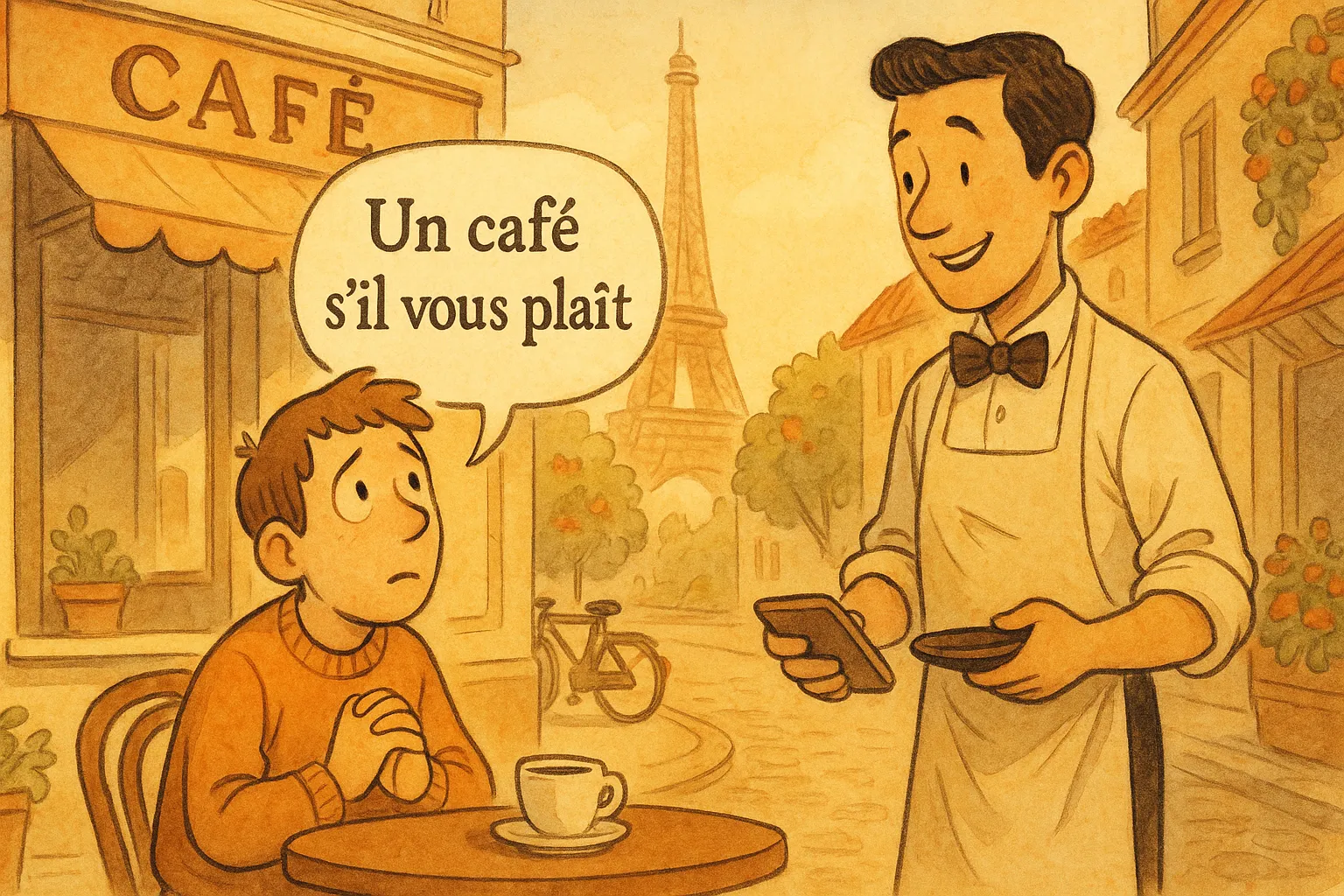
The single biggest mistake anglophone tourists make is not pronunciation. It is walking up to the counter and saying “un café” without greeting the person first. In French culture, every interaction begins with “Bonjour.” Skipping it marks you as rude faster than any accent. The politeness guide explains the full system. This section covers the café-specific version.
“Un café” = espresso. Not drip coffee. Not Americano. If you want larger coffee, order un café allongé (espresso + hot water) or un café crème (with steamed milk). Asking for “a regular coffee” produces confusion. The drinks guide covers everything beyond coffee.
If the ordering moment makes you freeze, that is the same response described in the shy beginners guide. Pre-decide your phrase before you walk in. The 3-second rule: inhale, say bonjour, deliver the order. Done.
What you must never do in a French café
These are not preferences. They are rules nobody writes down but everyone enforces through silent judgment. Break one and the server remembers. Break two and you become the anecdote they tell other servers.
- 1Never skip the greeting No bonjour, no respect. The interaction starts wrong and never recovers.
- 2Never snap fingers or wave aggressively Make eye contact, raise a hand slightly, or say “Excusez-moi” at moderate volume. That is it.
- 3Never ask for the bill prematurely Request “L’addition, s’il vous plaît” only when you are ready to leave. The bill is a signal that you are going, not a request to hurry.
- 4Never sit at an uncleared table A dirty table means unavailable. Wait for it to be cleared.
- 5Never bring outside food or drinks This causes genuine offense, even with water. Applies at every French establishment.
The server is not rude. You did not say bonjour.
French service culture is reserved, not hostile. The server will not check on you five times, will not suggest dessert, will not bring the bill uninvited. This is not indifference. It is respect for your autonomy. Americans read it as cold. The French read American service as intrusive. The don’t-smile guide explains the same cultural distance in every other French context.
The laptop question. Parisian cafés tolerate laptop workers less than American coffee shops. It is not forbidden, but it violates the spirit of the café as social space. If you must work: order regularly, avoid peak hours, choose larger cafés, and read the room.
The terrasse: why chairs face the street and not each other
The café terrasse is the most iconic image of Parisian life: wicker chairs, small round tables, people watching the city pass. The chairs face outward. That arrangement enables the essential Parisian activity: watching street life as entertainment. Sitting side by side observing the theatre of the city is a perfectly acceptable alternative to conversation.
Tipping in French cafés
Service is included in every price by law (service compris). The server earns a full wage regardless. Tipping is optional: round up to the nearest euro, or leave small change (0.50-2€ for coffee). Large percentage-based tips are neither expected nor appropriate. Overtipping can be read as condescension rather than generosity. The restaurant guide covers the same logic for meals.
Budget hack. Drink your morning espresso au comptoir like locals do. ~1.50€, two minutes, real French coffee ritual. Save the terrasse for the afternoon when you want to sit and watch the city. The bakery guide covers the same logic for breakfast: croissant at the boulangerie is 1.20€. Croissant at the café terrasse is 3.50€.
Study glossary: French café vocabulary
| French | English | Context |
|---|---|---|
| Un café | Espresso | Default. Not drip coffee. |
| Un café crème | Coffee with steamed milk | The “latte” equivalent |
| Un café allongé | Americano | Espresso + hot water |
| Un noisette | Espresso + drop of milk | Between espresso and crème |
| La terrasse / en salle / au comptoir | Terrace / inside / at the bar | Three price tiers |
| L’addition | The bill | Only comes when you ask |
| Le pourboire | Tip | Optional. Small coins on the saucer. |
| Service compris | Service included | By law in all French prices |
| Le serveur / la serveuse | Waiter / waitress | Not rude. Reserved. |
| Sur place / emporter | For here / takeaway | Determines which price column applies |
| Une carafe d’eau | Jug of tap water (free) | Your legal right. Ask without hesitation. |
| L’apéro | Pre-dinner drinks | The sacred 6-7pm ritual on the terrasse |
If the café code now makes sense but the broader social rhythm still feels opaque, the next step is usually the restaurant ordering guide (the full meal version of the same protocol), the bakery guide (the morning version), and the drinks guide for everything stronger than coffee. “For sure.” 🕶️
Go further
Stop making the same 21 French mistakes. Play them away.
300 pages of games, riddles and quizzes built around the 21 mistakes English speakers actually make in French. You fix them by playing, not by memorising rules. By Camille Aubert.
📚 Keep building in the Learning Center
French Property Taxes for English Speakers: Taxe Foncière Explained
Most anglophone owners discover French property taxes the hard way: a notice arrives in late August, in administrative…
Read →Imparfait vs Passé Composé Explained: Timeline Method
Imparfait vs passé composé trips up every English speaker because English never forces the same choice. You say…
Read →French news websites guide — political leanings and reading levels explained
Navigate the French media landscape with this comprehensive guide to major news websites, their political orientations, editorial approaches,…
Read →