
Long-Stay Visitor Visa France: Explain Your Plans and Prepare Your File
A long-stay visitor visa for France requires a clear account of a stay without professional activity. Organise your plans, read the official document instructions and prepare focused questions about accommodation, resources and insurance in French.
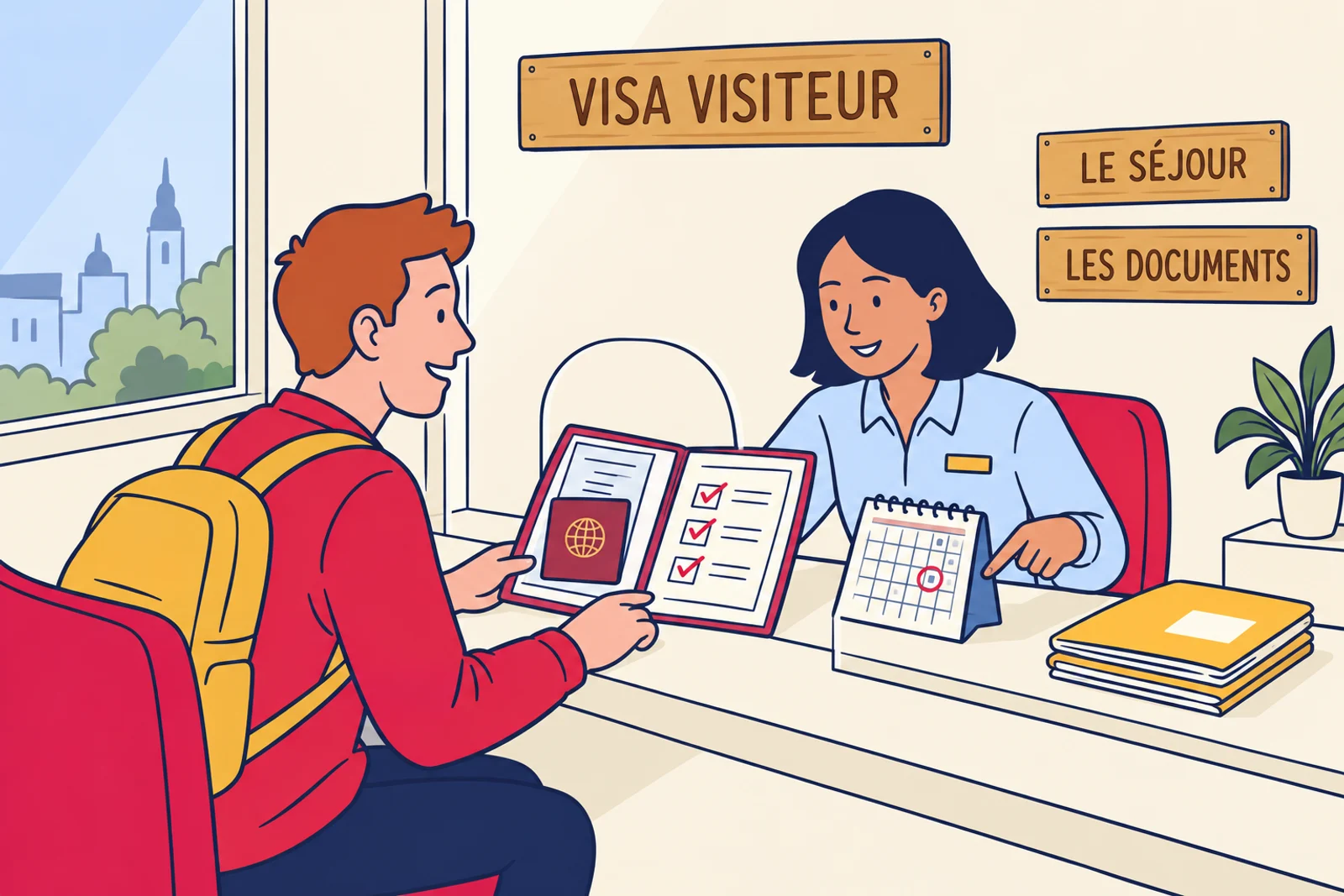
A visitor application asks you to explain a particular kind of stay. Before collecting documents, establish whether that route matches what you actually intend to do. A year abroad, retirement, a sabbatical and working from another country can involve different questions even when the destination is the same.
This page focuses on preparing a clear explanation and understanding the vocabulary around a visitor file. It does not decide eligibility. Use the France-Visas visitor guidance and the personalised assistant to identify the instructions for your circumstances.
If you are still comparing categories, start with the long-stay visa overview.
Describe the real plan
Write down the intended duration, accommodation arrangements, source of support and any activity you expect to carry out. Separate confirmed facts from plans that remain tentative. “I have booked accommodation” and “I intend to look for accommodation” make different statements; your wording should preserve that difference.
If you plan any work, describe it accurately when checking the appropriate route. Do not assume that a foreign employer or an overseas bank account answers the immigration question. Ask about the actual activity before drafting a statement that could contradict it.
List the facts supporting that question. A precise description is more useful than asking whether “expats” can apply, because the word expat does not identify your administrative situation.
Understand what the official visitor description covers
France-Visas describes the visitor route for a private stay exceeding three months without professional activity. Its overview identifies evidence concerning circumstances such as leave or retirement, resources, accommodation and medical cover, alongside a formal commitment concerning professional activity. The personalised assistant determines the supporting list for the applicant's nationality and residence. Official visitor-route guidance.
Use that description to examine your plans honestly. “Visitor” is not a general label you can apply to any long stay because you prefer its paperwork. If an important part of your intended life is absent from the description, identify the question before preparing statements around the route.
The practical starting point is a short situation sheet. Write the purpose, intended dates, current residence, financial arrangements and planned activities. Add uncertainties in a separate column. This makes a conversation with the relevant service or adviser more efficient because the facts and the questions are already distinguishable.
Describe a sabbatical without assuming what it permits
A sabbatical can mean several things in ordinary conversation. One person has agreed leave with no work performed; another expects to answer client requests throughout the stay. The same English word can therefore conceal very different facts.
Describe the actual arrangement when checking your route. Will you perform any professional tasks? What has your employer agreed? What period does the arrangement cover? Are the documents you have consistent with your description? You do not need to decide the legal answer yourself to formulate those factual questions accurately.
Avoid treating a reassuring nickname as evidence. “Career break”, “remote year” and “working holiday” are descriptions people use socially. The authority needs the relevant facts and applicable category. If your plan changes after an initial enquiry, ask about the changed plan rather than relying on an answer obtained for different circumstances.
Describe retirement with the same precision
Retirement can be part of a person's circumstances, but it does not answer every question about the stay. Someone may receive retirement income while also consulting occasionally. Another person may be retired but moving with a partner who intends to work. Prepare a separate factual description for each applicant.
When explaining resources, distinguish what you currently receive from what you expect to receive later. Keep the relevant periods and currency labels attached to your notes. Follow the requested evidence rather than assuming that the word “retired” makes any particular record unnecessary.
If your research concerns retirement more broadly, keep questions about housing, taxation and healthcare in their appropriate workstreams. They may affect your planning, but a general retirement article cannot replace the visitor application instructions or qualified advice about an individual financial situation.
Turn an uncertainty into an answerable question
“Can I move to France?” is broad enough to produce an equally broad answer. A useful question identifies the unresolved feature of your situation. You might need to establish how a planned activity affects the route, which instructions apply to your country of residence or what evidence is appropriate for a particular arrangement.
Follow the sentence with facts, not a conclusion you hope the recipient will approve. Write “I intend to do X for Y hours” rather than “This should not count as work”. The first supplies information; the second asks the recipient to accept your interpretation before examining it.
Connect statements to evidence
Create two columns: what you say about the stay and which requested document supports it. This is a consistency exercise, not an invitation to produce a document for every sentence. Your official checklist determines the submission requirements.
For example, if your explanation gives particular dates, compare those dates with the evidence whose validity depends on the stay. If you mention accommodation for only part of the period, avoid describing it as covering the entire stay.
| Statement to review | Useful consistency check |
|---|---|
| Intended dates | Do the dates match across the form and evidence? |
| Accommodation | Does the description match the document? |
| Resources | Is the explanation accurate and supported as requested? |
| Insurance | Does the certificate say what you claim it says? |
Avoid copying another applicant's financial figure or insurance arrangement. Their circumstances and instructions may differ. Ask for clarification where your own requirements are uncertain, and retain the response with the relevant document.
The document checklist guide provides a method for checking names, periods and readable copies.
Build a simple explanation-and-evidence table
Put each material statement in the left column and the requested supporting record in the right. Add a third column for any mismatch. The table is for your preparation; it is not a substitute for the official form or a recommendation to submit an extra document.
For instance, your statement might say that you intend to stay at a particular address for an initial period. The evidence might be the relevant confirmation, if requested and appropriate. The mismatch column records whether the name or dates differ. You now have a precise issue to resolve rather than a vague sense that the accommodation paperwork is “probably fine”.
Use the table to identify unsupported language as well. If a draft explanation says an arrangement is confirmed but the evidence only shows an enquiry, change the explanation to reflect the truth or complete the arrangement through the appropriate process. Do not make the evidence sound stronger by changing your adjective.
Keep accommodation plans in chronological order
If you have more than one intended location, write a timeline for yourself. Which dates concern the first address? What is confirmed after that? Which points remain undecided? The purpose is to see the actual sequence before answering questions about it.
Avoid presenting an intention as a booking. “I plan to look for longer-term accommodation after arrival” says something different from “I have accommodation for the full period”. If your official instructions require evidence you do not yet have, resolve that requirement rather than covering the gap with polished prose.
Check that your correspondence uses the same terms consistently. Hébergement is a broad accommodation word. A reservation, a lease and a host's statement describe different arrangements. Keep the original document name in your notes so a translation does not accidentally turn one type into another.
Keep the period attached to financial information
When reading a resource document, identify who it concerns, what it describes and the relevant period. A current balance, an income payment and a projected future amount answer different questions. A summary that strips away those distinctions can be misleading even when every number is copied correctly.
This article does not provide a universal financial threshold for an initial visitor application. Use the instructions that apply to your file and ask about a specific uncertainty. Do not import a figure from a different residence procedure or another applicant's anecdote without checking its relevance.
If you need to explain an irregular payment, describe it accurately rather than presenting it as monthly income. If you need help interpreting your individual resources or tax position, use an appropriately qualified professional. Language practice can help you ask the question; it cannot supply the professional conclusion.
Compare insurance dates with the stated stay
Identify which document you hold and what period it says it concerns. A quotation, a purchased policy and a certificate are different records. Keep them labeled correctly in your preparation folder so an early quotation does not become the file you attach by habit.
Read the named person and period before drawing conclusions from a product title. If the dates have changed, ask the issuer what can be updated and under what conditions. Do not alter an issued certificate yourself or assume a request for amendment means the amendment has taken effect.
For terminology and original insurer questions, continue with the long-stay visa insurance guide. Keep the answer from the insurer beside the specific policy version it concerns, then check the evidence against the application instructions.
Practise spotting an overstatement
Consider three fictional statements: “I have enquired about a room”; “I have received a reservation confirmation”; “My accommodation covers every date requested.” Each statement requires different facts. They should not be treated as interchangeable stages of sounding more persuasive.
Take an explanation you have drafted and underline certainty words such as confirmed, complete, all and guaranteed. Ask what supports each one. Replace a word when it overstates the facts, but do not weaken an accurate statement just to sound cautious. The goal is a precise description that you can explain consistently.
Prepare a clear explanation
If an explanation is requested, organise it around the facts the recipient needs. Begin with the purpose and dates. Explain the arrangements relevant to the request. Refer to supporting documents accurately. End with the specific clarification you need, if any.
Do not borrow dramatic language about your lifelong dream of France when the task is to explain a document. A calm account of the facts makes discrepancies easier to notice and questions easier to answer.
Here is an original language template for a clarification request, not a required application letter:
The names, dates and reference numbers in this spoken example are fictional. Adapt the wording to your actual situation.
Adapt the example details and remove anything irrelevant. A shorter accurate message is preferable to a polished template containing a claim you cannot support.
Choose a structure before choosing impressive vocabulary
A clear explanation usually follows the reader's questions. Who is writing? What is the intended stay? Which point needs clarification? Which relevant facts support the question? What response would help you act? Answer those in a sensible order before polishing the French.
Avoid turning a short request into a personal essay. Your interest in French culture may be sincere, but it does not explain why two dates differ or which evidence you need. Put the practical question where the recipient can find it and keep any background directly relevant.
You can draft in English first and then build simple French sentences you understand. Read the result back in your own words. If the translation contains a claim you cannot explain or a term you have never checked, simplify or verify it before using it.
Separate the opening from the question
An opening identifies the context. The question asks for the missing information. Learners sometimes combine so much background into one sentence that the question disappears. Two shorter sentences are often clearer.
For example, first state that you are preparing a visitor application and identify the relevant reference if you have one. Then ask whether a particular document needs a specified clarification. You do not need to repeat the entire intended stay when replying within a thread that already contains it, unless the contact instructions ask for those details again.
Use a subject line that describes the issue. “Question about the dates on an accommodation document” is easier to understand than “Urgent France help”. Mark urgency only when there is a real deadline and state the deadline accurately; the word itself cannot make a service answer sooner.
Distinguish a plan from a completed action
French tense choices help you report the stage accurately. Je prévois describes what you plan. J’ai demandé reports that you requested something. J’ai reçu reports receipt. J’ai transmis reports that you sent it. None of those actions should be substituted for another because it sounds more confident.
This sentence contains useful administrative information: the request has been made, and the document is still outstanding. If you are asked for a date you do not know, do not invent one. Explain what is confirmed and ask what process applies to the situation.
For practice, write one statement about your plans, one about a request you have made and one about a document you actually hold. Check that the evidence in your records matches each tense. This makes the language exercise a consistency check as well.
Edit a fictional message for clarity
Imagine a draft that reads: “Hello, I love France and have wanted to come for many years, and I am very worried because the paperwork is complicated, and I think the dates on my document might not be right, so could you help me with everything?”
The underlying task is to clarify dates. A useful revision identifies the document, the two dates and the question. The personal background can be removed because it does not help the recipient establish which date is intended.
A revised English version might read: “My accommodation confirmation starts on 12 May, while the date entered in my draft application is 2 May. I am checking my intended arrival date before finalising the file. Which procedure should I use if the application information needs correction?” This is an original exercise, not a universal official message template.
Notice that the revision does not tell the reader which date is correct without first establishing that fact. It also does not claim that a correction will be possible through any particular channel. It asks for the procedure needed to act accurately.
Practise questions and replies
Practise the conversation in both directions. It is useful to ask a question, but you also need to recognise a reply that changes the next step. Have a partner answer “a different document”, “a clearer copy” or “through your online account”, then repeat the action in your own words.
Useful phrases to keep
This sentence checks your understanding without pretending you caught everything. Change the final noun or condition to match the actual reply. Then ask where the revised document should go if the destination is unclear.
Practise listening for the condition
In a role-play, ask a partner to give a short instruction with one condition. They might say the document needs to be readable, signed or accompanied by another named item. Your job is to repeat the condition and identify the next action.
Start with familiar vocabulary so the listening task remains manageable. Once you can catch the condition, add a date or destination. Avoid adding several new difficulties at once; otherwise you may not know whether the problem was the word, the number or the length of the sentence.
The sentence combines document quality and channel. In real correspondence, use it only when both details are accurate. In practice, have your partner change one and ask you to correct your summary.
Ask about a phrase without translating the entire letter
If one expression blocks you, quote the expression and ask what action it requires. This is more efficient than asking someone to explain a whole message when you understand most of it. Keep enough surrounding context to avoid a misleading isolated translation.
For example, a message might refer to a pièce complémentaire. You can identify that as additional supporting evidence while still needing to know which particular item is meant. Translating the phrase does not resolve the missing reference. The follow-up question should therefore concern the document, not the dictionary meaning.
When using a translation tool for personal understanding, compare the result with the original. Check especially names, dates, negatives and conditions. Keep the original available when asking for clarification; a paraphrase produced by another tool may have altered the very detail you need explained.
Build a three-turn exchange
A useful practice conversation has an opening, a reply and a response to that reply. If you only rehearse the opening, you may sound prepared until the other person answers. Write three reply cards and choose one at random during practice.
One card can ask for a newer document. Another can direct you to a particular channel. A third can ask you to clarify a date. Your response should address the card selected, not the one you hoped would appear. End by confirming the action in a single sentence.
Afterwards, note which detail caused trouble. If you missed the date, practise dates. If you understood the date but could not ask for repetition, practise the repair phrase. This produces a small next lesson tied to an actual difficulty.
Use a vocabulary notebook that preserves context
Instead of recording “ressources = resources” alone, save a short phrase and the situation where it appeared. The English word resources is broad; an administrative request may concern a more specific financial meaning. Context helps you avoid applying a translation too widely.
For each term, record the French expression, a plain-English explanation, one original sentence and a question you might ask. Keep legal conclusions out of the vocabulary entry unless you have an appropriate source. Learning a word is not the same as establishing what evidence an authority will accept.
Check the issued visa
After a decision, read the document and its accompanying instructions. Do not assume that every long-stay visa has identical arrival formalities. Record the action attached to the endorsement you actually receive, with the official source and relevant date.
The France-Visas arrival page is the place to check the corresponding procedure. Keep that separate from your everyday arrival list: collecting keys and opening a local service account do not replace immigration formalities.
If your plans later change, check the consequences before acting. The language template above can help formulate the question, but it cannot determine what a change permits. Describe the new facts accurately and use the competent channel.
Separate the requested route from the issued document
Your planning notes describe what you intended to request. The issued visa and accompanying instructions describe what you actually received. Read the latter directly. Do not carry a checklist forward merely because its heading matches the category you researched months earlier.
Inspect identity details and dates, then read the endorsement and instructions. If you notice an apparent error, contact the appropriate issuing channel before making assumptions about travel or arrival. Keep the question factual: identify the field, explain the difference and ask what procedure applies.
The visitor overview distinguishes a VLS-TS from a temporary long-stay visa that may be issued in appropriate circumstances. That distinction is a reason to read your document, not to select arrival actions from memory. France-Visas visitor guidance.
Make an arrival sheet linked to the endorsement
Write the exact endorsement in your own record, with the corresponding official guidance and action. Add any relevant date from the instructions and a place to save the completion evidence. Keep this sheet separate from the practical moving list so it does not disappear among tasks such as buying kitchen equipment.
The practical list can cover collecting keys, confirming a contact number and reaching your first accommodation. The administrative list covers the formalities attached to your situation. Completing items on one list does not automatically complete the other.
If you are moving with someone else, prepare the record for each person. Do not assume that your partner's document carries the same endorsement or action. Compare the actual documents, then use the relevant guidance for each.
Keep the first follow-up understandable
After arrival, you may receive messages about a procedure you began earlier. Retain access to the account and email address used for the application. Save references in a place you can retrieve without relying on an old laptop you left elsewhere.
When a message arrives, identify whether it concerns an earlier submission, an arrival formality or a new request. Those contexts can use similar vocabulary. Put the message in the correct record before deciding what to do, and check the actual deadline rather than assuming it follows your general moving schedule.
If a detail remains unclear, quote it through the designated contact channel. A precise question about the endorsement or request is easier to answer than “What should visitors do after arriving?”, because the latter leaves your specific document unstated.
Review a changed plan before treating it as settled
A longer stay, a different activity or a new family circumstance can raise questions beyond the original plan. Write down what changed, when it changed and what you are considering doing. Ask the relevant authority or qualified adviser before assuming that the original arrangement automatically covers the new one.
This is another place where tense matters. “I am considering” invites guidance about a proposed change. “I have already started” reports a different factual situation. Do not use the first wording to disguise the second. Accurate information is necessary for a useful answer.
Keep any response with the question that produced it. A short answer separated from its original facts can later appear to authorise something broader. Preserving the complete exchange helps you understand the practical limits of the information you received.
End the preparation with a decision record
Before closing your planning session, note what you established and what remains open. You might have identified the official route page, prepared a document question and practised two phrases. Those are real completed tasks even if an application decision remains in the future.
Give each open question a next action and a source or recipient. “Check accommodation evidence with the appropriate instructions” is actionable. “Worry about whether the file is good enough” is understandable but cannot be checked off. The record should help you resume useful work when the next answer arrives.
Work through a fictional planning case
Consider a fictional couple, Morgan and Sam, preparing a private stay. Morgan has agreed leave from a job; Sam receives retirement income and is also considering occasional consulting. They have researched the visitor route together and saved one shared checklist. Their immediate task is to identify what needs individual checking before either application is prepared.
First, they write separate situation sheets. Morgan describes the leave arrangement and any professional activity actually contemplated. Sam records the consulting idea as an unresolved route question. Neither person assumes that sharing a household creates identical circumstances. They can still share practical moving research while keeping the application facts distinct.
Second, they review the accommodation timeline. Their initial reservation covers a shorter period than the stay they are considering. They record the confirmed dates and the later plan separately. The exercise does not decide whether the arrangement meets a requirement. It identifies the precise accommodation question they need to resolve using their own instructions.
Third, they inspect resource descriptions. Morgan's notes include a payment expected later, while Sam's records show payments already received. They keep those categories distinct. The shared planning budget can include expectations, but statements about present evidence must describe what the documents actually show.
Fourth, they prepare two clarification requests. Sam's question concerns the planned professional activity and the route appropriate to it. The accommodation question concerns the evidence requested for their actual timeline. Combining those into a single vague message about whether “everything is okay” would make a useful answer less likely.
Finally, they assign next actions. One person will consult the official instructions and appropriate adviser about the activity question. The other will establish the exact accommodation evidence requested. They will then revisit the documents affected by those answers. Their result is a clear preparation process, not a prediction that either application will be approved.
Practise summarising the case in French
Try explaining the fictional situation in three short sentences: the purpose and intended duration, the unresolved activity question and the document point requiring clarification. Use simple constructions you understand. Leave out decorative background that does not affect the question.
Then have a partner ask which facts are confirmed. You should be able to identify the current reservation and the records actually received, while describing later arrangements as plans. If you find yourself changing from “we plan” to “we have” because it sounds smoother, stop and correct the meaning.
The aim is an accurate account that another person can follow. Your French does not need to reproduce the style of an official letter. It needs to distinguish who is involved, what is intended and what remains uncertain.
You can use this exercise with your own preparation by replacing the fictional details privately. Keep sensitive information out of shared practice materials. A partner can help you rehearse the structure using invented names and dates without receiving copies of your actual financial or identity records.
After the practice, choose one phrase to review and one real administrative question to resolve. Keeping those two actions separate is useful: improved French can make the question clearer, while the answer still has to come from the appropriate source.
Match a visitor plan to evidence
Write a fictional visitor's paragraph covering purpose, intended dates, accommodation and resources. Beneath it, draw four lines for the evidence requested by that person's official checklist. Match each statement to its supporting document; the exercise does not create an application template that fits everyone.
Suppose the paragraph describes eight months at one address, but the available booking covers six weeks. Circle the mismatch and identify what remains undecided. Do not silently change the description to imply an arrangement has already been made. Ask which evidence is required for the remaining period.
Read the paragraph aloud in simple language. Can you answer a question about activities during the stay without introducing a work activity absent from the original description? Resolve that substantive question through the appropriate official guidance before polishing the wording.
Useful phrases to keep
| 🇫🇷 French | 🇺🇸 English | 💡 Context |
|---|---|---|
| la durée prévue du séjour | the intended duration of the stay | Explaining the planned timeline |
| mes moyens de subsistance | my means of support | Describing financial support |
| les justificatifs de mes ressources | evidence of my financial resources | Matching resources to evidence |
| mon lieu d’hébergement | the place where I will stay | Explaining accommodation plans |
| une précision concernant mon dossier | clarification concerning my file | Requesting a focused clarification |
| une activité professionnelle | a professional or work activity | Checking the appropriate visa route |

Long-Stay Visa Language Pack
Know what belongs in your visa file.
For US citizens planning a long stay
Start with the route that fits your plans. Use the document checklists to organise your file, decode the French on forms and check the official instructions before you apply.
- Document checklists and a file organiser
- Useful French for forms and appointments
About 170 pages · Fillable and printable PDF
Get the Visa pack · $9 Read a preview before you buyOne payment · Instant PDF download
Practise explaining your plans in French.
Tell a tutor why you are moving and which forms or messages you find hard to understand. Rehearse the language you need for your own situation.
Find a French tutor →Paid lessons. Compare tutors and prices before booking.
Affiliate link: we may earn a commission when you book.
📚 Keep building in the Learning Center
Moving to France from the US: A Practical First-90-Days Plan
Your first 90 days in France involve overlapping tasks, from housing and banking to everyday conversations. Use this…
Read →French Health Insurance for Expats: The Vocabulary Behind the Paperwork
French health insurance arrangements for expats depend on status and circumstances. Distinguish eligibility, registration, evidence of cover and…
Read →How to Retire in France: A Practical Moving Timeline
Plan the stages of retiring in France: research, visa preparation, housing, banking and healthcare, with a moving timeline…
Read →