
Updated on September 15, 2026
French Prepositions of Place: À, En, Au and Chez
Choose French prepositions for cities, countries and people’s homes. Compare à, en, au, chez and return journeys with examples and audio.
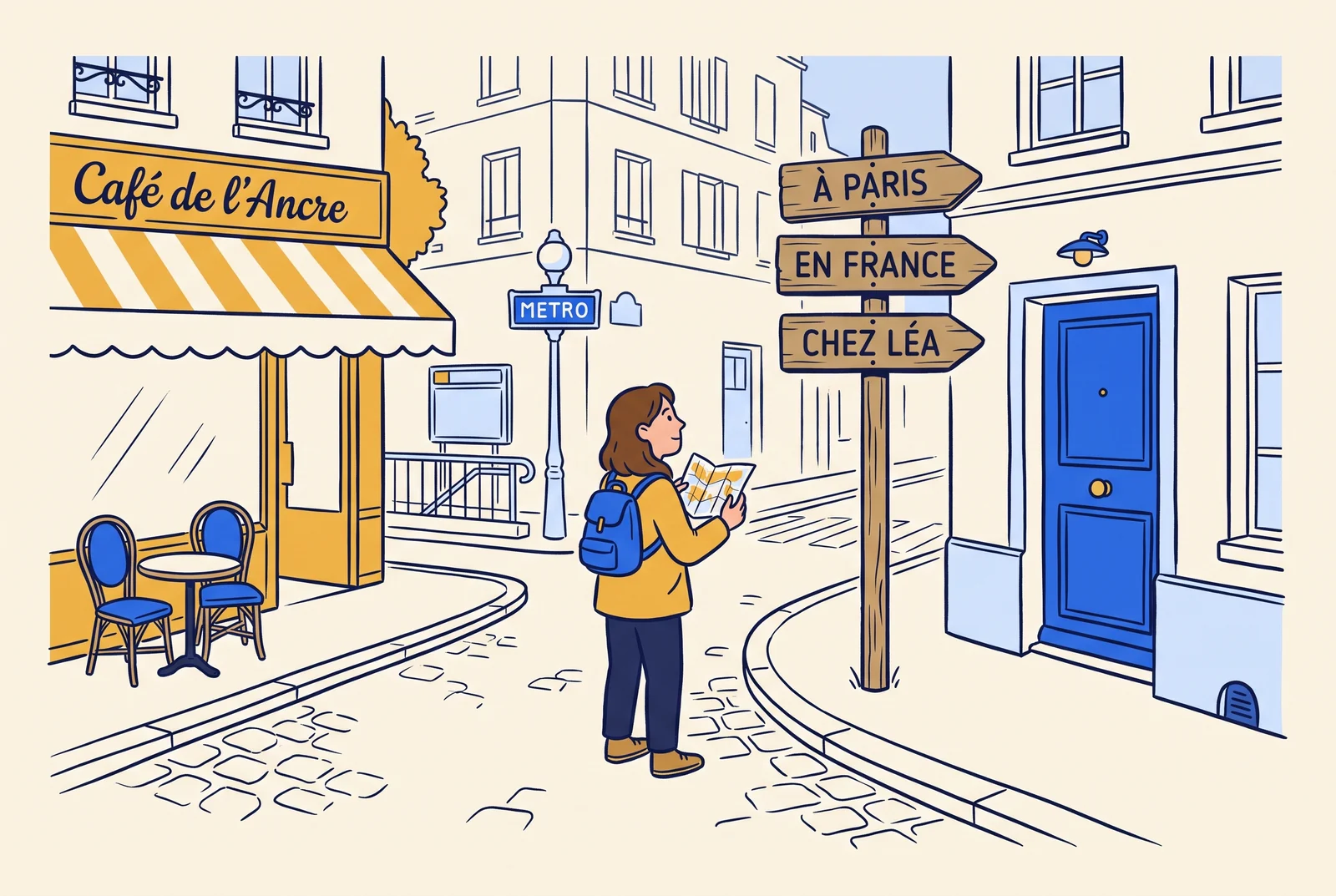
By the end of this lesson: Describe where you are going and where you are coming from using the destination’s French pattern.
Start with the destination, then work through the contrasts below. Read each French sentence with its translation, listen, and explain why that form fits. Finish with the optional quiz to check your choices.
A destination is more than the English word to
French does not use one universal equivalent of to. Identify whether the destination is a city, a country, a place or a person’s home.
🇺🇸 I’m going to Paris tomorrow.
The city name normally appears after à without an article. The same phrase can describe where something happens, so à does not mean movement by itself. The verb tells you whether someone is going, staying or working there. Compare the destination above with a stable workplace.
🇺🇸 My sister works in Paris.
For a named person’s home or place of business, chez provides another pattern. You do not add à before it. The sentence can mean going to Léa’s place even though no word translating “house” appears. Context supplies the relevant premises.
🇺🇸 I’m stopping by Léa’s after work.
Now compare a common place noun. Café is masculine singular, and à combines with le to produce au. The preposition has not developed a special meaning reserved for drinks; the contraction follows the article attached to the noun.
🇺🇸 We’re meeting at the café near the station.
Start with the complete destination. Ask whether you have named a city, a country, a place with an article or a person. The answer narrows the choice before you translate any English preposition.
Cities and countries take different patterns
Cities commonly take à. Countries commonly take en, au or aux according to gender, number and initial sound; learn the country together with its preposition.
🇺🇸 They have lived in Lyon for three years.
Countries usually have a grammatical gender in French. For a feminine country name, location or destination normally uses en. The same rule extends to continents. A name ending in a written e is often feminine, but several common exceptions mean that the ending remains a clue rather than a guarantee.
🇺🇸 She wants to study in France.
Masculine country names beginning with a consonant normally use au. Do not keep the article le as an additional word after au: the contraction already includes it. This pattern works for being in the country as well as travelling there.
🇺🇸 My brother lives in Canada.
With a masculine country name beginning with a vowel, en is normally used instead. That prevents “masculine equals au” from becoming a rule you apply too broadly. Iran provides a familiar example of the vowel pattern.
🇺🇸 She worked in Iran.
Plural country names take aux. They are grammatically plural regardless of how you picture the country as a single destination. Keep the whole place expression together when practising a sentence about work or travel.
🇺🇸 We’re going to the United States this winter.
An established city name with its own article illustrates the limit of the ordinary à plus city pattern. Learn the contraction with the name instead of adding a second article.
🇺🇸 We’re spending the weekend in Le Havre.
Some names without articles, including certain islands and countries, have their own established patterns. Learn à Cuba or à Madagascar as complete expressions. For a first route, choose three real destinations and verify those; adding dozens of exceptions before using a sentence is an efficient way to forget the destination you started with.
À la, au and aux around town
À plus le contracts to au; à plus les contracts to aux. À la and à l’ remain separate forms.
Related reading: article and gender lesson.
🇺🇸 I’m going to the pharmacy before heading home.
A masculine place noun produces au, even when it describes an institution rather than a physical room. You might be referring to attending or visiting the place without saying anything about the exact position of your body inside it.
🇺🇸 He is at the museum with his children.
Before an appropriate vowel, à l’ keeps the preposition and shortens the article. You will hear the phrase as a connected unit, which is one reason isolated flashcards for à and école can feel less useful than a whole sentence.
🇺🇸 The children are at school.
Dans is useful when you want to emphasise being physically inside a space. It is not a replacement for every English “in.” Being at the station and being inside its building may overlap in reality, but the speaker has chosen a different way of locating the person.
🇺🇸 I’m waiting for you inside the station, near the departures board.
You can take that distinction into the train-ticket conversation. An exact meeting point is more helpful than a perfectly memorised list of station facilities. If someone says they cannot see you, add the physical position rather than repeating the same destination louder.
Au is à plus le, whereas du is de plus le. Practise them in paired routes: going to a place, then coming from it. The change in direction will make the contraction easier to remember.
Chez points to a person or their place
Use chez for someone’s home or a place associated with a person or professional. It does not replace every English at or to.
🇺🇸 We’re having dinner at Paul’s tonight.
For the professional premises, notice that the noun refers to a person rather than naming the building. Both this expression and a place-noun expression can refer to the same practical errand, but the words you choose lead to different grammatical constructions.
🇺🇸 I have an appointment at the dentist’s.
Personal pronouns after chez are the stressed forms: moi, toi, lui, elle, nous, vous, eux and elles. The everyday invitation below uses one of them. The form is not the ordinary subject pronoun je because the pronoun is following a preposition.
🇺🇸 You can come to my place after lunch.
You may also encounter chez with a company, among a group, or in discussion of a writer’s work. Those are related uses, but they need not crowd your first directions exercise. For travel around town, avoid putting chez before an ordinary building noun such as gare or école.
🇺🇸 I’m going to the baker’s, then to the post office.
If you are making a request during the errand, the tu and vous guide helps you choose how to address the person. It does not change the location rule. Keeping the two decisions separate means you can repair a preposition without rebuilding the whole interaction.
The way you travel introduces another set of common expressions. Learn en train, en voiture and en bus alongside à pied and à vélo. These describe transport rather than the destination, so they can occur in the same sentence as au bureau or au marché.
🇺🇸 I travel to the office by train.
For a bicycle journey, standard written French uses à vélo. The destination phrase remains independent of that choice.
🇺🇸 She cycles to the market.
Chez also works with a company name when talking about employment. In that use, it identifies the employer rather than a person’s private home.
🇺🇸 My brother works at Renault.
Coming back with de, du and des
For origin, de can become du or des with a definite article. Compare the outward and return journeys to see which destination pattern changes.
🇺🇸 I’m coming back from Marseille on Sunday.
With feminine country names, ordinary origin expressions generally use de without the article. Compare en France for being there with de France for coming from there. You are learning two related patterns, rather than swapping en for a single universal equivalent of “from.”
🇺🇸 This parcel is arriving from France.
A masculine country beginning with a consonant normally gives du. With plural country names, the corresponding origin form is des. Their spellings match forms used elsewhere in French, so check the role they play in the actual sentence.
🇺🇸 He is returning from Canada with his family.
The plural form appears in the next sentence, where the country is the origin of a journey. This des is a contraction involving a definite article, rather than the indefinite quantity in a phrase such as des pommes.
🇺🇸 They are arriving from the United States tomorrow morning.
For a person’s premises, de chez expresses the starting point. This pattern is useful when explaining where you have just been. The prepositions work together because chez still names the type of place and de supplies the origin relationship.
🇺🇸 I’m leaving the doctor’s.
The quantity lesson explains the other jobs of du and des. Identical spelling does not guarantee identical function. In this route, asking “from where?” is more revealing than looking for an amount of something.
À and de can also be selected by a verb without naming a destination. Penser à un projet and parler d’un projet require learning the verb’s construction. A place-preposition chart cannot decide every à or de in French.
Say the whole route in French
Combine a starting point and a destination. Keep the same place names while practising both going there and returning.
🇺🇸 After the library, I’m going to Léa’s to return a book to her.
Once a place has been named, you can replace it with y instead of repeating the entire expression. The next reply only makes sense because the destination is already clear. The y and en lesson shows how to keep track of that missing information.
🇺🇸 Are you going to the pharmacy? Yes, I’m going there now.
Use the same technique when reading a short item in the French Briefing: identify a place, then notice how the writer refers to it again. For further practice, the common-mistakes article includes other constructions where English gives the wrong starting point. End your own route with an actual meeting place and a time.
Your friend is waiting inside the station, next to the departures board, while you are still outside the café looking at your map.
Useful phrases to keep
| 🇫🇷 French | 🇺🇸 English | 💡 Context |
|---|---|---|
| à Paris | in / to Paris | The usual city pattern. |
| en France | in / to France | A feminine country. |
| au Canada | in / to Canada | A masculine country beginning with a consonant. |
| aux États-Unis | in / to the United States | A plural country name. |
| chez Léa | at / to Léa’s | A person’s place. |
| dans la gare | inside the station | A physical location inside. |
| du Canada | from Canada | An origin phrase. |
| de chez le médecin | from the doctor’s | Origin from professional premises. |

Use your French in a real conversation.
Bring a question from a guide to a French tutor. Try it aloud, ask for feedback and leave with something to practise.
Find a French tutor →Paid lessons. Compare tutors and prices before booking.
Affiliate link: we may earn a commission when you book.
📚 Keep building in the Learning Center
French Reflexive Verbs: Daily Routine and Word Order
Build a daily routine in French with reflexive pronouns, negatives and infinitives. Compare translated examples, listen and practise.
Read →French Nominalisation: Examples and Clear Writing
Turn French verbs into nouns without hiding the actor or losing the time reference. Compare examples and practise…
Read →10 Common French Mistakes English Speakers Make
Understand ten common French mistakes involving gender, verbs, prepositions and pronunciation. Compare examples and practical corrections. An error…
Read →