
Updated on September 15, 2026
French Articles: Le, La, Les, Un, Une and Des
Choose definite and indefinite articles in French. Learn gender, plurals and noun phrases through translated examples, audio and practice.
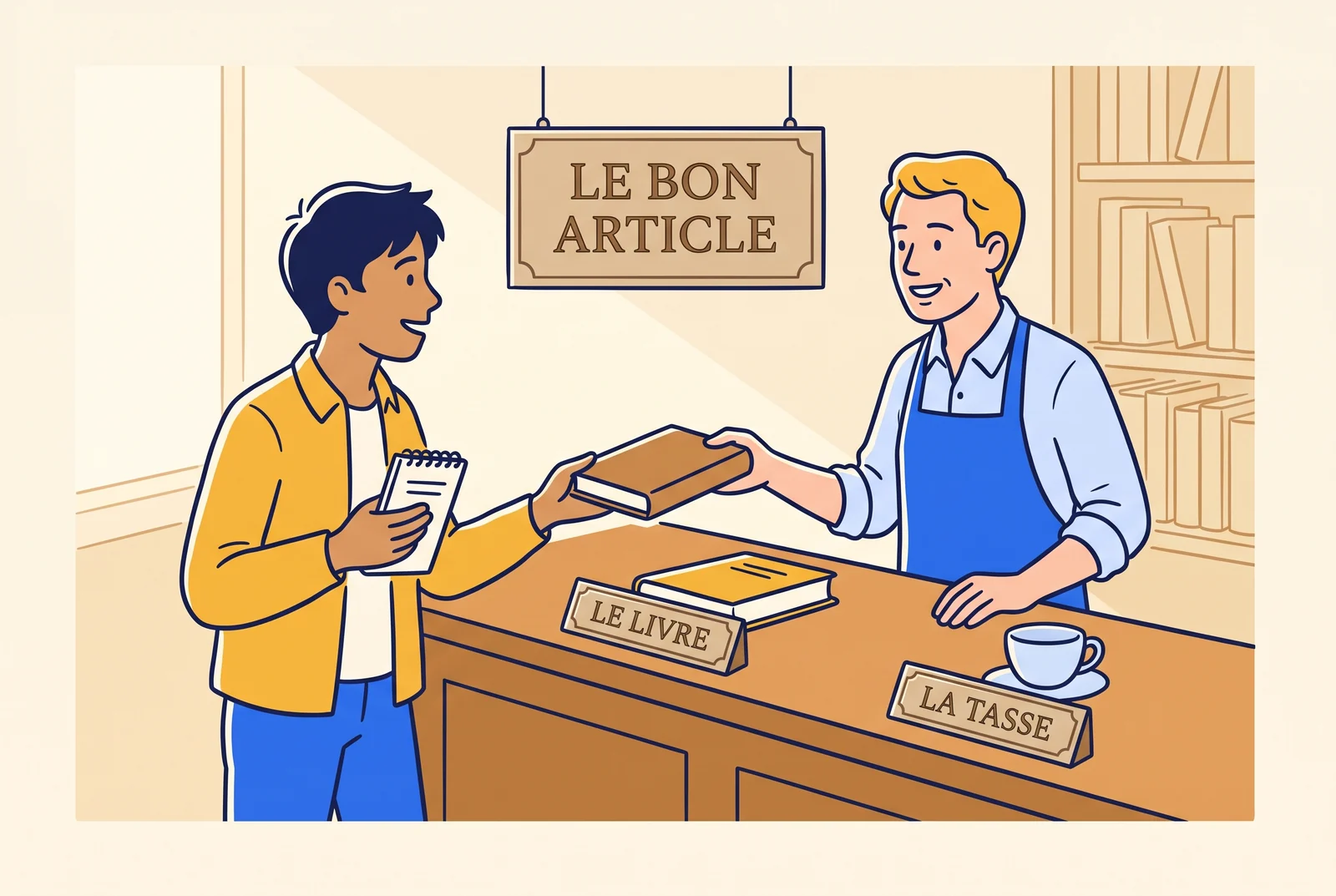
By the end of this lesson: Choose a noun’s article when introducing something, referring back to it or speaking in general.
Start with un or le?, then work through the contrasts below. Read each French sentence with its translation, listen, and explain why that form fits. Finish with the optional quiz to check your choices.
Introducing an object, then naming it again
Use an indefinite article to introduce an unspecified item. Use a definite article when the listener can identify which item you mean.
🇺🇸 I’m looking for a book for the journey.
Here, un introduces an unspecified member of a category. It does not mean that the speaker has forgotten the name of a particular book. Once the bookseller offers a title and you discuss that same object, use the definite article to refer back to it. The noun remains masculine throughout; what changes is whether the listener can identify its referent.
🇺🇸 The book has short chapters.
The same progression works with a feminine noun, with no change to the underlying idea. Suppose you notice a cup near the till and ask whether it is for sale.
🇺🇸 Do you sell a cup with this design?
After the seller points to one, the object becomes identifiable within the conversation. French can now use la because the listener knows which cup is being discussed.
🇺🇸 The cup is on the counter.
There is no requirement to introduce every definite noun earlier in the conversation. Shared surroundings can do the identifying work: a shop has an entrance, your appointment has a time, and the book in someone’s hand is visible. At the till, this request can therefore make sense without an earlier discussion of the door.
🇺🇸 Can you close the door?
Two decisions, not one. First decide whether the noun is identifiable in this context. Then select the masculine, feminine or plural form. Memorising le and la without the first decision leaves half the problem unsolved.
Learn the noun with its gender
Learn each noun together with its article. The ending may offer a clue, but it does not replace learning the noun’s gender.
🇺🇸 A table is available near the window.
Do endings help? Sometimes, and they are useful clues when treated as clues. Many nouns ending in -tion are feminine, while many in -age are masculine. Exceptions matter because they include ordinary words you will actually need. A masculine noun ending in a written e can still appear in a completely normal sentence.
🇺🇸 The problem is easy to explain.
Likewise, a familiar -age noun can be feminine. When you meet one, record the whole phrase instead of inventing a rule that will force you to correct it every time.
🇺🇸 The beach is quiet this morning.
For people, some nouns keep the same spelling while their article changes. Other nouns have different masculine and feminine forms. At this stage, notice the combination in the sentence you are learning rather than expecting one transformation to work for every occupation. Here the noun form stays unchanged.
🇺🇸 An artist is exhibiting her paintings here.
The published practice game at this point checks noun gender. It does not test every use of definite and indefinite articles. If you miss an answer, say the noun with its article and add a short description, as in this example with a clearly masculine head noun.
🇺🇸 An interesting museum is near the station.
Keep gender attached to a useful phrase. A note such as une grande table carries more information than table on its own, because both the article and adjective reveal the agreement.
When le and la become l’
Le and la become l’ before a vowel sound or silent h. The shortened article does not show whether the noun is masculine or feminine.
🇺🇸 There is a hotel near the bridge.
The masculine gender is audible in un hôtel. In the next sentence, the shortened definite article no longer tells you that on its own, although the noun has kept its gender.
🇺🇸 The hotel overlooks the river.
A feminine noun can look identical at the start of the phrase. The article has shortened for the same sound-related reason, not because école and hôtel belong to the same gender group.
🇺🇸 The school is at the end of the street.
Be careful with written h. Some words have an aspirated h, a traditional label that usually means elision and liaison are blocked, rather than that a strong English h must be pronounced. Learn those words individually. The following everyday example keeps its full article.
🇺🇸 The hero returns at the end of the film.
For more on what actually joins in speech, use the pronunciation and listening guide. Listen to the whole noun phrase rather than trying to hear a separate sound for every written letter. Plural les stays written in full even before a vowel, though its final consonant can link to the next word.
🇺🇸 Léa’s friends are arriving tomorrow.
Do not turn every word beginning with h into an English pronunciation exercise. The useful distinction here is whether French permits elision and liaison with that particular word.
Preferences, plurals and familiar objects
French often uses the definite article when talking about a category in general, including likes and dislikes. English may leave that article out.
🇺🇸 I like illustrated books.
Compare that general taste with buying an unspecified number of books. Des is the plural indefinite article in this example. The sentence concerns some individual objects being bought, whereas the preference above concerns a category of things you like. Quantity is a separate topic, explored more fully in du, de la, des and de in context.
🇺🇸 I’m buying some books for my grandchildren.
Once the purchased books are identified, les can refer back to that particular set. Definite does not always mean general, and plural does not always mean vague: the listener’s ability to identify the group still matters.
🇺🇸 The books are in my bag.
General preferences also use the definite article with many singular mass nouns. This is one reason “some” is an unreliable translation shortcut for choosing an article. A statement about liking coffee is different from a request for a quantity of it.
🇺🇸 I prefer coffee without sugar.
French does have places where an article is omitted. An unmodified profession after être commonly appears without one, for example. That is a specific construction, not permission to remove articles whenever English does. Notice how the next sentence simply states an occupation.
🇺🇸 My neighbour is a bookseller.
If the pattern reminds you of other English-to-French shortcuts, the common-mistakes guide puts article errors alongside agreement and verb choices. Avoid fixing everything in one breath. During a bookshop exchange, getting the intended object across is already a useful test of your sentence.
Choose the article in a short exchange
Follow the object through the exchange. The article can change once both speakers know which object is being discussed.
🇺🇸 I’d like a notebook for taking notes.
The seller offers two notebooks and you point to the blue one. Both people can now identify the object from the situation. The colour helps identify it, while the article matches the masculine noun.
🇺🇸 I like the blue notebook.
Now ask about a particular pencil lying beside it. The question does not introduce just any pencil in the shop: pointing and physical location make it specific. If addressing the seller still feels uncertain, revisit choosing tu or vous before practising the exchange aloud.
🇺🇸 Is the pencil next to it also for sale?
You decide to buy several postcards without specifying which ones yet. This returns you to an indefinite plural. The later choice of exact cards may change the article again, just as it did with the book.
🇺🇸 I’m also taking some postcards.
Finally, the seller asks which cards you mean. The question refers to the category just introduced, and your pointing makes the intended selection clear. Try replacing the last phrase with another visible position, using French place expressions when you need a fuller destination or location phrase.
🇺🇸 The cards near the till, please.
Keep the whole noun phrase together
Check the article, noun and any adjective together. The article expresses both a grammatical agreement and a relationship to what the listener knows.
You can later reduce repeated nouns with y and en in short conversations, but a clear full noun phrase comes first. For now, underline articles in a paragraph from the French Briefing and ask what each one identifies. Some answers will depend on an earlier sentence; that is part of the reading task.
Back at the bookshop, the seller wraps the blue notebook and puts the postcards beside it, and you can name each purchase without pointing twice.
Useful phrases to keep
| 🇫🇷 French | 🇺🇸 English | 💡 Context |
|---|---|---|
| un livre | a book | Introducing an unspecified masculine noun. |
| une tasse | a cup | Introducing an unspecified feminine noun. |
| le comptoir | the counter | A location both speakers can identify. |
| une école | a school | Une makes the feminine gender visible. |
| un hôtel | a hotel | Un retains the masculine gender before a vowel. |
| des cartes postales | some postcards | An indefinite plural. |
| les achats | the purchases | An identified set of objects. |
| un carnet | a notebook | A useful noun to learn with its article. |
For a related pattern with guided examples and practice, continue with French Possessives: Choose Mon, Ma and Mes in Context.
Use your French in a real conversation.
Bring a question from a guide to a French tutor. Try it aloud, ask for feedback and leave with something to practise.
Find a French tutor →Paid lessons. Compare tutors and prices before booking.
Affiliate link: we may earn a commission when you book.
📚 Keep building in the Learning Center
French Reflexive Verbs: Daily Routine and Word Order
Build a daily routine in French with reflexive pronouns, negatives and infinitives. Compare translated examples, listen and practise.
Read →French Nominalisation: Examples and Clear Writing
Turn French verbs into nouns without hiding the actor or losing the time reference. Compare examples and practise…
Read →French Reported Speech: Tenses, Pronouns and Time
Report speech in French while keeping the speaker and time clear. Compare tense shifts, indirect questions and requests…
Read →