
Updated on September 15, 2026
Du, De La, Des or De? French Quantities Explained
Choose French partitive articles and de after quantities or negatives. Compare everyday food examples, exceptions and a practice quiz.
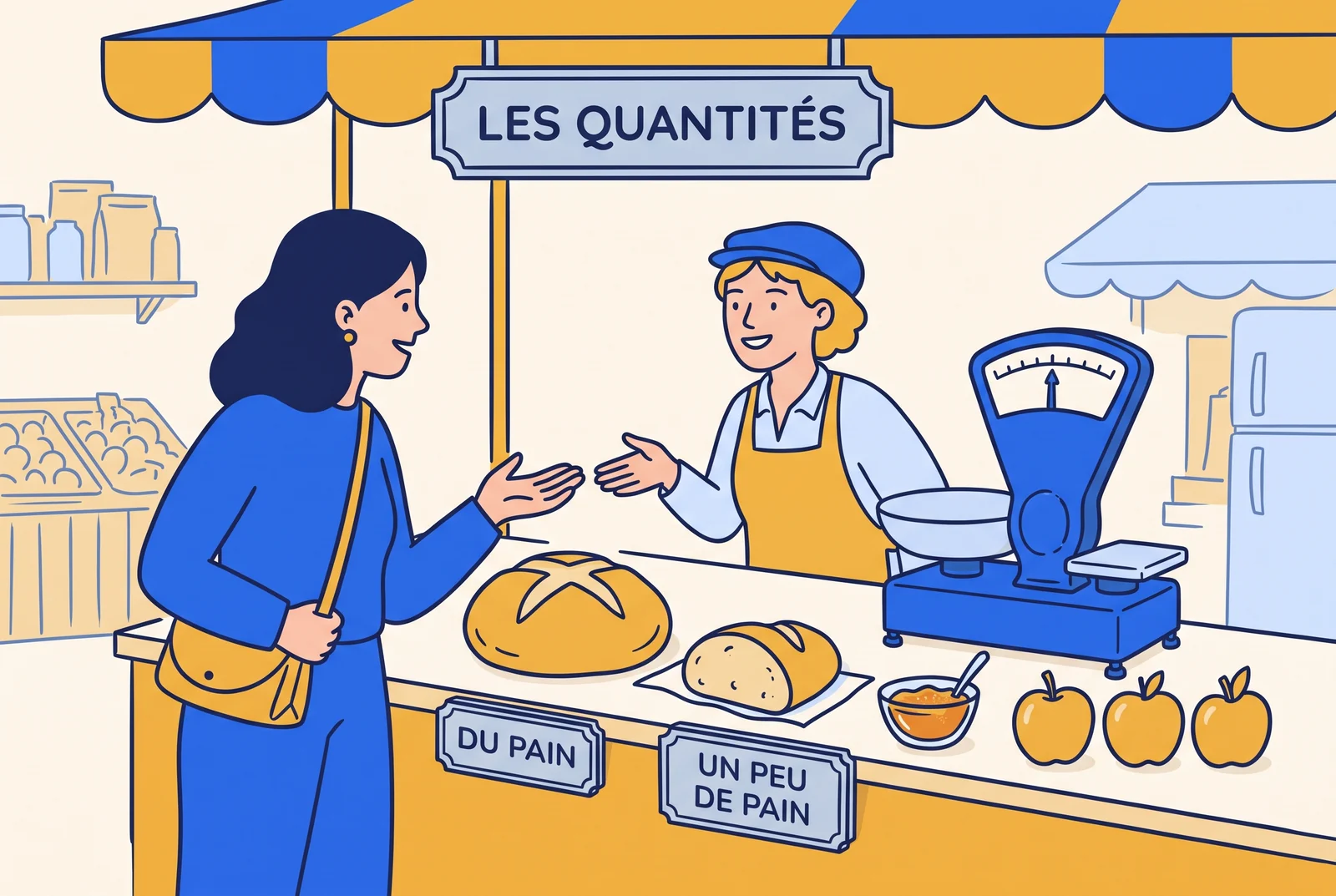
By the end of this lesson: Ask for an amount of food and explain why the article changes after a quantity or a negative.
Start with an amount, then work through the contrasts below. Read each French sentence with its translation, listen, and explain why that form fits. Finish with the optional quiz to check your choices.
What changes when you measure the food
Distinguish an unspecified amount from a measured quantity. The expression of quantity determines how de is used.
🇺🇸 I’d like some bread for this evening.
Du introduces an unspecified quantity of a masculine noun. The request says what kind of thing you want, while leaving the exact amount open. If you choose a unit of measurement, the measure supplies the quantity and is normally followed by de. The noun does not change gender between these two requests.
🇺🇸 I’d like a kilo of bread.
A countable item works differently. You can buy one whole loaf or several whole loaves, using the indefinite article or a number. The same everyday substance can therefore appear as an amount or as separate objects, depending on how you are talking about it.
🇺🇸 I’m taking two country loaves.
This distinction matters beyond food. You can have patience, an idea or three ideas; the intended meaning decides whether you treat the noun as a quantity or as countable instances. For an amount that is deliberately small, use a quantity expression rather than adding an extra partitive article after it.
🇺🇸 Add a little flour.
Identify what supplies the quantity. If a measure or expression such as beaucoup already does that job, ordinary constructions normally continue with de. If no amount is specified, a partitive or indefinite article may introduce the noun.
Du, de la and de l’ with uncountable quantities
Use a partitive article for an unspecified amount: du with masculine nouns, de la with feminine nouns and de l’ before a vowel sound or silent h.
🇺🇸 There is some cheese left in the fridge.
A feminine noun keeps de la before a consonant. In a recipe, this can introduce an ingredient whose amount will be specified elsewhere, such as in a list or by the person cooking beside you.
🇺🇸 She adds some cream to the sauce.
Before the appropriate vowel sound, elision produces de l’. The spelling does not tell you the gender by itself. For eau, the noun remains feminine even though the written phrase starts in the same way as a masculine noun such as argent.
🇺🇸 We need some water for the soup.
Partitive articles also occur with abstract qualities and activities. Treat the following as a phrase expressing an amount of patience, rather than trying to count individual pieces of it. The grammar remains useful even when the shopping basket has disappeared.
🇺🇸 This work takes patience.
To name a drink you like in general, French normally switches to a definite article. That gives you a useful contrast between consuming a quantity and expressing a preference. The separate guide to French articles explains the identifiable and general uses in more detail.
🇺🇸 I’m drinking tea, but I prefer coffee.
Des with several countable items
Des introduces unspecified plural items. It is useful to distinguish several countable objects from an amount of a substance.
🇺🇸 We’re buying some apricots for dessert.
If the number is supplied, use the number directly before the noun. There is no need to insert des between trois and pommes. The sentence now tells the seller exactly how many separate objects belong in the bag.
🇺🇸 Put three apples in the bag.
An identified set of plural items takes les. Perhaps you have already selected a particular tray, or the other person is pointing to it. What matters is that the listener can tell which group you mean, rather than that the group happens to be large or small.
🇺🇸 The tomatoes in this basket are ripe.
In careful standard French, des normally becomes de before a plural adjective placed before the noun. This is a separate pattern from measuring or negating. Fixed expressions and ordinary spoken usage can complicate the picture, so learn the core contrast without treating every heard des plus adjective as a failure to communicate.
🇺🇸 The stallholder is offering beautiful strawberries.
If that feels like several rules arriving at once, return to the noun phrase you need for today’s purchase. The common French mistakes article gives a broader view; this page stays with the quantity decision so you can explain why one particular sentence changes.
Practise an ingredient in three forms: an unspecified amount, a measured amount and an identified amount. Saying du riz, un bol de riz and le riz dans ce bol makes the difference concrete.
Why beaucoup de and pas de lose the article
A quantity expression such as beaucoup de takes de. An ordinary negative of quantity also commonly changes the indefinite or partitive article to de.
🇺🇸 There is too much salt in the soup.
The construction does not depend on the noun being singular. With countable plural items, the same quantity phrase can still be followed by de. The noun carries its normal plural ending because you are still referring to several objects.
🇺🇸 We have enough glasses for everyone.
Under an ordinary negative statement of absence, indefinite and partitive articles used with the object commonly become de or d’. You are saying there is none of the thing, or that you do not have any, rather than identifying a particular object that you dislike.
🇺🇸 I don’t have any milk at home.
The same pattern applies to an absent plural quantity. This makes a useful shop response when someone asks for an item you do not stock. The words are different from refusing a specific packet that both people can see.
🇺🇸 We aren’t selling eggs today.
Definite articles stay in general preferences even when the preference is negative. Compare an absence of coffee with disliking coffee as a drink. Negation has changed the statement, but it has not turned the general category into an unspecified quantity.
🇺🇸 I don’t like very strong coffee.
You can hear similarly short everyday choices in the French Briefing. After reading a sentence, ask what the negation applies to before trying to replace its articles. Treating every pas as an instruction to delete everything except de will eventually change a sentence’s meaning.
The exceptions with être and a specific contrast
After être, the article generally remains. It can also remain in an explicit contrast where you are correcting which kind of thing is meant.
🇺🇸 That isn’t milk; it’s cream.
An indefinite article can also remain after être when the speaker rejects an identification. This construction is worth learning as a whole, especially if English interference makes you uncertain about being, having and describing. The article on être, avoir and English sentence patterns develops that broader contrast.
🇺🇸 This isn’t a pricing error.
Another important case is a specific correction: the speaker rejects one quantity or kind in favour of another. Articles can remain when the negation is contrastive instead of simply denying the existence of an amount. The next sentence names the alternative explicitly so the intended correction is clear.
🇺🇸 I don’t want tea; I want coffee.
Quantity expressions also need care when they refer to part of an already identified whole. Compare “a lot of cheese” with “a lot of the cheese you bought.” In the latter, de combines with the definite article because the cheese is specified. It is not the same structure as an unspecified beaucoup de fromage.
🇺🇸 We ate a lot of the cheese you bought.
Learn common part-of-a-whole expressions separately. La plupart des invites a different construction from beaucoup de, because it refers to most of a group. The appearance of des here is no reason to rewrite every other quantity expression the same way.
🇺🇸 Most of the guests are drinking water.
A useful rule has a context. Pas de describes ordinary absence; it does not replace the article after every negative verb. Check identification with être, general preferences and explicit contrasts before editing.
Read a shopping list back aloud
Read the whole request aloud: the quantity, de if needed, and the noun. Check the meaning of the request before correcting the article.
Related reading: saying which shop you are going to.
🇺🇸 I’ll take a jar of jam and the apples you put aside.
When repeating the noun becomes cumbersome, en lets you keep the quantity while replacing the thing being discussed. That is the natural continuation of this lesson: first decide what amount you mean, then learn how to mention it again without rebuilding the entire noun phrase. A short sentence at the counter can make that transition for you.
🇺🇸 Do you have any pears? I’d like four.
Close the list and explain your purchases aloud. Include one negative sentence and one measured quantity, then compare them with your original wording. The seller has already weighed the bread; the remaining question is how many pears to put beside it.
Useful phrases to keep
| 🇫🇷 French | 🇺🇸 English | 💡 Context |
|---|---|---|
| du pain | some bread | An unspecified amount. |
| de la crème | some cream | A feminine partitive phrase. |
| de l’eau | some water | Elision before a vowel. |
| un kilo de farine | a kilo of flour | De follows the measure. |
| un peu de sel | a little salt | A quantity expression. |
| pas de lait | no milk | Ordinary absence. |
| de belles fraises | beautiful strawberries | De before a preceding plural adjective. |
| la plupart des invités | most of the guests | A part of an identified group. |
Use your French in a real conversation.
Bring a question from a guide to a French tutor. Try it aloud, ask for feedback and leave with something to practise.
Find a French tutor →Paid lessons. Compare tutors and prices before booking.
Affiliate link: we may earn a commission when you book.
📚 Keep building in the Learning Center
French Reflexive Verbs: Daily Routine and Word Order
Build a daily routine in French with reflexive pronouns, negatives and infinitives. Compare translated examples, listen and practise.
Read →French Nominalisation: Examples and Clear Writing
Turn French verbs into nouns without hiding the actor or losing the time reference. Compare examples and practise…
Read →Tu or Vous in French: Choosing and Switching Politely
Choose tu or vous in French across work, social and everyday situations. Understand uncertainty, polite defaults and how…
Read →