How to Think in French and Stop Translating From English: Practical Guide for Adult Learners
Every sentence still takes the same hidden route: French comes in, gets converted into English, then English sends an answer back out dressed in French. That system cannot carry real fluency. This guide shows how to break it.
Why you still translate in your head
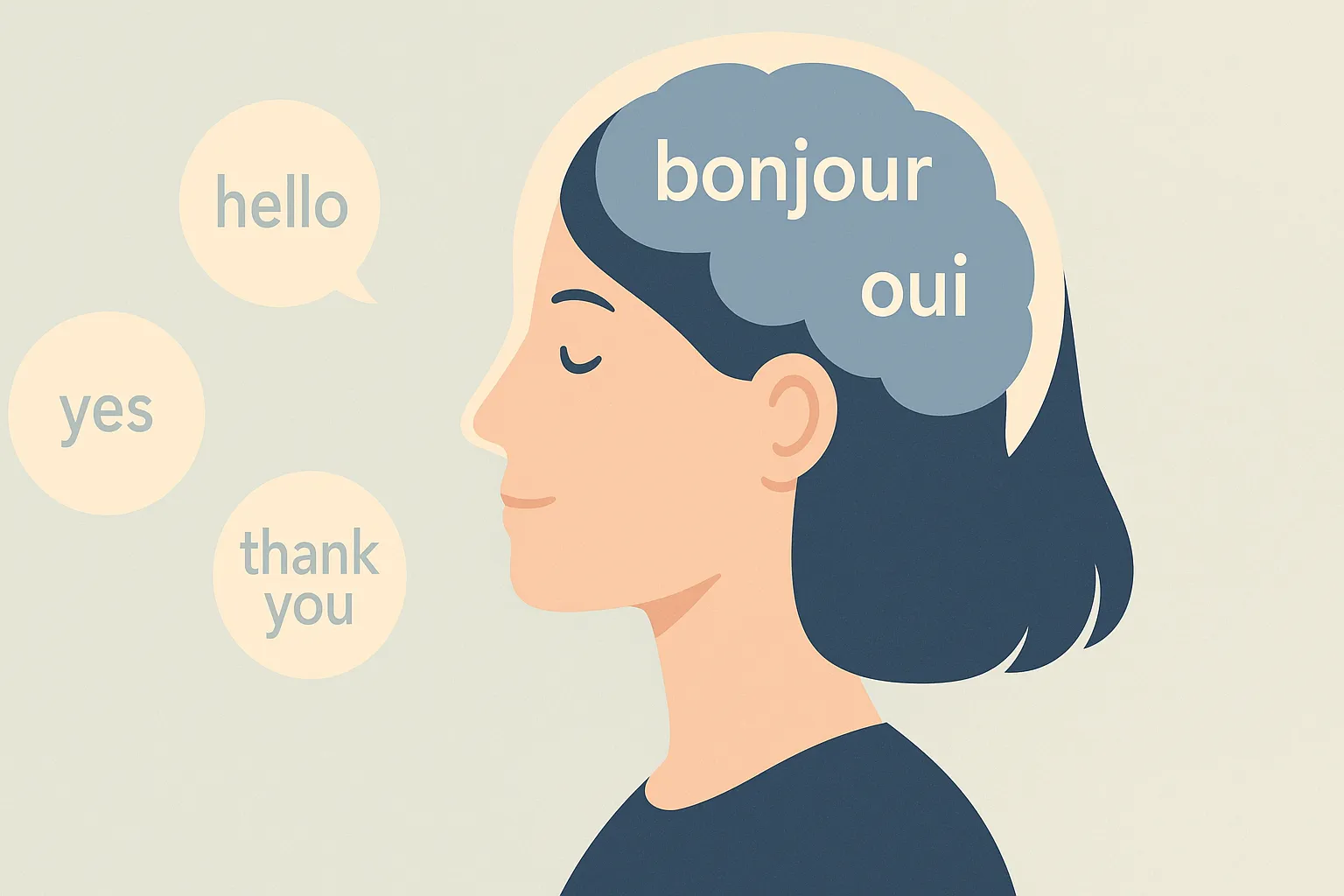
Translation is not proof that you are bad at French. It is proof that your brain is still protecting speed and certainty by using the strongest system it already has, which is English. For an absolute beginner, that is normal. For a learner who already knows common verbs, daily vocabulary, and basic sentence patterns, it becomes expensive.
The cost is not only speed. Translation distorts meaning. English and French do not cut reality in the same places. The English speaker wants to say “I am cold,” then searches for a French equivalent. The language does not want that sentence. It wants j’ai froid. The learner who keeps building from English first does not just move slowly. They keep trying to force French to obey a foreign architecture. That same mismatch shows up across dozens of expressions covered in the false friends guide and the 10 most common mistakes.
The goal is not to erase English
The goal is to make French available earlier, faster, and more often. Thinking in French does not mean thinking perfectly. It means the sentence begins in French often enough that English is no longer the only launch point.
What thinking in French actually looks like
People imagine some dramatic transformation where one morning the internal voice has become Parisian. That is not how it works. Direct French thinking appears in fragments before it appears in systems.
At first, it is a few stable units. You see the coffee machine and café arrives before “coffee.” Someone asks how you are and ça va feels faster than any English equivalent. Then it widens. Daily actions, weather, food, directions, routine preferences, small reactions. Only later do more abstract thoughts begin to move directly in French.
The three stages
Stage one: isolated high-frequency words and chunks appear without translation.
Stage two: short daily sentences begin directly in French.
Stage three: entire familiar situations can be processed in French without constant English support.
If you believe “thinking in French” means full native-like internal fluency, you will miss the real progress happening much earlier. The useful measure is how often French appears before English gets there first.
The core method: internal narration
If one technique does the most work for adult learners, it is internal narration. You take ordinary life and start attaching French to it before English has time to formalize everything.
You narrate a routine in French while you do it. Mentally is enough. The point is to connect action, object, and sensation directly to French language instead of to English commentary about French language.
Internal narration has three advantages most classroom tasks do not. First, it uses your real life, so meaning is always present. Second, it repeats the same vocabulary domains again and again, which builds automaticity. Third, it trains retrieval under low pressure. No grade. No audience. Just repetitions that slowly stop feeling foreign. If you freeze when speaking out loud, internal narration is the safest bridge because nobody is watching.
Do not wait until you can narrate elegantly. Start with ugly, simple French. Clean French comes later. Direct French comes first. If a word is missing, describe around it: le truc pour ouvrir les bouteilles instead of going silent because you forgot tire-bouchon.
Mind games that force the switch
Internal narration builds the base. These techniques push further. They are deliberate cognitive tricks that make your brain default to French in specific moments, even when English is still available. None of them require a classroom, a partner, or a trip to France. They require a decision and about five minutes.
The language lock: pick one activity and make it French-only forever
Choose one daily activity and declare it permanently French. Not “I will try to think in French while cooking.” That is a suggestion. It will last two days. Instead: “Cooking is now French. Every time. No exceptions.” Your grocery list is in French. Your recipe reading is in French. Your internal narration while chopping onions is in French. Je coupe les oignons. Où est le sel ? Il faut encore dix minutes. The restriction is what makes it work. When there is no option to fall back to English for this one activity, your brain stops negotiating and starts producing.
After cooking feels natural, add a second lock. Walking. Then showering. Then commuting. Each lock is a permanent French zone that never goes back to English. Over months, the locked zones expand until French is the default internal language for large parts of your day.
The 60-second sprint: set a timer and think only in French
This one sounds trivial. It is surprisingly hard and surprisingly effective. Set a timer for 60 seconds. During those 60 seconds, every thought must stay in French. If English appears, do not fight it. Just notice it and return to French. Like meditation, but for language.
Most people cannot do 60 seconds cleanly on their first try. That is the point. The exercise makes you aware of how often English hijacks your internal monologue without permission. Over time, 60 seconds becomes 2 minutes, then 5, then you stop needing the timer because French starts holding territory on its own.
The emotional anchor: attach French to feelings, not just facts
Most learners connect French to information. La table = the table. Le chien = the dog. That works for objects. It does not work for the moments when you think fastest, which are emotional reactions. Surprise. Frustration. Relief. Amusement. Hunger. Those micro-moments are where your brain defaults to English most stubbornly because emotions feel too urgent for a second language.
The fix: deliberately override the emotional default. When you stub your toe, force aïe, merde instead of “ow, shit.” When something is funny, push c’est trop drôle before “that’s hilarious” arrives. When you are hungry, make j’ai faim the first thought, not a translation of “I’m hungry.” These micro-switches rewire the deepest layer of language because they attach French to the moments where your brain is most automatic and least analytical. Over time, French stops being the language you use for exercises and becomes the language you react in.
The dream rehearsal: replay your day in French before falling asleep
Lie in bed. Close your eyes. Replay your entire day from morning to now, but narrate it in French. Ce matin je me suis levé tard. J’ai pris le métro. Il y avait du monde. Au travail, j’ai eu une réunion longue. J’ai déjeuné avec Marie. L’après-midi était calme. Maintenant je suis fatigué. This does three things at once: it reviews real vocabulary from your actual day (not a textbook), it builds the past tense naturally (passé composé and imparfait appear organically because you are describing what happened), and it trains your brain to process experience through French right before sleep, which is when memory consolidation is strongest.
The label game: rename everything in your environment
Look at any room. Name every object you can see. In French. No English. La fenêtre, le mur, la chaise, le tapis, l’écran, le stylo, la tasse, les clés. When you hit a word you do not know, describe it: le truc noir sur la table (the black thing on the table). Do not stop to look it up. The point is continuous French production, not accuracy. Look up the missing word later. During the game, the only rule is: no English enters the room.
Advanced version: do not just label. Connect. La tasse est sur le bureau. Le bureau est près de la fenêtre. La fenêtre est ouverte parce qu’il fait chaud. Now you are building sentences, not just listing nouns. That is the difference between vocabulary and language.
The phone switch: change your phone language to French
This one is older advice but most people still have not done it. Change your phone’s system language to French. Not your computer if that would slow down work. Just the phone. Every notification, every menu, every settings label becomes French. Réglages. Luminosité. Notifications. Rechercher. You will look things up for two days. Then you will stop because your brain will have memorized the positions. That passive exposure is worth more than it sounds because you touch your phone 80-150 times a day. That is 80-150 micro-contacts with French that cost zero effort after the first week.
If you also switch your French SIM card to a French carrier, you start receiving SMS, voicemail prompts, and customer service messages in French too. That is accidental immersion built into admin.
The inner debate: argue with yourself in French
Pick a question. Any question. Est-ce que je devrais déménager ? Est-ce que ce film était bon ? Est-ce que je travaille trop ? Then argue both sides. In French. Out loud or in your head. D’un côté, mon appartement est trop petit. De l’autre, le loyer est pas cher. Mais le quartier est bruyant. Par contre, je suis près du métro. This technique forces complex thinking in French: cause and effect, comparison, weighing options, conditional reasoning. It is the hardest exercise here because it requires French to handle ambiguity, not just description. But it is also the one that, when it starts working, signals that your French is becoming a thinking language, not just a labeling language.
Start with one technique. Not all seven. Pick the one that fits your day most naturally. Do it for two weeks before adding a second. The techniques compound, but only if each one becomes automatic before you stack the next.
How to consume French without feeding the translation habit
Many learners believe they are doing immersion while they are actually training bilingual dependence. French audio, English subtitles. French article, constant English dictionary checks. The brain never has to remain inside French long enough to stabilize there.
The useful rule: stay in French longer than feels comfortable. Let context do more work. Let partial comprehension stand. Let uncertainty remain alive a little longer before you kill it with translation. The French Briefing is built for exactly this: daily French input at a readable level where you can process in French first, then check understanding after.
Better immersion sequence
Step 1: listen or read for general meaning. Step 2: infer as much as possible from context. Step 3: only then check key unknown items. Step 4: stay in French for the explanation if your level allows it.
Content choice matters. If the material is too hard, your brain runs back to English. If it is too easy, there is no stretch. The podcast guide ranks French audio by difficulty so you can match your level. French shows on Netflix work the same way if you use French subtitles instead of English. And the French music guide ranks 12 artists from A1 to C1 with the same principle: difficulty should match your ear, not your ambition.
Build vocabulary that leads to direct French
The classic English-to-French flashcard trains the exact reflex many learners later want to dismantle. See English, retrieve French. That helps on a test. In life, the goal is to see a thing and have French arrive directly.
Concrete words are the easiest place to start. Dog should become chien tied to an actual dog, not just to the English word “dog.” Hunger should become j’ai faim tied to the bodily feeling, not just to a translation note. And words stored in clusters survive better than words stored alone: not just ennuyeux = boring but ce film est ennuyeux, je m’ennuie, l’ennui. The words that don’t translate guide is especially useful here because those are the concepts that cannot be reached through English at all. They force direct French acquisition by design.
Create monolingual moments on purpose
A lot of learners wait for life to force French on them. A more reliable approach: create short periods where French becomes the only internal language allowed.
Choose a short time window. Fifteen minutes is enough. During that window, all internal speech stays in French. If a word is missing, describe around it. If grammar is clumsy, keep going. Morning preparation, walking, cooking, commuting. These are not practice sessions. They are zones where French becomes the medium, not the subject.
If your monolingual blocks keep collapsing because you lack basic daily-life phrasing, the problem is often solved faster through situation-specific articles: café culture, bakery vocabulary, train ticket phrases, or restaurant booking language. Each one fills a gap that was breaking your French block.
How to measure progress without lying to yourself
Thinking in French is not an all-or-nothing event. The better measure is domain by domain. Can you handle breakfast in French? Commuting? Weather? Basic feelings? Small plans for the day? Those are real wins. They count because they show that French is occupying mental space directly.
In the first month, the main win is habit. Internal narration feels less artificial. In the second month, familiar routines begin producing more French automatically. In the third month, some comprehension and some self-generated speech start happening without English first. The realistic timeline guide covers how long each CEFR level takes so you do not mistake normal speed for failure.
The good sign is not the total absence of English. The good sign is that French begins arriving before English more often in familiar moments. That is enough. That is the shift. “For sure.” 🕶️
Study glossary: thinking and learning vocabulary
| French | IPA | English |
|---|---|---|
| Penser | /pɑ̃se/ | To think |
| Traduire | /tʁadɥiʁ/ | To translate |
| Comprendre | /kɔ̃pʁɑ̃dʁ/ | To understand |
| La pensée | /la pɑ̃se/ | Thought / thinking |
| Le cerveau | /lə sɛʁvo/ | Brain |
| La fluidité | /la flɥidite/ | Fluency |
| Un réflexe | /œ̃ ʁeflɛks/ | A reflex |
| Automatique | /ɔtɔmatik/ | Automatic |
| S’améliorer | /sameljɔʁe/ | To improve |
| L’immersion | /limɛʁsjɔ̃/ | Immersion |
| Contourner | /kɔ̃tuʁne/ | To work around (a missing word) |
| Le déclic | /lə deklik/ | The click / the breakthrough moment |
Thinking in French starts with reading in French, daily and at the right level. Our French reading practice page lines up real news excerpts from A1 to B2, translations included, so you can start today.
Go further
Stop making the same 21 French mistakes. Play them away.
300 pages of games, riddles and quizzes built around the 21 mistakes English speakers actually make in French. You fix them by playing, not by memorising rules. By Camille Aubert.
📚 Keep building in the Learning Center
French Property Taxes for English Speakers: Taxe Foncière Explained
Most anglophone owners discover French property taxes the hard way: a notice arrives in late August, in administrative…
Read →Imparfait vs Passé Composé Explained: Timeline Method
Imparfait vs passé composé trips up every English speaker because English never forces the same choice. You say…
Read →French Subjunctive Made Simple for English Speakers
The French subjunctive has one job: it marks that something is filtered through a mind, not stated as…
Read →