Why French Speakers Say “I Am Agree” Instead of “I Agree”: The Grammar That Explains Everything
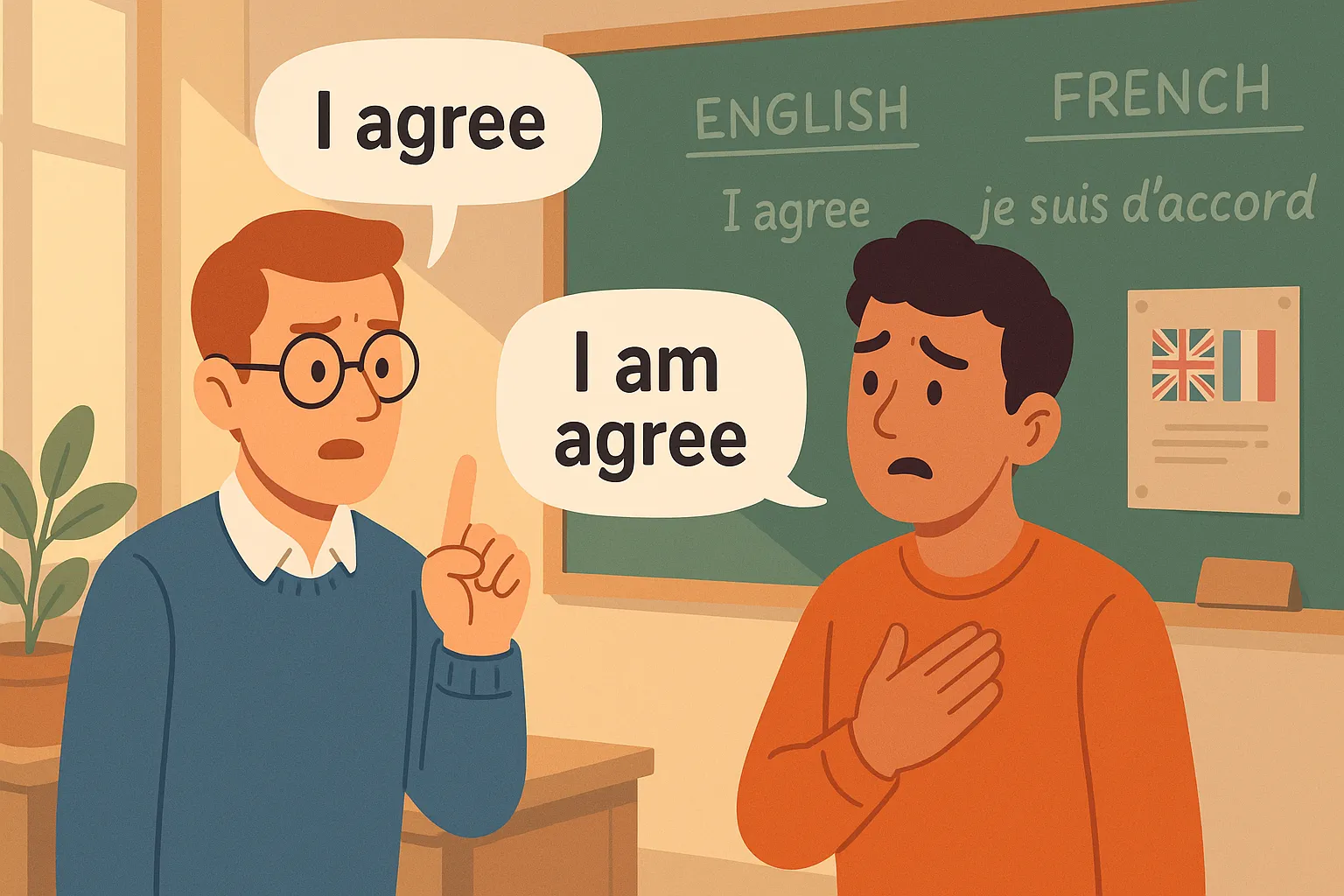
“I am agree” is structural interference from je suis d’accord, where French uses être + prepositional phrase and English uses “agree” as a standalone verb. This guide maps the root cause, every similar pattern between French and English, and why understanding the mechanism makes you better at both languages.
The root cause: French “être d’accord” vs English “agree”
French treats agreement as a state of being. English treats it as an action. That single structural difference explains the error and every error like it. In French, d’accord is not a verb. It is a prepositional phrase meaning “of accord.” It requires être (to be) the way “happy” requires “to be” in English. In English, “agree” is a standalone verb that needs no auxiliary. The collision between these two systems produces “I am agree” every time a French speaker’s first-language wiring fires before their English can override it.
The error persists even at advanced levels because it involves deep structural wiring, not surface vocabulary. French speakers know intellectually that “I agree” is correct. In spontaneous speech, the French pattern activates before conscious monitoring can intervene. Correcting someone does not fix it. Understanding the mechanism does. The same pattern shows up across dozens of other structures, which is why the common mistakes guide keeps coming back to this family of errors.
The “être” reflex: every place French speakers over-insert “to be”
French uses être far more broadly than English uses “to be.” The reflex to insert “am/is/are” transfers to English in predictable patterns. Once you see the list, you understand it is one error with many faces. The false friends guide covers the vocabulary version of this problem. This section covers the structural version.
The être/avoir swap on age and sensations
French uses avoir (to have) where English uses “to be” for age and physical sensations. The interference runs in both directions: French speakers say “I have 30 years” in English, English speakers say je suis 30 ans in French. Neither is a vocabulary mistake. Both are structural misfires.
The article reflex
French requires le/la/les before generic nouns. English drops the article. The reflex to include it is so deep that even C1 French speakers maintain it in English. This error is less dramatic than “I am agree” but more persistent and harder to eliminate because it does not sound obviously wrong to the speaker.
The false friend that causes real embarrassment
The continuous tense blind spot
French has no continuous form. Je mange covers both “I eat” (habitual) and “I am eating” (right now). French speakers skip the continuous in English because it does not exist in their system. It never fires automatically. It has to be consciously inserted every time, which is why it fails under pressure. The imparfait vs passé composé guide covers the closest French equivalent to this English distinction.
The verb test. When tempted to say “I am [X],” ask: is X a verb or an adjective? “I am happy” (adjective → needs “to be”). “I agree” (verb → no “to be”). If X is a verb in English, drop the “am.” Always.
The reverse: errors English speakers make in French
English speakers learning French make the exact opposite mistakes. Where French speakers over-insert “to be” in English, English speakers under-use être and avoir in French. The interference runs both ways, and understanding one direction automatically explains the other. The think in French guide addresses the deeper habit: the reflex to translate through English instead of processing French directly.
The symmetry that teaches both languages
Every interference error French speakers make in English reveals a structure English speakers get wrong in French. “I am agree” teaches you je suis d’accord. “I have 30 years” teaches you j’ai 30 ans. Understanding the interference in one direction automatically explains the other. One mechanism, two languages, mirror-image errors.
How to actually fix structural interference
Knowing the rule is not enough. The error persists because the wrong pattern is wired deeper than the correction. The fix requires building a competing reflex that fires faster than the interference. Three methods work. Everything else is just knowing the answer without being able to produce it under pressure.
- 1Paired sentence drilling For each interference pair, learn one correct sentence in each language. Je suis d’accord + “I agree.” J’ai 30 ans + “I am 30.” J’ai froid + “I am cold.” Paired sentences rewire the reflex faster than rules.
- 2Third-person testing “She is agree” sounds obviously wrong. “I am agree” sounds less wrong to the speaker because first person is automatic. Test every structure in third person first. If “she is agree” fails your ear test, “I am agree” should fail too.
- 3Context repetition, not isolated correction Hearing the correct pattern in real situations prevents fossilization better than memorizing rules. The 15-minute routine builds this kind of repetition into daily life without requiring a class.
The deeper lesson
Languages do not just label the same reality with different words. They structure reality differently. French treats agreement as a state (être d’accord). English treats it as an action (“agree”). French treats age as a possession (avoir 30 ans). English treats it as a state (“be 30”). Neither is more logical. They are different systems for organizing the same human experience. Once you see that, interference stops feeling like mistakes and starts feeling like evidence of how language actually works.
Useful expressions: agreement and disagreement in real French
The textbook teaches je suis d’accord. Real French uses shorter forms most of the time. The gap between knowing the full phrase and knowing when to shorten it is the gap between textbook French and the register you hear on a café terrace or in a work meeting.
Study glossary: grammar interference vocabulary
| French | English | Context |
|---|---|---|
| Être d’accord | To agree | State of being, not action |
| Avoir (âge, sensations) | To have (age, sensations) | J’ai 30 ans, j’ai froid, j’ai faim |
| Interférence linguistique | Language interference | L1 patterns affecting L2 production |
| Transfert négatif | Negative transfer | When L1 rules produce L2 errors |
| Erreur fossilisée | Fossilized error | Permanent, resistant to correction |
| Verbe auxiliaire / principal | Auxiliary / main verb | “Être” = auxiliary. “Agree” = main verb. |
| Aspect continu | Continuous aspect | “I am eating” — does not exist in French |
| Faux ami | False friend | Words that look similar but mean different things |
| Analyse contrastive | Contrastive analysis | Comparing two language structures systematically |
If this article made the structural collision clear, the next step is spotting the vocabulary version of the same problem. The false friends guide covers words that look English but mean something completely different. And if the broader error pattern interests you, the Google Translate mistakes guide shows what happens when machines make the same structural errors humans do. “For sure.” 🕶️
Go further

Stop making the same 21 French mistakes. Play them away.
300 pages of games, riddles and quizzes built around the 21 mistakes English speakers actually make in French. You fix them by playing, not by memorising rules. By Camille Aubert.
📚 Keep building in the Learning Center
French Property Taxes for English Speakers: Taxe Foncière Explained
Most anglophone owners discover French property taxes the hard way: a notice arrives in late August, in administrative…
Read →Imparfait vs Passé Composé Explained: Timeline Method
Imparfait vs passé composé trips up every English speaker because English never forces the same choice. You say…
Read →How to order drinks in French bars — regional alcohols and essential phrases
Master ordering drinks in French bars and cafés with essential phrases, understand French bar etiquette, and discover regional…
Read →