
Updated on September 15, 2026
French Translation Mistakes: Checking Google Translate
Check French machine translations for context, idioms and register. Compare possible errors and follow a practical revision workflow.
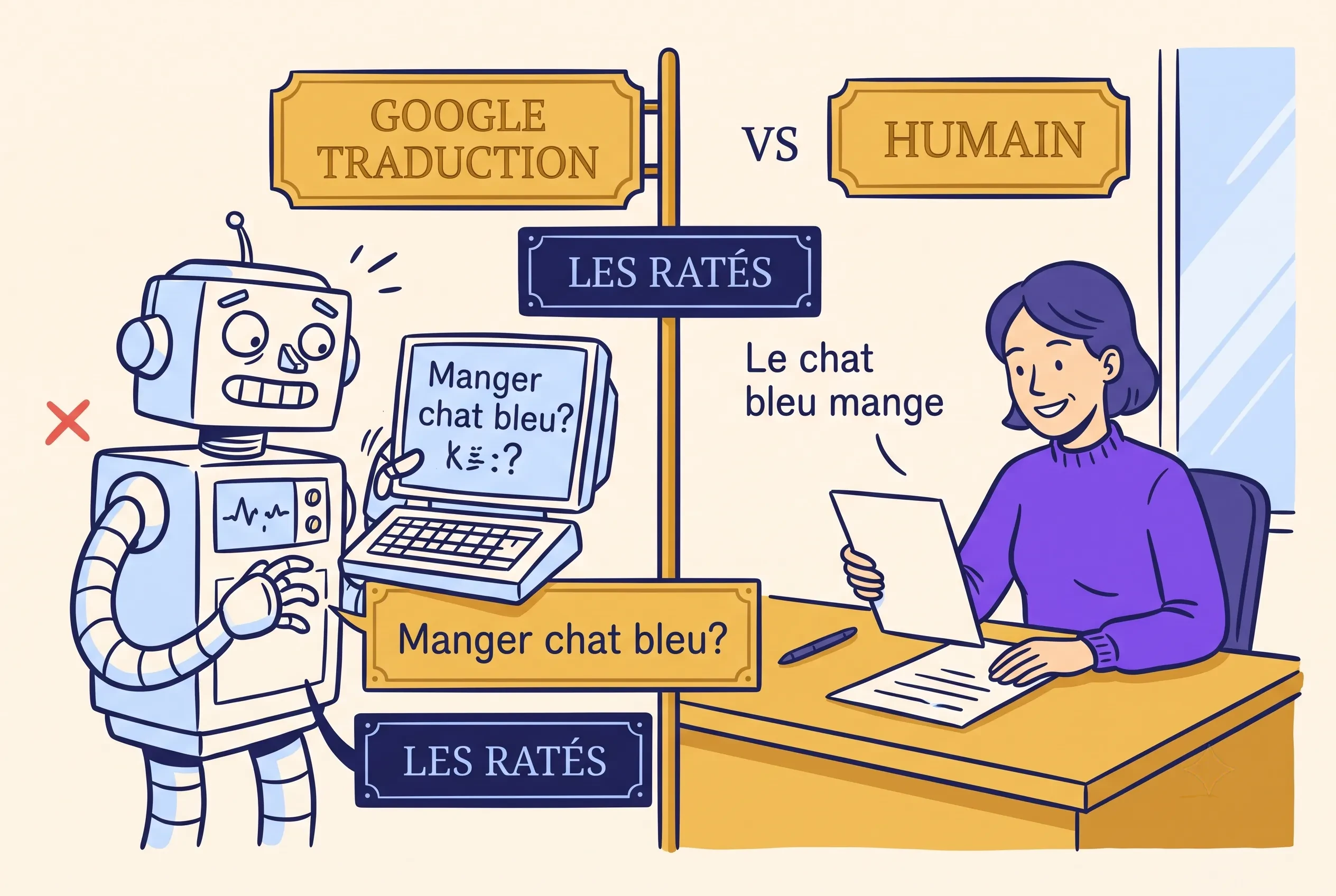
A fluent-looking translation can still change the meaning or tone. The examples illustrate problems to check for, rather than fixed outputs from a tool that changes over time. Follow the revision steps with your own text.
Check false friends and ambiguous words
False friends resemble words in another language but have different meanings. A translation tool may handle them correctly, especially with sufficient context. The examples below illustrate misleading readings to watch for; they are not a benchmark of current Google Translate outputs.
Google: “I am actually working on this project.” ❌
Correct: “I am currently working on this project.” ✓
“Actuellement” = currently. The mistranslation inverts the emphasis entirely.
Google: “He was blessed in the accident.” ❌
Correct: “He was injured in the accident.” ✓
“Blessé” = injured. In a medical context, this error could cost someone appropriate care.
Google: “I have an appointment with my avocado.” ❌
Correct: “I have an appointment with my lawyer.” ✓
“Avocat” = both lawyer and avocado. Short sentences give insufficient context.
Google: “The location of this apartment is expensive.” ❌
Correct: “The rent for this apartment is expensive.” ✓
“Location” = rental. The moving to France guide covers the full administrative vocabulary.
Why the algorithm fails on false friends
Machine translation uses patterns learned from language data, and additional context can change a result. Check the intended meaning and grammatical role rather than assuming that a familiar-looking word has the meaning you expect.
Compare idiomatic and literal meaning
An idiom's meaning may differ from the literal meaning of its words. Translation tools can recognise many idioms, but you still need to check the context and tone. Compare a literal rendering with the intended message in the examples.
🇫🇷 “Coûter les yeux de la tête.” → Google: “Cost the eyes of the head.” ❌ → Correct: “Cost an arm and a leg.” ✓
Different body parts, same meaning. The leap is cultural, not linguistic.
🇫🇷 “Avoir d’autres chats à fouetter.” → Google: “Have other cats to whip.” ❌ → Correct: “Have other fish to fry.” ✓
Same concepts. Different animals. The translation sounds like a threat instead of a polite exit.
- “Tomber dans les pommes.” → Google: “Fall in the apples.” ❌ → Correct: “Faint.” ✓
- “Ce n’est pas la mer à boire.” → Google: “It’s not the sea to drink.” ❌ → Correct: “It’s not that hard.” ✓
- “Mettre son grain de sel.” → Google: “Put his grain of salt.” ❌ → Correct: “Put in his two cents.” ✓
For a legal, medical or other consequential text, use an appropriately qualified reviewer. The level of review should match the consequences of an error; a fluent-looking sentence is not proof of accuracy.
Check grammar, reference and register
“Ne…que” = “only.” Google reads “ne” as negation and produces the opposite meaning.
Google: “Please accept my distinguished greetings.” ❌ → Correct: “Yours sincerely.” ✓
The work culture guide covers the formulas machines cannot translate.
- “Il fait beau.” (isolated) → Google: “He is handsome.” ❌ → Correct: “The weather is nice.” ✓
- “On y va ?” → Google: “We go there?” ❌ → Correct: “Shall we go?” ✓
- “Je viens de manger.” → Google: “I come from eating.” ❌ → Correct: “I just ate.” ✓
Google: “The doctor arrived. He examined the patient.” ❌ → Correct: “She examined the patient.” ✓
“Elle” = feminine. Google defaults to “he” for doctor. Training data bias reflects corpus assumptions, not the French original.
The back-translation test
Back-translation can reveal a possible problem, but it is not a test of correctness. A correct translation may return different wording, and two translations may repeat the same mistake. Compare the result with the intended meaning and verify key terms independently.
Match the review to the purpose of the text
| Purpose | What to check |
|---|---|
| Everyday gist | Check names, numbers and the main request |
| Menus and ingredients | Verify ingredients and anything relevant to an allergy |
| Instructions | Confirm actions, negation and sequence |
| Work messages | Review meaning, recipient and register |
| Humour and idioms | Check the intended meaning and effect |
| Legal or medical text | Obtain appropriately qualified review |
Use complementary checks: a dictionary for definitions and grammatical information, and contextual examples for usage. Comparing another translation can reveal alternatives, but agreement between tools does not prove that the wording fits your situation.
The deeper problem is dependency itself. Stopping the mental relay and the four-part routine that replaces it are the two halves of one repair: take the habit out, put something in its place, or it is back by Friday. And a good share of what people paste in is not unknown vocabulary at all, only vocabulary they have never heard. Attach the sounds to the words and the tab stops opening.
Stop guessing where Google gets it wrong
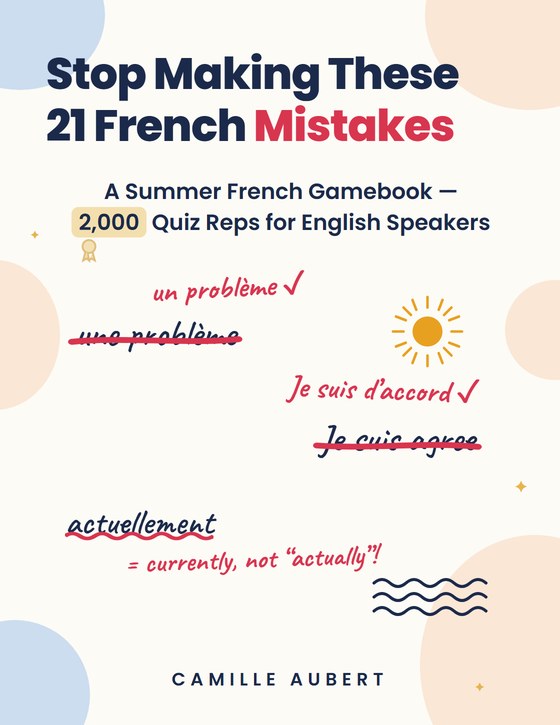
Keep a short reference list of the distinctions you personally need to check: false friends, verb forms and register. The free cheat sheet pack offers nine reference sheets to support that review.
A safe workflow: how to sanity-check a machine translation
Machine translation is fine for gist and risky for anything that has to be correct. When the stakes are real — an email to a landlord, a message to a French colleague — run this four-step check before you send.
1. Compare the meaning. Check who does what, the time reference, negation and any conditions. Back-translation may flag a difference, but it cannot certify the result.
2. Check the register. Confirm that tu or vous and the level of formality match the recipient and relationship.
3. Check ambiguous words. Verify familiar-looking terms in a dictionary and in the context of your sentence.
4. Verify the key word in a real dictionary. For any single word that carries the message, confirm it in a context tool like Linguee or a monolingual dictionary before trusting it.
Study glossary: translation vocabulary
| 🇫🇷 French | 🇺🇸 English | 💡 Context |
|---|---|---|
| Traduction automatique | Machine translation | Google Translate, DeepL |
| Faux ami | False friend | Words that look alike but differ |
| Expression idiomatique | Idiom | Figurative phrase, not literal |
| Registre | Register | Formal vs informal language level |
| Traduction littérale | Literal translation | Word-for-word, usually wrong |
| Rétro-traduction | Back-translation | Translate back to verify accuracy |
| Nuance | Nuance | Subtle meaning machines miss |
| Langue source / cible | Source / target language | Original vs translation language |
| Contexte | Context | What determines correct meaning |
| Ambiguïté | Ambiguity | Multiple meanings (avocat = lawyer/avocado) |
Prefer to keep it free today? Read the French Briefing →
Use your French in a real conversation.
Bring a question from a guide to a French tutor. Try it aloud, ask for feedback and leave with something to practise.
Find a French tutor →Paid lessons. Compare tutors and prices before booking.
Affiliate link: we may earn a commission when you book.
📚 Keep building in the Learning Center
italki vs Preply for French: Lessons and Costs Compared
Compare italki and Preply for French lessons: payment models, tutor choice, trials and cancellation rules. Choose according to…
Read →French Learning Apps Compared: Choose by Your Goal
Compare French learning apps for drills, listening, conversation and feedback. Understand their limits and choose a tool that…
Read →How to Think in French: Exercises for Everyday Practice
Practise thinking in French with short narration, familiar word groups and focused listening. Build direct associations without banning…
Read →