French for Shy Beginners: How to Start Speaking Without Feeling Stupid
You’ve been studying French for months but freeze when actual French people talk to you. Your heart races. Your mind goes blank. You suddenly “forget” every word you’ve learned. Shyness and fear of embarrassment keep you silent while confident beginners make mistakes fearlessly and improve faster. This complete guide gives shy learners specific psychological strategies, ultra-safe starter phrases, progressive confidence-building techniques, and realistic practice methods that eliminate the paralysis of perfectionism so you can finally start speaking French without the crushing anxiety.
Why shy people struggle more with speaking French
You’re not alone. Studies show 30-40% of language learners identify as shy or anxious about speaking. The problem isn’t your French ability. The problem is that shyness creates a vicious cycle that prevents practice, which prevents improvement, which reinforces anxiety.
Here’s what happens in your brain when you try to speak French as a shy beginner: You think of something to say in English. You try to translate it to French. You worry the translation is wrong. You imagine the listener judging you. Your anxiety spikes. Your working memory (the mental space needed for language processing) gets hijacked by fear. You actually can’t access vocabulary you know. You give up and stay silent.
Confident beginners experience the same uncertainty about correctness. But they speak anyway. They make mistakes, get corrected, learn, and improve. Shy learners avoid speaking to avoid mistakes. This feels safer but guarantees slower progress.
The perfectionism trap that keeps shy learners silent
Shy language learners often have perfectionist tendencies. You want to speak correctly, so you don’t speak until you’re sure. But certainty never comes. There’s always another grammar rule to master, more vocabulary to learn, better pronunciation to achieve. Perfectionism creates analysis paralysis.
Most French textbooks are written by native speakers who’ve forgotten what confuses beginners. They explain grammar assuming you already think like a French person.
Roger learned French as an adult after growing up with English and German. He remembers exactly which explanations clicked and which ones left him confused. The FrenchToEnglish approach was built from those memories, including specific strategies he developed to overcome the speaking anxiety that nearly made him quit learning French during his first months in France.
Why mistakes feel more painful for shy learners
When confident learners make mistakes, they laugh it off. When shy learners make mistakes, they replay the moment for days, feeling mortified. This difference isn’t about French ability. It’s about how you process social feedback.
Shy people have hyperactive threat detection systems. Your brain treats linguistic mistakes as social threats. Small errors trigger disproportionate shame. This made sense evolutionarily (social rejection meant death in tribal societies) but doesn’t serve you now. French people won’t reject you for saying “je suis” instead of “j’ai” when talking about age. Your brain thinks they will. That’s the problem.
The psychology of overcoming speaking fear
Before learning phrases, you need to understand and rewire the mental patterns keeping you silent.
Cognitive reframe #1: Everyone expects you to make mistakes
The truth shy learners miss: French people know you’re learning. They expect mistakes. They make mental allowances. They’re not judging you nearly as harshly as you judge yourself.
Proof: Think about when someone speaks broken English to you. Do you judge them harshly? No. You’re impressed they’re trying. You help them. You appreciate the effort. French people feel the same way about you.
Cognitive reframe: Replace “They’ll think I’m stupid” with “They’ll appreciate I’m trying to speak their language.”
Cognitive reframe #2: Mistakes are required for learning
Scientific fact: Your brain learns languages through hypothesis testing. You guess at how to say something. You get feedback (explicit corrections or confused faces). Your brain updates its model. Mistakes aren’t failures – they’re data points required for learning.
The shy learner’s error: Trying to eliminate mistakes before speaking. Impossible. You must make mistakes while speaking to improve speaking.
Cognitive reframe: Replace “I need to avoid mistakes” with “I need to make mistakes so my brain can learn from them.”
Cognitive reframe #3: Silence is more noticeable than imperfect French
Shy learner assumption: Staying silent is safer than speaking badly.
Reality: Silence in conversational contexts makes you more conspicuous. Speaking imperfect French is normal and expected. Not speaking at all is odd and creates awkwardness.
Example: In a French café, “Un café, s’il vous plaît” with terrible pronunciation gets you coffee and respect for trying. Pointing silently at the menu while avoiding eye contact makes staff uncomfortable and marks you as refusing to engage.
Cognitive reframe: Replace “Speaking badly will draw negative attention” with “Silence draws more negative attention than imperfect French.”
💡 The 70% rule for shy learners:
Confident speakers aim for 70% accuracy and speak constantly. Shy speakers aim for 95% accuracy and speak rarely. The confident speakers improve faster because they practice 10x more.
Your new rule: If you’re 70% sure you know how to say something, say it. Accept that 30% of the time you’ll need correction. That’s how learning works.
Ultra-safe starter phrases for your first attempts
These phrases are psychologically safe because they’re universally accepted, very short, and nearly impossible to pronounce so badly that French people won’t understand.
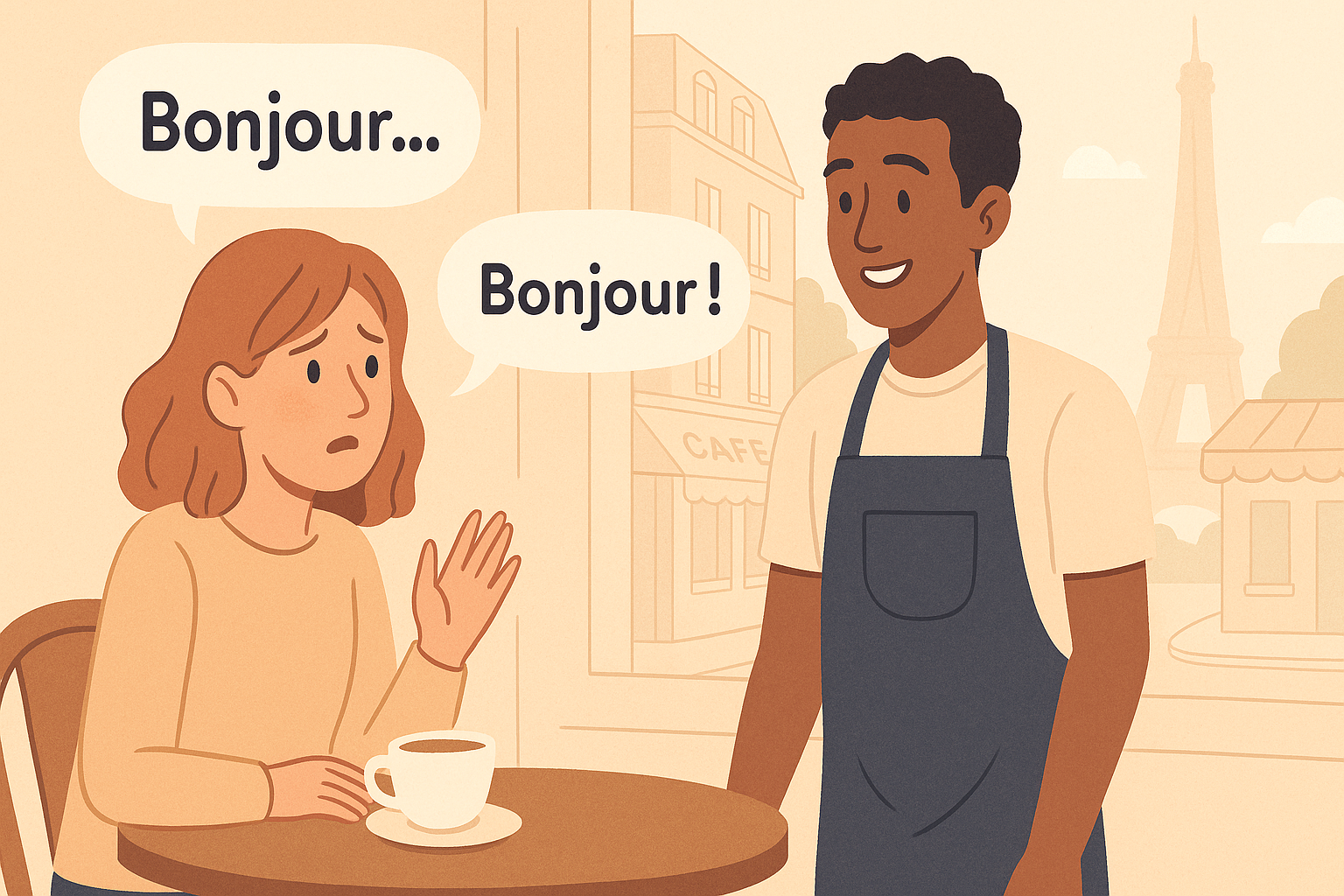
The universal opener (works everywhere, always)
🇺🇸 EN — Hello/Good morning/Good afternoon
Why it’s safe: Two syllables. No grammar. No conjugation. Impossible to use wrong. French people say it 50 times daily. You can’t mess this up.
When to use it: Entering shops, starting conversations, acknowledging people, before every request. Use it compulsively. It’s your safety phrase.
Pronunciation: /bɔ̃ʒuʁ/ – “bone-ZHOOR” (the “r” is soft, in the throat)
Shy learner strategy: Make “Bonjour” your automatic first word in any French interaction. This breaks the silence barrier with zero risk. Once you’ve said one word successfully, the second word is easier.
The universal safety net
🇺🇸 EN — Excuse me
🇺🇸 EN — Sorry/Pardon me
Why these are safe: These phrases frame you as polite and apologetic, which French culture values highly. Even if your next sentence is grammatically terrible, you’ve already established yourself as respectful.
Strategic use: Start difficult requests with “Excusez-moi” to buy yourself psychological safety and signal politeness before attempting harder phrases.
The essential request phrase
🇰🇺🇸 EN — Please
Why it’s safe: Adding “s’il vous plaît” to any request makes it polite. You can point at things and say this phrase, and French people will help you even if you say nothing else.
Minimum viable transaction: “Bonjour” + [point at item] + “s’il vous plaît” = successful purchase with only two French phrases.
The gratitude phrases
🇺🇸 EN — Thank you
🇺🇸 EN — Thank you very much
Why these are safe: Short, universally positive, impossible to use inappropriately. Even with bad pronunciation, French people understand and appreciate gratitude.
Shy learner advantage: Ending interactions with “Merci” gives you a confident exit. You’ve participated in French, completed the interaction successfully, and can leave feeling accomplished rather than anxious about whether to continue.
The conversation ender
🇺🇸 EN — Goodbye
🇺🇸 EN — Have a good day
Why these are safe: They signal clear interaction endings. For shy learners, knowing how to exit conversations confidently reduces anxiety about being “trapped” in conversations you can’t handle.
💡 The five-phrase challenge for week one:
Your only goal for week one: Use these five phrases in real situations: 1. Bonjour (entering shops) 2. S’il vous plaît (when asking for things) 3. Merci (after receiving things) 4. Excusez-moi (before asking questions) 5. Au revoir (when leaving)
That’s it. No complex sentences. No conjugations. Just five ultra-safe phrases. Once you’ve used each phrase successfully 10 times, you’ll have conquered the initial fear barrier.
Progressive exposure – building confidence gradually
Jumping from silence to full conversations guarantees failure for shy learners. You need structured progression.
Level 1: Transactional interactions (weeks 1-2)
What these are: Scripted interactions with predictable responses. Ordering food, buying items, asking simple directions.
Why they’re perfect for shy beginners: You know exactly what will happen. The interaction has a clear beginning, middle, and end. The French person expects your role (customer) and plays their role (server/shopkeeper). Mistakes don’t derail the interaction.
Starter transactions:
🇺🇸 EN — A coffee, please
🇺🇸 EN — I would like a baguette
🇺🇸 EN — How much does it cost?
🇺🇸 EN — The bill, please
Practice strategy: Same transaction daily. Order coffee the same way every morning for a week. Familiarity reduces anxiety. Success builds confidence.
Level 2: Asking simple questions (weeks 3-4)
What changes: Now you initiate communication beyond transactions. You ask for information. Responses are less predictable.
Why this is the next step: Questions have built-in forgiveness. If you ask incorrectly, people still try to help. Questions signal you’re engaging with French culture, which French people appreciate.
Safe question starters:
🇺🇸 EN — Where is…?
🇺🇸 EN — Where are the toilets?
🇺🇸 EN — How much is it?
🇺🇸 EN — What time is it?
🇺🇸 EN — Do you have…?
Anxiety management: Write your question on your phone before asking. If you freeze, show your phone. French people will read it and help. This backup reduces performance anxiety.
Level 3: Making statements about yourself (weeks 5-6)
What changes: You share information, not just request or ask. This requires more grammar (verb conjugation, adjectives) but deepens interactions.
Why this matters: Statements about yourself invite conversation. French people respond, ask follow-up questions, create connection.
Safe personal statements:
🇺🇸 EN — I’m American (male/female)
🇺🇸 EN — I’m on vacation
🇺🇸 EN — I’m learning French
🇺🇸 EN — I like Paris
🇺🇸 EN — It’s my first visit
Psychological benefit: Saying “J’apprends le français” (I’m learning French) immediately explains any mistakes you make. French people become more patient and helpful once they know you’re actively learning.
Level 4: Expressing preferences and opinions (weeks 7-8)
What changes: You move beyond facts to preferences. This requires more vocabulary and confidence in your right to have opinions in French.
Starter opinion phrases:
🇺🇸 EN — I really like…
🇺🇸 EN — I prefer…
🇺🇸 EN — It’s delicious
🇺🇸 EN — It’s very beautiful
🇺🇸 EN — It’s interesting
Specific strategies for shy personality types
Not all shyness is identical. Different shy profiles need different strategies.
For perfectionists
Your challenge: You won’t speak until you’re certain you’ll say it correctly. This certainty never arrives.
Strategy: Implement the “good enough” rule. If you’re 60% sure, speak. Track how often your 60% certainty produces successful communication. You’ll discover most “risky” attempts work fine.
Reframe: Replace “I need to say this perfectly” with “I need to communicate the message. Perfect grammar is optional.”
For social anxiety sufferers
Your challenge: All social interaction triggers anxiety, not just French. Language barriers compound existing anxiety.
Strategy: Start with transactional interactions where your customer role is clear. Shopkeepers expect certain behaviors from customers. This structure reduces social ambiguity that triggers anxiety.
Gradual exposure: Same café, same order, daily. Familiarize the social environment before expanding vocabulary.
For introverts
Your challenge: Conversations drain energy. Extended French practice feels exhausting, leading to avoidance.
Strategy: Practice French in your already-necessary interactions. Don’t add extra social events to practice. Just convert your existing transactions (coffee orders, grocery shopping) to French practice.
Energy management: Three 2-minute French interactions (morning coffee, lunch order, evening grocery) drain less energy than one 20-minute language exchange.
For people-pleasers
Your challenge: You fear inconveniencing French speakers with your slow, imperfect French. You switch to English to “save them time.”
Strategy: Recognize that French people in service roles are paid to serve you. Speaking French isn’t inconveniencing them – it’s their job. Your French practice is legitimate use of their professional time.
Reframe: Replace “I’m bothering them” with “I’m engaging in normal customer-service provider interaction.”
Managing mistakes and embarrassing moments
You will make embarrassing mistakes. Here’s how to handle them without spiraling into shame.
⚠️ Common embarrassing mistake #1: Gender confusion
You’ll say “le” when you mean “la” constantly. You’ll call croissants feminine and baguettes masculine. French people will understand perfectly and either gently correct you or ignore it.
What to do: Thank them for the correction and move on. Don’t apologize profusely. Don’t explain why you got it wrong. Just say:
🇺🇸 EN — Ah yes, thank you
Why this works: Brief acknowledgment shows you heard them without turning the correction into a big moment. Conversation continues normally.
⚠️ Common embarrassing mistake #2: Saying something accidentally rude
You’ll use “tu” instead of “vous” with strangers. You’ll forget “s’il vous plaît.” You’ll directly translate English politeness that sounds rude in French.
What to do: If you realize immediately, correct yourself. If someone looks offended, apologize simply:
🇺🇸 EN — Sorry, I’m sorry
Then add:
🇺🇸 EN — I’m a beginner in French
Why this works: Acknowledging you’re learning explains the mistake without over-apologizing. Most French people immediately become helpful once they understand you’re a genuine learner, not a rude tourist.
⚠️ Common embarrassing mistake #3: Complete brain freeze mid-sentence
You start a sentence. Halfway through you forget the verb. You stand there mouth open, silence growing, panic rising.
What to do: Use one of these rescue phrases:
🇺🇸 EN — How do you say…?
🇺🇸 EN — Um… I don’t know the word
🇺🇸 EN — Wait… I’m looking for the word
Why this works: These phrases fill the silence while signaling you’re still engaged. French people will often help supply the word you’re searching for.
⚠️ Common embarrassing mistake #4: Nobody understands your pronunciation
You try three times. The French person still looks confused. You feel stupid. They feel awkward.
What to do: Have backup communication methods:
- Write it down
- Show a picture on your phone
- Point at something similar
- Use Google Translate’s text display
Then say:
🇺🇸 EN — My pronunciation isn’t good
Why this works: Switching to visual communication removes the pronunciation barrier while acknowledging the difficulty. Most French people appreciate this problem-solving approach.
💡 The 24-hour rule for embarrassing moments:
When you make an embarrassing mistake, your brain will want to replay it endlessly. Set a timer for 24 hours. You’re allowed to think about it and feel embarrassed for 24 hours. After that, the incident is permanently archived. No more rumination.
This sounds artificial but works. Giving yourself permission to feel embarrassed for a limited time prevents the endless replay loop that makes shy learners avoid speaking again.
Practice methods that don’t require human interaction
For extremely shy learners, practicing alone builds confidence before attempting real conversations.
Self-talk practice
What to do: Narrate your actions in French as you do daily tasks.
🇺🇸 EN — I’m making coffee
🇺🇸 EN — I’m reading a book
🇺🇸 EN — I’m preparing dinner
Why it works: Zero performance pressure. You get used to producing French sounds without judgment. Builds automaticity in common verb patterns.
Progression: Start with present tense actions. Add descriptors. Then add opinions about what you’re doing. Build complexity gradually.
Recording practice
What to do: Record yourself saying phrases, listen back, identify problems, re-record.
Why it works: You hear yourself as others hear you. This reveals pronunciation issues you don’t notice while speaking. No audience means no anxiety.
Structure: Record five phrases daily. Listen. Note one thing to improve. Re-record. Track progress over weeks.
Shadowing native speakers
What to do: Play French audio (podcast, video, audiobook). Repeat immediately after the speaker, mimicking rhythm and intonation.
Why it works: You practice the physical act of speaking French without needing to generate language. Your mouth gets used to French sounds and rhythms.
Best for shy learners: Start with podcasts for learners (slower, clearer). Progress to native-speed content once comfortable.
Written-then-spoken practice
What to do: Write out conversations you want to have. Perfect them. Read them aloud multiple times. Use these as scripts in real situations.
Why it works: Preparation reduces anxiety. You’re not improvising – you’re performing a script you’ve practiced. Success rate is much higher.
Example preparation: Write out your coffee order including possible variations. Practice at home 10 times. Use it in real café. Confidence increases with preparation.
Study glossary – Confidence-building vocabulary
| FR | EN | Usage Context |
|---|---|---|
| J’apprends le français | I’m learning French | Explains mistakes, invites patience |
| Je suis débutant(e) | I’m a beginner | Sets expectations for interaction |
| Parlez lentement, s’il vous plaît | Speak slowly, please | Request for accommodating speech |
| Je ne comprends pas | I don’t understand | Signals need for clarification |
| Répétez, s’il vous plaît | Repeat, please | Request to hear again |
| Comment dit-on… ? | How do you say…? | Ask for vocabulary help |
| Qu’est-ce que ça veut dire ? | What does that mean? | Ask for definition |
| Pouvez-vous écrire ça ? | Can you write that? | Request written form |
| Je fais des erreurs | I make mistakes | Acknowledge imperfection |
| Corrigez-moi, s’il vous plaît | Correct me, please | Invite helpful corrections |
| Merci pour votre patience | Thank you for your patience | Show appreciation |
| Je vais réessayer | I’m going to try again | Shows persistence |
Your 30-day confidence-building roadmap
These techniques work, but they work faster with structured learning designed for English speakers. Roger’s approach teaches you how to rewire your English-speaking brain for French patterns.
Here’s your realistic 30-day plan for shy beginners:
Days 1-7: Safety phrase mastery – Use only the five ultra-safe phrases (Bonjour, S’il vous plaît, Merci, Excusez-moi, Au revoir) in real situations. Goal: 20 successful uses of each phrase. Success builds confidence for week two.
Days 8-14: Transactional practice – Add simple transactions. Order coffee the same way daily. Buy baguette with same phrase. Success rate will be near 100% because transactions are scripted. Your brain learns “French interactions can succeed.”
Days 15-21: Question expansion – Add three simple questions to your repertoire. “Où est…?”, “C’est combien?”, “Vous avez…?” Use each question at least five times. Accept that you might not understand full answers – that’s normal.
Days 22-30: Personal statement addition – Add statements about yourself. “Je suis américain(e)”, “J’apprends le français”, “C’est ma première visite”. These invite conversation. Practice with friendly service workers who seem patient.
The goal isn’t fluency in 30 days. The goal is breaking the silence barrier with zero-risk phrases, building confidence through repeated success, then gradually expanding your comfort zone through structured progression.
Shy learners who follow this progression report feeling “normal” speaking basic French by day 30. Not fluent. Not confident in all situations. But normal – not paralyzed by fear. That’s the foundation everything else builds on.
Your shyness doesn’t disappear. But it stops controlling whether you speak. You develop coping strategies: backup phrases, written notes, willingness to look imperfect. These strategies let shy people achieve the same fluency as confident people. It just takes a slightly different path.
Remember: Confident beginners aren’t less afraid. They just speak despite fear. You can learn this skill. The fear lessens with exposure, but you don’t need to wait for fearlessness to start speaking. Start speaking despite fear. The fear diminishes through action, not before it.