French Games Online: Seven Formats and What to Do After Playing
Online French games vary in what they practise and how they handle feedback. Assess a browser activity, check its practical limits and build a short routine that connects on-screen choices with French you can use independently.
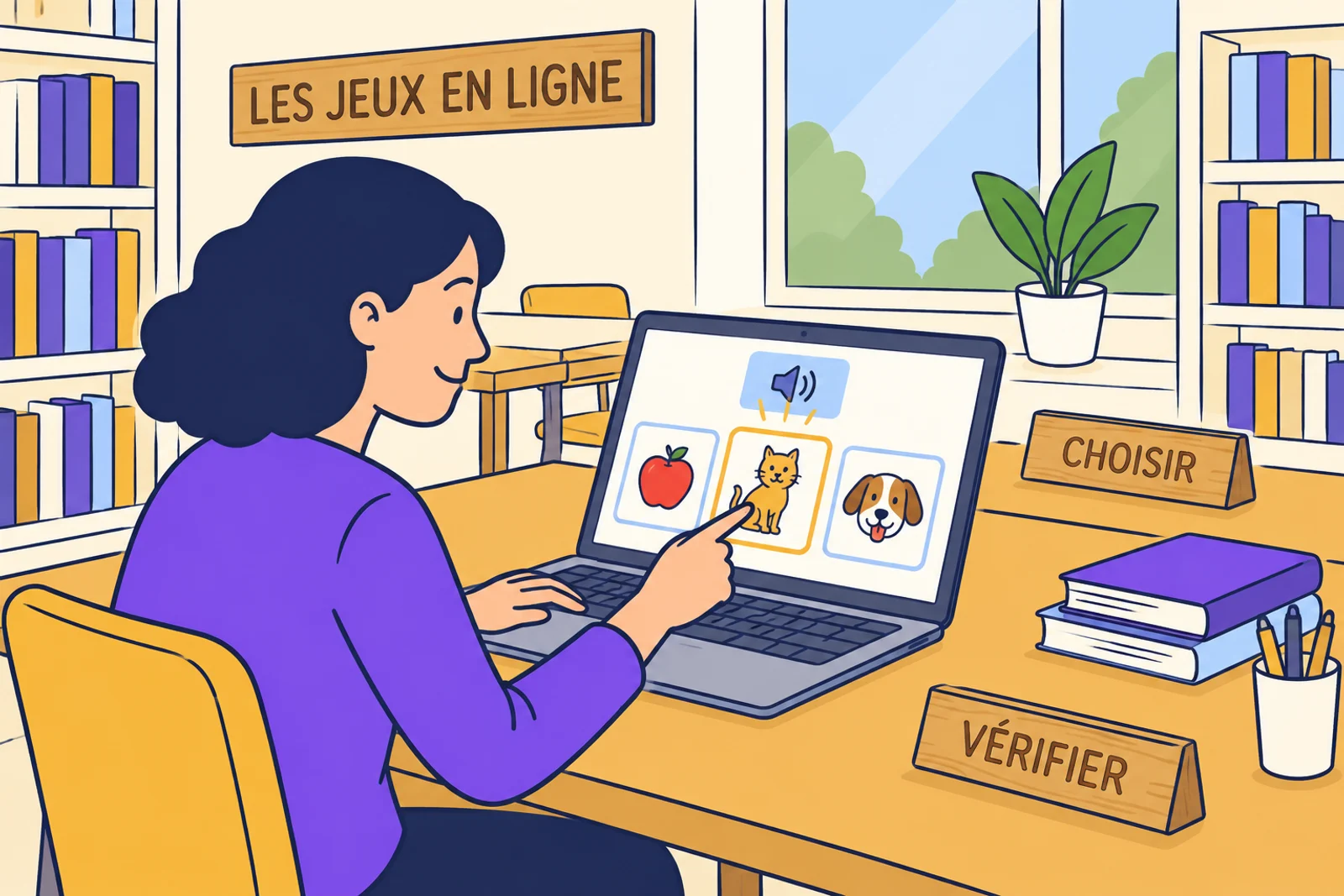
Online French games are easy to start. Choosing the right kind takes a little more thought. A spelling puzzle, a listening quiz and a role-play may all be enjoyable while exercising different parts of your French.
This guide compares seven formats rather than claiming to have tested seven commercial products. For a broader selection method, read the French learning games guide. The exercises below are suggestions you can apply to a resource you already use.
Start with three focused quiz formats
1. Grammar choice. Choose the correct form in a sentence. Look for enough context to make the decision meaningful. After checking the answer, write a related sentence without options. This extra step distinguishes recognising the answer from producing the pattern.
2. Listening choice. Listen for a detail such as a number or location. After answering, repeat what you heard and compare it with any available transcript. If you replayed several times, note that; a score alone may conceal the amount of support you used.
3. Meaning in context. Read a short sentence and select its meaning. Review the word that changed the interpretation. Avoid treating every unfamiliar word as equally important when one negation or date determines the answer.
The useful detail is the corrected day. A game question should reward understanding that relationship, not merely recognising a weekday.
Format one: inspect the clue before choosing
In a grammar-choice game, begin by identifying what the sentence asks you to distinguish. It may be a subject, a meaning contrast or an expression. If you answer only by the visual familiarity of an option, you may obtain a correct result without understanding the intended clue.
Try this original item: “Nous ___ faim.” The options are avons and sommes. The intended answer is avons because the expression is avoir faim. The subject nous then determines the form. Explain both parts before moving on: the expression and the conjugation do different jobs.
Now hide the options and say “You are hungry” using vous. Check “Vous avez faim”. If you cannot retrieve avez, the recognition round has identified a production task. Keep that result separate from the original correct choice. The follow-up asks more of you than clicking the visible answer.
When evaluating a browser game, see whether the correction explains the distinction or simply highlights an option. Both can tell you the intended answer, but only the explanation directly supplies the reason. If the game gives no explanation, plan how you will check the rule through a reliable lesson or teacher.
Avoid turning a single sentence into a universal translation rule. Avoir faim is a specific expression; it does not mean every English sentence with “be” should use avoir in French. Good review keeps the explanation connected to checked examples and identifies the boundary of what you have learned.
Format two: make a listening record that includes support
Choose a short listening item where the sound contains information needed for the answer. Listen once and record your response before replaying. Then use additional playback or a transcript if available. Note which support helped, because the final score may not distinguish a first hearing from several supported attempts.
For an original practice task, ask a partner to read one of two sentences: the appointment is Tuesday, or the appointment is Thursday. Your job is to identify the day. Keep the time and location out of the first round so the result concerns the contrast you intended to practise.
After checking, repeat the whole short sentence. This does not make pronunciation and listening the same skill, but it gives you another way to inspect the phrase. If you cannot distinguish the sound, slow down, compare with a reliable model and ask for help where needed.
Add a second detail only after the first task is manageable. You might include a time, then ask which day and time were given. If you miss one part, record it specifically. “Understood Thursday but missed the hour” is a more useful review note than “failed listening”.
When using an online activity, confirm that the audio actually plays on your device before interpreting any score. A silent or failed recording is a technical problem, not evidence about your French. Follow the resource's instructions for playback and use an accessible alternative if the format does not work for you.
Format three: read for the relationship between details
Meaning-in-context questions often depend on a small word that changes the relationship between two facts. A negation, alternative or time expression can be more important than a long noun you do not yet know. Begin by asking what happened in the sentence, not by collecting every unfamiliar word equally.
Use the appointment example above. The sentence rejects Monday and replaces it with Tuesday. A response that simply mentions Monday shows recognition of a word but misses the correction. Explain the relationship in English, then identify the French wording that carries it.
Create a checked variation with two other days. Keep the same structure so you can concentrate on meaning. Then ask a partner to choose one version without showing it. Your answer should identify the actual appointment day, not the first day mentioned.
Inspect how the game handles a wrong answer. Does the feedback show the relevant phrase? Can you return to the sentence? If the activity only advances to another item, keep a brief note of the contrast you need to revisit. Do not guess the explanation from the colour of a button alone.
This format can support reading practice without being a complete reading assessment. A short sentence-choice score says little about how you manage a long unfamiliar text. Use the activity for its specific task and add longer reading when that is the skill you want to investigate.
Try three production and vocabulary formats
4. Word recall. Retrieve a word from a definition or situation. Add its article and a short phrase where useful. If spelling and meaning are assessed separately, keep both results rather than collapsing them into one score.
5. Sentence reconstruction. Put a sentence in order. Then hide the tiles and reproduce it. Tile order can provide hints that disappear in actual writing, so the second attempt adds a useful check.
6. Word puzzle. Solve clues or spelling patterns. Confirm the meaning and use of any unfamiliar solution. A correct sequence of letters is only one part of knowing the word.
For deeper vocabulary work, use the vocabulary-games guide. For written puzzles and clue-building, see French word games.
Format four: define what a complete recall answer includes
Before starting a word-recall activity, decide what you want to retrieve. A noun may need its article and spelling. A phrase may need the whole expression. A definition prompt may allow several reasonable answers, so check how the resource handles alternatives before treating every mismatch as an error.
For an original small set, use a book, a table and a question: un livre, une table and une question. Hide the French and retrieve each noun with its article. Then use one in a short checked phrase. The article belongs in the recall task rather than being added only after you have already declared the answer correct.
Record different difficulties separately. You may know the meaning but miss the spelling, or recall the noun but hesitate over the article. Those observations suggest different follow-ups. Copying a translation again may not address the exact point where your answer became uncertain.
If a game supplies a picture, inspect whether it clearly identifies the intended object. A picture of a room can contain many possible nouns. If your answer is reasonable but differs from the key, use the prompt and explanation to understand the intended scope rather than assuming your word is invalid.
After the round, retrieve one word from a new clue. This checks whether the original picture or card position was doing much of the work. Keep the new clue fair and verifiable. A recall game should make you retrieve language, not guess what an ambiguous drawing means to its author.
Format five: remove the tiles after reconstruction
Sentence reconstruction gives you pieces of a sentence and asks you to arrange them. The tiles supply useful support: the words are visible, and their number may suggest the structure. A successful arrangement therefore differs from writing the same meaning with no words provided.
Try arranging “voudrais / une / je / question / poser” into “Je voudrais poser une question”. Check the sentence and its meaning. Then hide the tiles and write the request from the English intention. If you need to look back, note which part was unavailable.
Next, use a checked variation such as “Je voudrais parler à quelqu'un”. Compare the shared structure and the changed expression. Do not assume that any word can replace any tile without affecting the rest of the sentence. The variation should preserve a meaning you understand and language you can verify.
In an online activity, look at how punctuation and capitalisation are handled. Some interfaces supply these automatically, while others require you to choose them. Know what the game actually assessed before interpreting the result as evidence about independent writing.
For a useful follow-up, say the reconstructed sentence in a short role-play. A partner can answer with a simple question. This adds a conversational demand beyond tile order. Keep both results: you may arrange the sentence accurately while still needing help understanding the reply.
Format six: connect the puzzle solution to meaning
A word puzzle can ask you to recognise a spelling, solve a clue or find a hidden sequence. Identify which of those tasks the activity actually requires. Finding letters in a grid may be possible without knowing the word, while a definition clue makes meaning more central to the decision.
After solving an unfamiliar word, check its meaning and typical context through a reliable source. Add its article where appropriate and use a short checked phrase. Do not assume that a correct letter sequence gives you every detail needed to use the word naturally in conversation.
If you create your own clues, make them specific enough to support the intended answer. A clue such as “something in a room” has many possibilities. A more precise description can reduce ambiguity, but you should still accept suitable alternatives or revise the clue when another player finds one.
Use spelling patterns as observations to investigate, not universal rules inferred from one puzzle. If two words share an ending, that does not automatically establish identical meaning, gender or pronunciation. Check the feature you want to learn before turning the pair into a flashcard rule.
A puzzle can remain enjoyable while you add only one follow-up. Choose a few useful words rather than writing a paragraph for every solution. The aim is to connect the activity to language use at a size you will actually repeat.
Use a scenario as the seventh format
7. Branching situation. Read a situation, choose a response and examine its consequence. Ask whether the feedback explains language, social context or both. A polite response can be grammatically correct but fail to answer the actual question.
Try this original scenario: someone asks whether you can wait ten minutes. A useful reply acknowledges the wait and asks where to stand. A response about tomorrow's opening hours ignores the immediate task.
Then practise an alternative: you cannot wait. Explain that politely and ask for another option. The goal is a response matched to your actual intention.
Format seven: choose a response that fits the intention
In a branching scenario, the best response depends on what you are trying to do and what the other person has said. A grammatically correct sentence can be irrelevant to the moment. Begin by identifying the immediate task before selecting the most familiar-looking option.
Use the waiting example. The person asks whether you can wait ten minutes. If you can, you may acknowledge that and ask where to wait. If you cannot, say so politely and ask about another option. The appropriate response changes because your intention changes, not because one sentence is always better French.
Write both versions in English before practising the French. This keeps the meaning clear. Then compare checked model responses and identify which parts express agreement, inability or a request. You are learning conversational functions, not merely a sequence of buttons that leads to a winning ending.
Ask what the feedback evaluates. It may address grammar, politeness, relevance or the scenario's rules. Those are related but distinct. A game can prefer one response for its fictional story without establishing that every other response would be wrong in all real conversations.
After choosing, say your own short response without the options. If the meaning remains appropriate but the wording differs, inspect it fairly. The goal is not always exact reproduction of the game's sentence. It is to express the intended response accurately in the context provided.
Build a two-branch scenario with a partner
Give one player a request and the other two possible responses. For example, the first player wants an appointment; the second can offer one of two days. The first must listen and confirm a suitable option or ask about an alternative. Use fictional details and keep the information separate so the answer is not known in advance.
Run the scenario once, then compare the final notes. Did both players record the same day and time? If not, identify where the information changed or was missed. A short repair question can be added to the next round. This makes the outcome check concrete.
In the second round, change one condition. Perhaps only the other day is available. Keep the vocabulary familiar so the challenge concerns adaptation rather than a completely new topic. Later, add a request for a missing detail if the simple version is manageable.
Do not use real private documents to make the role-play feel authentic. Invented names and references are sufficient for language practice. The task is to ask, listen and confirm; exposing personal information adds no necessary learning value to that sequence.
Review a plausible but unhelpful answer
Imagine that someone asks whether you can return tomorrow, and you answer with a statement about where you live. The sentence may be correct French, but it does not answer the question. A scenario review should identify that mismatch rather than treating grammatical accuracy as the only criterion.
Explain the question in English and state what kind of answer it needs. Then produce a brief appropriate response. If you want to add background, do so after answering the immediate question. This order makes the exchange easier for the other person to follow.
For online scenarios, inspect whether the feedback helps you understand such mismatches. A simple “wrong” message may not reveal whether the issue was grammar or relevance. Keep the full prompt when asking a teacher or reference for clarification so the intended context is not lost.
Check access and feedback
The site's Playground offers short browser activities in several categories. Read the current activity page for its instructions. This article does not claim that playing those activities establishes a certified language level.
Check whether a resource works on your device, whether audio plays, whether corrections remain accessible and whether an account is required.
Do not assume “interactive” means browser-native. A PDF can contain buttons whose behaviour depends on the viewer. Choose the medium that works for your device and practice routine.
Test the controls with a short sample
Before planning a long session, open one activity and inspect its basic controls. Can you start, submit, replay and see the correction? If audio is part of the task, confirm that it works. If text is hard to read or the controls are difficult to use, choose an accessible format rather than interpreting the obstacle as a learning problem.
This article does not claim that every named format works on every device. Resource features and access conditions can change. Use the current activity instructions to establish what the particular game supports, including any account, connection or software requirements.
Keep a technical problem separate from an answer error. A failed submission or silent recording is not evidence about your French. Once the interface works, you can evaluate the language task itself. If it does not, an alternative resource or paper version may be more practical for that session.
Check whether you can return to mistakes
Some activities show corrections only briefly, while others provide a review page. Inspect the actual behaviour of the resource you use. If you want to revisit errors later, determine how you will keep a reference without copying more material than you need for private study.
A small note can identify the topic, item reference and question you have. Preserve enough context to understand the correction later. “Bien, not bon” alone may be unclear after a week; the short sentence or reference to the relevant item makes the note useful.
If the resource does not explain the answer, pair it with a reliable source. Do not assume that repeated exposure to a highlighted option will eventually tell you why it fits. The review should answer the actual uncertainty you recorded during the round.
Inspect account and payment information before committing
If a resource asks you to create an account or pay, read what access is included and what information it requests. Check the current terms rather than relying on a generic article's description. A free sample and a paid subscription may provide different features, so compare the offer you are actually considering.
This guide recommends a way to evaluate formats, not a ranking of commercial platforms or a claim to have tested their privacy practices. Choose a resource whose access and learning features you understand. If something important is unclear, obtain the answer before making the commitment.
For the linked Gamebook, consult the current product page for the PDF contents and compatibility details. A downloadable interactive file is a different format from a browser game. Make that distinction part of the decision if your intended device or workflow depends on browser-only use.
Keep a format comparison based on your own trial
After a short trial, record the task, feedback and follow-up you could complete. For example: a grammar choice gave a clear correction, and you produced one changed sentence. Another activity may have been enjoyable but offered no way to review an uncertain answer. These are observations about your trial, not universal verdicts on the resource.
Use the same questions for each format so the comparison remains useful. Do not compare a five-minute first attempt with a familiar activity you have used for months as though the conditions were identical. Note the difference and choose the next trial accordingly.
The purpose is to find a practical place for the activity in your routine. You might keep one format for short recall, another for listening and a partner scenario for interaction. No single score needs to decide the value of every part of that routine.
Build a balanced session
Choose one recognition activity and one production follow-up. For example, answer a grammar quiz, then write three new sentences. Or complete a listening choice, then ask and answer a related question aloud.
Useful phrases to keep
End with one note about what to revisit. The game-session method provides a repeatable review sequence.
Try a twenty-minute mixed session
Use a few minutes to choose a target and complete a small recognition round. Then inspect one uncertain answer and explain the correction. Spend the next part on a production follow-up: remove the choices, change a detail or answer a short prompt aloud. Finish by recording one next task.
These timings are a suggested structure, not a researched promise of a particular result. Adjust the amount of material to your attention and starting point. If a correction takes longer to understand, reduce the number of items rather than skipping the explanation just to satisfy the clock.
Keep the follow-up connected to the original task. A listening quiz about appointment days can lead to confirming a day aloud. A word-recall game can lead to using the noun in a checked phrase. The connection makes it easier to see what each stage added.
Use a quiet or offline alternative when needed
If you cannot play audio, choose a reading or recall task whose purpose does not depend on hearing. Do not complete a listening activity silently and treat the resulting score as a listening result. You can return to that format when the necessary conditions are available.
If a connection is unreliable, a prepared paper or compatible downloadable exercise may be more practical. Check the actual resource's permitted use and technical requirements. The important point is to preserve the learning task rather than spend the entire session troubleshooting a format that does not suit the moment.
At the next session, review the same language through another appropriate format. This can provide additional evidence about what you can do, but do not assume all formats measure the same skill. Reading a phrase, hearing it and producing it create different demands worth recording separately.
Compare three sample sessions without ranking the learner
In a fictional first session, a learner completes a grammar quiz and recognises most answers. The learner then struggles to write one new sentence without the options. The useful conclusion is that recognition is stronger than production for those examples. The next session can preserve the quiz but add a short recall step.
In a second session, another learner uses a listening game and needs three replays to identify a time. The final answer is correct, and the replay count belongs in the record. A follow-up can inspect the number contrast, then return to a short sentence at ordinary speed. There is no need to label the whole session a failure because support was used.
In a third session, a learner solves a word puzzle quickly but cannot explain two solutions. The puzzle result shows successful letter or clue processing under those conditions. The next task is to check the words' meanings and use one in a phrase. A fast completion time does not answer that separate question.
These fictional examples illustrate how to interpret a task, not measured comparisons between learners or products. Your own notes may show a different pattern. Use the result to select the next exercise rather than forcing every activity onto one ladder of “good” and “bad” French.
Keep a seven-format personal menu
Write the seven formats on a single page and add one purpose beside each. Grammar choice can target a form contrast; listening choice can target a spoken detail; meaning in context can target interpretation. Recall, reconstruction, puzzles and scenarios each add their own demands. Keep the descriptions tied to the actual activities you use.
Mark which formats are practical in your usual study setting. You may have audio available at home but prefer silent practice during a break. You may enjoy typing answers but find a particular interface awkward on a small screen. These are legitimate constraints when building a routine.
Next, choose only one or two formats for the coming week. A menu is a selection tool, not an obligation to complete every category. If you attempt all seven in a short session, you may spend more time switching activities than inspecting any useful correction.
At the end of the week, review what each chosen activity helped you observe. Keep the one that served a clear purpose and adjust the one that did not. The menu can evolve as your needs change; it does not need to become a permanent ranking of formats.
Use the bilingual examples as a miniature activity
Take the sentence about the appointment moving from Monday to Tuesday. Read the English meaning, hide it and listen to the French. Identify the confirmed day. Then read the French and explain which words reject the first possibility and introduce the second.
For another round, cover the French and try to express the same meaning yourself. Compare with the model and check any variation you are unsure about. You have now used one sentence for comprehension and production, keeping the tasks separate enough to know what each attempt showed.
Do the same with the waiting response. First identify whether the speaker can wait. Then say the response from its English meaning. Finally, change the intention so the speaker cannot wait and prepare a checked alternative. Do not reuse the original sentence after changing the situation; the response must match the intended meaning.
The audio controls provide normal and slower playback for these page examples. Use the slower option to inspect difficult parts, then return to normal speed for another attempt. Keep any remaining question for a teacher or reliable reference rather than assuming a repeated guess becomes correct through familiarity.
Finish with one portable piece of language
At the end of an online session, choose a phrase you can take away from the interface. It might be a clarification question, a complete noun phrase or a short request. Say it without looking and explain when you would use it. This makes the session's result tangible without claiming that one phrase represents broad fluency.
Write one changed example beside it and verify that example. If you cannot yet do that, keep the original model and identify the question you need to resolve. The unfinished point is a useful next task, not something to hide because the game awarded a high score.
When deciding whether to use a paid collection, compare its actual format with this routine. A PDF question book can provide structured written material, while browser activities may suit quick access. Neither label guarantees the kind of feedback, listening or conversation support you need; check the offer and choose the resource that fills the observed gap.
Keep the final note somewhere you will see it before opening another activity. Include the format, the useful result and the unresolved question. For example, you recognised a corrected appointment day but still needed the transcript for the time. That note gives the next session a purpose and prevents a new game's score from replacing the information you just discovered. A small, accurate record is enough; you do not need a complex dashboard to connect one session to the next.
Check the practical limits
Open an activity on the device you intend to use. Check how to start, pause, restart and find corrections. Test sound at a comfortable volume before a listening round. A promotional screenshot cannot demonstrate whether these controls work for your setup.
Check whether an account, subscription or payment is needed for the particular exercise you want. Read current terms before choosing a paid service. A free demonstration and continuing access to the full activity may be different offers.
Complete a short round and note one item to revisit away from the screen. If its correction will not remain accessible, write a checked example while it is available. Keep the review small enough to sustain. Carrying a few useful expressions into another situation is more manageable than collecting every unfamiliar word with no plan to revisit them.
Useful phrases to keep
| 🇫🇷 French | 🇺🇸 English | 💡 Context |
|---|---|---|
| Je voudrais réécouter la phrase. | I would like to hear the sentence again. | Repeating the listening model |
| Quel est le détail qui change le sens ? | Which detail changes the meaning? | Comparing similar answer options |
| Je peux le dire sans regarder. | I can say it without looking. | Testing independent recall |
| Cette réponse ne correspond pas à la situation. | This answer does not fit the situation. | Checking an answer against context |
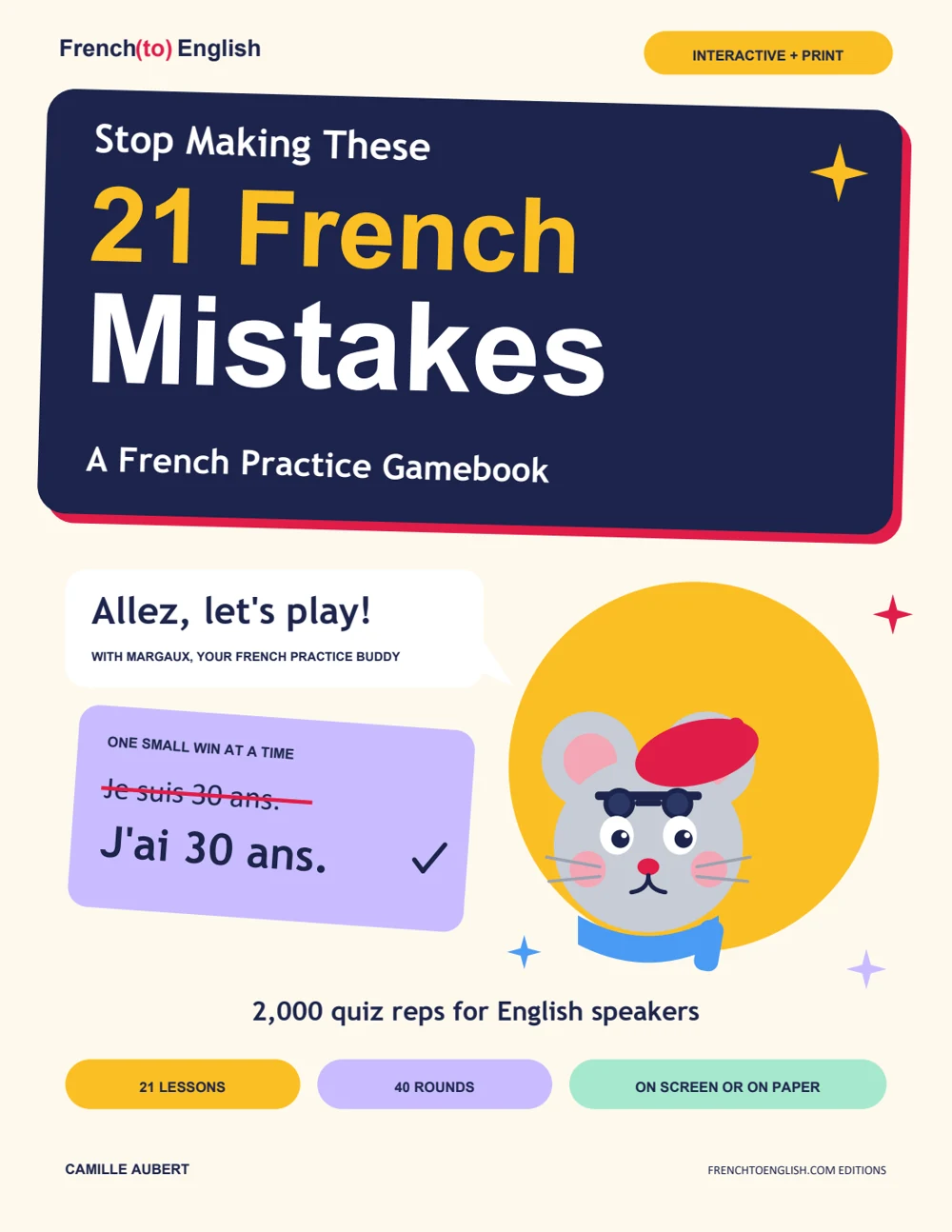
The French Gamebook
Give your study routine something to practise.
For English speakers practising French
Pick a lesson, play a round and note the mistakes you want to revisit. The Gamebook gives your next session a concrete task and answers to check.
- 21 lessons with explanations
- 40 practice rounds · 2,000 questions
300 pages · Play on your computer or print
Get the Gamebook · $9 Read a preview before you buyOne payment · Instant PDF download
Try the French with someone who can reply.
Bring a sentence you found difficult. Ask a tutor to help you say it naturally, then try it in a short conversation.
Find a French tutor →Paid lessons. Compare tutors and prices before booking.
Affiliate link: we may earn a commission when you book.
📚 Keep building in the Learning Center
French Learning Games for Adults: Pick a Format That Fits Your Life
French games for adults work best when the task feels useful and everyone can participate. Plan cooperative or…
Read →Learn French with a Game: Turn One Round into a Useful Study Session
To learn French with a game, choose one small language goal and make the rules serve it. Build…
Read →French Learning Apps Compared: Choose by Your Goal
Compare French learning apps for drills, listening, conversation and feedback. Understand their limits and choose a tool that…
Read →