How to Describe Nature in French: Trees, Rivers, Mountains and Natural Beauty
You want to describe the beautiful Alps scenery you saw while hiking, share your experience exploring French forests, or discuss environmental topics with French speakers, but you’re frustrated because your vocabulary stops at basic words like “arbre” and “montagne” while native French speakers use rich, specific vocabulary distinguishing oak from pine trees, describing water as “cristalline” or “tumultueuse,” and expressing emotional connections to landscapes through expressions you’ve never learned. This complete guide covers comprehensive nature vocabulary from specific tree species and forest types to river features and mountain terminology, water bodies and weather phenomena, plus the poetic descriptive language French speakers naturally use when discussing outdoor beauty, enabling you to participate in hiking conversations, understand French nature writing, and appreciate why French culture places such importance on natural landscapes and environmental protection.
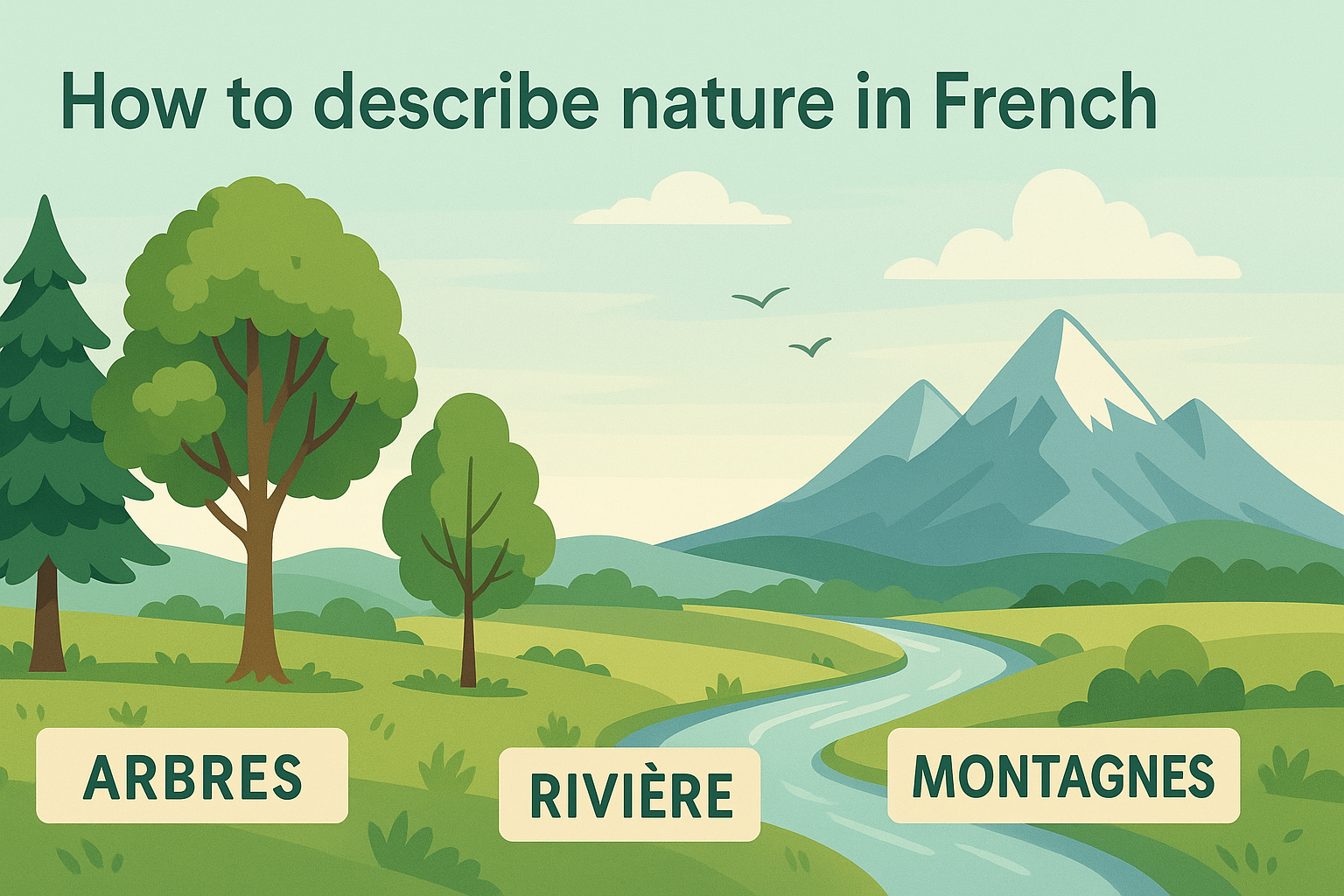
Why French nature vocabulary is different from English
French has more specific vocabulary for natural features than English in some areas, less in others. Understanding these differences prevents awkward direct translations.
French distinguishes between “rivière” (river flowing into another river) and “fleuve” (river flowing into sea). English just says “river” for both. French has specific words for mountain passes, forest types, and water conditions that English expresses through adjective phrases.
French nature vocabulary also carries cultural weight. References to specific trees, mountains, or landscapes evoke shared cultural meanings. Mentioning “les sapins” (fir trees) immediately suggests Christmas or mountain regions. “Le chêne” (oak) symbolizes strength and French identity. These associations matter in conversations.
Most French textbooks are written by native speakers who’ve forgotten what confuses beginners. They explain grammar assuming you already think like a French person.
Roger learned French as an adult after growing up with English and German. He remembers exactly which explanations clicked and which ones left him confused. The FrenchToEnglish approach was built from those memories, including discovering which nature vocabulary was essential for understanding French literature, participating in hiking conversations, and appreciating French environmental discussions.
Trees and forests – Les arbres et les forêts
Common French trees
🇺🇸 EN — The oak tree
🇺🇸 EN — The beech tree
🇺🇸 EN — The pine tree
🇺🇸 EN — The fir tree
🇺🇸 EN — The spruce tree
🇺🇸 EN — The birch tree
🇺🇸 EN — The poplar tree
🇺🇸 EN — The plane tree
🇺🇸 EN — The chestnut tree
🇺🇸 EN — The walnut tree
🇺🇸 EN — The olive tree
🇺🇸 EN — The willow tree
Cultural note: Le chêne (oak) is France’s most symbolically important tree, representing strength and permanence. Centuries-old oaks are protected landmarks.
Tree parts and features
🇺🇸 EN — The trunk
🇺🇸 EN — The bark
🇺🇸 EN — The branches
🇺🇸 EN — The roots
🇺🇸 EN — The leaves
🇺🇸 EN — The needles (pine/fir)
🇺🇸 EN — The treetop
🇺🇸 EN — The foliage
🇺🇸 EN — The bud
🇺🇸 EN — The sap
Forest types and areas
🇺🇸 EN — The forest
🇺🇸 EN — The woods / small forest
🇺🇸 EN — The dense forest / thick forest
🇺🇸 EN — The coniferous forest
🇺🇸 EN — The deciduous forest
🇺🇸 EN — The clearing
🇺🇸 EN — The undergrowth / forest floor
🇺🇸 EN — The canopy
🇺🇸 EN — The forest path
💡 Famous French forests to know:
- La forêt de Fontainebleau – Near Paris, popular for hiking and rock climbing
- La forêt de Brocéliande – Brittany, legendary Arthurian forest
- La forêt des Landes – Southwest France, largest pine forest in Europe
- La forêt de Compiègne – Historic forest where WWI armistice was signed
Rivers and water bodies – Les cours d’eau
Types of water bodies
🇺🇸 EN — The river (flowing to sea)
🇺🇸 EN — The river (tributary)
🇺🇸 EN — The stream / brook
🇺🇸 EN — The torrent / fast-flowing mountain stream
🇺🇸 EN — The waterfall
🇺🇸 EN — The lake
🇺🇸 EN — The pond
🇺🇸 EN — The puddle / small pond
🇺🇸 EN — The canal
🇨🇺🇸 EN — The spring / source
Critical distinction: Fleuve vs Rivière. La Seine is “un fleuve” (flows to English Channel). Le Cher is “une rivière” (flows into la Loire). French speakers notice if you use the wrong term.
River features and characteristics
🇺🇸 EN — The bank / shore
🇺🇸 EN — The riverbed
🇺🇸 EN — The current
🇺🇸 EN — The rapids
🇺🇸 EN — The mouth (where river meets sea)
🇺🇸 EN — The meander / bend
🇺🇸 EN — The confluence (where two rivers meet)
🇺🇸 EN — The bridge
🇺🇸 EN — The dam
Describing water quality and movement
🇺🇸 EN — Crystal-clear water
🇺🇸 EN — Murky water / muddy water
🇺🇸 EN — Turquoise water
🇺🇸 EN — Calm water / still water
🇺🇸 EN — Rough water / turbulent water
🇺🇸 EN — To flow quickly
🇺🇸 EN — To flow gently
🇺🇸 EN — To overflow / flood
🇺🇸 EN — The flood / high water
Mountains and elevated terrain – Les montagnes
Mountain vocabulary
🇺🇸 EN — The mountain
🇺🇸 EN — The mountain range
🇺🇸 EN — The peak / summit
🇺🇸 EN — The ridge
🇺🇸 EN — The slope / mountainside
🇺🇸 EN — The slope
🇺🇸 EN — The mountain pass
🇺🇸 EN — The glacier
🇺🇸 EN — The cliff
🇺🇸 EN — The ravine / precipice
🇺🇸 EN — The valley
🇺🇸 EN — The Alps
🇺🇸 EN — The Pyrenees
Mountain activities and features
🇺🇸 EN — To hike
🇺🇸 EN — To go mountain climbing
🇺🇸 EN — To climb
🇺🇸 EN — To reach the summit
🇺🇸 EN — The hiking trail
🇺🇸 EN — The mountain hut / refuge
🇺🇸 EN — The altitude
🇺🇸 EN — The permanent snow
🇺🇸 EN — The panoramic view / the view
Weather and atmospheric phenomena
Weather conditions in nature
🇺🇸 EN — The fog
🇺🇸 EN — The mist
🇺🇸 EN — The dew
🇺🇸 EN — The frost
🇺🇸 EN — The thunderstorm
🇺🇸 EN — The lightning
🇺🇸 EN — The thunder
🇺🇸 EN — The rainbow
🇺🇸 EN — The storm
🇺🇸 EN — The wind
🇺🇸 EN — The breeze
Sky and celestial features
🇺🇸 EN — The clear sky
🇺🇸 EN — The cloudy sky
🇺🇸 EN — The clouds
🇺🇸 EN — The sunset
🇺🇸 EN — The sunrise / dawn
🇺🇸 EN — The twilight / dusk
🇺🇸 EN — The full moon
🇺🇸 EN — The stars
🇺🇸 EN — The starry sky
Landscape features and terrain
Natural landforms
🇺🇸 EN — The plain
🇺🇸 EN — The plateau
🇺🇸 EN — The hill
🇺🇸 EN — The cave
🇺🇸 EN — The rock / boulder
🇺🇸 EN — The stone
🇺🇸 EN — The sand
🇺🇸 EN — The island
Coastal features
🇺🇸 EN — The coast / coastline
🇺🇸 EN — The beach
🇺🇸 EN — The cliff
🇺🇸 EN — The bay
🇺🇸 EN — The cove
🇺🇸 EN — The cape / headland
🇺🇸 EN — The sea
🇺🇸 EN — The ocean
Descriptive adjectives for nature
Describing landscapes poetically
🇺🇸 EN — A magnificent / splendid landscape
🇺🇸 EN — A breathtaking view
🇺🇸 EN — A stunning panorama
🇺🇸 EN — Wild / pristine nature
🇺🇸 EN — A peaceful / quiet place
🇺🇸 EN — A picturesque place
🇺🇸 EN — A majestic forest
🇺🇸 EN — Imposing mountains
🇺🇸 EN — A winding river
🇺🇸 EN — A vast sky
Describing colors in nature
🇺🇸 EN — Bright / vivid green
🇺🇸 EN — Azure blue
🇺🇸 EN — Light blue sky
🇺🇸 EN — The autumn colors
🇺🇸 EN — Golden tones
🇺🇸 EN — Pristine snow
Useful phrases for describing nature experiences
Talking about hiking and outdoor activities
🇺🇸 EN — I went hiking in the Alps
🇺🇸 EN — The view from the summit was incredible
🇺🇸 EN — We crossed a magnificent forest
🇺🇸 EN — The trail follows the river
🇺🇸 EN — You can see the mountains in the distance
🇺🇸 EN — The air is pure and fresh in the mountains
🇺🇸 EN — The landscape is breathtaking
🇺🇸 EN — I love walking in the heart of nature
Expressing feelings about nature
🇺🇸 EN — I feel at peace in nature
🇺🇸 EN — It’s refreshing / invigorating
🇺🇸 EN — Nature does me good
🇺🇸 EN — I recharge my batteries in nature
🇺🇸 EN — It’s soothing / restful
Study glossary – Essential nature vocabulary
| FR | EN | Usage Context |
|---|---|---|
| La nature | Nature | Se promener dans la nature |
| Le paysage | The landscape | Un paysage magnifique |
| La forêt | The forest | Une forêt dense |
| Le fleuve / La rivière | River (to sea / tributary) | Le fleuve Seine |
| La montagne | The mountain | Les montagnes des Alpes |
| Le chêne | The oak tree | Un vieux chêne centenaire |
| Le lac | The lake | Le lac d’Annecy |
| La cascade | The waterfall | Une belle cascade |
| Le sommet | The summit/peak | Atteindre le sommet |
| Le sentier | The trail/path | Suivre le sentier |
| La vue | The view | Une vue à couper le souffle |
| Randonner | To hike | J’aime randonner en montagne |
French nature in literature and culture
French literature is saturated with nature descriptions. Understanding this vocabulary unlocks major works:
Jean Giono wrote extensively about Provence countryside. His novel “L’homme qui plantait des arbres” (The Man Who Planted Trees) requires forest vocabulary throughout.
Victor Hugo described mountains and forests romantically in works like “Les Contemplations.” His nature descriptions use poetic vocabulary.
Émile Zola set many novels in rural France. “La Terre” requires agricultural and landscape vocabulary to understand fully.
Marcel Pagnol captured Provence landscapes in “La Gloire de mon père” and other autobiographical works. Knowing regional nature vocabulary enhances understanding.
French environmental movements use this vocabulary constantly. Climate discussions, conservation debates, national park policies – all require solid nature vocabulary to follow.
French people vacation in nature extensively. Conversations about weekend hiking trips, vacation destinations, regional landscapes appear constantly in casual French. Without nature vocabulary, you miss significant chunks of French social conversation.