Belgian French Expressions That Confuse France French Speakers (A2-B1)
You’re learning French and discover that Belgium speaks French too, but when you encounter Belgian French expressions for the first time you’re completely confused by their logical number system saying “septante” and “nonante” for 70 and 90 instead of the complicated “soixante-dix” and “quatre-vingt-dix,” their mysterious habit of adding “une fois” to sentences that seems grammatically pointless, words like “tantôt” that mean completely different things in Belgium versus France, uniquely Belgian vocabulary where a “pistolet” is a bread roll not a gun and “brol” means messy stuff, food terms that leave France French speakers bewildered, pronunciation that sounds softer and more sing-song than Parisian French, and you wonder whether learning these Belgian expressions matters for your French studies or whether you should stick to France French and ignore Belgian variants entirely.
Why Belgian French is so different from France French
Belgium has three official languages – French, Dutch (Flemish), and German – with French spoken primarily in Wallonia (southern Belgium) and Brussels. Belgian French developed its own distinctive features through centuries of influence from neighboring languages, particularly Flemish Dutch, creating vocabulary and expressions that sound bizarre to France French speakers.
🇺🇸 Belgian French has its own expressions that confuse French people
Unlike Quebec French which diverged from France French through 400 years of geographic separation, Belgian French remained in contact with France but developed parallel innovations influenced by the multilingual Belgian context. The result? A French variant that’s mutually intelligible with France French but peppered with expressions that leave Parisians scratching their heads.
Roger encountered Belgian French expressions during his linguistic studies and now includes these variants in his French lessons when students express curiosity about Francophone diversity across Europe.
The famous Belgian number system – logical and clear
Belgium’s superior counting system
Perhaps the most famous difference between Belgian and France French is how they count from 70-99. Belgium uses a logical decimal system while France uses a complicated vigesimal (base-20) system.
Counting 70-79:
🇺🇸 Belgium: septante, septante et un, septante-deux… (seventy, seventy-one, seventy-two)
Counting 80-89:
🇺🇸 Belgium: quatre-vingts (same as France – 4×20), BUT Swiss French says “huitante” (eighty)
Counting 90-99:
🇺🇸 Belgium: nonante, nonante et un, nonante-deux… (ninety, ninety-one, ninety-two)
Why this matters: Belgian children learn math faster because their number system doesn’t require mental arithmetic just to say numbers! France’s system requires you to calculate “4 times 20 plus 12” to say 92, while Belgium simply says “nonante-deux.”
💡 Historical note on number systems:
Both systems existed in medieval French. The decimal system (septante, octante/huitante, nonante) was used in southern France, while the vigesimal system (soixante-dix, quatre-vingts, quatre-vingt-dix) came from northern France. When Paris became the capital and Parisian French became standardized, the complicated northern system won out in France – but Belgium and Switzerland kept the logical southern system!
Many France French speakers secretly envy Belgium’s number system and wish France had kept it. Roger teaches both systems in lessons because understanding Belgian numbers helps comprehension when watching Belgian media or traveling to Brussels.
The mysterious “une fois” – Belgium’s grammatical quirk
Understanding the Belgian “une fois” particle
Belgians add “une fois” (literally “one time” or “once”) to sentences for emphasis or friendliness, but it doesn’t mean “once” – it’s just a filler phrase that confuses the hell out of France French speakers.
🇺🇸 The “une fois” adds emphasis/warmth but doesn’t literally mean “come eat once”
🇺🇸 Again, “une fois” is just emphasis, not literally “that’s good one time”
🇺🇸 “Une fois” makes it friendlier/more insistent, but doesn’t mean “look once”
Origin: This comes from Flemish influence. In Flemish/Dutch, “eens” (once) is used similarly as a particle for softening commands or adding friendliness. Belgians translated this pattern directly into their French, creating “une fois” as a grammatical particle that makes no literal sense to France French speakers.
France French reaction: Parisians find this hilarious and confusing. They’ll ask “Why are you saying ‘once’? Do you mean do it once? Or come once?” The Belgian just shrugs – it’s how they talk!
Belgian vocabulary that confuses France
Food and meals – completely different words
🇺🇸 Belgium: un pistolet (bread roll – yes, like the gun!)
🇺🇸 Belgium: un couque au chocolat (chocolate pastry)
🇺🇸 Belgium: des frittes / des frites (both spellings used, pronounced slightly different)
🇺🇸 Belgium: une gaufre (same word, but Belgian waffles are culturally sacred!)
🇺🇸 Belgium: le déjeuner (breakfast – like Quebec!)
🇺🇸 Belgium: le dîner (lunch – yes, like Quebec, this confuses everyone!)
🇺🇸 Belgium: le souper (dinner – again, like Quebec and Swiss French)
Critical confusion point: When a Belgian invites you for “dîner,” they mean LUNCH, not dinner! This is the same confusion Quebec French creates. Belgium, Quebec, and Switzerland all shifted meal names compared to France.
Everyday objects and concepts
🇺🇸 Belgium: le brol (messy stuff, junk, disorder)
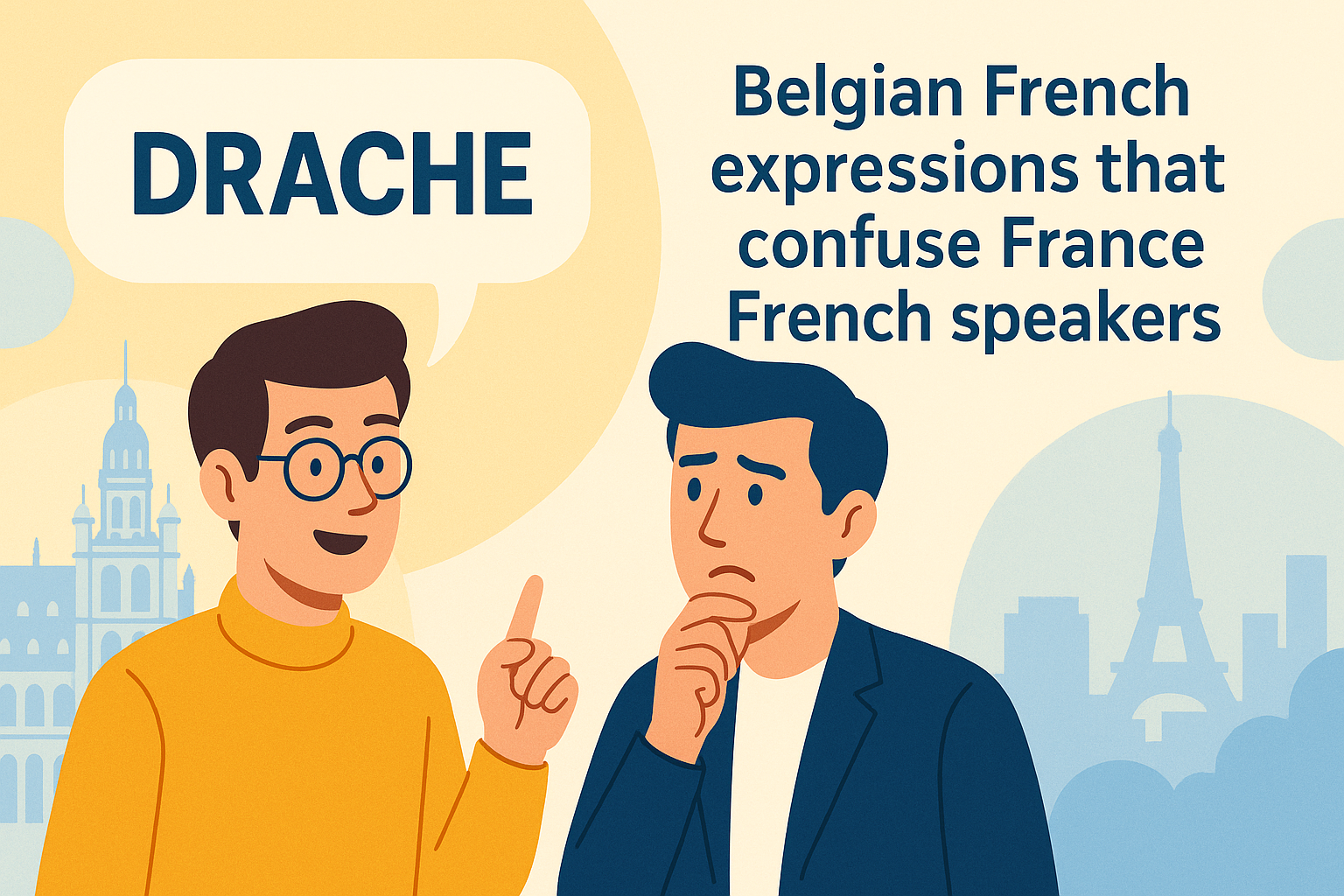
🇺🇸 Belgium: une drache (heavy rain – from Dutch “draaien”)
🇺🇸 Belgium: une loque / un loque (cleaning cloth, rag)
🇺🇸 Belgium: la wassingue (floor mop – from Flemish)
🇺🇸 Belgium: un sachet (plastic bag)
🇺🇸 Belgium: une tirette (drawer in some regions)
🇺🇸 Belgium: parker / se parker (to park – influenced by English but conjugated as French verb!)
⚠️ The “brol” confusion story:
When Roger first encountered Belgian students using “brol,” he was completely lost. A student said “Mon appartement est plein de brol” and Roger thought it was slang he’d never learned. Turns out “brol” is standard Belgian French meaning “messy stuff” or “junk.”
🇺🇸 There’s junk/mess everywhere in my room (Belgian)
France French speakers would say “C’est le bazar” or “Il y a du désordre partout” – they don’t use “brol” at all. Using “brol” with France French speakers marks you immediately as Belgian (or someone who learned French in Belgium)!
The confusing “tantôt” – different meanings entirely
Tantôt – the word that means opposite things
This word causes massive confusion because it means completely different things in Belgium versus France.
In Belgium, “tantôt” means “this afternoon”:
🇺🇸 France speaker thinks: “See you soon/later?” (confused about when exactly)
🇺🇸 France speaker thinks: “You’ll be back soon? In an hour? Tomorrow?”
In France, “tantôt” has two meanings:
- Meaning 1: Soon, in a moment (vague future)
- Meaning 2: Earlier, a moment ago (vague past)
🇺🇸 NOT “this afternoon” – just vaguely “later”
🇺🇸 Past meaning – NOT afternoon!
Why this confuses everyone: A Belgian says “Je reviens tantôt” meaning “I’ll be back this afternoon” (specific time: afternoon). A France French speaker interprets it as “I’ll be back soon” (vague time: could be 10 minutes or 3 hours). Then the Belgian doesn’t return until 3pm and the France person is annoyed they waited!
💡 How to avoid tantôt confusion:
If you’re speaking with Belgians, ask for clarification when they say “tantôt”:
🇺🇸 Do you mean this afternoon, or soon?
If you’re learning French and want to avoid confusion entirely, use:
- “Cet après-midi” (this afternoon) – clear to everyone
- “Bientôt” or “tout à l’heure” (soon) – clear to everyone
- Avoid “tantôt” unless you know your audience’s variant!
Roger teaches these practical communication strategies in his lessons because textbooks ignore these real-world confusion points between French variants.
Belgian pronunciation – softer and more melodic
How Belgian French sounds different
1. Softer, less nasal than Parisian French
Belgian French sounds gentler and less sharp than Parisian French. The nasal vowels are less pronounced, making it sound “clearer” to some learners.
2. Flemish influence on intonation
Belgian French (especially in Brussels and Flemish regions) has a more sing-song intonation pattern borrowed from Dutch/Flemish, making sentences rise and fall more than flat Parisian pronunciation.
3. Different “r” sound
While both use the uvular French “r” (back of throat), the Belgian “r” is often softer and less guttural than the harsh Parisian “r.”
🇺🇸 Belgium: “Paris” with softer, gentler r
4. Clearer distinction between similar sounds
Belgians tend to pronounce certain sound distinctions more clearly than Parisians, making their French sometimes easier for learners to understand initially.
Expressions and phrases unique to Belgium
Common Belgian expressions
🇺🇸 How are you? / Is it okay? (Belgian way of asking)
🇺🇸 That’s great! (Belgium uses “chouette” more than France)
🇺🇸 It’s raw/damp outside (Belgian expression for cold, damp weather)
🇺🇸 To be lucky to… (different preposition than France French)
🇺🇸 Belgium uses “savoir” more broadly than France (Flemish influence)
🇺🇸 Go to the coast/beach (specifically Belgian expression for going to Belgian seaside)
France French equivalents
🇺🇸 How are you? (France – simpler than “ça va ou bien”)
🇺🇸 That’s great! (France uses these more than “chouette”)
🇺🇸 It’s cold and humid outside (France – doesn’t use “cru” this way)
🇺🇸 To be lucky to… (France uses “de” not “pour”)
🇺🇸 France distinguishes “savoir” (knowledge) vs “pouvoir” (ability) more strictly
🇺🇸 Go to the beach/sea (France – “à la côte” is less common)
Belgian slang and informal expressions
Informal Belgian vocabulary
🇺🇸 Vanilla ice cream with chocolate sauce (specific Belgian dessert name)
🇺🇸 Coffee with cream (Belgian café term)
🇺🇸 Homemade grilled ham and cheese (Belgium’s “maison” means homemade in café context)
🇺🇸 One white (coffee with milk), one black (coffee) – Belgian café ordering with “une fois”!
🇺🇸 To have a crush on someone (Belgian expression)
🇺🇸 To have an ice cream cone (Belgian term)
🇺🇸 To queue/wait in line (Belgium and Quebec use this, France says “faire la queue”)
Should you learn Belgian French expressions?
Learn Belgian French if:
- You’re planning to live, work, or study in Belgium (Brussels, Liège, Namur, Charleroi)
- You work with Belgian colleagues or clients regularly
- You’re interested in Belgian culture, chocolate, beer, and comics
- You want to understand Belgian French media and literature
- You’re learning about Francophone diversity across Europe
🇺🇸 Belgian French is useful if you’re going to live or work in Belgium
Stick to France French if:
- You’re learning French for general purposes (travel, culture, career)
- You have no specific connection to Belgium
- You’re focused on passing standardized French exams (DELF, DALF, TEF, TCF)
- You want the most internationally recognized French variant
- You’re already overwhelmed with learning basic French
🇺🇸 France French is more universal if you have no connection to Belgium
💡 Roger’s recommendation:
Focus on learning solid France French first (it’s what most textbooks, apps, and courses teach). Once you reach B1-B2 level, if you have specific interest in Belgium or encounter Belgian French regularly, you can easily pick up Belgian expressions and vocabulary in a few weeks.
The good news? Belgian French and France French are mutually intelligible. Belgians understand France French perfectly (they consume French media), and France speakers understand Belgians with minor clarifications. The differences are charming quirks, not barriers to communication.
Roger includes Belgian French variants in his lessons when students express curiosity or need practical knowledge for Belgian contexts, but the core curriculum focuses on France French as the most broadly useful foundation.
Study glossary – Belgium vs France French
| English | Belgium French | France French |
|---|---|---|
| Seventy | Septante | Soixante-dix |
| Ninety | Nonante | Quatre-vingt-dix |
| Bread roll | Un pistolet | Un petit pain |
| Messy stuff | Le brol | Le bazar |
| Heavy rain | Une drache | Une averse |
| This afternoon | Tantôt | Cet après-midi |
| Breakfast | Le déjeuner | Le petit-déjeuner |
| Lunch | Le dîner | Le déjeuner |
| Dinner | Le souper | Le dîner |
| Floor mop | La wassingue | La serpillière |
| To park | Parker / Se parker | Se garer |
| To queue | Faire la file | Faire la queue |
The beauty of Belgian French diversity
Belgian French expressions don’t make communication impossible – they enrich the French language with regional character and historical depth. The differences between Belgian and France French are like differences between British and American English: noticeable, sometimes confusing, but ultimately charming and easy to navigate once you’re aware they exist.
🇺🇸 French variants enrich the language, they don’t complicate it
Understanding Belgian French helps you appreciate the diversity of Francophone culture across Europe. Belgium’s bilingual context created unique expressions that reflect centuries of French-Flemish coexistence. These aren’t “mistakes” or “bad French” – they’re legitimate regional variants with their own logic and history.
The famous Belgian number system (septante, nonante) proves that language evolution isn’t always about adding complexity – sometimes it’s about maintaining clarity and logic that other regions abandoned. Many linguists argue Belgium kept the better counting system!
Whether you choose to learn Belgian French expressions or stick with France French, understanding these differences makes you a more complete French speaker who can appreciate and navigate the rich tapestry of Francophone culture from Paris to Brussels to Quebec to Dakar.