Québec French vs France French: Key Differences for Learners (B1-B2)
You’re learning French and suddenly discover there are actually TWO major variants – Québec French and France French – that differ so dramatically in pronunciation, vocabulary, and expressions that speakers from each region sometimes struggle to understand each other, leaving you confused about which version to learn, worried that studying France French might be useless if you move to Montreal or that learning Québécois will make you sound strange in Paris, frustrated when French learning resources don’t clarify which variant they’re teaching, bewildered by Québécois expressions like “char” (car) and “blonde” (girlfriend) that don’t exist in France French, and uncertain whether these differences are just accent variations or fundamental enough to require choosing one variant and sticking with it throughout your learning journey.
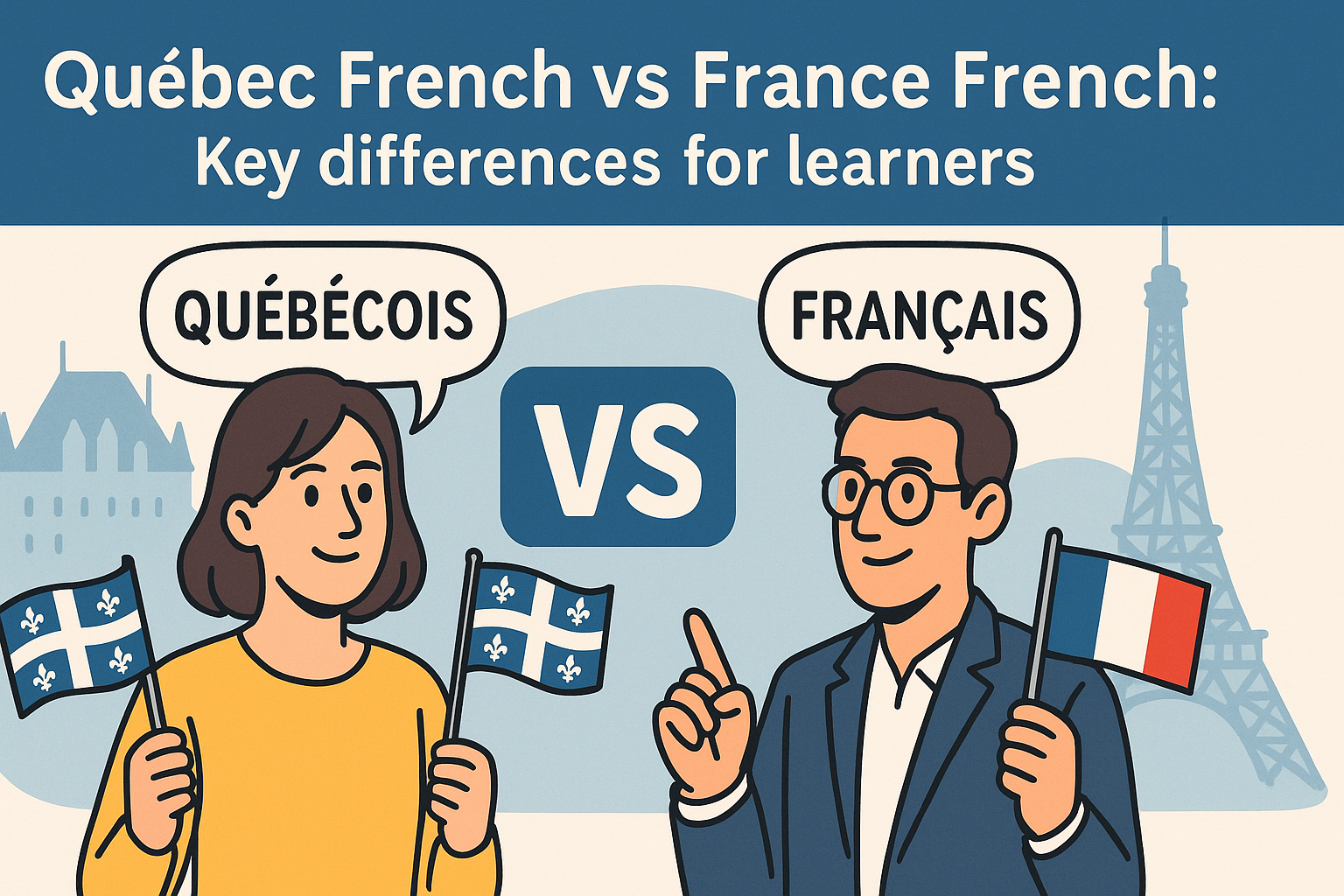
Why Québec French and France French differ so much
Québec French and France French diverged dramatically over 400+ years of separation. When French settlers arrived in New France (now Quebec) in the 1600s, they brought 17th-century French with them. Meanwhile, French in France continued evolving, particularly after the French Revolution standardized Parisian French as the national language.
🇺🇸 Québec French preserved 17th-century expressions that France lost
Add 250+ years of British rule in Quebec (1763-present), heavy American English influence from proximity to the United States, geographic isolation from France, and Quebec’s fierce cultural identity preservation, and you get two French variants that sound and feel remarkably different.
Roger teaches both variants in his French lessons because understanding the differences helps you choose which variant suits your goals and avoid confusion when encountering the other variant in media, travel, or conversation.
Pronunciation differences – the most obvious distinction
Accent and intonation patterns
Québec French sounds more nasal and uses different vowel sounds:
1. The diphtongization of long vowels
Québécois turn long vowels into diphthongs (two-part sounds):
🇺🇸 Québec: “père” [paɛ̯ʁ] (two sounds – sounds like “pa-air”)
🇺🇸 Québec: “fête” [faɛ̯t] (sounds like “fa-ette”)
2. The affrication of “t” and “d” before high vowels
Québécois pronounce “t” and “d” differently before “i” and “u” sounds:
🇺🇸 Québec: “tu” sounds like [tsʏ] (with a “ts” sound)
🇺🇸 Québec: “dire” sounds like [dzɪʁ] (with a “dz” sound)
3. Retention of final consonants
Québécois pronounce some final consonants that France French drops:
🇺🇸 Québec: “plus” [plys] (“s” often pronounced)
4. Different “r” sound
While both use a uvular “r” (back of throat), the Québécois “r” is stronger, more rolled, and more prominent:
🇺🇸 Québec: “Paris” has a more pronounced, rolled “r”
⚠️ Why this matters for learners
If you learn France French pronunciation, you’ll understand Québécois but you might struggle initially with their accent. If you learn Québec pronunciation, France French speakers might find your accent “old-fashioned” or “rural-sounding.”
Roger recommends starting with France French pronunciation because:
- It’s more widely taught internationally
- Québécois easily understand France French (they consume French media)
- France French is considered more “neutral” for formal/professional contexts
- You can later adapt to Québec pronunciation if you move there
That said, if you’re specifically moving to Quebec, learning Québécois pronunciation from the start makes sense for daily integration.
Vocabulary differences – completely different words
Essential everyday vocabulary that differs
Transportation and vehicles:
🇺🇸 Car
🇺🇸 Gasoline (Québec borrowed from English “gas”)
🇺🇸 Parking (ironically, France uses English word, Quebec uses French!)
🇺🇸 To drive (Québec uses “chauffer” = to heat/warm up)
People and relationships:
🇺🇸 Girlfriend (In France, “blonde” just means blonde person!)
🇺🇸 Boyfriend (from English “chum”)
🇺🇸 Kids / Guy / Girl
Time and numbers:
🇺🇸 Seventy
🇺🇸 Ninety
🇺🇸 Now (Québec preserves old French “à cette heure”)
Food and meals:
🇺🇸 Breakfast
🇺🇸 Lunch
🇺🇸 Dinner
This shift causes massive confusion! When a Québécois invites you for “dîner,” they mean lunch, not dinner!
Shopping and commerce
🇺🇸 To do grocery shopping
🇺🇸 A store
🇺🇸 Supermarket
🇺🇸 Sales (discounts)
🇺🇸 Change (coins)
Expression and phrase differences
Common France French expressions
🇺🇸 How’s it going? / Does that work? (France)
🇺🇸 Okay / Agreed (France)
🇺🇸 That’s great (France)
🇺🇸 Have a good day! (France)
🇺🇸 Goodbye! (France)
Common Québec French expressions
🇺🇸 How’s it going? / Does that work? (Québec – note the “-tu” particle)
🇺🇸 Okay / That’s good (Québec)
🇺🇸 That’s fun / That’s cool (Québec – “fun” from English)
🇺🇸 Have a good day! (Québec uses both)
🇺🇸 Goodbye! (Québec uses “Bonjour” for goodbye too!)
💡 The famous Québécois “-tu” interrogative particle
Québécois add “-tu” (or “-ti”) to statements to make them questions – this doesn’t exist in France French:
🇺🇸 Québec: Tu viens-tu ? (same meaning, but adds “-tu”)
🇺🇸 Québec: C’est-tu bon ? / C’est bon-tu ?
This “-tu” particle comes from “est-ce que tu” contracted over centuries. France French dropped this pattern, but Quebec preserved and evolved it.
Roger explains these grammatical quirks in his French lessons because they’re fascinating examples of how languages evolve differently in isolation.
The famous Québécois “sacres” – religious swear words
Understanding Québec’s unique swearing system
Québec French has a completely unique swearing system based on Catholic religious terms called “sacres” (sacraments). These words are considered VERY vulgar in Quebec but meaningless in France.
Common sacres (from mild to very strong):
🇺🇸 The strongest Québécois swear word (equivalent to English f-word)
🇺🇸 Very strong swear (equivalent to “damn” or stronger)
🇺🇸 Strong swear word
🇺🇸 Strong swear word
🇺🇸 Moderate swear word
Why this exists: Quebec was heavily Catholic for centuries. Swearing using religious terms was the ultimate rebellion against the Church’s strict control. France developed different swear words (merde, putain, etc.) that Quebec doesn’t use as strongly.
⚠️ Critical for learners: Don’t use these casually!
If you’re learning French and plan to visit Quebec:
- These words are considered VERY vulgar – equivalent to English f-word or worse
- You’ll hear them constantly in Quebec movies, TV, casual conversation
- Don’t repeat them unless you’re very close with Québécois friends
- France French speakers find these words bizarre and meaningless
- Using France French swear words in Quebec sounds odd too
Roger advises students to recognize sacres for comprehension but avoid using them unless fully integrated into Québécois culture.
Anglicisms – different English influences
France French anglicisms
France borrows English words for technology, business, and trendy concepts:
🇺🇸 Weekend
🇺🇸 Parking lot
🇺🇸 Shopping
🇺🇸 Cool
Québec French anglicisms
Quebec borrows heavily from American/Canadian English for everyday life:
🇺🇸 Weekend
🇺🇸 Parking lot (Quebec resists English word here!)
🇺🇸 To shop (verb form borrowed from English)
🇺🇸 Fun (used as noun – “that’s fun”)
💡 The paradox of anglicisms
Ironically, Quebec officially resists anglicisms more than France (Quebec has strict language laws protecting French), but everyday Québécois speech contains MORE English influence than France French because of constant proximity to English Canada and the United States.
France French speakers sometimes criticize Québécois French as “too English” while simultaneously using English words like “parking,” “shopping,” and “weekend” that Quebec officially rejects!
Grammar and structure differences
Tu vs vous – formality differences
France French: Maintains strict tu/vous distinction in professional and formal contexts. You ALWAYS use “vous” with strangers, bosses, older people until invited to use “tu.”
Québec French: Much more relaxed about tu/vous. Québécois use “tu” more quickly and broadly, even with strangers in casual contexts. The workplace culture is less formal.
🇺🇸 Québec: Salut, comment ça va ? / Comment tu vas ? (informal, tu more common)
This doesn’t mean “vous” doesn’t exist in Quebec – it’s used in very formal situations, with elderly people, or in professional contexts. But the threshold for switching to “tu” is much lower than in France.
Question formation differences
France French uses three main question structures:
🇺🇸 Are you coming?
🇺🇸 Are you coming?
🇺🇸 Are you coming?
Québec French adds the “-tu” particle:
🇺🇸 Are you coming? (Québec’s unique structure)
🇺🇸 Is it good?
This “-tu” particle doesn’t exist in France French and marks you immediately as Québécois (or someone who learned French in Quebec).
Which variant should you learn first?
Learn France French if:
- You’re planning to live, work, or study in France, Belgium, Switzerland, or French-speaking Africa
- You want to consume French media (films, TV, books) – most international French content uses France French
- You’re learning for professional/business purposes – France French is standard in international business
- You want the most internationally-recognized variant
- You’re learning French as academic requirement – most textbooks teach France French
- You’re undecided where you’ll use French – France French is more “universal”
🇺🇸 France French is more widely taught and recognized internationally
Learn Québec French if:
- You’re planning to live, work, or study specifically in Quebec
- You have family, friends, or professional connections in Quebec
- You want to integrate deeply into Québécois culture and identity
- You’re studying French-Canadian history or literature
- You prefer the Québécois accent and want to sound local in Montreal/Quebec City
🇺🇸 Québec French is essential for integrating in Quebec
💡 Roger’s recommendation for most learners:
Start with France French for these practical reasons:
- More learning resources: 90%+ of French textbooks, apps, courses teach France French
- Easier transition: Learning France French first makes understanding Québécois easier (they consume French media constantly). The reverse is harder.
- Broader applicability: If your plans change, France French works in more countries
- Professional standard: International business, diplomacy, academia use France French
Then add Québec French later if needed: Once you’re B1-B2 in France French, learning Québec vocabulary and expressions takes only weeks/months, not years.
Roger teaches primarily France French in his private lessons but includes Québec variant explanations when students express interest or plan Quebec moves. His trilingual background helps him explain these dialectal differences clearly – something native speakers often can’t articulate.
Study glossary – Québec vs France vocabulary
| English | France French | Québec French |
|---|---|---|
| Car | Une voiture | Un char |
| Girlfriend | Une copine | Une blonde |
| Boyfriend | Un copain | Un chum |
| Breakfast | Le petit-déjeuner | Le déjeuner |
| Lunch | Le déjeuner | Le dîner |
| Dinner | Le dîner | Le souper |
| To drive | Conduire | Chauffer |
| Now | Maintenant | Asteure / À c’t’heure |
| Parking lot | Le parking | Le stationnement |
| Fun | Amusant / Sympa | Le fun |
| To shop | Faire du shopping | Magasiner |
| Goodbye | Au revoir | Bonjour / Salut |
The bottom line: Variants enrich French, not divide it
Québec French and France French aren’t separate languages – they’re variants of the same language that developed differently over four centuries. Speakers of both variants understand each other with minor adjustments, similar to how Americans and British people understand each other despite vocabulary and accent differences.
🇺🇸 Québec French and France French are two enriching variants of the same language
Learning one variant doesn’t prevent you from understanding or learning the other. Most French learners naturally absorb both variants over time through media consumption, conversation, and exposure. The key is starting with clear foundations in one variant (typically France French for practical reasons) then expanding to appreciate and understand the other.
Roger’s approach in his French lessons focuses on France French as the base while explaining Québécois variations when they arise naturally in conversation or media. This gives students flexibility to adapt their French to whichever context they encounter without starting from scratch.
The beautiful truth? Both variants preserve different aspects of French linguistic heritage, and knowing both makes you a more complete French speaker who can engage with Francophone culture from Paris to Montreal to Brussels to Dakar.