How to Introduce Yourself in French: Beyond “Je m’appelle”
You learned “Je m’appelle” in your first French class, but when you actually try to introduce yourself to French people, it sounds stiff and textbook-like compared to how natives introduce themselves naturally. Real French speakers rarely say “Je m’appelle” in casual situations, preferring more authentic expressions that vary by formality, context, and relationship. This complete guide teaches you how French people actually introduce themselves, from informal friend-of-a-friend situations to formal business meetings, including the cultural nuances about sharing personal information, asking follow-up questions, and making introductions feel natural rather than like reciting a lesson.
Why “Je m’appelle” marks you as a textbook learner
“Je m’appelle” is grammatically correct and French people will understand you perfectly. But it’s the linguistic equivalent of wearing a sign that says “I learned French from a textbook, not from actual French people.”
Here’s what happens when you say “Je m’appelle Marie” to a French person: They understand. They respond politely. But in their head, they’ve categorized you as a formal learner rather than someone who knows colloquial French. It’s like meeting an English learner who says “My name is John” instead of the more natural “I’m John” or “John” with a handshake.
French people use “Je m’appelle” primarily in three situations: filling out forms, talking to children, or speaking very formally to authority figures. In normal adult social situations, there are much more natural ways to introduce yourself.
The formality spectrum in French introductions
French has more formality levels than English. Your introduction method must match the context or you’ll sound either inappropriately casual or unnecessarily stiff. Understanding this spectrum is crucial.
Most French textbooks are written by native speakers who’ve forgotten what confuses beginners. They explain grammar assuming you already think like a French person.
Roger learned French as an adult after growing up with English and German. He remembers exactly which explanations clicked and which ones left him confused. The FrenchToEnglish approach was built from those memories, including how he discovered that his textbook introductions were making French people perceive him as overly formal until he learned how natives actually introduce themselves.
Informal introductions – how French friends actually meet
When meeting friends of friends, at parties, in casual social settings, French people use relaxed, natural introductions that textbooks rarely teach.
The most natural casual introduction
🇺🇸 EN — Me, it’s Marie / I’m Marie
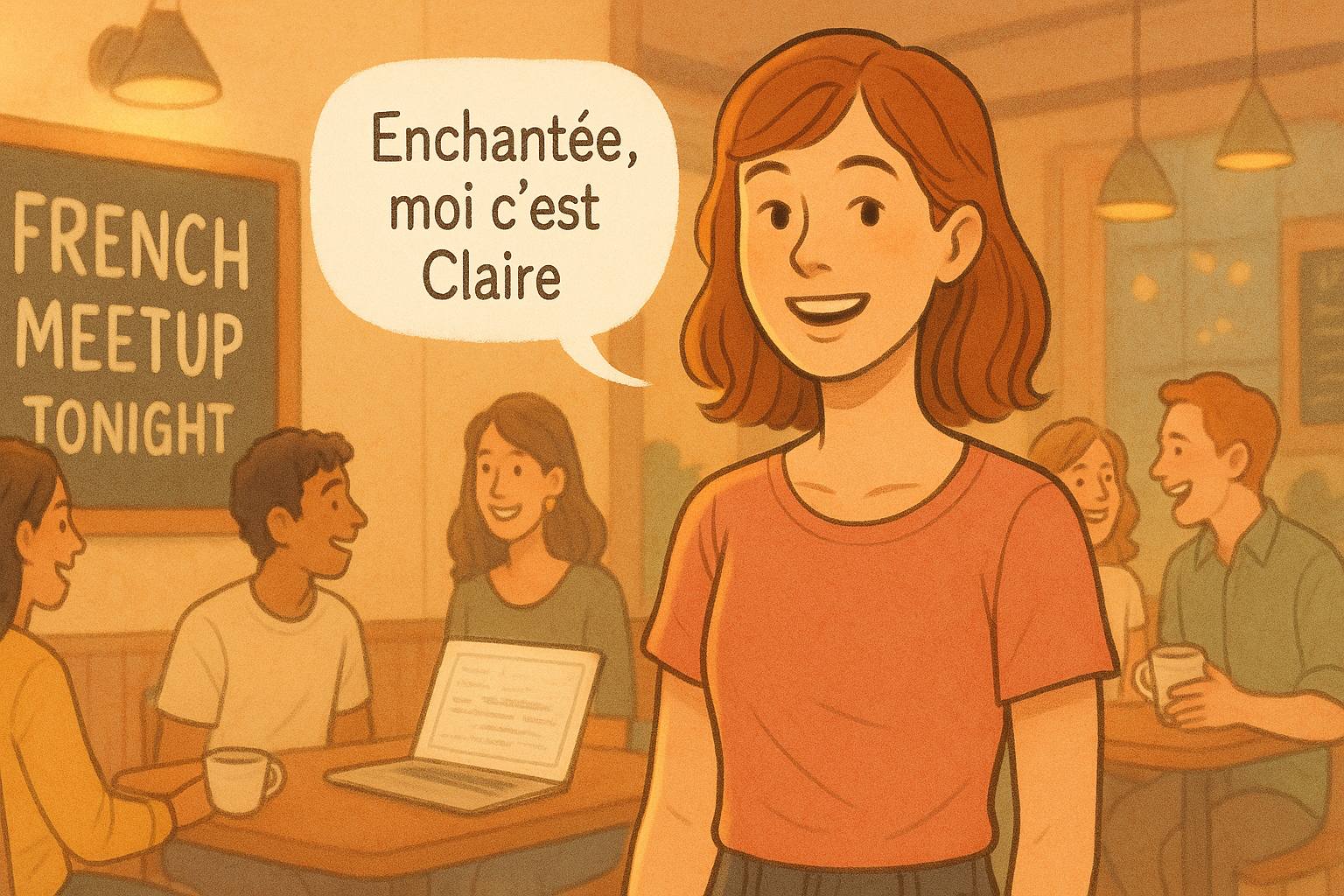
Why this works: This is how French people actually introduce themselves casually. It’s relaxed, natural, and appropriately informal. The structure “Moi, c’est [name]” is the casual equivalent of English “I’m [name].”
When to use it: Parties, social gatherings, meeting friends of friends, casual restaurant/bar encounters, networking events with relaxed atmosphere.
Pronunciation: /mwa, sɛ maʁi/ – The “c’est” contracts naturally when spoken quickly.
🇺🇸 EN — Hi, I’m Thomas
🇺🇸 EN — I’m Sophie, and you?
Alternative casual introductions
🇺🇸 EN — I’m Alex
Why this works: Direct and simple. More natural than “Je m’appelle” while still being clear. Works in both casual and semi-formal contexts.
🇺🇸 EN — Pleased to meet you, I’m Lucas
🇺🇸 EN — Hi, it’s Julie
Context note: Using just your name with “c’est” is very casual and works when someone is introducing you or when context makes it clear you’re introducing yourself.
Responding to informal introductions
When someone says “Moi, c’est Pierre”:
🇺🇸 EN — Nice to meet you, I’m Marie
🇺🇸 EN — Hi Pierre, I’m Thomas
🇺🇸 EN — Happy to meet you
Cultural note: In informal French introductions, using “enchanté” even in casual contexts shows politeness without being overly formal. It’s the perfect middle ground.
💡 The handshake vs. kiss greeting dilemma:
- First meetings (any context) – Always handshake, never “la bise” (cheek kisses)
- Friends introducing friends – Often “la bise” if the introducer does it first with both people
- Professional contexts – Always handshake, firm but not crushing
- If unsure – Extend hand for handshake, follow their lead if they go for la bise
- COVID note – Many French people now prefer elbow bumps or verbal greetings only
Formal introductions – business and professional contexts
Professional situations require more structured introductions. Here’s where “Je m’appelle” becomes more appropriate, though still not the only option.
Standard professional introduction
🇺🇸 EN — Hello, I’m Marie Dubois
Why this works: “Je suis [full name]” is professional, clear, and appropriately formal without being stiff. It’s the business equivalent of “I’m John Smith.”
🇺🇸 EN — Pleased to meet you, my name is Pierre Martin
When “Je m’appelle” works: In very formal business contexts, especially with high-level executives, government officials, or formal events. The extra formality shows respect.
🇺🇸 EN — Hello, let me introduce myself, Sophie Laurent
Extra formal option: “Je me présente” (I introduce myself) is extremely formal and used primarily in presentations, speeches, or very formal first meetings.
Adding your professional role
🇺🇸 EN — Hello, I’m Marc Leroy, marketing director at TechCorp
🇺🇸 EN — Pleased to meet you, my name is Claire Bernard, I’m a lawyer
🇺🇸 EN — I’m Thomas Petit, sales manager
Structure: Name first, then job title, then company (optional). French business culture values clarity and directness in professional introductions.
Professional introduction responses
🇺🇸 EN — Pleased to meet you (formal)
🇺🇸 EN — Delighted to make your acquaintance
🇺🇸 EN — It’s a pleasure
Note the formality: “Vous” instead of “tu,” “votre” instead of “ta/ton,” more complete sentence structures. These signal professional respect.
⚠️ Common mistake: Tu vs Vous confusion in introductions
English speakers struggle with tu/vous because English doesn’t have this distinction. In introductions:
Always use VOUS with:
- Anyone in a professional setting
- People significantly older than you
- Authority figures (police, government, professors)
- Service workers you don’t know well
- Anyone you’re meeting for the first time in a formal context
You can use TU with:
- People your age in casual social settings
- After someone explicitly says “On se tutoie?” (Should we use tu?)
- Children
- Close friends and family
When in doubt, use VOUS. Switching from vous to tu is easy. Going from tu to vous after using tu feels awkward and insulting.
Going beyond your name – sharing your background
After names, French conversations typically move to where you’re from, what you do, and why you’re in France. Here’s how to share this naturally.
Talking about your origin
🇺🇸 EN — I come from the United States
🇺🇸 EN — I’m American (male/female)
🇺🇸 EN — I’m from New York
🇺🇸 EN — I come from London, but I live in Paris now
🇺🇸 EN — I’m Canadian, from Montreal
Cultural note: French people are genuinely interested in where you’re from. This is a standard conversation topic, not intrusive questioning.
Explaining what you do – profession
🇺🇸 EN — I’m a teacher
🇺🇸 EN — I work in IT
🇺🇸 EN — I’m an engineer at Google
🇺🇸 EN — I do digital marketing
🇺🇸 EN — I’m a medical student
🇺🇸 EN — I’m retired (male/female)
Grammar note: Unlike English, French doesn’t use an article before professions. You say “Je suis professeur” not “Je suis un professeur.”
Explaining why you’re in France
🇺🇸 EN — I’m on vacation
🇺🇸 EN — I’m here for work
🇺🇸 EN — I’ve lived in Paris for two years
🇺🇸 EN — I’m studying here
🇺🇸 EN — I’m visiting France for the first time
🇺🇸 EN — I’m on a business trip
Talking about your French level
🇺🇸 EN — I’m learning French
🇺🇸 EN — I speak a little French
🇺🇸 EN — My French isn’t very good
Why mention this: Sets expectations and often makes French people more patient and helpful.
Sharing interests briefly
🇺🇸 EN — I like French cinema
🇺🇸 EN — I’m passionate about cooking
🇺🇸 EN — I love traveling
Complete introduction examples by situation
Here are full introduction sequences showing how these elements combine naturally.
Scenario 1: Meeting at a party (informal)
You:
🇺🇸 EN — Hi! I’m Sarah
Them:
🇺🇸 EN — Nice to meet you, I’m Thomas. Have you known Julie long?
You:
🇺🇸 EN — No, we work together. I come from the United States, I’ve been in Paris for six months
Natural flow: Name, connection to host, origin, time in France. This is the typical casual introduction sequence.
Scenario 2: Professional networking event
You:
🇺🇸 EN — Hello, I’m David Miller, I work at Microsoft as project manager
Them:
🇺🇸 EN — Pleased to meet you, Sophie Laurent, I’m a digital marketing consultant
You:
🇺🇸 EN — Delighted to meet you. Are you based in Paris?
Professional markers: Full names, job titles, “vous” form, more formal courtesy phrases.
Scenario 3: First day of French class
You:
🇺🇸 EN — Hello, my name is Emma. I’m English, from London. I’ve lived in Paris for a month and I want to improve my French
Why “Je m’appelle” works here: Educational settings are formal enough that “Je m’appelle” doesn’t sound stiff. You’re introducing yourself to a class, which is a semi-formal presentation context.
Questions to ask after introducing yourself
Good introductions lead to conversations. Here are natural follow-up questions.
Asking about them (informal – tu)
🇺🇸 EN — And you, what’s your name?
🇺🇸 EN — Where are you from?
🇺🇸 EN — What do you do for a living?
🇺🇸 EN — Do you live in Paris?
🇺🇸 EN — Have you been here long?
Asking about them (formal – vous)
🇺🇸 EN — And you, what is your name?
🇺🇸 EN — Where do you come from?
🇺🇸 EN — What do you do for work?
🇺🇸 EN — Are you from the area?
🇺🇸 EN — Do you know Paris well?
💡 The art of French small talk after introductions:
- Weather – Always acceptable: “Il fait beau aujourd’hui” (Nice weather today)
- The event/location – Comment on where you are: “C’est un bel endroit” (It’s a nice place)
- Shared connections – If introduced through someone: “Comment tu connais Marie?” (How do you know Marie?)
- Avoid immediately – Politics, religion, money, age (especially with women), personal life details
- Food is safe – French people love discussing food: “Tu aimes la cuisine française?” (Do you like French food?)
Common mistakes English speakers make
⚠️ Mistake 1: Using “Mon nom est…”
English speakers try to literally translate “My name is…” to “Mon nom est…” This is grammatically possible but sounds extremely unnatural. Native French speakers almost never say this.
What sounds natural:
- “Je m’appelle…” (formal)
- “Je suis…” (any context)
- “Moi, c’est…” (informal)
Avoid: “Mon nom est Pierre” – Technically correct but very awkward.
⚠️ Mistake 2: Over-sharing personal information too quickly
Americans often share personal details (marriage status, number of kids, home address) very quickly in introductions. French culture is more reserved initially.
Good sequence: Name → Origin → Profession → Interests Too much too soon: Name → Marriage status → Kids’ names and ages → Home town street address → Medical history
Wait for relationship to develop before sharing very personal information. Let French people ask questions about topics they’re comfortable discussing.
⚠️ Mistake 3: Forgetting gender agreement
Wrong: “Je suis américain” (when you’re female) Right: “Je suis américaine” (female version)
Wrong: “Je suis étudiant” (when you’re female) Right: “Je suis étudiante”
Most professions have different forms:
- Professeur / Professeure
- Avocat / Avocate
- Directeur / Directrice
- Serveur / Serveuse
⚠️ Mistake 4: Asking “Comment tu t’appelles?” too formally
The grammatically correct question “Comment tu t’appelles?” sounds formal and textbook-like in casual contexts.
More natural informal ways to ask someone’s name:
🇺🇸 EN — What’s your name?
🇺🇸 EN — What’s your name? (word order more casual)
🇺🇸 EN — And you, what is it? (very casual)
Study glossary – Introduction vocabulary
| FR | EN | Usage Context |
|---|---|---|
| Moi, c’est… | I’m… / Me, it’s… | Most natural casual self-introduction |
| Je suis… | I am… | Universal, works in any context |
| Je m’appelle… | My name is… | Formal contexts, presentations, official situations |
| Enchanté(e) | Pleased to meet you | Standard polite response when meeting someone |
| Ravi(e) de te/vous rencontrer | Delighted to meet you | More enthusiastic than enchanté, shows genuine pleasure |
| Je viens de… | I come from… | Explaining origin/hometown |
| Je travaille dans… | I work in… | Describing profession by industry |
| J’habite à… | I live in… | Current residence |
| Je suis ici pour… | I’m here for… | Explaining purpose of visit/stay |
| Et toi/vous ? | And you? | Natural way to turn conversation back to them |
| Tu fais quoi dans la vie ? | What do you do for a living? | Casual way to ask about profession |
| C’est un plaisir | It’s a pleasure | Polite response to meeting someone |
Your action plan for natural French introductions
These techniques work, but they work faster with structured learning designed for English speakers. Roger’s approach teaches you how to rewire your English-speaking brain for French patterns.
Here’s your practical implementation plan:
Week 1: Master one casual introduction – Memorize “Moi, c’est [your name]” until automatic. Practice saying it naturally, not robotically. Use it in your head every time you meet someone new, even in English. Build muscle memory.
Week 2: Add your origin story – Combine introduction with origin: “Moi, c’est Sarah, je viens des États-Unis.” Practice the complete two-sentence introduction until smooth. Record yourself. Listen. Adjust pronunciation.
Week 3: Include profession/purpose – Expand to three elements: Name, origin, what you do/why you’re in France. This complete introduction handles 80% of situations. “Moi c’est David, je viens de Londres, je suis en vacances à Paris.”
Week 4: Learn follow-up questions – Master 3-5 questions to ask after introducing yourself. Natural conversation flows from introductions, not awkward silence. Questions show interest and keep conversation going.
The goal isn’t memorizing every possible introduction variation. The goal is having 2-3 natural introduction sequences you can use confidently in different contexts without thinking.
Most English speakers fail at French introductions not because they don’t know the words, but because they try to translate English introduction patterns directly. “My name is John” becomes “Mon nom est Jean” which sounds wrong to French ears.
Instead, learn how French people actually introduce themselves. “Moi, c’est Jean” feels weird to English speakers initially because we don’t have this structure. But it’s natural French. Embrace it. Use it. Sound like you learned French from French people, not textbooks.
Introductions are the gateway to every French relationship – friendships, professional connections, romantic encounters, language exchanges. Getting introductions right opens doors. Sounding too textbook-formal or making cultural errors closes them before you begin.
The difference between “Je m’appelle Sarah” and “Moi, c’est Sarah” seems tiny. But to French people, one marks you as a textbook learner, the other suggests you’ve actually spent time around French speakers. That perception difference affects how they interact with you.
Start using natural French introductions today. Not tomorrow. Today. The next time you introduce yourself – even in English – mentally practice your French version. When you meet French people, use the natural version. Notice how they respond differently.