
French Self Study for Expats: Build Your Routine Around the Next Conversation
French self study for expats works best when practice follows the conversations you need next. Build a manageable routine around real situations, rehearse both sides of an exchange and use short weekly reviews to choose what to practise again.
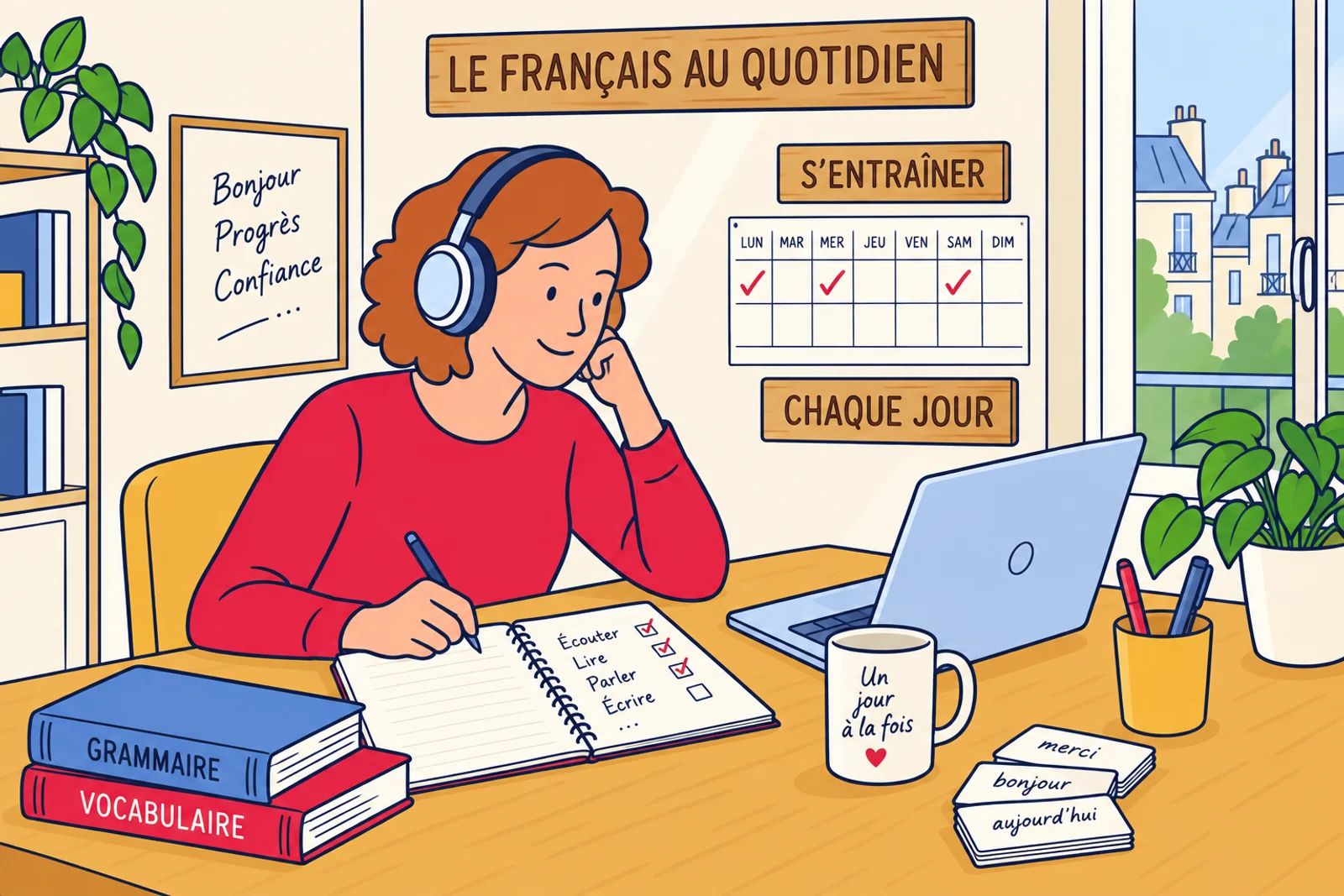
Self-study becomes easier to organise when you know what the French is for. An upcoming call gives you a reason to practise dates. A repair request gives you a reason to describe a problem. A neighbourhood conversation gives you a reason to introduce yourself and ask a follow-up question.
That does not mean abandoning grammar. It means choosing a small piece of grammar and using it in a situation you can recognise. The routine below is a suggested learning method, not a promise of a particular level after 90 days.
Use the first-90-days plan to identify practical priorities.
Choose one weekly situation
Select a task you may actually face: arranging a visit, asking about a document, reporting a problem or joining a local activity. Write the result you want in plain English. “Understand the appointment time and required documents” is more useful than “improve French”.
Choose three language targets. For an appointment, these might be asking availability, distinguishing two days and confirming the address. Keep unrelated words on another list. A narrow session gives you room to practise producing the language rather than collecting it.
Change the time expression and the reason. Keep the structure stable until you can retrieve it without looking. Then introduce a reply that requires you to adapt.
Define a task small enough to rehearse
“Deal with housing” contains many different conversations. Collecting keys, asking how the heating works and reporting a broken fitting require different words and responses. Pick one exchange and describe its endpoint. For collecting keys, that endpoint might be knowing where and when to meet, then confirming who will be there.
Keep the goal observable. At the end of a practice round, you should be able to tell whether you obtained the time and location. “Sound more French” is harder to evaluate because it does not identify what you are trying to accomplish. You can work on pronunciation within a task, but the task gives the session a clear boundary.
Choose a situation that is useful soon without making every lesson urgent. If a real appointment concerns a consequential decision, prepare carefully and use appropriate support. A learning exercise is a place to make harmless mistakes; an important administrative exchange is not the place to test guesses about facts you have not established.
Make a weekly menu rather than an endless list
Write down three possible situations and choose one as the main focus. Keep the others for later. This reduces the temptation to add every unfamiliar word you encounter to today's lesson. You can still note an interesting phrase, but it does not have to interrupt the practice you planned.
A sample week might focus on arranging an appointment. A second week could cover a delivery problem, and a third could practise joining a local activity. This is an example sequence, not a curriculum every newcomer must follow. Your own daily life should determine which situations are worth repeating.
For each chosen situation, prepare a small set of materials: a short model, a few reply variations and one repair phrase. If you cannot explain how a page or exercise supports the week's task, set it aside. A smaller collection you use actively is more practical than a large folder you only browse.
Choose a grammar point because the task needs it
For a polite request, you may practise “je voudrais” followed by the appropriate noun or verb. For a recent problem, you may need a past-tense sentence. Choose one structure and use it in several meaningful examples. The grammar lesson then answers a question your conversation actually raised.
Do not try to cover an entire tense system during a short appointment lesson. Start with the forms needed for the exchange and use a reliable reference when you need to understand the rule more fully. Keep a separate note of broader questions for a longer study session or a teacher.
As a quick check, explain in English what changes when you replace a word or verb form. If the meaning changes in a way you did not intend, return to the model. Producing a sentence is useful practice only if you know what you are trying to say and can check whether the sentence expresses it.
Adapt the task to your starting point
A beginner may practise an opening, two possible replies and a request for repetition. A more experienced learner can add reasons, alternatives and a short explanation of a problem. Both are working on the same real-world task, but the amount of language should match what they can practise attentively.
If a dialogue is too difficult, simplify the scenario before abandoning it. Remove a secondary complication, shorten a reply or supply a small word bank. Keep the central task intact. You want a challenge you can investigate, not a page where almost every sentence requires outside help.
If the dialogue feels easy, test it without reading and change a detail. Recognition can feel like mastery when the answer is visible. Being able to respond to a new time or condition gives you better evidence of what you can actually retrieve and understand.
Use a twenty-minute session
The timings here are a practical proposal. Adjust them to your attention and schedule.
| Minutes | Activity | Result |
|---|---|---|
| 0–4 | Read a short dialogue | Identify the task and key detail |
| 4–8 | Hide the translation and recall phrases | Find what you cannot yet retrieve |
| 8–13 | Speak both roles | Practise the exchange |
| 13–17 | Change dates, names or conditions | Use the pattern flexibly |
| 17–20 | Record one correction and next review | Keep the next session focused |
If you have less time, shorten the material rather than racing through every step. Two carefully practised sentences can be a useful session. Twenty minutes of copying words you never retrieve is harder to evaluate.
Prepare the materials before starting the timer
Choose one short exchange and have the translation available for checking. Put unrelated tabs and vocabulary lists aside. A timed session loses its purpose if most of it is spent searching for a new resource. You can schedule resource selection separately and reuse a small set of materials across several sessions.
Decide what you will record at the end: one phrase you could not retrieve, one reply you misunderstood and one next review. This gives you a place to put useful observations without transcribing the whole exercise. Your notes should help you restart tomorrow, not become another assignment that takes longer than the practice.
If you use audio, check that you can pause and replay a short segment. Listen once for the purpose of the exchange before focusing on individual sounds. Slow playback can help you inspect a difficult phrase, but return to ordinary speed when you are ready to check whether you recognise it in a more natural flow.
Use the first reading to understand the situation
Before translating word by word, identify who is speaking, what they want and what changes during the exchange. In an appointment dialogue, the change may be a different day. In a repair dialogue, it may be a request for a photograph or another detail. This gives unfamiliar words a context.
Then mark the two or three phrases that carry the task. These might be the opening request, the changed information and the confirmation. You can study other details later. During a short session, focus first on the language without which you could not complete the exchange.
Explain the dialogue in one English sentence. If you cannot, use the translation to resolve the misunderstanding before practising aloud. Repeating sounds from a passage you have misread can reinforce an incorrect interpretation. Understanding the task gives your speaking practice a purpose.
Hide the model and attempt a small piece
Cover the French opening and try to say it from the English intention. Do not require a perfect performance on the first attempt. Notice where you hesitate, then check the model. Practise that part again and try the complete sentence once more without looking.
The point is to expose the gap between recognising a phrase and producing it. Copying the sentence neatly may feel productive, but it does not show whether you can retrieve it when someone is waiting for an answer. A short attempt without the model gives you that information.
Keep the correction specific. If you forgot the preposition, practise the whole expression containing it. If you forgot the noun, add its article and use it in the sentence. Avoid turning one missed word into a reason to restart the entire lesson from the beginning.
Speak both roles, then separate them
Reading both sides once helps you understand the exchange. After that, practise your role while using a recording or a partner for the other role. If you are alone, pause between turns and answer before looking at the next line. This creates a small opportunity to retrieve rather than simply read.
Use a different voice or position for each role if that helps you track the turns. The technique is optional; the important point is to know which sentence is the question and which is the response. Some learners accidentally memorise a dialogue without being able to identify where their own next line belongs.
End the round by stating the result in English: the appointment is Thursday morning, the item must be collected elsewhere or the person needs more information. This checks comprehension alongside pronunciation. A fluent reading of the French does not by itself prove that you understood the outcome.
Keep a five-minute version for crowded days
When twenty minutes is unrealistic, reduce the task to one opening, one reply and one confirmation. Read them, hide the model and try the exchange. Check one error and repeat with a changed detail. That is a complete small session rather than a rushed attempt to cover everything.
Do not make up missed time by adding an unmanageable session the next day. Resume the routine at a size you can actually repeat. You can lengthen a later session if you have the attention and time, but the plan should not turn a busy day into a growing debt of unfinished study.
Keep the small version written at the top of your weekly sheet. On a tired evening, deciding what to study can be harder than doing a short exercise. A prepared minimum gives you a clear starting point while leaving room for rest when you need it.
Study the reply as well as the question
Learners often practise the opening perfectly and freeze at the answer. Prepare likely replies: no availability, a different date, a missing document or a request to call another number. Your task is to recognise what changed.
The useful skill is responding to Thursday, not repeating the original request for Tuesday. Ask a partner to change the reply unpredictably or shuffle written reply cards before reading one aloud.
Build reply cards around different outcomes
Create four cards: agreement, alternative, missing information and referral. Write one simple reply for each using language you can check. The same opening can then lead to different next steps. This is particularly useful for learners who can ask a polished question but expect only one possible answer.
For agreement, your next line confirms a detail. For an alternative, it accepts or asks about another option. For missing information, it clarifies what is needed. For referral, it asks whom to contact and how. These are conversational functions, so you can reuse them in several everyday contexts.
Shuffle the cards and practise the appropriate response. Do not look at the card title before hearing or reading the reply. If you always know the category in advance, the exercise tests memory of the sequence more than understanding of the French.
Listen for the word that changes the answer
In the appointment example, mardi and jeudi change your plan. In another exchange, aujourd'hui and demain may be the important contrast. Identify the detail on which the task depends and practise hearing it in short sentences before returning to a longer dialogue.
Write two fictional possibilities on paper and ask a partner to choose one without telling you. Repeat the information you heard, then compare. If you make a mistake, replay the sentence and inspect the sound or word boundary that caused it. Keep the exercise small enough to diagnose the problem.
Avoid treating every listening error as a vocabulary gap. You may know the word when you see it but miss it in connected speech. In that case, more written definitions are unlikely to address the exact difficulty. Practise the phrase in audio and verify your understanding with a reliable model or teacher.
Practise a repair before the conversation breaks down
A repair phrase helps you recover a missing detail. Instead of asking the person to repeat everything, you can identify the part you missed: the time, the last word or the location. This gives the speaker a manageable way to help.
Use the repair in the role-play even when you could guess the answer. Your practice goal is to make the clarification available when you need it. A guess that happens to be correct does not train the same skill as asking and checking.
In the next round, ask for confirmation instead of repetition. Repeat the detail you think you heard and invite correction. This gives you two different tools: recovering information you missed and verifying information you believe you understood.
Keep your response tied to the meaning
Suppose the other person offers Thursday instead of Tuesday. A memorised reply about Tuesday no longer fits, even if its grammar is perfect. Pause long enough to identify the new information, then choose the response that matches it. You can practise this slowly before attempting a faster exchange.
For a written exercise, place three possible responses under one reply. Explain why only one fits the situation. Then change the reply so another response becomes appropriate. This helps you attend to meaning rather than selecting a familiar-looking sentence automatically.
When practising with a tutor, ask them to introduce a small unexpected detail. Tell them which task you are trying to complete and which language you have studied. The unpredictability should be manageable, so it tests adaptation rather than overwhelming you with a completely unrelated conversation.
Review with changed details
Return to a situation after a gap. First try it without your notes. Then check the model and correct one error. Finally, change a detail: singular to plural, today to tomorrow, request to confirmation.
Do not make every review harder at once. If you change the vocabulary, tense and social situation simultaneously, it becomes difficult to see which part caused the problem. Change one variable, then combine them later.
Use a review log with evidence
Keep three columns: task attempted, difficulty observed and next exercise. “French was bad” is not useful evidence. “I understood the proposed day but missed the time” identifies something you can practise. “Review two time expressions in short replies” gives the next session a clear starting point.
Record successes with the same precision. “Asked for the address and repeated it correctly” tells you which skill worked. It does not mean that every future conversation will be easy, but it provides a concrete result to compare with later attempts.
Avoid turning the log into a score for your personality or effort. It is a practical record of a task on a particular day. Fatigue, unfamiliar voices and more complex language can affect an attempt. Use the observation to adjust the exercise rather than drawing a broad conclusion about your ability.
Change one variable, then combine two
Start by changing only the date in an appointment exchange. Once that works, keep the date stable and change the location. Later, change both. This sequence lets you see which detail causes difficulty and prevents every unsuccessful attempt from becoming an unexplained bundle of errors.
You can use the same approach with a repair request. First change the object, then the description of the problem, then the time when it occurred. Keep the surrounding structure familiar while you practise the new element. Use checked examples so you are not repeatedly rehearsing a sentence whose accuracy is uncertain.
After several controlled rounds, try a freer version. Explain the situation in your own words and ask for the information you need. The model remains available for checking, but you are no longer trying to reproduce it exactly. This connects structured practice with more flexible use.
Revisit the task after a gap
At a later session, attempt the exchange before opening the old notes. This shows what remains available without immediate prompting. If you hesitate, check the model and practise the difficult part again. A review is useful even when it reveals that a phrase needs more work.
Choose review intervals that fit your schedule rather than treating a particular calendar as a universal rule. You might revisit a task the next day, later in the week and after another gap. Keep the schedule simple enough that you will actually use it.
When the exchange becomes easy, do not keep repeating the identical version only to preserve a perfect score. Change a reply, remove a prompt or combine it with a second short task. At the same time, avoid escalating difficulty so quickly that you lose track of which language needs attention.
Use corrections without copying them endlessly
After a correction, write the useful phrase once with its meaning and context. Then use it in a new sentence or reply. If the correction concerns a rule, consult a reliable explanation and check a few examples. The goal is to understand and use the change, not fill a page with identical copies.
If you receive conflicting corrections, preserve the full sentences and the intended meaning. Ask a teacher or reliable reference about the difference. Context can affect whether a phrase is natural or appropriate, so comparing isolated words may not resolve the disagreement.
Do not confidently teach yourself an invented rule from one example. A phrase can be useful before you understand every grammatical detail behind it. Mark the unresolved question and continue with checked language while you seek the explanation you need.
Useful phrases to keep
Use repair phrases in the exercise itself. They are not evidence that the practice failed; they are part of keeping a real exchange going.
Measure what you can do
At the end of the week, try the situation once without a model. Record whether you completed the task, understood the key reply and repaired a misunderstanding. Keep separate notes for vocabulary, grammar and listening.
Over the first month, build a few reliable exchanges. In the second, vary replies and practise speaking with another person when possible. In the third, revisit tasks after longer gaps and combine two short exchanges. This is a flexible sequence, not a deadline for fluency.
Use week-one situations when you need immediate practice and the moving checklist when choosing the next task. Bring persistent uncertainties to a teacher or reliable reference rather than reinforcing a guess.
Use a simple task checklist
After a practice round, ask whether you stated the purpose, understood the key reply and confirmed the next step. Add a fourth question: did you ask for clarification when you needed it? These observations provide more useful feedback than counting every small mistake equally.
Keep grammar and pronunciation notes separate from task completion. You may complete an exchange with imperfect French and still have a useful correction to study. You may also pronounce every prepared sentence clearly while misunderstanding the answer. Both kinds of information matter, but they describe different aspects of the attempt.
Repeat the same task later with a changed detail and compare the evidence. Did you need less prompting? Did you notice the alternative date? Could you recover after a misunderstanding? These are concrete signs of progress within the task, without claiming a formal language level from a short home exercise.
Plan the first month around reliable exchanges
For an example first month, choose four situations that recur in your life. Spend each week on one while briefly reviewing earlier ones. Keep the material small: an opening, likely replies, a confirmation and repair language. The purpose is to make several exchanges usable rather than sample dozens once.
At the end of each week, record a short attempt or practise with another person if possible. Use harmless fictional details. Listen or review for the task outcome first, then choose one language point to improve. You do not need to correct every feature of your speech in a single session.
If an unexpected real situation becomes urgent, swap it into the plan. The schedule serves your learning needs. Keep the previous task in the review list so it does not disappear entirely, but do not preserve a calendar at the expense of practising the conversation you actually need.
Use month two for variation and interaction
Once the basic exchanges are familiar, increase variation. Ask another person to choose the reply, use a different voice in audio practice or combine two related questions. Keep the purpose clear so the added difficulty remains connected to the skill you are trying to develop.
If you work with a tutor, bring a specific task and your error log. Ask for a short role-play, feedback on the main misunderstanding and another attempt. This gives a paid lesson a concrete focus. It also helps you leave with a phrase or listening target you can practise independently.
Continue using written resources for preparation and checking. They provide a stable model you can revisit. Spoken interaction adds uncertainty and turn-taking. The two formats can support each other without either one being treated as sufficient for every learning need.
Use month three to connect situations
Try linking two short exchanges: introduce yourself, then ask about an activity; describe a problem, then arrange a visit; request an appointment, then confirm the documents. Connecting tasks makes the practice more like a conversation while preserving manageable components.
Include an unfamiliar but related detail and see how you respond. You may need to ask for an example, repeat a word or explain that you do not understand one part. Those strategies belong in the assessment. A successful conversation can include clarification rather than proceeding without any hesitation.
At the end of the period, choose what to continue. Some tasks may now need only occasional review; others may require focused help. Build the next plan from that evidence. Ninety days is an organising window, not a guarantee of fluency or a reason to stop practising when the calendar ends.
Match the resource to the gap you have found
If you need more written settlement scenarios, a structured guide can provide them in one place. If you need feedback on speech, use an appropriate person or service. If a grammar question keeps recurring, consult a reliable explanation and practise it in context. The best next purchase or free resource is the one that addresses an observed gap.
The settlement product linked here contains written bilingual situations; it does not include audio recordings or individual feedback. The audio examples on this Learning Center page are separate practice material. Check that distinction before buying so you know which part of your routine the product can support.
You can begin with the free routine on this page. Choose one situation, practise both sides, change a detail and record the result. That completed cycle gives you a better basis for deciding what additional help you need than collecting resources before trying any of them.
Work through one complete sample week
On Monday, choose the appointment exchange and identify its purpose. Read the model, check the meaning and practise the opening without looking. Your note might say that you can remember the request but hesitate over the time expression. That observation becomes Tuesday's starting point.
On Tuesday, practise three short time expressions in replies. Ask a partner to choose one or use checked audio examples. Repeat the detail and compare it with the model. Finish by using the time in the complete appointment exchange so the exercise remains connected to the conversation.
On Wednesday, introduce an alternative. The requested day is unavailable, so you need to ask about another slot. Keep the vocabulary familiar and concentrate on responding to the changed information. If you accidentally repeat the original date, record that specific error and try the reply again slowly.
On Thursday, practise a clarification. Pretend that you understood the day but missed the hour. Ask for that detail, listen and confirm it. This round can be short: the useful result is a repair phrase you can retrieve when the conversation does not go exactly as expected.
On Friday, attempt the full exchange without the script. Let your partner select a reply from the cards. Afterwards, compare your written appointment note with the reply they gave. Choose one correction and one success to record. A weekend review can revisit the exchange after a gap, or you can leave it for the next available session.
The example does not require five perfect study days. If you miss Wednesday, continue with the next useful step instead of rushing through three exercises to restore the calendar. The sequence matters because each activity has a purpose; the dates are simply a way to make the example concrete.
Keep the next session easy to start
End by leaving the exact material and next task ready. “Practise the alternative-date reply twice, then change the time” is an instruction you can act on tomorrow. “Study more listening” leaves you with another planning decision before you can begin.
Over several weeks, this habit makes your notebook a working tool. It contains tasks, evidence and checked language connected to your life in France. You can bring that record to a teacher, use it to choose a resource or continue independently with a clearer idea of what needs attention.
Turn a reply into tomorrow's practice
Choose a short, non-sensitive reply from an everyday interaction or one of this article's examples. Identify its purpose before collecting vocabulary. Does it confirm, refuse, request a document, propose a time or ask you to choose?
Write two plausible answers in French using language you can check. One accepts the proposal; the other explains a simple constraint. Keep the facts fictional when sharing with a partner. Rehearse both without the page, then compare them with your checked versions.
The next day, change one detail in the prompt: move the appointment, change the requested item or make the original option unavailable. If your answer still works, you are practising a usable pattern. If it does not, identify the exact word or structure needed before starting another exercise. Keep the revised example with the original so the difference remains visible.
Useful phrases to keep
| 🇫🇷 French | 🇺🇸 English | 💡 Context |
|---|---|---|
| Vous pouvez répéter le dernier mot ? | Can you repeat the last word? | Clarifying a word you missed |
| Je n’ai pas compris l’heure. | I did not understand the time. | Checking appointment details |
| Est-ce que j’ai bien compris ? | Have I understood correctly? | Confirming your understanding |
| Je vais le noter. | I am going to write it down. | Recording an instruction |
| Pouvez-vous donner un exemple ? | Could you give an example? | Asking for a concrete explanation |
Your First 90 Days in France
Prepare the French for your first weeks.
For English speakers getting settled in France
A viewing, a bank appointment, a phone call: start with the situation you face next. Read the steps in English, rehearse the French dialogue and adapt a message before you use it.
- 30 everyday situations to rehearse
- 90 practice questions with explanations
About 180 pages per edition · Interactive + Print A4 included
Get the 90-day guide · $9 Read a preview before you buyOne payment · Instant PDF download
Rehearse the conversation before the appointment.
Tell a tutor what you need to do in France. Practise the questions, try an unexpected reply and ask for the words you were missing.
Find a French tutor →Paid lessons. Compare tutors and prices before booking.
Affiliate link: we may earn a commission when you book.
📚 Keep building in the Learning Center
French Health Insurance for Expats: The Vocabulary Behind the Paperwork
French health insurance arrangements for expats depend on status and circumstances. Distinguish eligibility, registration, evidence of cover and…
Read →Health Insurance for a France Long-Stay Visa: Read the Certificate and Ask Better Questions
Insurance for a French long-stay visa needs to match the instructions for your application. Compare certificates, dates and…
Read →France Long-Stay Visa Requirements: A Document Checklist You Can Actually Use
France long-stay visa requirements depend on your route and circumstances. Build your file from the official checklist, then…
Read →