
Updated on September 15, 2026
Dont vs Lequel: French Relative Pronouns Explained
Choose dont, lequel, qui or que by rebuilding the original sentence. Compare prepositions, possession and common errors with examples.
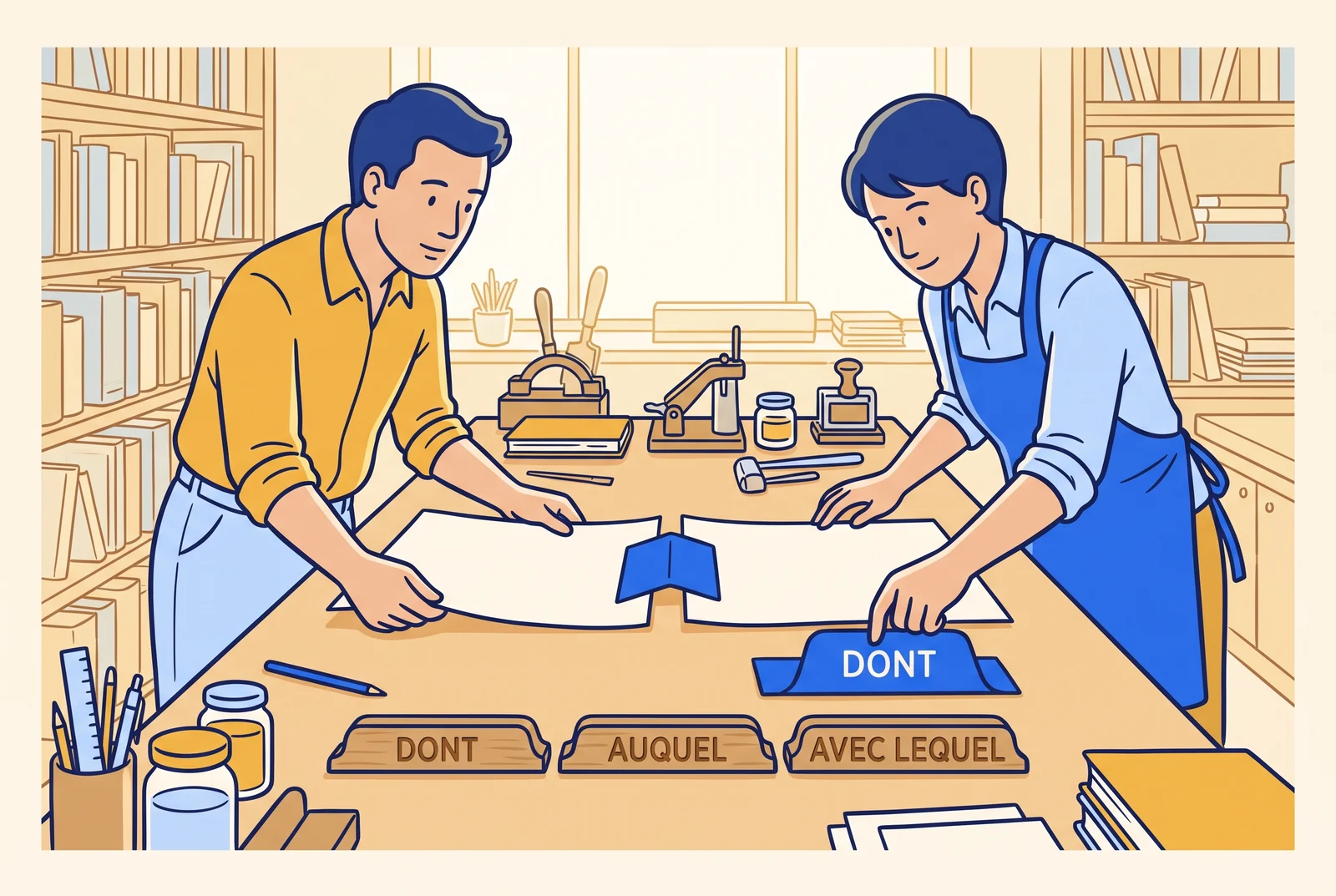
By the end of this lesson: Join clauses by identifying the missing grammatical relationship, especially when a preposition is involved.
Start with rebuild the clauses, then work through the contrasts below. Read each French sentence with its translation, listen, and explain why that form fits. Finish with the optional quiz to check your choices.
Rebuild the two sentences before choosing a pronoun
Separate the two clauses and restore the repeated noun. The noun’s role tells you which relative pronoun is needed.
🇺🇸 Here is the document. I need this document.
Dont expresses the relationship involving de when you join these clauses. The document becomes the antecedent, the noun to which the relative pronoun refers. In the result, you no longer repeat de ce document after besoin because dont already carries that connection.
🇺🇸 Here is the document I need.
Now change the second verb. Consulter takes a direct object in French, so its relative construction needs que rather than dont. The real-world document is identical, but its grammatical role has changed. This is why choosing the pronoun by the kind of object alone cannot work.
🇺🇸 Here is the document I’m consulting.
A third version gives the document the job of grammatical subject. It is now the thing explaining the procedure, rather than something a person needs or consults. Qui marks that subject role within the relative clause.
🇺🇸 Here is the document that explains the procedure.
Identify the missing function inside the relative clause. Is the antecedent its subject, direct object or a complement introduced by a preposition? The English translation may hide that function; the reconstructed French sentence exposes it.
Qui and que keep their grammatical jobs
Qui replaces a subject; que replaces a direct object. Choose by the role in the relative clause, not by whether the noun names a person.
🇺🇸 The colleague organising the meeting is waiting for us.
In the next sentence, someone else has invited the colleague. She is the object of avons invitée inside the relative clause, even though she is also the person described by the main sentence. Keep the two clauses separate when deciding the pronoun.
🇺🇸 The colleague we invited is arriving tomorrow.
Que becomes qu’ before a vowel or silent h. That spelling change does not alter its role. The relative pronoun remains necessary in standard French even where English can omit “that” or “which,” so do not remove it just because your English translation sounds smoother without one.
🇺🇸 The book she recommends is available here.
For a place or time, où can often express the relevant relationship. It is useful, but it should not be used merely because the antecedent happens to be a place name. Ask whether the missing element actually means “in/at which” or otherwise supplies the location or time of the clause.
🇺🇸 On the day we moved, it was raining.
If tense choices are distracting you from the relative construction, the past-tense timeline lesson separates events from background. Here, identify the antecedent and grammatical role first. You can then review the tense without confusing two different reasons a sentence might need revision.
Dont already includes the de relationship
Dont includes a de relationship. Avoid adding a second de or a possessive that repeats the same relationship.
🇺🇸 The problem we’re discussing concerns the whole team.
An adjective can provide the same relationship. In the next sentence, the team is proud of a result. The antecedent résultat is what the de-complement would name in the uncombined version: nous sommes fiers de ce résultat.
🇺🇸 It’s a result we’re proud of.
With possession, dont can correspond to English “whose.” French normally uses a definite article before the possessed noun because the relative construction already makes the relationship clear. Adding son or sa would repeat the possessive information instead of making the sentence more precise.
🇺🇸 The researcher whose book won a prize will come on Thursday.
A part-of-a-whole relationship can also use dont. Here, half of the books have been read. You do not need en as well, because dont already expresses the relationship between the fraction and the books. This connects directly with the separate lesson on what en replaces.
🇺🇸 Here are the books of which I’ve read half.
When the antecedent is an unspecified idea rather than a named noun, ce dont is useful with a de-construction. Do not let the English “what” tempt you into ce que when the French expression is avoir besoin de. The preposition still belongs to the underlying construction.
🇺🇸 Tell me what you need.
Expand a difficult relative clause into two ordinary sentences. If the expansion needs de plus the antecedent, investigate dont. If it needs another preposition, keep that preposition in view before choosing a form of lequel.
Which prepositions need a form of lequel
After many prepositions, use a form of lequel agreeing with the noun. À and de create contracted forms in some genders and numbers.
🇺🇸 Here is the file I’m working on.
A feminine antecedent changes the pronoun’s form, even if a masculine noun appears closer to it inside another phrase. Agreement belongs to the antecedent being represented. In this example, the table is the surface beneath the keys.
🇺🇸 The table the keys fell under is heavy.
Plural forms follow the same rule. The tools below are masculine plural, and avec remains the preposition expressing how the team works. The noun’s gender is worth checking rather than guessing from an English translation; the article and gender guide is a useful refresher.
🇺🇸 The tools we work with are new.
À contracts with lequel and the plural forms to give auquel, auxquels and auxquelles. The feminine singular remains à laquelle. These combinations preserve the à required by the verb, so participer à provides the model for the next sentence.
🇺🇸 The meeting I’m taking part in starts at nine.
Responding to proposals uses répondre à. Because propositions is feminine plural, the relative form becomes auxquelles. The pronoun’s spelling records both the preposition and agreement; neither part is optional just because the word looks long.
🇺🇸 The proposals we responded to were specific.
Compound prepositions ending in de often require a form such as duquel or de laquelle, rather than inserting dont into the middle of the compound. Près de gives a concrete location example. The place-preposition lesson helps you identify the original location phrase.
🇺🇸 The museum near which we live is closed on Mondays.
Pour remains visible when an organisation is the antecedent. Because association is feminine singular, its matching relative form is laquelle.
🇺🇸 The association she works for is organising the meeting.
When referring to a person, preposition plus qui is often the natural choice, although forms of lequel are possible in suitable contexts. This is different from bare qui as a subject: the preposition is still present and still has its grammatical job.
🇺🇸 The person I work with knows the neighbourhood well.
Avoid duplicate possessives and unclear antecedents
Check that each relationship appears once and that the relative clause attaches to the intended noun.
🇺🇸 The neighbour whose car is blocking the entrance is looking for his keys.
Here, la voiture belongs in the relative clause. There is no need for sa voiture because dont has already supplied the relationship to the neighbour. If you want to make possession explicit in a separate sentence instead, remove the relative construction and rebuild the sentence honestly.
🇺🇸 The neighbour is looking for his keys. His car is blocking the entrance.
An antecedent can also become unclear when two possible nouns stand near a relative clause. Rather than hoping a reader infers the intended one, repeat the noun or split the sentence. This is particularly useful in professional emails, where a small ambiguity can turn into an unnecessary follow-up message.
🇺🇸 I spoke to the agency manager. This agency is organising the visit.
Check vocabulary as well as syntax. A grammatically connected sentence can still mislead if one familiar-looking word has the wrong meaning; French false friends are a separate source of trouble. Grammar joins the ideas you give it, including an idea you did not intend to express.
The feminine form also keeps de separate after a compound expression. A site belonging to a business provides a more demanding example than a simple location.
🇺🇸 The company on whose website this offer appears is French.
Dont does not replace every sequence containing de. Compound prepositions and the internal structure of the relative clause can require de laquelle, duquel or another construction. Reconstruct the complete phrase before applying the shortcut.
Revise a paragraph without overloading it
A relative clause should help identify or describe a noun. If several clauses obscure the reference, divide the sentence.
For a more demanding revision task, the ambiguity and reformulation workshop examines what a rewrite actually commits the writer to saying. You can also select one relative clause from the French Briefing and expand it into two sentences before listening to the original again.
On the desk, two versions of the email remain open; in the shorter one, the reader can immediately tell which agency is arranging the visit.
Useful phrases to keep
| 🇫🇷 French | 🇺🇸 English | 💡 Context |
|---|---|---|
| dont j’ai besoin | which I need | From avoir besoin de. |
| qui organise | who / which organises | The relative pronoun is the subject. |
| que je consulte | which I consult | The relative pronoun is the direct object. |
| sur lequel | on which | Keep the preposition. |
| à laquelle | in / to which | A feminine singular à-complement. |
| auxquelles | to which | A feminine plural contraction. |
| près duquel | near which | A compound preposition. |
| avec qui | with whom | Common with a person. |
Use your French in a real conversation.
Bring a question from a guide to a French tutor. Try it aloud, ask for feedback and leave with something to practise.
Find a French tutor →Paid lessons. Compare tutors and prices before booking.
Affiliate link: we may earn a commission when you book.
📚 Keep building in the Learning Center
French Reflexive Verbs: Daily Routine and Word Order
Build a daily routine in French with reflexive pronouns, negatives and infinitives. Compare translated examples, listen and practise.
Read →French Nominalisation: Examples and Clear Writing
Turn French verbs into nouns without hiding the actor or losing the time reference. Compare examples and practise…
Read →Agree and Disagree in French: D’accord and Alternatives
Compare ways to agree and disagree in French, and understand why être d’accord differs from English agree. Read…
Read →