French Reflexive Verbs: Daily Routine and Word Order
Build a daily routine in French with reflexive pronouns, negatives and infinitives. Compare translated examples, listen and practise.
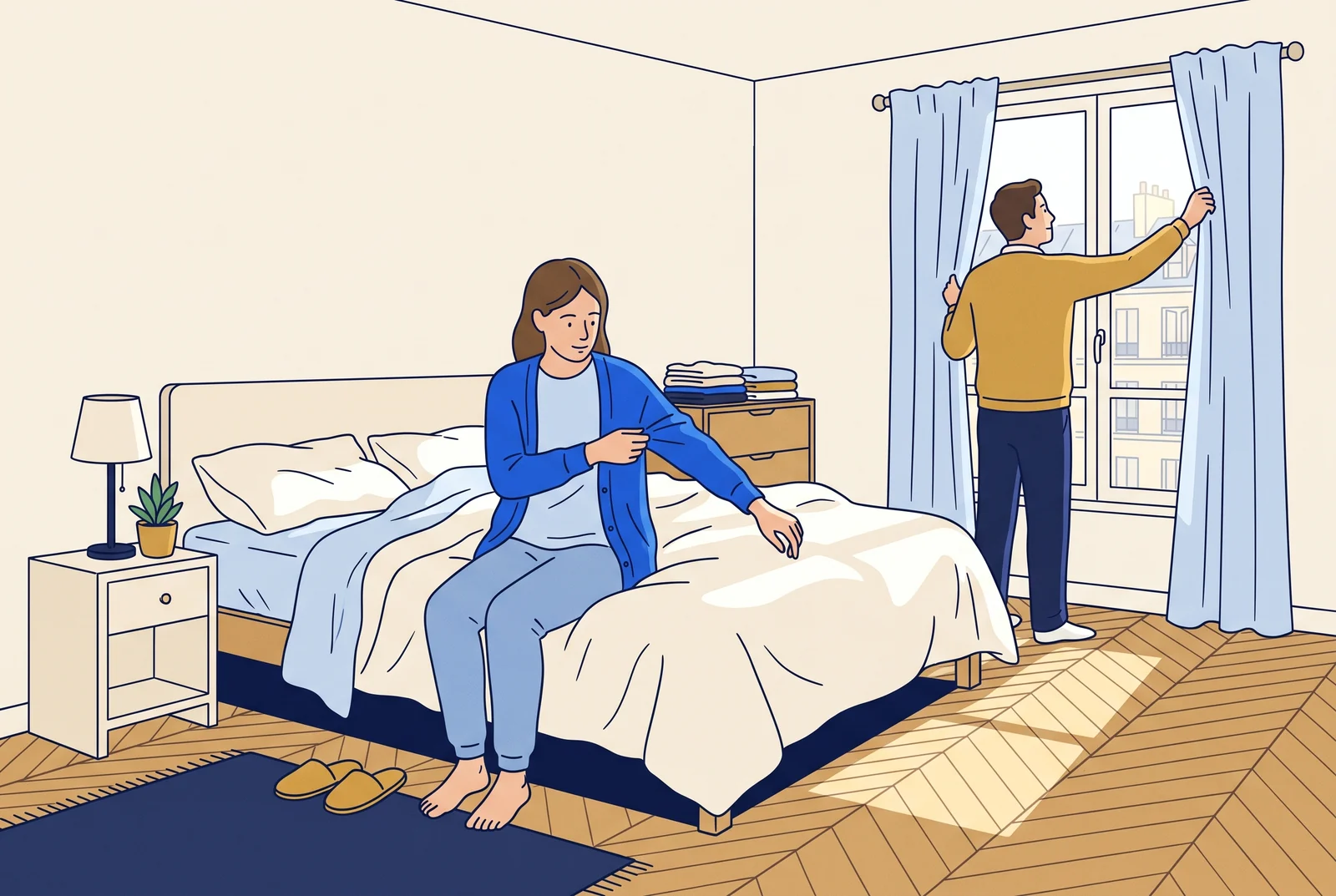
By the end of this lesson: Describe a daily routine and place the reflexive pronoun correctly in statements, negatives and infinitive phrases.
Start with the pronouns, then work through the contrasts below. Read each French sentence with its translation, listen, and explain why that form fits. Finish with the optional quiz to check your choices.
Follow the person through the routine
Match the pronoun to the subject: je → me, tu → te, il/elle/on → se, nous → nous, vous → vous, ils/elles → se. Put it before the conjugated verb.
Start with the moment someone gets out of bed. The following sentence describes a regular habit.
🇺🇸 I get up at seven during the week.
Addressing a friend changes the subject and the reflexive pronoun together. Te refers back to tu.
🇺🇸 You get up later on Sundays.
Talking about someone else brings back se. The pronoun has the same form with il, elle and on.
🇺🇸 She gets ready before having breakfast.
The practical question is who the small pronoun points back to. In these examples, it points to the subject. However, the term pronominal is broader than a physical action performed on yourself: se souvenir means remember, and se dépêcher means hurry. Translating every se as yourself produces some very strange English and makes perfectly ordinary French harder to learn. Keep the whole verb and its meaning together.
For a joint routine, the repeated nous has two different jobs: subject first, reflexive pronoun second.
🇺🇸 We get ready in the same bedroom.
The same-looking repetition occurs when addressing one person politely or a group with vous.
🇺🇸 Do you get up early to catch the train?
Check three items in order: the person, the matching pronoun, then the verb form. With nous nous préparons, crossing out one nous removes a grammatical job rather than tidying up a repeated word.
The pronoun changes the action
Compare the verb with and without se. Sometimes the action returns to the subject; sometimes the whole expression has a different meaning. Learn the complete verb expression.
With a named object, the speaker is preparing breakfast rather than getting ready personally.
🇺🇸 I prepare the coffee while Léa gets dressed.
Before a vowel, me, te and se shorten to m’, t’ and s’. The apostrophe represents that contraction in writing.
🇺🇸 I get dressed before going down to the kitchen.
The same verb without its reflexive pronoun directs the action towards another person.
🇺🇸 She dresses her child before leaving.
Waking up and waking someone else follow the same contrast. The situation tells you who is doing the waking.
🇺🇸 The noise wakes me up, then I get up.
In le bruit me réveille, me is an object pronoun but it does not refer back to le bruit. In je me lève, it does refer back to je. The words can look alike while describing different relationships. You do not have to label every occurrence during a conversation, but checking the relationship is useful when a sentence seems grammatically tidy and means something unexpected.
A plural subject can also describe people doing something to one another. That reciprocal reading depends on the verb and context.
🇺🇸 We call each other after work.
A reflexive pronoun can describe an action involving yourself, a reciprocal action or an established verb meaning. Learn se préparer, se téléphoner and se souvenir as complete expressions, then check their participants in the sentence.
Keep the pronoun inside a negative sentence
In a simple negative, ne comes before the reflexive pronoun and pas comes after the conjugated verb. Keep the pronoun attached to the verb group.
The speaker rejects a particular habit while retaining the reflexive structure.
🇺🇸 I don’t get up before eight on Saturdays.
With a vowel-starting verb, the contraction belongs to the pronoun immediately before it.
🇺🇸 She doesn’t get dressed straight away.
Replacing pas with jamais changes the meaning to never while keeping the same overall placement.
🇺🇸 We never go to bed this early.
If you need a fuller comparison of meanings, pas, jamais and plus in context separates a simple negative from a habit that has ended. That distinction still applies to pronominal verbs. Concentrate on the intended message before changing the negative word; the grammar can be correct while the statement about your routine is wrong.
Here the speaker used to worry about the issue, but that has stopped.
🇺🇸 I’m no longer worried about this appointment.
A routine question can keep statement order in conversation. With est-ce que, the subject and pronoun also stay together.
🇺🇸 Do you rest after lunch?
You can compare alternative openings in the lesson on French questions. Avoid practising every possible question structure at once. Choose one pattern, ask about waking up, resting and going to bed, then answer both positively and negatively. The repeated situation gives the changes a purpose, especially if someone can answer with a routine that differs from yours.
Put the pronoun beside its infinitive
When a second verb stays in the infinitive, place the reflexive pronoun directly before that infinitive. It still agrees with the person doing the action.
An immediate intention places me before coucher rather than before vais.
🇺🇸 I’m going to bed after this chapter.
For a possibility involving several people, use nous with the infinitive even though the first verb already carries its own ending.
🇺🇸 We can meet outside the station.
A polite invitation follows the same arrangement with vous. It can address one guest or several.
🇺🇸 You can settle down near the window.
The negative usually surrounds the first conjugated verb when it denies the intention. Notice that the pronoun remains beside its own infinitive.
🇺🇸 I’m not going to hurry for nothing.
For the choice between plans and predictions, continue with futur proche and futur simple. The present lesson concentrates on pronoun placement. You will see the same need to locate the verb an object belongs to in the order of French object pronouns, although that later lesson introduces combinations you do not need for a basic morning routine.
A preference can also take a pronominal infinitive. The subject determines the small pronoun just as it does with aller.
🇺🇸 She prefers to get ready in peace.
The infinitive stays unconjugated, but its reflexive pronoun still changes with the person. Je vais me préparer, tu vas te préparer and nous allons nous préparer keep that distinction visible.
For a person finishing a busy day, se reposer supplies a useful final action without requiring an English word for yourself.
🇺🇸 I rest for a few minutes before preparing dinner.
Body parts and a routine you can actually say
With an ordinary reflexive action, French usually uses le, la or les for the body part. The reflexive pronoun already tells us whose body is involved.
At the sink, the action and its affected person are already explicit.
🇺🇸 I wash my hands before preparing the meal.
The same arrangement works with a plural subject and a different body part.
🇺🇸 The children brush their teeth after dinner.
Compare that construction with mon, ma and mes for ordinary ownership. A bag or coat can belong to someone without being involved in a reflexive action. For routine practice, write four moments in chronological order and give each one a complete subject-pronoun-verb group. Add one non-pronominal action between them, so you have to choose instead of mechanically inserting me into every sentence.
This sentence joins an ordinary action to an established pronominal expression meaning to take a walk.
🇺🇸 We have lunch at noon, then we take a walk in the park.
A final evening habit uses s’endormir, whose English equivalent does not need a reflexive pronoun at all.
🇺🇸 I fall asleep quickly when the house is quiet.
Read your short routine aloud, then change its subject from je to nous. Listen for the small pronoun each time and check the conjugated ending separately. If a missing pronoun keeps returning, add the whole expression to your notes beside the other English-to-French sentence traps you are working on.
Tomorrow morning, describe the first action before you reach for your clothes.
Useful phrases to keep
| 🇫🇷 French | 🇺🇸 English | 💡 Context |
|---|---|---|
| 🇫🇷 se lever | to get up | Adapt the pronoun to the subject. |
| 🇫🇷 s’habiller | to get dressed | Elision before a vowel. |
| 🇫🇷 se reposer | to rest | Learn the complete expression. |
| 🇫🇷 se dépêcher | to hurry | Pronominal in French. |
| 🇫🇷 se laver les mains | to wash your hands | Definite article with the body part. |
| 🇫🇷 se retrouver | to meet up | A shared meeting. |
Read and listen to the French Briefing →
Use your French in a real conversation.
Bring a question from a guide to a French tutor. Try it aloud, ask for feedback and leave with something to practise.
Find a French tutor →Paid lessons. Compare tutors and prices before booking.
Affiliate link: we may earn a commission when you book.
📚 Keep building in the Learning Center
Futur Proche vs Futur Simple: Examples and Practice
Compare futur proche and futur simple in French plans, promises and announcements. Learn the forms and practise choosing…
Read →French Nominalisation: Examples and Clear Writing
Turn French verbs into nouns without hiding the actor or losing the time reference. Compare examples and practise…
Read →Y and En in French: Meaning, Position and Examples
Learn what French y and en replace, where they go and when to keep a quantity. Compare places,…
Read →