
French Possessives: Mon, Ma, Mes Explained
Choose mon, ma, mes, son, sa and ses with French examples and audio. Learn how the owner, noun and vowel sounds affect your choice.
By the end of this lesson: Say whose belongings you mean, even when English his and her would suggest the wrong French form.
Start with mon, ma, mes, then work through the contrasts below. Read each French sentence with its translation, listen, and explain why that form fits. Finish with the optional quiz to check your choices.
Start with the owner, then check the noun
Choose the owner first, then match the noun: mon for a masculine singular noun, ma for a feminine singular noun, and mes for a plural noun. The owner’s gender does not choose the form.
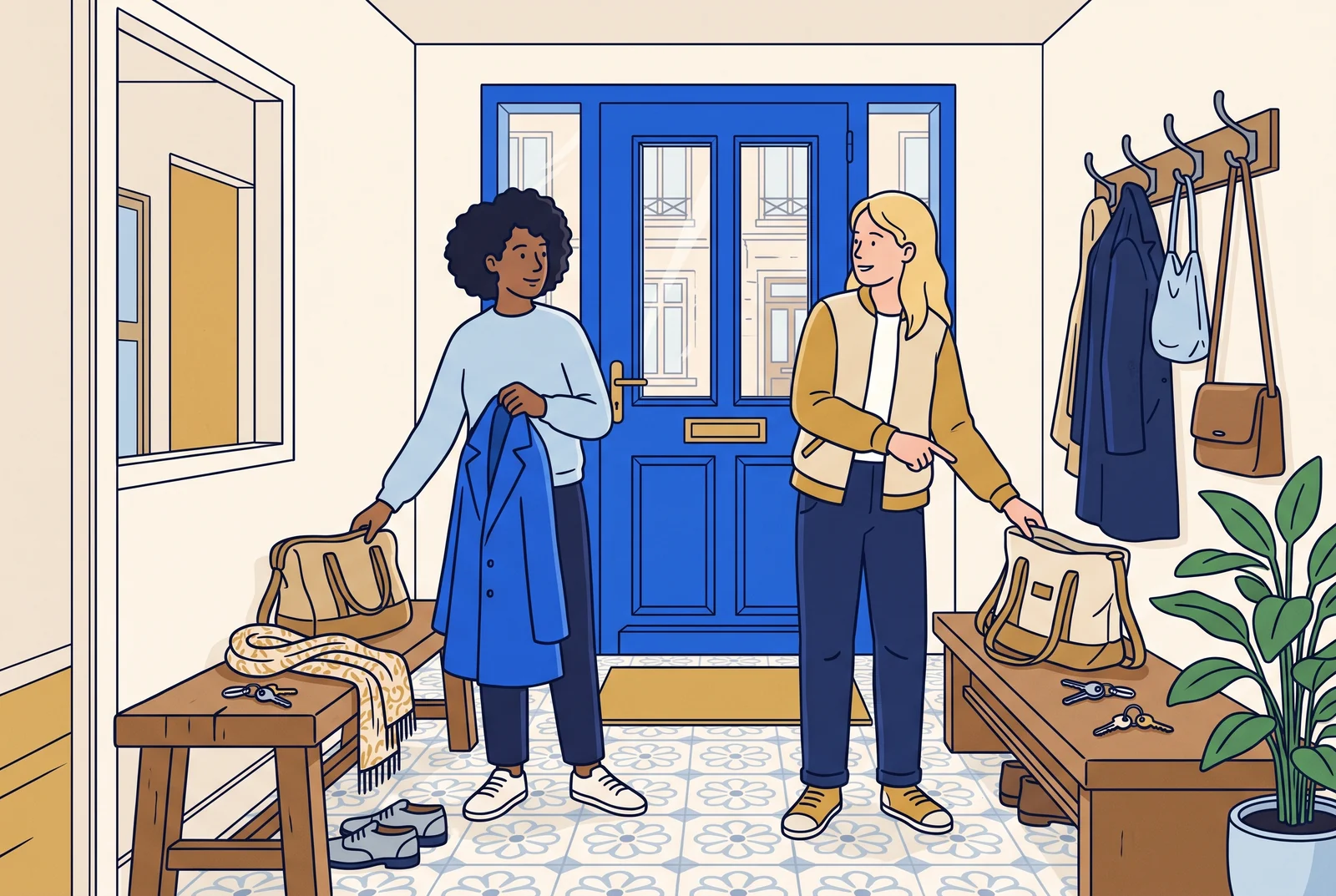
Léa identifies the coat she is holding. Manteau is masculine, so her own gender has no effect on the possessive.
🇺🇸 I’m taking my coat before going out.
The same speaker refers to a feminine singular noun in the next sentence. The owner has stayed the same; the object has changed.
🇺🇸 My jacket is on the chair near the door.
With several objects, mes works for both masculine and feminine nouns. You still need to know which objects the speaker means.
🇺🇸 My keys are in the small blue bag.
This gives you a practical correction method. Keep the person constant and swap the objects: a coat, a jacket, some keys. Then keep the object constant and swap the owner. A conventional table contains the same information, but changing one variable at a time exposes exactly where a mistake occurs. The sentence can be grammatically correct and still identify the wrong person's belongings, which is why a real situation matters.
A housemate addressing one friend uses the ton family. The noun sac selects the masculine singular form.
🇺🇸 Your bag is next to my coat.
A question about a feminine noun selects ta without changing the relationship between the speakers.
🇺🇸 Are you looking for your jacket or your shoes?
Practise with three objects you can point to. Name the owner before choosing the possessive, then check the noun. Correcting these decisions separately is easier than repeating a whole table after every mistake.
His and her both use son, sa and ses
Son and sa can both mean his or her. Sac requires son; veste requires sa. When the owner is unclear, name the person explicitly.
Here the owner is explicitly named, and sac determines the form son.
🇺🇸 Léa takes her bag and closes the door.
Replace Léa with Paul and the possessive stays unchanged because the noun still has the same form.
🇺🇸 Paul takes his bag and closes the door.
The reverse English trap appears with veste. A masculine owner can perfectly well have sa veste.
🇺🇸 Paul has forgotten his jacket in the kitchen.
Several belongings call for ses, regardless of their grammatical gender or the owner's gender.
🇺🇸 Léa has been looking for her glasses since this morning.
When two people could be the owner, repeat a name. French grammar does not require you to leave your listener guessing. In a sentence mentioning both Paul and Léa, sa veste can need clarification from the wider conversation. There is nothing clumsy about using de plus a name when ownership matters. Beginners sometimes work harder to preserve a possessive than to communicate the actual information.
The clarification below settles whose jacket is being discussed.
🇺🇸 It’s Paul’s jacket, the one on the chair.
Son does not mean “belonging to a man”, and sa does not mean “belonging to a woman”. To translate his or her, identify the French noun before selecting the possessive.
Mon amie is still feminine
Use mon, ton or son before a feminine word beginning with a vowel sound or silent h. The noun stays feminine. An adjective between the possessive and noun can change which sound comes next.
An introduction gives the common feminine example without changing the identity of the person introduced.
🇺🇸 My female friend is arriving tomorrow for lunch.
Adresse is also feminine. Its opening vowel calls for ton when you are addressing one familiar person.
🇺🇸 Can you give me your full address?
The rule applies to the sound immediately after the possessive. If a consonant-starting adjective intervenes, ma can return.
🇺🇸 My best friend lives on this street.
An adjective beginning with a vowel can itself trigger mon before a feminine noun. Listen to the whole group rather than jumping straight to the final noun.
🇺🇸 My old address is still on the form.
If noun gender itself feels uncertain, the examples in choosing le, la, un and une give you a way to learn a noun with its article. That article is your starting clue for possession too. A possessive usually occupies the determiner position by itself: mon sac, rather than adding a definite article in front. Learn the complete expression aloud so that the word boundary becomes familiar.
You can hear the plural liaison in this ordinary introduction. The written s joins to the following vowel sound.
🇺🇸 My friends are waiting outside the café.
Notre, votre and leur keep the same singular form
Notre, votre and leur go with one thing; nos, vos and leurs go with several things. Count the things possessed separately from the people who own them.
Two housemates speaking together can describe their shared address this way.
🇺🇸 Our apartment is on the second floor.
The same owners refer to more than one object in the next sentence.
🇺🇸 Our bicycles are in the building’s courtyard.
A receptionist addressing one guest politely uses votre. It does not imply that several guests are being addressed.
🇺🇸 Your room is ready, and here is your key.
For plural items, vos is appropriate with either one politely addressed person or several people. The conversation tells you how many listeners there are.
🇺🇸 You can leave your luggage at reception.
The same relationship choices apply here as in addressing someone with tu or vous. Once you have chosen how to address a person, keep the possessive family consistent. A sentence with vous and ton can be legitimate if it refers to a different person, but it is an easy accidental mismatch when both words are meant for the same listener.
Several neighbours share one garden in this example. Leur follows the singular noun.
🇺🇸 Their garden is behind the house.
Changing to several objects requires the written s on leurs. Listen carefully: leur and leurs sound alike in many contexts.
🇺🇸 Their windows overlook the garden.
Several owners do not automatically require leurs. Start with leur jardin for one garden and leurs jardins for more than one. Context decides whether the objects are shared or individually owned.
Make ownership clear in an actual exchange
Put the choices together: identify the object, ask who owns it, and give a short answer. Check that your listener could pick up the right item.
Related reading: question patterns with est-ce que.
Someone holding a bag can ask this directly before handing it over.
🇺🇸 Whose bag is this near the door?
The owner can answer with a possessive and a clear identification. There is no need to explain the bag's whole history.
🇺🇸 It’s my bag, but those are Léa’s keys.
A correction can use the ordinary negative pattern. Possessives stay in place after pas; they do not automatically become de.
🇺🇸 It isn’t my jacket; it’s Paul’s.
Compare this with articles and French negatives, where the type of determiner matters. The frequently taught change from un or du to de does not erase ownership. For a body part in an ordinary reflexive action, however, French often uses a definite article because the reflexive pronoun already establishes the relationship. That is a different construction, developed in describing a routine with reflexive verbs.
The final request identifies an item belonging to the speaker while keeping the request itself simple.
🇺🇸 You can take my umbrella if you want.
Before leaving this lesson, choose three objects near you and write who owns each one. Say one sentence as the owner, a second to the owner and a third about the owner. If the result changes gender when you change the person's name, check your reasoning against the noun. For other English-driven patterns to watch, keep the common French mistakes as a separate review rather than trying to correct everything at once.
Cover your written answers and do the same exchange aloud with the objects in a different order. The useful test is whether your listener could hand you the right bag. By the front door, everyone is waiting to leave.
Useful phrases to keep
| 🇫🇷 French | 🇺🇸 English | 💡 Context |
|---|---|---|
| 🇫🇷 mon manteau | my coat | A masculine singular noun. |
| 🇫🇷 ma veste | my jacket | A feminine singular noun. |
| 🇫🇷 Mes clés sont ici. | My keys are here. | Plural belongings in a complete sentence. |
| 🇫🇷 son adresse | his or her address | Feminine noun starting with a vowel. |
| 🇫🇷 notre maison | our house | Several owners, one house. |
| 🇫🇷 leurs affaires | their belongings | Plural possessed items. |
Read and listen to the French Briefing →
Use your French in a real conversation.
Bring a question from a guide to a French tutor. Try it aloud, ask for feedback and leave with something to practise.
Find a French tutor →Paid lessons. Compare tutors and prices before booking.
Affiliate link: we may earn a commission when you book.
📚 Keep building in the Learning Center
Futur Proche vs Futur Simple: Examples and Practice
Compare futur proche and futur simple in French plans, promises and announcements. Learn the forms and practise choosing…
Read →French Nominalisation: Examples and Clear Writing
Turn French verbs into nouns without hiding the actor or losing the time reference. Compare examples and practise…
Read →French Gérondif: En + Present Participle Explained
Use the French gérondif to express while, by and contrast. Learn formation, the shared-subject rule and common mistakes…
Read →