French Phrases for Visiting Paris: Essential Guide for Nervous Beginners
You’ve dreamed about Paris for years but panic sets in when you realize you’ll need to speak French. Your high school French classes taught you verb conjugations but not how to order coffee without sounding rude. This complete guide covers essential phrases for first-time Paris visitors, from navigating the metro to handling restaurant interactions, with beginner-friendly pronunciation and cultural context that eliminates the anxiety of your first French conversation.
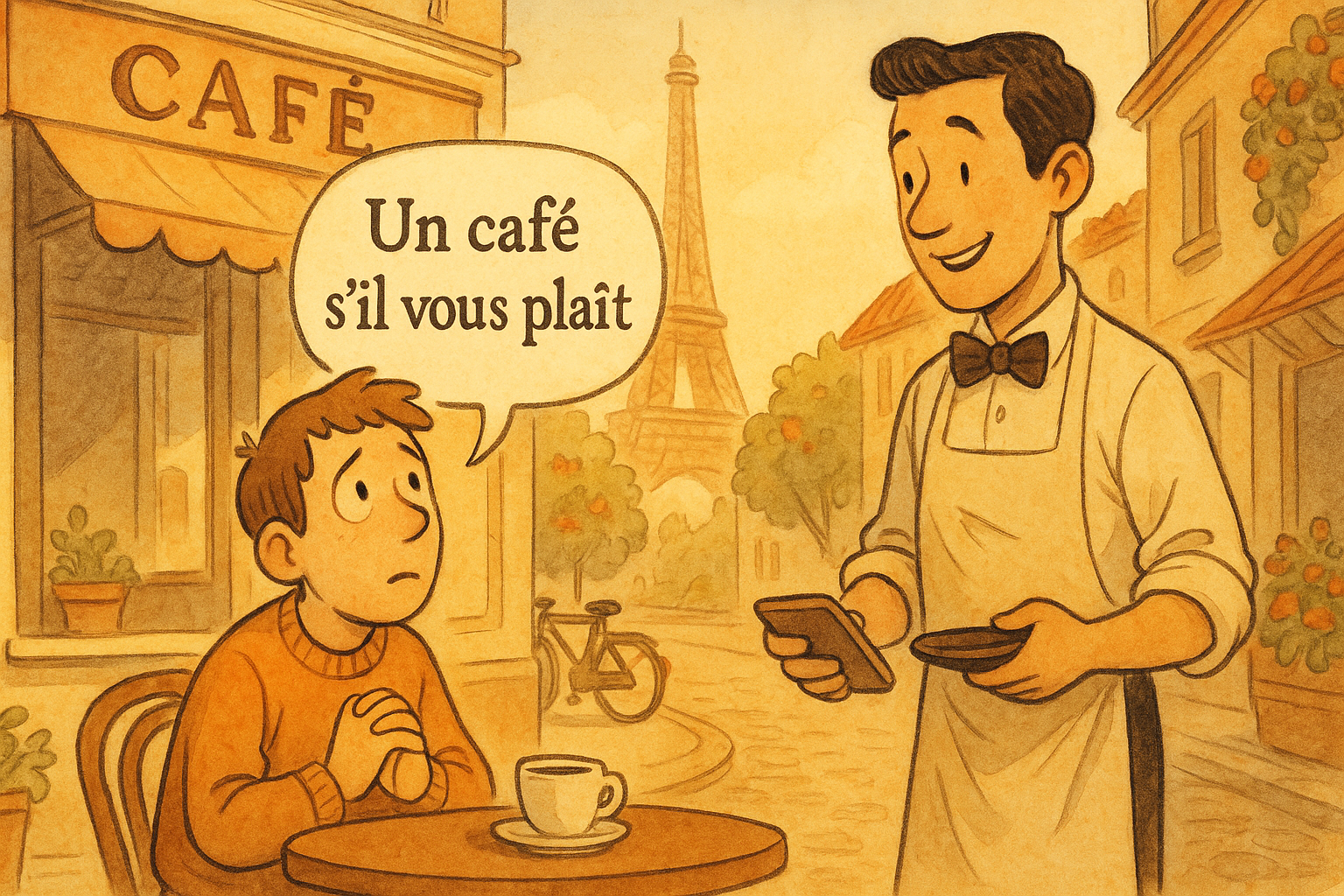
Why nervous beginners struggle with French in Paris
Paris has a reputation that terrifies English speakers. You’ve heard the stories: Parisians refuse to speak English, they mock your accent, they roll their eyes when you mispronounce words. Most of these stories are exaggerated or outdated, but the anxiety they create is real.
Here’s what actually happens: Parisians appreciate effort. If you start conversations in French, even badly, most respond positively. The problem isn’t that Parisians are mean – it’s that English speakers don’t know which phrases matter most and which cultural rules they’re unknowingly breaking.
Most French textbooks are written by native speakers who’ve forgotten what confuses beginners. They explain grammar assuming you already think like a French person.
Roger learned French as an adult after growing up with English and German. He remembers exactly which explanations clicked and which ones left him confused. The FrenchToEnglish approach was built from those memories, including the specific phrases that helped him navigate Paris independently during his first visits when speaking French felt overwhelming.
The politeness trap that marks you as rude
In English, we can walk into a store and immediately ask “Where are the shoes?” In French, this directness is shockingly rude. You must always greet first, then ask. This greeting ritual confuses English speakers because we don’t have equivalent social requirements.
Every French interaction follows this pattern: greeting, then request, then thank you, then goodbye. Skip any step and French people perceive you as rude, even if your grammar is perfect.
Why “I don’t speak French” doesn’t work as expected
English speakers think saying “I don’t speak French” in English will make Parisians switch to English. It doesn’t. It just makes you look like a tourist who expects everyone to accommodate you.
Instead, saying “I don’t speak French well” in French shows respect and effort. Parisians respond much more helpfully when you acknowledge their language, even imperfectly.
Essential survival phrases – memorize these first
These six phrases handle 80% of first-time Paris situations. Master them before you land.
The universal opener – use this everywhere
🇺🇸 EN — Hello/Good day
🇺🇸 EN — Good evening (after 6 PM)
When to use it: Before every single interaction. Before ordering. Before asking directions. Before entering shops. Before speaking to anyone. Always. No exceptions.
Why it matters: This single word determines whether Parisians perceive you as respectful or rude. Say it automatically, like reflex.
The apology that opens doors
🇺🇸 EN — Excuse me
🇺🇸 EN — Sorry/Pardon me
When to use it: Before interrupting, before asking questions, when you bump into someone, when you need attention in crowded spaces.
Cultural note: Parisians value personal space. Always acknowledge when you’re intruding on it.
The phrase that changes everything
🇺🇸 EN — I don’t speak French well
🇺🇸 EN — Do you speak English?
Why it works: Saying this in French shows respect and effort. Many Parisians will switch to English after hearing you try. Never start conversations in English without attempting French first.
The magic words
🇺🇸 EN — Please (formal)
🇺🇸 EN — Thank you
🇺🇸 EN — Thank you very much
Usage rule: Add these to every request. Never command. Always request politely with please and thank you.
The essential goodbye
🇺🇸 EN — Goodbye
🇺🇸 EN — Have a good day
🇺🇸 EN — Have a good evening
When to use it: Always say goodbye when leaving shops, restaurants, hotels. Don’t just walk out silently. Acknowledge the interaction ended.
💡 The complete interaction formula that never fails:
- Step 1: Greeting – “Bonjour”
- Step 2: Apology – “Excusez-moi”
- Step 3: Disclaimer – “Je ne parle pas bien français”
- Step 4: Request – Your actual question with “s’il vous plaît”
- Step 5: Thanks – “Merci”
- Step 6: Goodbye – “Au revoir”
Navigating Paris metro and transport
The Paris metro is efficient, affordable, and completely confusing if you don’t know the French terms. Here’s what you actually need.
Buying metro tickets
🇺🇸 EN — I would like a metro ticket, please
🇺🇸 EN — A book of 10 tickets, please
🇺🇸 EN — How much does it cost?
Money-saving tip: A carnet (book of 10 tickets) costs less per ticket than buying individually. Perfect for multi-day visits.
Asking for directions in the metro
🇺🇸 EN — Where is the metro?
🇺🇸 EN — Which line to go to the Eiffel Tower?
🇺🇸 EN — Where do I need to transfer?
🇺🇸 EN — Which direction is it?
Navigation key: Paris metro lines are named by their final stops. You need to know the terminus in your direction, not just your destination stop.
Understanding metro vocabulary
🇺🇸 EN — The exit
🇺🇸 EN — The transfer/connection
🇺🇸 EN — The platform
Taxi and Uber phrases
🇺🇸 EN — To [destination], please
🇺🇸 EN — Stop here, please
🇺🇸 EN — How much do I owe you?
⚠️ Metro etiquette mistake tourists make constantly
On escalators, always stand on the right. The left side is for people walking up. Parisians in a hurry will push past you or say something rude if you block the left side. This is serious metro etiquette in Paris.
Ordering in restaurants and cafés
Restaurant interactions stress beginners most. Here’s exactly what to say and when.
Arriving at a restaurant
🇺🇸 EN — Hello, a table for two people, please
🇺🇸 EN — Do you have a table available?
🇺🇸 EN — I have a reservation under the name [name]
Cultural rule: Never seat yourself in Paris restaurants. Wait for staff to seat you, even in casual cafés. Self-seating is considered rude.
Reading the menu and ordering
🇺🇸 EN — The menu, please
🇺🇸 EN — What do you recommend?
🇺🇸 EN — I would like the [dish name], please
🇺🇸 EN — For me, it will be the steak and fries
🇺🇸 EN — What is that?
Menu vocabulary: French menus often don’t translate. Point and ask “Qu’est-ce que c’est?” if you don’t recognize something.
Ordering drinks
🇺🇸 EN — A carafe of water, please (tap water, free)
🇺🇸 EN — A coffee, please (espresso by default)
🇺🇸 EN — A glass of red wine
🇺🇸 EN — A draft beer
Water trick: Asking for “une carafe d’eau” gets you free tap water. If you just say “de l’eau,” they bring bottled water and charge you.
Handling dietary restrictions
🇺🇸 EN — I’m allergic to [food]
🇺🇸 EN — I’m vegetarian (male/female)
🇺🇸 EN — Without meat, please
🇺🇸 EN — I don’t eat pork
Getting the bill
🇺🇸 EN — The bill, please
🇺🇸 EN — Can I pay by card?
🇺🇸 EN — Can we pay separately?
Service culture: French waiters won’t bring the bill until you ask. They consider it rude to rush diners. You must explicitly request it.
⚠️ The café pricing trap
Prices differ based on where you sit. Standing at the bar is cheapest. Sitting inside costs more. Sitting on the terrace costs most. The same coffee can be €2 at the bar, €4 inside, €6 on the terrace. Check the price list posted by law showing all three prices.
Shopping phrases and interactions
French shops have different etiquette than American stores. These phrases handle most shopping situations.
Entering shops
🇺🇸 EN — Hello
Critical rule: Always greet shopkeepers when entering. They often greet you first. Always respond with “Bonjour.” Silence is incredibly rude in small French shops.
Asking for help
🇺🇸 EN — Can I try it on?
🇺🇸 EN — Do you have this in [size/color]?
🇺🇸 EN — How much is it?
🇺🇸 EN — It’s too expensive
🇺🇸 EN — I’m looking for [item]
Buying and paying
🇺🇸 EN — I’ll take it
🇺🇸 EN — A bag, please
🇺🇸 EN — Do you accept credit cards?
Declining politely
🇺🇸 EN — I’m just looking
🇺🇸 EN — No thank you, I’m going to think about it
🇺🇸 EN — Thank you, goodbye
Asking for directions around Paris
Getting lost is guaranteed. These phrases help you find your way.
Basic direction questions
🇺🇸 EN — Excuse me, where is [place]?
🇺🇸 EN — How do I get to [destination]?
🇺🇸 EN — Is it far from here?
🇺🇸 EN — I’m lost (male/female)
🇺🇸 EN — Can you show me on the map?
Understanding directions given
🇺🇸 EN — Straight ahead
🇺🇸 EN — To the left
🇺🇸 EN — To the right
🇺🇸 EN — At the corner of the street
🇺🇸 EN — Across from/opposite
🇺🇸 EN — Near
💡 Direction survival strategy:
- Have your destination written down – Show your phone with the address if pronunciation feels overwhelming
- Google Maps works offline – Download Paris maps before your trip
- Look for younger Parisians – More likely to speak English if you get stuck
- Use landmarks everyone knows – “Où est la Tour Eiffel?” easier than street addresses
Emergency and help phrases
Hope you never need these, but memorize them just in case.
Getting help
🇺🇸 EN — Help!
🇺🇸 EN — Call the police!
🇺🇸 EN — Call an ambulance!
🇺🇸 EN — I need a doctor
🇺🇸 EN — Where is the hospital?
Lost items and theft
🇺🇸 EN — My bag was stolen
🇺🇸 EN — I lost my passport
🇺🇸 EN — Where is the police station?
🇺🇸 EN — Can you help me?
⚠️ Pickpocket awareness
Paris metro lines 1 and 4 (tourist lines) have active pickpocket problems. Keep bags zipped and phones secured. If you feel someone bump you or distract you, immediately check your belongings. Most Parisians keep backpacks in front on crowded trains.
Common mistakes that mark you as a complete beginner
⚠️ Mistake 1: Skipping the greeting
Walking into a shop or restaurant without saying “Bonjour” is the fastest way to get cold service. Parisians perceive this as incredibly rude. Always greet first, then make requests.
⚠️ Mistake 2: Speaking English without trying French first
Starting conversations in English without attempting French makes you look entitled. Even if your French is terrible, starting with “Bonjour, je ne parle pas bien français” changes everything. Parisians respect effort.
⚠️ Mistake 3: Saying “oui oui” repeatedly
English speakers say “yes yes” to show understanding. In French context, “oui oui” sounds sarcastic or mocking. Say “oui” once, or use other acknowledgments:
🇺🇸 EN — Okay/Agreed
🇺🇸 EN — I understand
⚠️ Mistake 4: Not making eye contact when toasting
If you have drinks with French people and toast, make eye contact when clinking glasses. Avoiding eye contact is considered bad luck (supposedly seven years of bad sex). French people take this superstition seriously.
Study glossary – Essential Paris vocabulary
| FR | EN | Usage Context |
|---|---|---|
| Bonjour | Hello/Good day | Use before 6 PM everywhere |
| Bonsoir | Good evening | Use after 6 PM |
| Excusez-moi | Excuse me | Before interrupting or asking questions |
| S’il vous plaît | Please | Add to all requests |
| Merci | Thank you | After receiving anything |
| Au revoir | Goodbye | When leaving any establishment |
| Je voudrais | I would like | Polite way to order or request |
| L’addition | The bill | Asking for restaurant check |
| Où est…? | Where is…? | Asking for locations |
| Combien? | How much? | Asking prices |
| Je ne comprends pas | I don’t understand | When confused |
| Parlez-vous anglais? | Do you speak English? | After attempting French first |
Your confidence-building action plan for Paris
These techniques work, but they work faster with structured learning designed for English speakers. Roger’s approach teaches you how to rewire your English-speaking brain for French patterns.
Here’s your preparation plan before your Paris trip:
3 weeks before trip: Memorize the six survival phrases. Practice saying “Bonjour, excusez-moi, je ne parle pas bien français” until automatic. Record yourself. Listen back. These three phrases solve 70% of anxiety.
2 weeks before trip: Practice restaurant and metro phrases. Role-play ordering coffee with a friend. Practice the complete interaction sequence: greeting, apology, request, thank you, goodbye. Make it muscle memory.
1 week before trip: Write your most-needed phrases on phone notes. Include hotel address in French. Practice pronunciation of places you’ll visit. “Tour Eiffel” not “Eye-full Tower.” “Louvre” with French ‘r’ sound.
Day 1 in Paris: Use your phrases immediately. Don’t wait to feel ready. Order breakfast in French. Ask metro directions in French. The first interaction is hardest. After that, confidence builds quickly.
The goal isn’t perfect French. The goal is respectful communication that shows you tried. Parisians appreciate effort more than perfection. Most will help you, switch to English if needed, or at minimum respect that you attempted their language first.
Paris is magical once you break through the language anxiety. The city opens up differently when you can navigate basic interactions confidently. French people aren’t mean. They just expect basic politeness that differs from Anglo-American norms.
Start with one phrase. Use “Bonjour” everywhere. Notice how it changes interactions. Then add more phrases gradually. Each successful interaction builds confidence for the next.
Your first Paris trip should feel exciting, not terrifying. These phrases give you the foundation to explore confidently.