Updated on September 15, 2026
French Nature Vocabulary: Trees, Rivers and Mountains
Describe nature in French with vocabulary for trees, rivers, mountains and weather. Compare landscape terms through translated examples and audio.
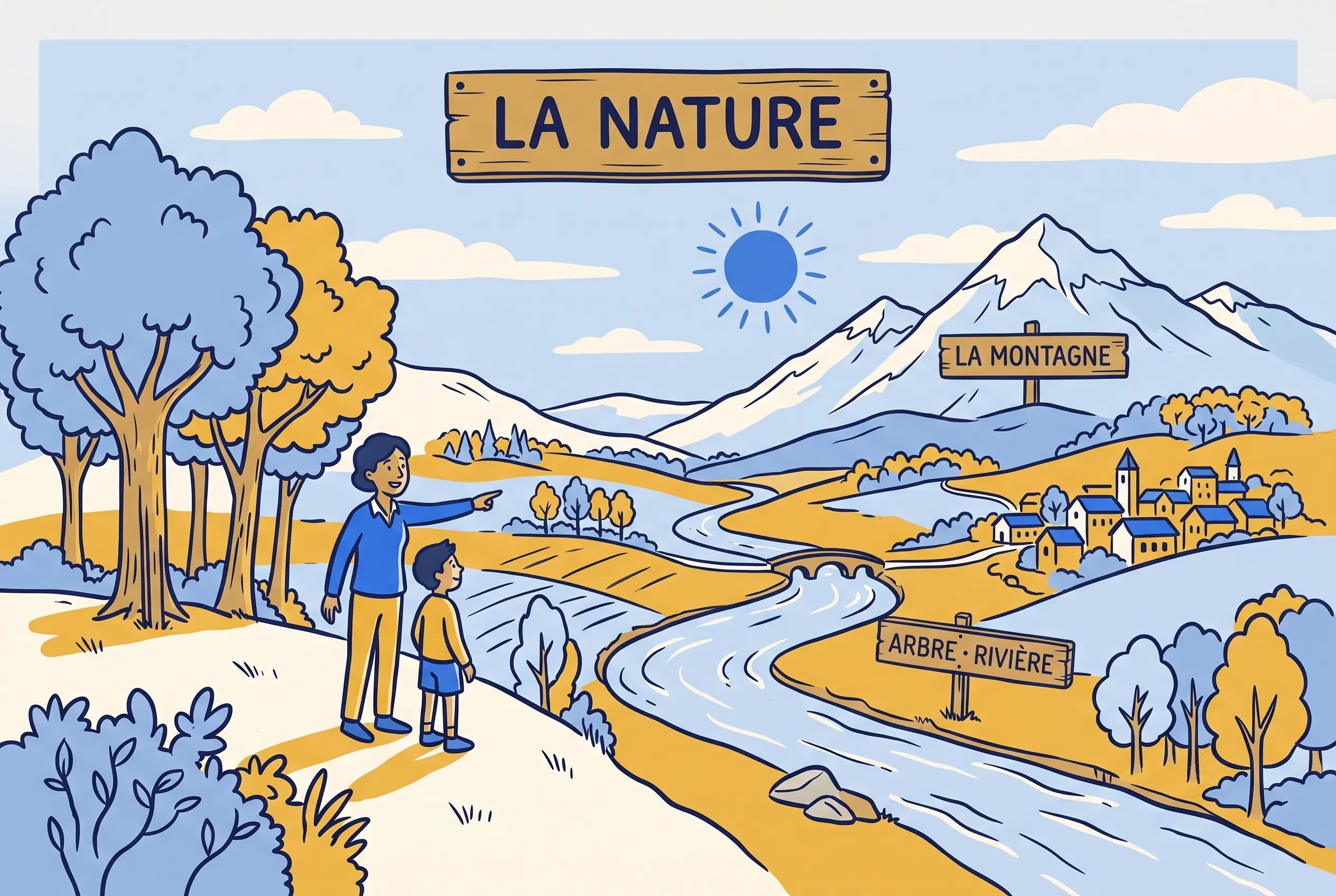
Landscape words help you describe what you see more precisely. Work through the vocabulary by setting, then compare nearby meanings such as types of waterways and terrain instead of memorising a disconnected list.
Trees and forests: the vocabulary French people actually use outdoors
French has specific names for trees that English speakers lump together as “that tree over there.” Knowing the difference between a chêne and a hêtre matters because French people reference specific species in conversation the way Americans reference car brands.
France’s symbolic tree. “Solide comme un chêne” (solid as an oak) = strong and reliable.
English speakers call all of these “pine trees.” French distinguishes them. Le sapin is the Christmas tree. Le pin is Mediterranean. L’épicéa grows at altitude.
Provence vocabulary. “L’oliveraie” is the olive grove. Property listings in the south mention olive trees the way Manhattan listings mention square footage.
Lines every road in southern France. “L’allée de platanes” is the iconic Provençal road image.
Forest types and features
French distinguishes between “le bois” (a small wooded area) and “la forêt” (a proper forest). French speakers are more precise about it and will correct you if you call a small copse “une forêt.” That same precision runs through the rest of rural vocabulary, where a hameau is not a village and a champ is not a pré.
The word hikers and mushroom pickers use constantly. “On a trouvé des cèpes dans le sous-bois” is autumn conversation in rural France.
Famous forests French people reference
La forêt de Fontainebleau: near Paris, popular for hiking and rock climbing. La forêt de Brocéliande: Brittany, legendary Arthurian forest. La forêt des Landes: southwest France, largest pine forest in western Europe.
- Forêt de Fontainebleau (ONF) — 22,000 hectares, 300 km of trails, 1h south of Paris.
- Forêt de Brocéliande (Paimpont) — Arthurian legends, the Val sans Retour, the Fontaine de Barenton.
- Forêt des Landes (ONF) — 1 million hectares of maritime pine, the largest planted forest in Europe.
Rivers and water: the fleuve vs rivière distinction that catches everyone
English has one word: “river.” French has two, and the difference matters. A “fleuve” flows into the sea or the ocean. A “rivière” flows into another river. La Seine is “un fleuve” because it reaches the English Channel. Le Cher is “une rivière” because it flows into la Loire. Using “rivière” for the Seine is like calling the Atlantic a lake.
Same water, further up the mountain and moving fast enough to be loud.
“Étang” is smaller and shallower than a lake. Many French properties advertise “avec étang” as a selling point.
Describing water movement and quality
How do you tell someone the swimming spot is worth the walk, or that it is not?
“La crue de la Seine” = the Seine flooding. Parisians track this annually.
See the distinction in real places:
- La Seine (fleuve, 775 km) — from Burgundy to the Channel at Le Havre. La Seine à Paris (paris.fr)
- La Loire (fleuve, 1,012 km) — longest in France, from the Massif Central to the Atlantic at Saint-Nazaire. Loire Valley UNESCO
- Le Verdon (rivière) — tributary of la Durance, famous for the Gorges du Verdon. Parc Naturel Régional du Verdon
- La Dordogne — technically a rivière (flows into la Garonne), but 483 km long. Vallée de la Dordogne
The “rivière” trap: Calling la Loire “une rivière” is factually wrong. La Loire is le plus long fleuve de France (1,012 km). When unsure, say “le cours d’eau” (the waterway). It’s neutral. Distinctions like this one are the reason a handful of French words simply do not survive translation: English collapses two ideas into one and loses the geography with it.
Mountains and elevated terrain: Alps, Pyrenees, and hiking vocabulary
Mountain vocabulary is unavoidable in France. The Alps, the Pyrenees, the Massif Central, the Vosges, the Jura: every winter the entire country tracks snow levels, avalanche warnings, and ski conditions.
Tour de France vocabulary. “Le col du Galibier” is a reference every French person knows.
The slope and the ridge are for walking; this one is for climbing or going round.
Hikers book “un refuge” the way city people book hotels. Essential for multi-day hikes in the Alps or Pyrenees.
Iconic mountain spots to know by name:
- Le Mont Blanc (4,808 m) — highest peak in western Europe, Chamonix. chamonix.com
- Le Col du Galibier (2,642 m) — legendary Tour de France climb, Savoie. Savoie Mont Blanc
- Le Cirque de Gavarnie — UNESCO amphitheatre in the Pyrenees, 1,500 m waterfall. UNESCO listing
- Les Calanques de Marseille — limestone cliffs plunging into the Mediterranean. Parc National des Calanques
- Le Parc National des Écrins — glaciers, 3,000+ m peaks, Alpine wilderness. ecrins-parcnational.fr
Hiking map vocabulary: French IGN maps use abbreviations: “Col” (pass), “Pic” (peak), “Rge” (refuge), “Cne” (commune). Learn these before your first hike.
Weather phenomena and sky descriptions
French nature descriptions are incomplete without weather vocabulary because the French relationship with landscape is inseparable from atmospheric conditions.
“Brouillard” is thick, visibility-reducing. “Brume” is lighter, atmospheric, almost poetic.
Right after the storm passes, the part everyone stops the car for:
Literary vocabulary that French speakers use in casual conversation more than English speakers use “twilight.”
Descriptive adjectives for landscapes
Nobody will call it original. Every hiker at the top of the pass has said it, and it still beats anything you could invent.
English keeps the adjective in front of the noun. Here it comes after, which is where French puts most of its description:
Coastal vocabulary for completeness
La côte / le littoral (the coast/coastline), la plage (the beach), la baie (the bay), la crique (the cove), le cap (the cape/headland). France has three coastlines: Atlantic, Mediterranean, and Channel.
- La Côte d’Azur — Nice to Menton. Explore Nice Côte d’Azur
- La côte sauvage — Quiberon, Brittany. Morbihan Tourisme
- La Dune du Pilat — tallest sand dune in Europe, Arcachon Bay. ladunedupilat.com
- Les falaises d’Étretat — iconic chalk cliffs, Normandy. etretat.net
Study glossary: essential nature vocabulary
| 🇫🇷 French | 🇺🇸 English | 💡 Usage context |
|---|---|---|
| Le chêne | The oak tree | Symbolic: strength, French identity |
| Le sapin | The fir tree | Christmas tree, mountain forests |
| La forêt / le bois | Forest / woods | Size distinction: forêt > bois |
| Le sous-bois | Undergrowth | Mushroom picking, hiking |
| Le fleuve | River (to sea) | La Seine est un fleuve |
| La rivière | River (tributary) | Le Cher est une rivière |
| La cascade | The waterfall | “Une belle cascade” |
| Le sommet / le col | Summit / mountain pass | Hiking and Tour de France |
| Le versant | The slope | “Le versant nord” |
| Le refuge | Mountain hut | Multi-day hiking accommodation |
| Le brouillard / la brume | Fog / mist | Density distinction matters |
| Le coucher de soleil | The sunset | Daily conversation topic |
| Le paysage | The landscape | “Un paysage magnifique” |
| Randonner | To hike | “J’adore randonner” |
Prefer to keep it free today? Read the French Briefing →
Use your French in a real conversation.
Bring a question from a guide to a French tutor. Try it aloud, ask for feedback and leave with something to practise.
Find a French tutor →Paid lessons. Compare tutors and prices before booking.
Affiliate link: we may earn a commission when you book.
📚 Keep building in the Learning Center
French Reflexive Verbs: Daily Routine and Word Order
Build a daily routine in French with reflexive pronouns, negatives and infinitives. Compare translated examples, listen and practise.
Read →Futur Proche vs Futur Simple: Examples and Practice
Compare futur proche and futur simple in French plans, promises and announcements. Learn the forms and practise choosing…
Read →French Nominalisation: Examples and Clear Writing
Turn French verbs into nouns without hiding the actor or losing the time reference. Compare examples and practise…
Read →