The Best Way to Learn French: Roger’s Proven Method + A1 Guide
You’re bombarded with conflicting advice about learning French from app advertisements promising fluency in three months, generic language teachers using one-size-fits-all approaches that ignore English speakers’ specific challenges, polyglots claiming immersion is the only path, and textbook authors defending grammar-focused study, leaving you paralyzed by choice and uncertain which method actually addresses the unique difficulties English speakers face with French articles, pronouns, verb tenses, and pronunciation patterns, while the real answer is that you need a teacher who has walked your exact path learning French as an adult English speaker, understands precisely which concepts confuse you and why, provides personalized instruction targeting your specific gaps rather than generic curriculum, combines structured lessons with the proven A1 Foundations Guide covering essential beginner patterns systematically, and offers affordable trial lessons starting at just €9 so you can experience this difference before committing to regular instruction with Roger, a trilingual teacher whose unique background and teaching method have helped hundreds of English speakers achieve their French goals efficiently.
Why Roger’s approach is the best way to learn French
After testing every popular French learning method over 13+ years teaching English speakers, Roger has identified what actually produces results: personalized instruction from someone who learned French as an adult English speaker combined with systematic foundations and strategic independent practice.
🇺🇸 EN — If I could do it, you can do it too
This isn’t marketing fluff. Roger’s trilingual background (English from British parents, German from growing up in Germany, French learned as an adult after moving to France in 2012) gives him unique insight into exactly what confuses English speakers about French. His degrees in Linguistics from University of London in Paris and French with Marketing from Northumbria University provide theoretical understanding combined with practical communication focus. Most importantly, he remembers the exact struggles you’re experiencing because he faced them himself.
Why Roger’s trilingual background makes him the ideal French teacher
Native French teachers can’t explain what they’ve never experienced:
Native speakers acquired French as children before conscious memory. When you ask “Why do we use subjunctive here?”, they respond “Because it sounds right” – true but useless. Roger remembers exactly which explanations clicked when he was learning and which ones left him confused.
🇺🇸 EN — A native teacher doesn’t remember learning their language
Roger’s unique advantages for teaching English speakers:
- He thinks like an English speaker first: Your confusion with French articles, pronouns, and verb tenses is his former confusion – he knows exactly why these concepts are hard and how to explain them clearly
- He uses German as a comparative bridge: German has grammatical features similar to French but structured differently, allowing Roger to explain French grammar through multiple linguistic frameworks
- He learned French systematically as an adult: Roger tested every learning method and knows which approaches work efficiently versus which waste time
- His linguistics education provides structure: Roger doesn’t just know French works – he knows WHY it works and can explain it systematically rather than relying on native-speaker intuition
🇺🇸 EN — A trilingual teacher who learned French as an adult understands your specific challenges
Read more about why Roger’s trilingual background makes such a difference in teaching effectiveness.
Roger’s complete learning system: lessons + guide + practice
Component 1: Personalized private lessons with Roger
What makes Roger’s private lessons different:
1. English-speaker-specific instruction:
Roger doesn’t teach generic French – he teaches French specifically designed for English speakers’ challenges. He anticipates your confusion before you articulate it because he experienced the same struggles.
🇺🇸 EN — I experienced all the frustrations my students are experiencing now
Example: Teaching “en” and “y” pronouns
Native teacher explanation: “Use ‘en’ when replacing something with ‘de’ and ‘y’ for places or things with ‘à.’ Just practice until it feels natural.”
Roger’s explanation in lessons: “English doesn’t have pronouns that specify quantity and location like French does. Your English brain wants to use ‘it’ for everything, but French forces you to be specific:”
🇺🇸 EN — Do you want coffee? — Yes, I want some (of it). [quantity specified]
🇺🇸 EN — Are you going to Paris? — Yes, I’m going there. [location specified]
“Think of ‘en’ as ‘some/any of it’ and ‘y’ as ‘there/to it.’ We’ll practice until choosing the right pronoun becomes automatic through contextual usage, not memorizing rules.”
2. Pattern-based error correction:
Roger doesn’t just mark errors – he explains the pattern behind them so you fix the root cause, not just the surface mistake.
Student error: “Je suis allé au docteur hier”
Generic correction: “No, it’s ‘chez le docteur'”
Roger’s correction: “French uses ‘chez’ + person for ‘to someone’s place.’ English says ‘to the doctor’ but French conceptualizes it as going to their location: ‘chez le docteur.’ You’d also say ‘chez le coiffeur’ (hairdresser), ‘chez mes parents’ (my parents’ house), ‘chez moi’ (my place). This pattern applies to any person’s location.”
This prevents the same error across dozens of contexts.
3. Immediate speaking practice from day one:
Roger’s students speak French in their first lesson – simple phrases at first, but actual communication from session one. Waiting until you “know enough grammar” delays fluency unnecessarily.
4. Flexible lesson structure adapted to YOUR goals:
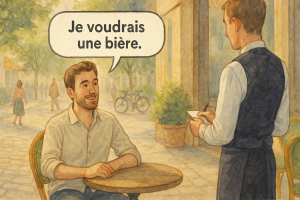
- Tourist French? Roger focuses on survival conversations, restaurant ordering, asking directions
- Professional French? Roger emphasizes business vocabulary, formal email structures, meeting language
- DELF preparation? Roger provides exam-specific strategies and practice tests
- Conversational fluency? Roger prioritizes speaking practice with real-time correction
5. Affordable entry point:
The €9 trial lesson lets you experience Roger’s teaching approach without major financial commitment. Most students book regular lessons immediately after the trial because the difference from other methods is obvious.
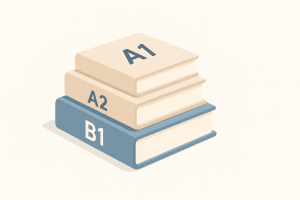
Component 2: A1 Foundations Guide – Your systematic beginner roadmap
Why Roger created the A1 Foundations Guide:
After teaching hundreds of English speakers, Roger identified the exact patterns beginners need in the optimal learning sequence. The A1 Foundations Guide provides this systematic foundation, ensuring you build French correctly from the start.
🇺🇸 EN — The A1 Guide gives you solid foundations from the start
What the A1 Foundations Guide covers:
- Essential pronunciation patterns: How to produce French sounds that don’t exist in English, nasal vowels, the French ‘r,’ silent letters, liaison rules
- Core grammar structures: Present tense conjugation patterns, article system (un/une/le/la/les), gender patterns, basic past tense (passé composé), question formation
- High-frequency vocabulary: The 500 most common French words organized by theme (greetings, food, time, numbers, family, daily routine)
- Practical conversation patterns: How to introduce yourself, order in restaurants, ask directions, make purchases, describe daily activities
- Common mistakes explained: Why English speakers make specific errors and how to avoid them from the start
How the A1 Guide works with Roger’s lessons:
The guide provides structured content you study independently between lessons. Roger’s lessons then focus on:
- Clarifying concepts you found confusing in the guide
- Practicing speaking using guide vocabulary and patterns
- Correcting errors in your application of guide concepts
- Accelerating progress through personalized attention
Students using the A1 Guide + weekly lessons typically reach A2 level in 3-4 months versus 6-8 months with lessons alone.
Component 3: Strategic independent practice Roger teaches you
Roger doesn’t just teach French – he teaches you HOW to learn French effectively between sessions through strategic independent practice.
Roger recommends specific resources matched to your level:
- Podcasts: Specific French podcasts at your exact level (A1, A2, B1, etc.)
- YouTube channels: Channels that teach French to English speakers with clear explanations
- TV series: French shows appropriate for your comprehension level with viewing strategies
- Reading materials: Graded readers, French news sites at your level, books that match your interests
- Apps: Which apps to use as supplements (15-20 min daily) and which to avoid
- Speaking practice: How to practice speaking alone when you don’t have conversation partners
🇺🇸 EN — Roger teaches you how to learn French effectively
Example of Roger’s personalized recommendations:
“Based on your A2 level and interest in French food culture, I recommend:
- Podcast: ‘Français Authentique’ episodes on food vocabulary
- YouTube: ‘Chef Michel’ cooking videos with French subtitles
- Reading: ‘L’Élégance du Hérisson’ (simplified version for A2-B1)
- Practice: Record yourself describing what you ate today in French, then review”
This personalized guidance eliminates the overwhelm of choosing from thousands of French resources online.
💡 Roger’s complete learning system in action:
Week 1 example for beginner student:
- Monday: Private lesson with Roger (1 hour) – learn present tense patterns + speaking practice
- Tuesday-Thursday: Study A1 Guide sections on present tense (30 min/day), practice with recommended app (15 min/day), watch French YouTube (20 min/day)
- Friday: Private lesson with Roger (1 hour) – practice speaking using present tense patterns, get pattern-based correction on errors
- Weekend: Complete A1 Guide exercises (45 min), review week’s lesson notes (30 min), practice self-talk in French (20 min)
This combination produces faster results than any single method alone because it addresses all essential components: structured instruction, systematic foundations, comprehensible input, and active practice.
Why other methods fall short (and how Roger’s approach fixes them)
⚠️ Problem with apps alone (Duolingo, Babbel):
What’s missing: No speaking practice with feedback, no personalized error correction, limited to A2 maximum, no explanation of WHY things work, gamification creates false sense of progress
How Roger fixes this: Use apps as 15-minute daily homework between lessons. Roger’s lessons provide the speaking practice, error correction, and explanations apps can’t offer. Students who combine Roger’s lessons + apps progress 3x faster than app-only learners.
🇺🇸 EN — Apps are useful as a supplement, not as the main method
⚠️ Problem with generic language schools:
What’s missing: One-size-fits-all curriculum ignoring English speakers’ specific challenges, teacher attention divided among 10-20 students, moving at class pace not your optimal pace, expensive for limited individual attention
How Roger fixes this: Every lesson customized to YOUR specific gaps and goals. Roger’s trilingual background means explanations designed specifically for English speakers. You progress at your optimal pace, not average class speed. More affordable than most group classes when you calculate cost per hour of actual teacher attention.
⚠️ Problem with native French teachers:
What’s missing: Can’t explain WHY French confuses English speakers (they never experienced it), rely on “it sounds right” explanations, don’t understand English-speaker error patterns, often teach formal/academic French not conversational
How Roger fixes this: Roger learned French as an adult English speaker – he remembers exactly which concepts confused him and which explanations worked. His pattern-based corrections address root causes, not just surface errors. He teaches practical French you’ll actually use.
🇺🇸 EN — Roger remembers exactly your confusions because he experienced them
⚠️ Problem with textbook self-study:
What’s missing: No speaking practice, no feedback on errors, no motivation/accountability, learning academic French vs practical conversation, easy to skip difficult concepts, no way to ask questions
How Roger fixes this: The A1 Foundations Guide provides textbook structure while lessons provide speaking practice, feedback, and accountability. Roger answers your questions about confusing concepts. You learn practical French you’ll actually use, not just academic exercises.
⚠️ Problem with immersion alone (living in France):
What’s missing: Passive exposure without active engagement produces minimal results, no systematic grammar instruction, easy to plateau at survival level, expensive to move to France just for language learning
How Roger fixes this: Online lessons work from anywhere – you don’t need to live in France to learn effectively. Roger’s systematic instruction prevents the plateau many expats hit at A2-B1 level. If you DO live in France, Roger shows you how to leverage immersion actively rather than passively.
🇺🇸 EN — Living in France doesn’t teach French automatically
⚠️ Problem with language exchange partners:
What’s missing: Partners aren’t teachers (no systematic error correction), inconsistent scheduling, not suitable for beginners, conversations often stay superficial, half the time spent teaching English not learning French
How Roger fixes this: Lessons provide systematic instruction and correction first. Roger then recommends when/how to add language exchange (usually from B1 level) as supplement, not replacement. Your lesson time focuses 100% on learning French, not teaching English.
What you get with Roger’s approach
In your €9 trial lesson with Roger
Full hour breakdown:
- Minutes 1-10: Roger assesses your current level through conversation and targeted questions, identifies your specific goals (tourism? conversation? professional? exams?) and realistic timeline
- Minutes 11-50: Actual French instruction targeting a concept you struggle with OR introducing a foundation you need. You’ll speak French from minute one – simple phrases at first, building complexity. Roger demonstrates his pattern-based error correction approach.
- Minutes 51-60: Roger provides honest assessment of realistic timeline to your goals, recommends optimal lesson frequency (weekly, bi-weekly, or intensive), explains how to combine lessons with A1 Guide and independent practice for fastest progress
🇺🇸 EN — The trial lesson is a real lesson, not just a consultation
What students say about the trial lesson:
“I’ve tried three other French teachers and multiple apps for months. Roger explained in 10 minutes what I’d been confused about for weeks. The way he uses his German and English to explain French grammar is brilliant. Booked weekly lessons immediately.” – Sarah M., A2 student
“The difference from native French teachers is night and day. Roger knows exactly why I make the errors I make because he made them himself when learning. Finally, explanations that actually make sense to my English-speaking brain!” – Michael T., B1 student
“Worth every cent. The €9 trial showed me immediately that Roger’s method is different. Three months of lessons later, I’m having actual conversations in French. Best investment in my learning journey.” – Jennifer L., A2 student
In regular lessons with Roger (weekly or bi-weekly)
Typical lesson structure:
- Review (10 min): Roger checks homework from A1 Guide or independent practice, addresses questions from concepts you studied independently
- New concept introduction (15 min): Roger introduces new grammar pattern, vocabulary theme, or communication skill with clear English-speaker-focused explanations and comparisons
- Immediate practice (25 min): You use the new concept in speaking or writing with real-time pattern-based correction and feedback
- Application assignment (10 min): Roger explains exactly what to practice before next lesson and provides specific resource recommendations
Between lessons you receive:
- Detailed lesson notes summarizing concepts covered, examples practiced, patterns explained, homework assigned
- Personalized resource recommendations (podcasts, videos, reading) matched to your level and interests
- Email support for quick questions when you’re stuck on homework or find something confusing
- Progress tracking showing which skills are strong vs need more focus
🇺🇸 EN — Every lesson is adapted to your specific needs
Lesson pricing options:
- Trial lesson: €9 for 60 minutes (most popular starting point)
- Weekly lessons: Best for consistent progress and accountability
- Bi-weekly lessons: Good for intermediate+ students doing significant independent study
- Intensive packages: For exam preparation or accelerated learning timelines
With the A1 Foundations Guide
What the guide provides between lessons:
- Structured progression: Lessons organized in optimal learning sequence Roger has refined over 13+ years, building complexity systematically
- Clear explanations: Grammar concepts explained specifically for English speakers, not generic textbook rules that assume you understand linguistic terminology
- Practical examples: Hundreds of example sentences with English translations showing real usage contexts you’ll actually encounter
- Practice exercises: Exercises with answer keys for self-checking between lessons
- Cultural notes: Context explaining why French works differently from English and cultural expectations around language use
- Common mistakes section: Errors English speakers typically make with explanations of the pattern causing the error and how to avoid it
🇺🇸 EN — The guide follows the optimal learning sequence Roger has perfected
How to use the guide effectively with Roger’s lessons:
- Study guide sections Roger assigns between lessons (30-45 min per section)
- Complete practice exercises to test understanding before next lesson
- Note questions or confusing concepts to ask Roger in next lesson
- Review previous sections periodically to maintain retention
The guide accelerates progress because you’re not dependent solely on lesson time for learning content – Roger can focus lesson time on practice, speaking, correction, and clarification rather than explaining every concept from scratch during your paid lesson hour.
Students using A1 Guide + weekly lessons progress 40-50% faster than lessons-only students.
Roger’s approach for different learning goals
For tourist/travel French (goal: A2)
Roger’s recommended approach:
- Lessons: 8-12 private lessons over 2-3 months focusing exclusively on travel scenarios
- A1 Guide: Sections on greetings, restaurant vocabulary, directions, shopping, hotel interactions, transportation
- Practice: French travel YouTube channels, restaurant menu practice, role-play exercises Roger provides
What you’ll achieve:
🇺🇸 EN — I would like to reserve a room for two people, from July 15-20. How much per night?
🇺🇸 EN — Where is the nearest metro station? Is it far from here?
Confident handling of all common travel situations in France including restaurants, hotels, directions, shopping, transportation, emergencies.
Timeline: 2-3 months with weekly lessons + 30 min daily practice
For conversational fluency (goal: B2)
Roger’s recommended approach:
- Lessons: 40-60 private lessons over 12-18 months, progressing systematically from A1 to B2
- A1 Guide: Complete foundation, then Roger provides B1-B2 materials and resources
- Practice: Extensive French media consumption (1-2 hours daily), language exchange from B1 level onward, speaking practice strategies Roger teaches
What you’ll achieve:
🇺🇸 EN — Although I like my current job, I often think about changing careers because I’d like something more creative that would allow me to express myself more and have better work-life balance
Comfortable conversations on any familiar topic, understanding native-speed speech in most contexts, expressing complex ideas fluently with occasional errors that don’t impede communication, following French films and TV without subtitles.
Timeline: 12-18 months with weekly lessons + 1-2 hours daily practice
For professional/business French (goal: B2-C1)
Roger’s recommended approach:
- Lessons: 50-80 private lessons over 18-24 months, with specialized business French modules Roger has developed
- A1 Guide + Business Materials: Foundation, then business French resources, email templates, meeting language Roger provides
- Practice: French business podcasts, news sites (Le Monde, Les Échos), professional writing assignments Roger assigns and corrects
What you’ll achieve:
🇺🇸 EN — Following yesterday’s meeting, I’m sending you the detailed minutes outlining the decisions made as well as the projected timeline for implementing the priority actions we identified
Conducting business meetings in French, writing professional emails and reports, giving presentations, negotiating contracts, understanding business vocabulary and formal register with confidence.
Timeline: 18-24 months with weekly lessons + 1-2 hours daily business French practice
For DELF/DALF exam preparation
Roger’s recommended approach:
- Lessons: Foundation lessons to target level + 8-12 intensive exam prep lessons in final 2-3 months before exam
- A1 Guide + Exam Materials: Foundation, then exam-specific materials, practice tests, scoring rubrics Roger provides
- Practice: Timed practice tests under exam conditions, exam strategies, specific skills training (oral production, written production) Roger assigns
Roger’s exam-specific timeline recommendations:
- DELF A2: 3-6 months foundation + 2 months exam prep = 5-8 months total
- DELF B1: 6-12 months foundation + 2-3 months exam prep = 8-15 months total
- DELF B2: 12-18 months foundation + 3 months intensive exam prep = 15-21 months total
- DALF C1: 18-24 months foundation + 3-4 months intensive exam prep = 21-28 months total
Roger provides exam-specific strategies including time management, what examiners look for at each level, common mistakes that cost points, how to maximize your score in each section (comprehension orale, comprehension écrite, production écrite, production orale).
Why Roger’s students progress faster than with other methods
💡 Student success comparison:
App-only learners (Duolingo, Babbel):
- Typical progress: A1 after 6-12 months, plateau at A2, minimal speaking ability
- Common frustration: “I can read and do exercises but can’t actually speak French”
Traditional group class students:
- Typical progress: A2 after 12-18 months, B1 after 24-30 months, limited speaking practice time
- Common frustration: “The class moves too slow/fast for me, I don’t get enough speaking time”
Roger’s students (lessons + A1 Guide + practice):
- Typical progress: A2 after 4-6 months, B1 after 9-12 months, B2 after 15-20 months
- Common success: “I’m actually having conversations in French! Roger’s explanations finally make sense and I’m speaking from day one”
🇺🇸 EN — Roger’s students progress 2-3 times faster than traditional methods
Why the difference?
- Roger targets YOUR specific English-speaker challenges, not generic curriculum
- Pattern-based error correction fixes root causes, preventing repeated mistakes
- A1 Guide provides systematic foundation between lessons, maximizing lesson efficiency
- Speaking practice from day one builds confidence and automaticity early
- Personalized resource recommendations eliminate time wasted on wrong-level materials
Study glossary – Learning method vocabulary
| FR | EN | Usage Context |
|---|---|---|
| Une méthode d’apprentissage | A learning method | Quelle méthode utilisez-vous pour apprendre ? |
| Efficace | Effective / efficient | Cette méthode est très efficace |
| Un cours particulier | A private lesson | Prendre des cours particuliers avec Roger |
| Un guide / Un manuel | A guide / A textbook | Le guide A1 Foundations |
| Progresser | To progress / To improve | Je progresse rapidement avec Roger |
| Pratiquer | To practice | Il faut pratiquer tous les jours |
| La correction | Correction / Feedback | Roger donne une correction détaillée |
| Un professeur trilingue | A trilingual teacher | Roger est un professeur trilingue |
| Une leçon d’essai | A trial lesson | Réserver une leçon d’essai à 9€ |
| Personnalisé(e) | Personalized / Customized | Des cours personnalisés selon vos besoins |
| Les bases / Les fondations | The basics / The foundations | Apprendre les bases avec le guide A1 |
| Systématique | Systematic | Une approche systématique |
The honest answer: Roger’s method is the best way for English speakers
After comparing every major French learning method, the evidence is clear: English speakers learn French fastest and most effectively with personalized instruction from a teacher who has walked their exact path, combined with systematic foundations and strategic independent practice.
🇺🇸 EN — The best method for English speakers is learning with someone who understands exactly your challenges
Roger’s unique combination of:
- Trilingual background (English, German, French learned as adult)
- Linguistics education providing theoretical understanding
- 13+ years teaching English speakers specifically
- Systematic A1 Foundations Guide refined through hundreds of students
- Pattern-based error correction addressing root causes
- Personalized resource recommendations matched to your level and goals
- Affordable €9 trial lesson letting you test the approach risk-free
…produces consistently faster results than apps alone, generic group classes, native French teachers, textbook self-study, or unguided immersion.
The proof is in student results:
Roger’s students typically reach A2 in 4-6 months, B1 in 9-12 months, and B2 in 15-20 months with consistent weekly lessons and daily practice – 2-3x faster than traditional methods.
Why it works:
Because Roger experienced every confusion you’re experiencing. He remembers exactly which explanations clicked and which ones left him frustrated when he was learning French as an adult English speaker. He’s refined his teaching approach over 13+ years specifically for English speakers, eliminating the trial-and-error period you’d face with other methods.
The €9 trial lesson demonstrates this difference immediately. Most students book regular lessons after the trial because finally, someone can explain French in ways that make sense to English-speaking brains.