
French Property Taxes for English Speakers: Taxe Foncière Explained (2026)
Most anglophone owners discover French property taxes the hard way: a notice arrives in late August, in administrative French, and the rules already moved while they were skim-reading. Here is how the taxe foncière actually works in 2026, what you will pay, and how it compares with the US, UK, and Canada.
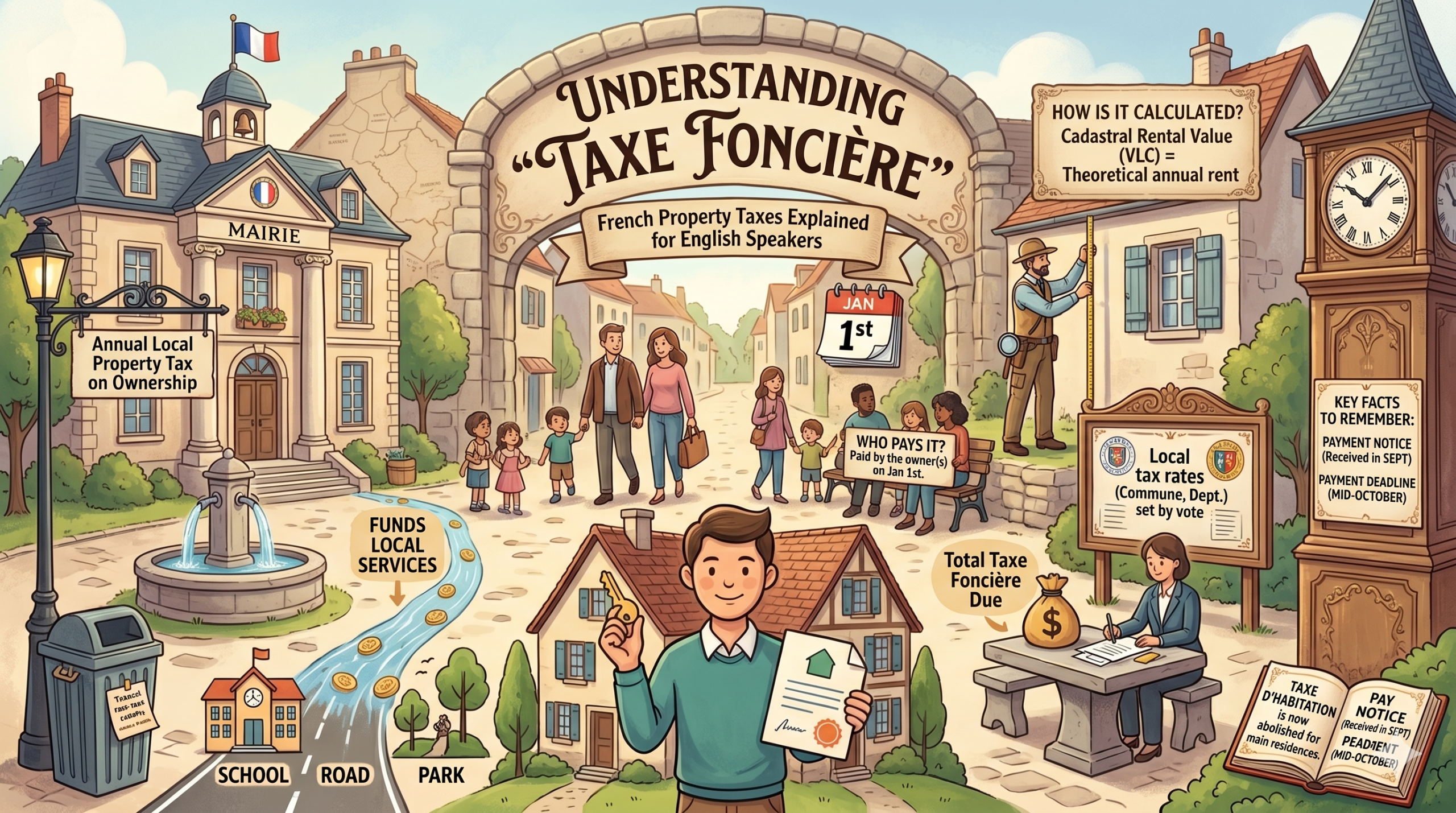
The trap nobody flags about French property taxes
Most anglophone owners who get burned by the French property tax system don’t get burned because the rates are high. They get burned because the bill follows ownership on 1 January, full stop, no proration. If you sell on 14 March, you still owe the entire 2026 taxe foncière. Buyer and seller usually split it privately in the deed, but the tax office only chases the registered owner. That detail breaks the mental model an American or British buyer arrives with.
That sentence, on the deed and in the tax office’s database, is the only legal trigger. Not your address. Not how many months you lived there. Not whether the property was rented, empty, or being gutted. The official source for everything that follows is impots.gouv.fr, available in English under the International tab. Bookmark it now, before the August notice arrives.
If the broader administrative landscape is still hazy, our guide to moving to France from the USA walks through visa, registration, and tax-residence basics in order. Property tax is one piece of a larger machinery, and it pays to see the machine.
Taxe foncière vs taxe d’habitation: stop confusing the two
France used to have two property-related taxes hitting nearly every home. Since 2023, the taxe d’habitation has been abolished on primary residences. It still exists on second homes (résidences secondaires), where about 3.7 million owners receive a bill each November, with an average around 1,125 €.
So in 2026, an English-speaking owner sits in one of three boxes: paying only taxe foncière (primary residence in France), paying both taxes (second home), or paying both plus a hefty surcharge (second home in a so-called zone tendue). Around 5,000 communes can now add a surtaxe of 5% to 60% on the taxe d’habitation for second homes. Coastal towns, ski resorts, Paris, and most of Brittany apply the maximum 60%.
You’re reading the French most expats decode the hard way. We do this every morning.
One French news story every weekday, picked at your level. Tax letters, prefecture forms, banking notices: the institutional French that costs real money when misunderstood. Glossary and quiz built in.
How taxe foncière is actually calculated in 2026
The formula looks deceptively simple:
Taxe foncière = (Valeur locative cadastrale × 50%) × Taux global
Three pieces matter. The valeur locative cadastrale (VLC) is a theoretical annual rent that the tax office estimates your property could fetch. Most VLCs were set in the 1970s and have only been indexed since, which is why they often look bizarrely low compared with real market rents. A 50% standard abatement is then applied to cover assumed maintenance. The result is multiplied by the taux global, voted yearly by the commune, the intercommunalité, and (sometimes) the département.
For 2026, the VLC is uplifted automatically by +0.8%, indexed on inflation (down from +3.9% in 2024 and +7.1% in 2023). The full general revaluation has been pushed to 2031; a separate update of éléments de confort across 7.4 million homes was suspended on 26 November 2025. If you bought thinking the cadastral system was about to be modernised, plan for the old logic to hold for years.
The taux global is where bills diverge wildly. Most towns sit between 25% and 45%. Paris voted a 52% rate hike in 2023 and now applies 13.8%, still unusually low for political reasons. Identical apartments in Paris and a small town nearby can produce taxe foncière bills differing by a factor of three. If the term commune itself is unfamiliar, our guide to the Fifth Republic’s political layers explains why so many local bodies share the tax pie.
How much you will actually pay
The order of magnitude matters more than the formula. Here is a worked example for a typical owner-occupied home in 2026:
Across France, the average taxe foncière sits between 800 € and 1,200 € per year for an apartment, and 1,200 € to 2,500 € for a house, with strong regional variation. The Union Nationale des Propriétaires Immobiliers tracks an average increase of +37.3% over the past decade. Building the French to read your own notice without translation tools is the single highest-leverage skill here, and that is exactly what a structured habit like the French Progress Pass targets — institutional French, daily, no scattered apps. From there the rest of the bureaucracy stops being a foreign language.
Calendar, démarches, and the official links you need
French property tax follows a strict autumn rhythm. For 2026, the schedule mirrors 2025, with dates confirmed by the DGFiP each summer. Missing the online deadline by a day triggers a 10% penalty automatically.
- Late August 2026. Taxe foncière notice (avis) appears in your impots.gouv.fr account. Mid-September if you are on monthly direct debit.
- 15 October 2026. Payment deadline by cheque, bank transfer, or cash at a partner counter.
- 20 October 2026. Online payment deadline (impots.gouv.fr or the mobile app).
- Early November 2026. Taxe d’habitation notice for second-home owners.
- 15 December 2026. Taxe d’habitation deadline (cheque, transfer).
- 20 December 2026. Online deadline for taxe d’habitation.
Three official links to bookmark: impots.gouv.fr (account, payment, biens immobiliers declaration), service-public.fr (plain-language fact sheets), and economie.gouv.fr (Ministry of Finance explainers). Setting up a French bank account is non-negotiable for SEPA direct debit, the smoothest way to pay.
Find your level. Then go further.
This article fixed one point. Now get your real level in 3 minutes. Then use the French Progress Pass when you want weekly structure instead of random articles.
Exemptions, reductions, and how to challenge a bill
The system has built-in reliefs that English speakers rarely know about. New constructions are exempt for the first two years after completion (article 1383 of the General Tax Code). Owners over 75 with a revenu fiscal de référence below 11,885 € for one tax-share are fully exempt; between 65 and 75 with the same income limit, a 100 € automatic reduction applies. Energy-efficient renovations and BBC-labelled buildings can win 50% to 100% local exemptions.
“La taxe foncière fait partie des impôts les plus importants pour les collectivités locales.”
French property tax vs USA, UK, and Canada
The question most English-speaking owners ask is “is France more or less expensive?” The honest answer: France is middle of the pack, but the structure differs sharply from what you know.
| Country | Average annual amount (2026) | Effective rate | Paid by | Reassessment |
|---|---|---|---|---|
| 🇫🇷 France | 800–2,500 € depending on type and commune | ~0.3% of market value (highly variable) | Owner only | Cadastral, frozen since 1970s; revaluation pushed to 2031 |
| 🇺🇸 USA | $2,040 (SC) to $8,920 (NJ) on a $400k home | 1.01% national average; 0.28% (HI) to 2.14% (NJ) | Owner (often via mortgage escrow) | Frequent, state-dependent |
| 🇬🇧 UK | £2,392 Band D England 2026-27 | Flat banded system based on 1991 values | Occupier (owner or tenant) | 1991 (England) / 2003 (Wales) |
| 🇨🇦 Canada | ~$2,800 (Vancouver) to ~$8,000 (Winnipeg) on $1m home | 0.28% (Vancouver) to 2%+ (some Atlantic cities) | Owner | Every 4 years (Ontario, MPAC) |
Two things stand out. First, France has the lowest effective rate in this group, but that is an artifact of frozen VLCs, not a deliberate tax-friendly policy. Second, France is the only one where the tax follows the owner, not the occupier. UK landlords renting their property are rarely on the hook for Council Tax; French landlords are always on the hook for taxe foncière.
If you are a non-resident owner
Non-residents pay the same taxe foncière as residents, but several extra rules apply. Rental income is taxed in France at a 20% minimum, plus social charges that rose to 18.6% on 1 January 2026 (up from 17.2% under the LFSS 2026). EEA, Swiss, and UK nationals affiliated to home social security pay only the 7.5% solidarity levy. The Impôt sur la Fortune Immobilière (IFI) wealth tax kicks in on net French real estate above 1.3 million €.
Capital gains on a sale are taxed at 19% plus social charges, with a new accelerated taper from the Loi de Finances pour 2026: full income tax exemption now after 17 years (down from 22), social charges still tapered out over 30 years. The US-France tax treaty and Foreign Tax Credit usually prevent double taxation for Americans, but you must still file in France. Above 150,000 € sale price and outside the EEA, an accredited représentant fiscal is mandatory.
Verify everything against the official non-residents portal on impots.gouv.fr, not blog summaries. Treaty interpretations and rates change with each Loi de Finances.
The French you need to read your tax notice
A glossary of the terms that appear on every official document. Memorising these turns the August notice into a 10-minute task.
| 🇫🇷 French term | 🇺🇸 English translation | 📋 Usage Context |
|---|---|---|
| Avis d’imposition | Tax notice | Document received late August, payment due mid-October |
| Valeur locative cadastrale (VLC) | Cadastral rental value | Theoretical rent set by tax office, foundation of every calculation |
| Base d’imposition | Taxable base | VLC × 50% abatement, before applying the taux global |
| Taux global | Combined tax rate | Voted yearly by commune + intercommunalité, varies wildly |
| Date limite de paiement | Payment deadline | 15 October by cheque, 20 October online |
| Mensualisation | Monthly direct debit | Spreads the bill over 10 monthly payments, opt-in |
| Prélèvement à l’échéance | Direct debit at due date | Single auto-payment on the deadline, avoids the 10% penalty |
| Dégrèvement | Tax relief or reduction | Applies to seniors, low income, energy-efficient renovations |
| Réclamation | Formal challenge or appeal | Filed before 31 December of the year following the bill |
| Résidence principale | Primary residence | Taxe d’habitation abolished since 2023 on this category |
| Résidence secondaire | Second home | Still taxed via taxe d’habitation, potential 60% surcharge |
| Logement vacant | Vacant property | Triggers a separate tax in zones tendues |
| Zone tendue | Housing-pressure zone | Coastal towns, ski resorts, Paris: allow second-home surcharges |
| Revenu fiscal de référence (RFR) | Reference taxable income | Threshold used to qualify for relief, capped per tax-share |
| Espace particulier | Personal taxpayer account | Where notices, payment, and biens immobiliers declaration happen |
| Représentant fiscal | Accredited tax representative | Mandatory for non-EEA owners selling above 150,000 € |
Reading your first taxe foncière notice in French is one of those moments when admin vocabulary stops being abstract. If you want to build that habit beyond tax season, our Learning Center has the full ladder of expat-facing topics, and the political vocabulary guide is the natural next step for understanding why your commune voted a particular taux.
You just decoded a full taxe foncière notice in French. We turn this into a weekly habit.
Tax letters, prefecture forms, contracts: every piece of institutional French costs real money when misunderstood. The Pass turns scattered admin reading into a system with native audio, CEFR tracking, full archives.
Or start free with The Briefing.
One French news story every morning, picked at your level. Tax letters, prefecture vocabulary, political quotes: the institutional French decoded in three minutes, glossary built in.