🎯 French Subjunctive Made Simple for English Speakers
The French subjunctive has one job: it marks that something is filtered through a mind, not stated as fact. Once you see that, the trigger list collapses into one question.
What the subjunctive actually is
The first obstacle to understanding the French subjunctive is that English speakers don’t have the conceptual framework for it. In English, you express these concepts through separate words (might, want, necessary) while keeping the main verb unchanged. In French, you express these concepts by changing the verb itself into subjunctive form. That is the entire gap. Not complexity. Visibility.
Same structure. Different verb form. The only thing that changed is the speaker’s relationship to the information. The same invisible-in-English logic shows up with words that look safe in French but carry different weight.
The one question that replaces the trigger list
Is the speaker stating a fact about reality, or filtering information through desire, doubt, emotion, necessity, or judgment? If filtered: subjunctive. If stated: indicative. That single filter covers 90% of daily usage.
The magic word “que” and the two-subject rule
The subjunctive almost always appears after “que” when two different subjects are involved. One person wants, doubts, or feels something. Another person does the action. The moment those two subjects split across “que,” the second verb shifts to subjunctive.
One Subject → Infinitive
Je veux partir (I want to leave)
Two Subjects → Subjunctive
Je veux que tu partes (I want you to leave)
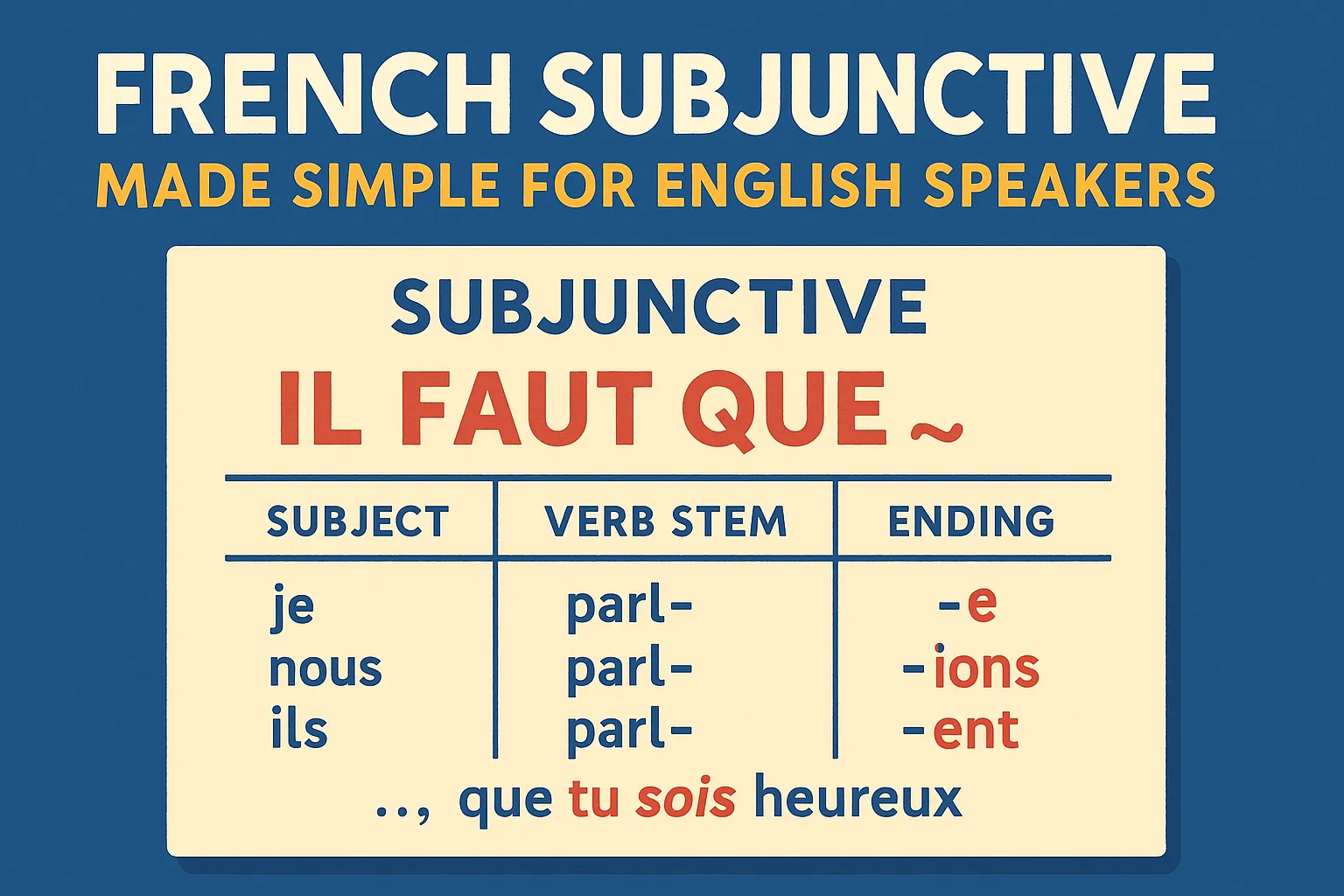
Regular conjugation: the pattern most learners never see
Take the third person plural present indicative (ils form), drop the -ent, add subjunctive endings. Done.
The Big Four Irregular Verbs
These four account for roughly 60% of daily subjunctive usage.
Common trigger phrases
| Trigger | Example | Why subjunctive |
|---|---|---|
| Il faut que | Il faut que tu viennes | Necessity |
| Je veux que | Je veux que tu sois là | Desire |
| Bien que | Bien qu’il soit tard | Concession |
| Je doute que | Je doute qu’il puisse venir | Doubt |
| Pour que | Pour que ça marche | Purpose |
| Avant que | Avant qu’il parte | Sequence |
| Je suis content que | Je suis content que tu sois là | Emotion |
| Sans que | Sans qu’il le sache | Exclusion |
Every trigger has one thing in common: the information after “que” is not a neutral fact. It is filtered. The same viewpoint logic drives the imparfait/passé composé split. “For sure.”
The espérer exception
When NOT to use the subjunctive
Negate a certainty verb and the mood flips. “Je pense qu’il vient” → indicative. “Je ne pense pas qu’il vienne” → subjunctive. The negation introduces doubt.
Study glossary
| French | English | Context |
|---|---|---|
| le subjonctif | the subjunctive | Le subjonctif exprime le doute |
| l’indicatif | the indicative | L’indicatif exprime les faits |
| il faut que | it is necessary that | Il faut que tu viennes |
| je veux que | I want that | Je veux que tu partes |
| bien que | although | Bien qu’il soit tard |
| pour que | so that | Pour que ça fonctionne |
| espérer que | to hope that (indicative!) | J’espère qu’il viendra |
Go further

Stop making the same 21 French mistakes. Play them away.
300 pages of games, riddles and quizzes built around the 21 mistakes English speakers actually make in French. You fix them by playing, not by memorising rules. By Camille Aubert.
📚 Keep building in the Learning Center
French Property Taxes for English Speakers: Taxe Foncière Explained
Most anglophone owners discover French property taxes the hard way: a notice arrives in late August, in administrative…
Read →Imparfait vs Passé Composé Explained: Timeline Method
Imparfait vs passé composé trips up every English speaker because English never forces the same choice. You say…
Read →Best Canal+ French series — where to watch legally (Dix pour cent, Baron Noir, Le Bureau)
Discover Canal+ premium French television series including Dix pour cent (Call My Agent!), Le Bureau des Légendes, Baron…
Read →