Best French Comics for Language Learners: Bande Dessinee, Manga and What to Read First
French comics give you visual context, natural dialogue, and cultural immersion without the wall-of-text fatigue that makes most learners quit novels after eight pages.
Why French comics matter more than most learners think
Most English speakers looking for French reading material make the same mistake early. They assume “real progress” means moving as fast as possible toward novels, essays, or dense nonfiction. That sounds serious. It also kills momentum for a huge number of learners. The problem is not intelligence. The problem is friction. A page of French prose gives you no visual support, no pacing relief, and no immediate context if a sentence goes opaque. French comics change that. Not by making French childish, but by making French readable at the exact stage where too many learners lose confidence.
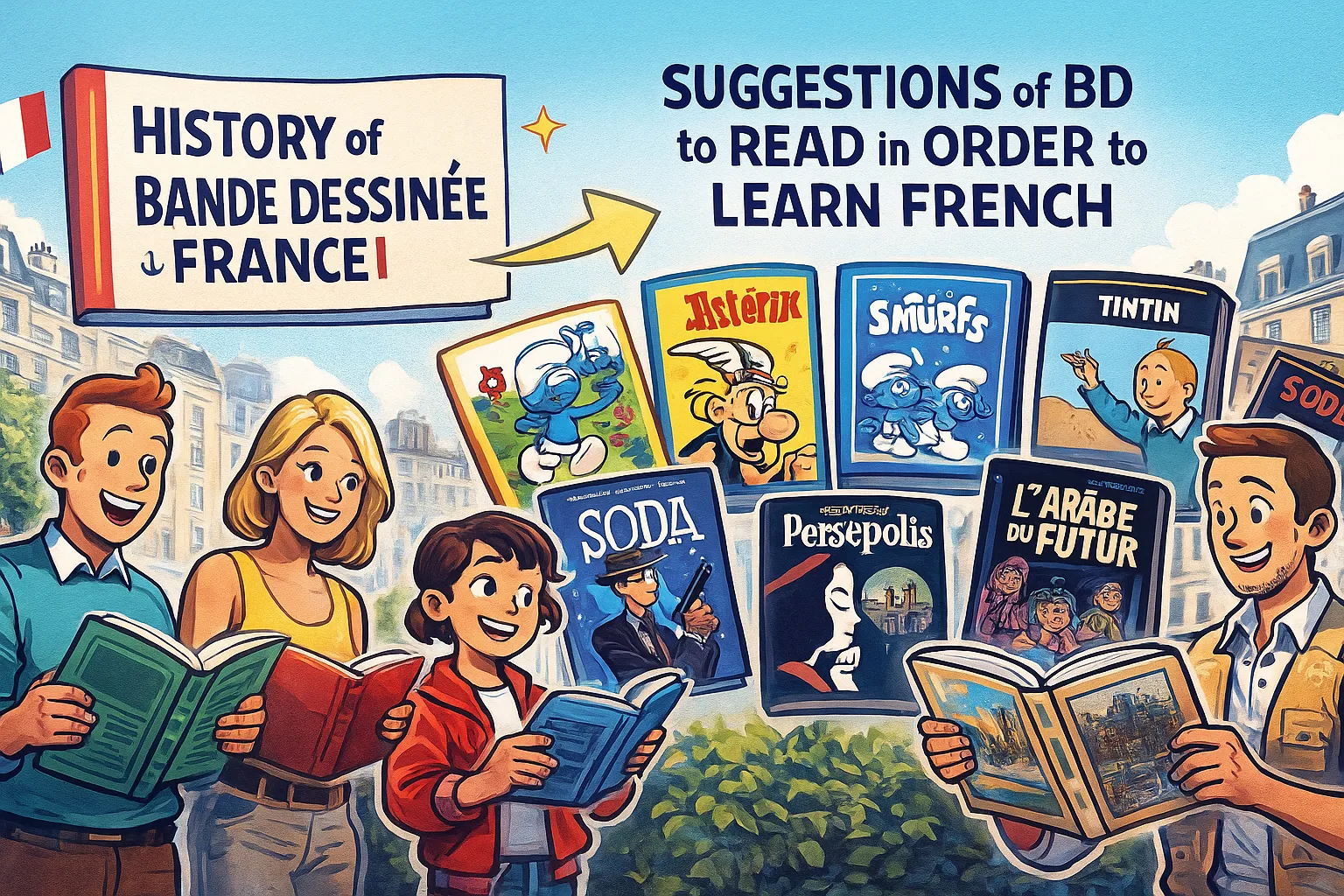
That is why French comics, French comic books, and bande dessinee deserve far more respect in language learning than they usually get in anglophone study culture. In France and Belgium, comics are not treated as a guilty side hobby for children. They are treated as a major artistic medium. That difference matters because it changes what the medium contains. You are not limited to kid-friendly joke strips. French comics include history, crime, philosophy, autobiography, satire, politics, science fiction, war, fantasy, social issues, and literary experimentation.
People say they want more French exposure. What they usually mean is exposure they can survive consistently. “For sure.” French comics are one of the rare reading formats that make consistency easier instead of harder.
Comics teach a very specific kind of French that many learners badly need: dialogue, reaction language, informal rhythm, repeated descriptors, and vocabulary anchored to visible action. That is also why French comics pair so well with broader media study. The same learners who improve through bande dessinee often benefit from adding audio through French podcasts on Spotify that fit their level.
What makes French comics different from manga and English-language comics
French comics are not just “French manga,” and they are not simply European versions of American comics. The traditions overlap, but they are not built the same way. French comics occupy a different space. They are usually album-based rather than issue-based, often released as complete hardcover volumes, and deeply tied to the Franco-Belgian bande dessinee tradition.
| Format | What it usually gives learners | Main strength | Main risk |
|---|---|---|---|
| French comics / BD | Stable page design, visible context, rich dialogue, cultural depth | Best bridge between textbook French and real reading | Wordplay and cultural references can hit harder than expected |
| Manga in French | High motivation, strong serial pull, modern speech patterns | Excellent if you already love manga and will read consistently | Some series move too fast or rely on niche genre language |
| American comics in French | Familiar stories with French text | Comfort through known characters and plots | Translation choices can feel less culturally French than native BD |
💡 Honest rule: if you already love manga, use that advantage. But do not confuse “I like manga” with “manga is automatically the best French reading tool.” Native French comics often teach broader everyday French faster.
Why French comic books are so effective for learning French
French comics work because they reduce one specific kind of cognitive load while preserving another. The visual layer helps you stay oriented when words fail. You can keep reading instead of crashing out of the page. But the language is still real enough to teach you something useful. Good French comic books sit between the extremes of trivial and discouraging. They let you infer. Inference is where a lot of real reading growth happens.
Another major advantage is dialogue. Comics give you speech patterns that are closer to how people actually sound than most beginner reading material. That also quietly strengthens listening and speaking, because you start internalising the shape of spoken French phrasing. If your ear still struggles with connected French, that connects directly to French pronunciation and listening at A1-B1.
⚠️ One trap: some learners rely on the pictures so heavily that they stop reading carefully. The visual support should keep you moving, not replace the language entirely.
Best French comics for beginners (A2-B1)
Asterix
Authors: Rene Goscinny (writer) & Albert Uderzo (artist), 1959. Published by Hachette (Dargaud originally). 40 albums, translated into 100+ languages. Currently drawn by Didier Conrad, written by Jean-Yves Ferri.
Level: A2-B1 | Genre: Historical adventure comedy
🛒 Find on Amazon.fr
Asterix is useful because the difficulty is survivable. You get repetitive settings, recurrent characters, predictable dynamics, and action that keeps the story legible even when the jokes go above your head. Some wordplay will absolutely escape you. That is normal.
Best starting albums: Asterix le Gaulois, Asterix et Cleopatre, Asterix chez les Bretons.
Tintin
Author: Herge (Georges Remi), 1929. Published by Casterman. 24 albums. Rights held by Moulinsart SA (Studio Herge). The ligne claire visual style defined an entire school of Franco-Belgian comics.
Level: A2-B1 | Genre: Adventure mystery
🛒 Find on Amazon.fr
Tintin works well because the art is exceptionally clear. Herge’s famous ligne claire style reduces visual noise, which makes the page easier to read and process.
Best starting albums: Tintin au Tibet, L’Ile Noire, Le Secret de la Licorne.
Lucky Luke
Authors: Morris (artist) & Rene Goscinny (writer, 1955-1977). Published by Dupuis, then Dargaud, now Lucky Comics. 80+ albums. Currently written by Jul, drawn by Achdé.
Level: A2-B1 | Genre: Western comedy
🛒 Find on Amazon.fr
Petit Poilu
Authors: Pierre Bailly (artist) & Celine Fraipont (writer), 2007. Published by Dupuis. 25+ albums. Wordless format, ideal for narration exercises.
Level: A2 (especially low A2) | Genre: Wordless children’s adventure
🛒 Find on Amazon.fr
Wordless comics are excellent for building descriptive thinking in French. You read the visual story, then narrate what happened in simple French. That forces active language production.
💡 Best beginner method: first pass for the story, second pass for 5 to 10 useful words, third pass reading out loud or retelling the page. That gives you reading, vocabulary, and speaking from one album.
Best French comics for intermediate learners (B1-B2)
Spirou et Fantasio
Authors: Created by Rob-Vel (1938), most famous era by Franquin (1946-1968). Published by Dupuis. 55+ albums. Currently written by Fabien Vehlmann, drawn by Yoann.
Level: B1 | Genre: Adventure comedy
🛒 Find on Amazon.fr
Le Petit Nicolas
Authors: Rene Goscinny (writer) & Jean-Jacques Sempe (illustrator), 1959. Published by Denoël then IMAV Editions. 5 original volumes + posthumous collections. Not a traditional BD format but illustrated short stories, often shelved alongside comics.
Level: B1 | Genre: Childhood humour
🛒 Find on Amazon.fr
Particularly valuable for first-person narrative and everyday childhood-social vocabulary.
Persepolis
Author: Marjane Satrapi, 2000-2003. Published by L’Association. 4 volumes (often sold as 2 collected editions). Adapted into an Oscar-nominated animated film (2007). Rights held by the author.
Level: B1-B2 | Genre: Autobiographical graphic novel
🛒 Find on Amazon.fr
Shows that French comics can also be serious literary reading. The black-and-white visuals reduce distraction. The personal narrative voice creates continuity.
Titeuf
Author: Zep (Philippe Chappuis), 1992. Published by Glenat. 17+ albums. One of the best-selling BD series in France. Contemporary kid slang, informal phrasing, embarrassment, and the texture of young spoken French.
🛒 Find on Amazon.fr
Gaston Lagaffe
Author: Andre Franquin, 1957. Published by Dupuis then Marsu Productions. 20+ albums. Recently revived with a new album by Delaf (2023, controversial among purists).
Level: B1 | Genre: Office humour
🛒 Find on Amazon.fr
If your motivation tends to collapse under too much material, the smartest move is often “simplify the total number of resources and use better ones.” The same minimalist logic is exactly what sits behind building a smaller French reading stack that you actually finish. The French Briefing adds daily reading practice that fits alongside your comics habit.
Best French comics for advanced learners (B2-C1)
Blacksad
Authors: Juan Diaz Canales (writer) & Juanjo Guarnido (artist), 2000. Published by Dargaud. 7 albums. Spanish-born creators writing directly in French. Multiple Angouleme prizes. Visually one of the most accomplished BD series ever produced.
Level: B2-C1 | Genre: Noir detective
🛒 Find on Amazon.fr, richer descriptive language, and strong narrative pull. Noir vocabulary, interrogation, mood, corruption, tension.
Le Chat du Rabbin
Author: Joann Sfar, 2002. Published by Dargaud. 6 albums + collected editions. Set in 1930s Algeria. Adapted into an animated film (2011). One of the most intellectually rich BD series in the modern catalogue.
Level: B2 | Genre: Philosophical comedy
🛒 Find on Amazon.fr. Intellectual humour, religious discourse, North African context, philosophical questioning.
La Guerre des Lulus
Authors: Regis Hautiere (writer) & Hardoc (artist), 2013. Published by Casterman. 7 albums in the main series. Set in occupied Picardy, 1914-1918. Strong educational value alongside emotional storytelling.
Level: B2 | Genre: Historical adventure
🛒 Find on Amazon.fr
XIII
Authors: Jean Van Hamme (writer) & William Vance (artist), 1984. Published by Dargaud. 26 albums in the original run + spin-offs. One of the defining Franco-Belgian thriller series. Currently continued by Yves Sente and Iouri Jigounov.
Level: B2-C1 | Genre: Political thriller
🛒 Find on Amazon.fr, political and investigative vocabulary, longer series commitment.
⚠️ Advanced does not mean “start here.” A difficult French comic you admire from a distance teaches less than a slightly easier one you actually finish.
French comics by genre: choose the comics you will actually keep reading
Science fiction comics
Valerian et Laureline, Les Cites Obscures. Excellent for world-building and highly descriptive French.
Fantasy comics
Thorgal, Lanfeust de Troy, De Cape et de Crocs. Genre love keeps you motivated.
Contemporary life comics
Penelope Bagieu, Les Cahiers d’Esther. Modern daily life, identity, relationships, current social language.
Humour and satire comics
Les Profs, Tamara, Gaston. Reaction language, tone, social patterns through comedy.
How to use French comics to learn faster instead of just reading passively
- 1Read the first pass for momentumUse the images. Skip most unknown words. Stay with the story.
- 2Mark only a few high-value expressionsNot every new word matters. Keep the list small and useful.
- 3Read again with those gaps reducedThe second pass is where comprehension often jumps unexpectedly.
- 4Read dialogue out loudComics are one of the best ways to make spoken French visible before you produce it yourself.
- 5Retell one scene simply in FrenchThat turns passive reading into active language.
💡 Best anti-burnout rule: stop the dictionary before it stops the story. If you are looking up every second balloon, you are studying vocabulary badly and reading badly at the same time.
Where to find the best French comics and French comic books
If you are in France, the answer is easy: bookstores, comic shops, larger cultural chains, libraries, and festival spaces all carry substantial BD sections. Outside France, you still have options. Specialized comic stores sometimes carry Franco-Belgian albums. Digital comic platforms can help if print access is weak. Libraries with foreign-language sections sometimes surprise people.
Digital reading is better than no reading, but print often wins for language learners because the page stays visually memorable in a different way. You remember where something was on the page, which panel carried a phrase, which speech balloon helped you infer a word. That spatial memory is underrated. If you are mixing comics with visual immersion, streaming options in French TV and passive immersion media can keep your exposure wide.
Study glossary: French comics and BD vocabulary
| French term | English translation | Usage context |
|---|---|---|
| une bande dessinee | a comic book / comic | The standard French term, often shortened to BD |
| une BD | a comic / graphic album | Everyday short form |
| un album | a comic volume | Common Franco-Belgian format |
| une planche | a comic page | Page composition or artwork |
| une case | a panel | The basic visual unit on the page |
| une bulle | a speech bubble | Where spoken dialogue appears |
| le dessinateur / la dessinatrice | artist / illustrator | The person responsible for the drawings |
| le scenariste / la scenariste | writer | The person who writes the comic script |
| le neuvieme art | the ninth art | How French culture refers to BD |
| la ligne claire | clear line style | Classic Franco-Belgian drawing style |
| franco-belge | Franco-Belgian | The historic tradition of French and Belgian comics |
| une serie | a series | A recurring comic universe with multiple albums |
Best French comics for language learners: what to do next
If your reading in French keeps stalling, French comics are probably not the detour you were avoiding. They are probably the route you needed earlier. Comics give you support without infantilising you, dialogue without artificial classroom stiffness, and culture without the wall-of-text pressure that makes so many learners quit too soon. Whether you start with Asterix, Tintin, Lucky Luke, Persepolis, Blacksad, or another series that genuinely fits your taste, the principle stays the same: choose French comics you can actually finish, not French books you admire abstractly.
The best French comics for language learners are the ones that keep you reading long enough for the medium to do its work. Once that happens, the gains spread. Vocabulary grows. Dialogue starts sounding more familiar. Humour becomes less opaque. Cultural references begin to land. And for many learners, reading stops feeling like a test and starts feeling like contact with a real living language. That is the point. Not just more words, but more time inside French without wanting to escape from it. “For sure.” 🕶️
Go further
Stop making the same 21 French mistakes. Play them away.
300 pages of games, riddles and quizzes built around the 21 mistakes English speakers actually make in French. You fix them by playing, not by memorising rules. By Camille Aubert.
📚 Keep building in the Learning Center
French Property Taxes for English Speakers: Taxe Foncière Explained
Most anglophone owners discover French property taxes the hard way: a notice arrives in late August, in administrative…
Read →Imparfait vs Passé Composé Explained: Timeline Method
Imparfait vs passé composé trips up every English speaker because English never forces the same choice. You say…
Read →Best Canal+ French series — where to watch legally (Dix pour cent, Baron Noir, Le Bureau)
Discover Canal+ premium French television series including Dix pour cent (Call My Agent!), Le Bureau des Légendes, Baron…
Read →