French Texting Abbreviations Young People Actually Use: The Informal Register Textbooks Pretend Doesn’t Exist
Your French friend texts “slt cv ? on se voit tjrs ce soir ?” and you stare at it like encrypted code. Every abbreviation decoded, from mdr to verlan, with the register rules that decide when using them is cool and when it gets you in trouble.
Greetings and conversation starters: the first texts you need to decode
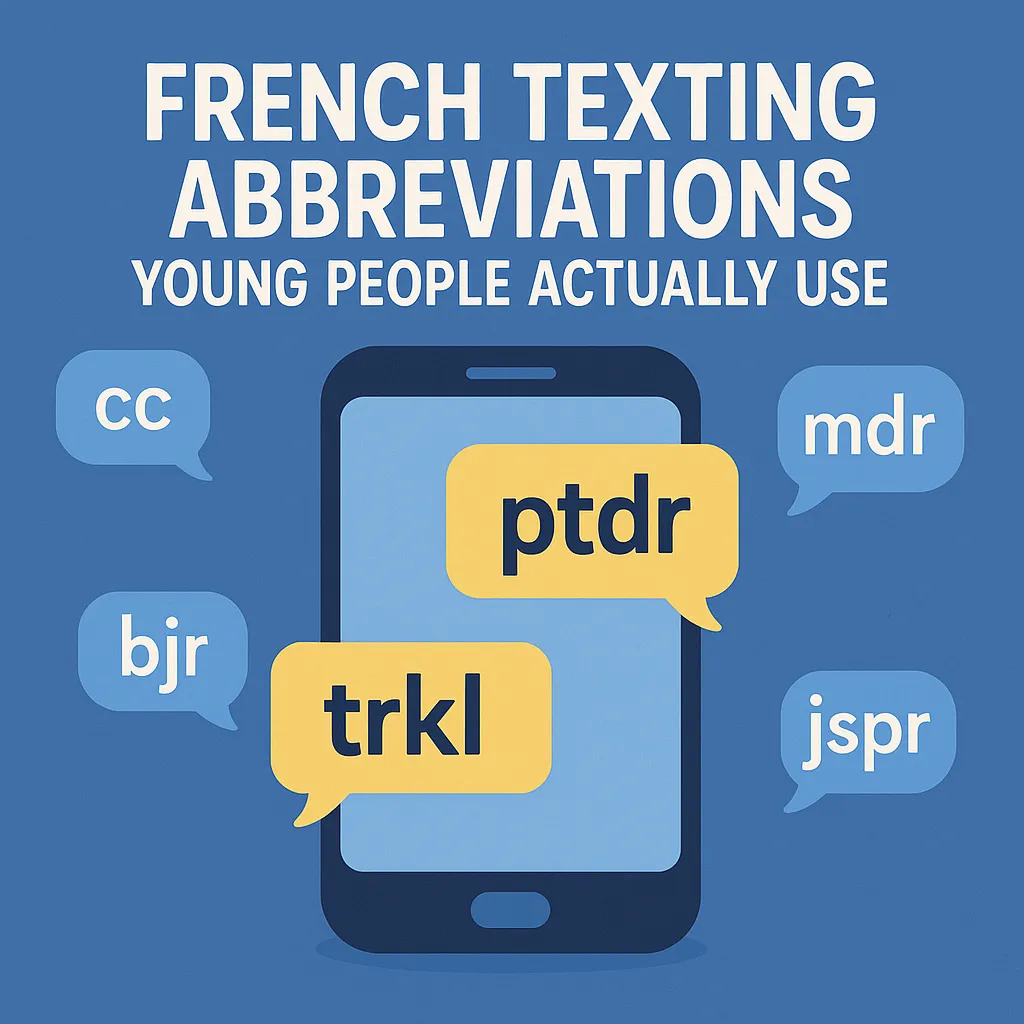
Traditional French courses teach “Bonjour, comment allez-vous ?” as the standard greeting. In texting, nobody writes that. Nobody. The formal greeting in a text message signals either that you’re over sixty, that you’re about to deliver bad news, or that you don’t understand how French people actually communicate through screens. The abbreviations below are what every French person under forty types every day, and understanding them is the minimum requirement for participating in any informal French digital conversation. The system is consistent once you see the patterns: vowels get dropped, common words compress to their consonant skeleton, and the most frequent phrases become two or three letter codes that function like English “lol” or “brb.”
The “koi 2 9” format uses numbers as phonetic substitutes: “2” sounds like “de,” “9” sounds like “neuf.” This number-as-sound system is a core feature of French texting that appears across dozens of abbreviations.
Responses, reactions, and the vocabulary of digital French conversation
The response vocabulary in French texting is where most learners freeze, because the gap between what textbooks teach and what people actually type is widest here. Your course taught “Oui, je suis d’accord” and “Non, je ne pense pas.” In a group chat, those responses read like a job application. The real responses are compressed, phonetic, and loaded with register information that tells the other person exactly how casual the relationship is. Using “dac” instead of “d’accord” signals friendship. Using full “d’accord” in a casual chat signals distance or formality that the other person will notice and interpret.
Laughter: the mdr system
French people don’t type “lol.” They type “mdr,” which stands for “mort de rire” (dying of laughter). Using “lol” in a French text marks you as either very young, heavily influenced by English internet culture, or not French. The mdr system has intensity levels that work exactly like the English progression from “lol” to “lmao” to “I’m dead,” and understanding which level to use is a social skill that textbooks never address because textbooks pretend informal French doesn’t exist.
Adding more “r”s to “mdr” intensifies it: “mdrr” = laughing harder, “mdrrr” = can’t stop, “mdrrrr” = tears. The more r’s, the funnier you found it. This system is universal across French texting and social media.
Why “mdr” matters more than you think
Using “mdr” correctly signals that you understand French digital culture. It’s the single most common abbreviation in French texting, appearing in virtually every casual conversation. Not knowing “mdr” is like not knowing “lol” in English: it marks you as someone who doesn’t communicate digitally with French speakers. The students who learn “mdr” first integrate into French group chats faster than students who learn fifty other abbreviations but miss this one.
Question words and time expressions: building actual text conversations
Asking questions in French texts follows the same compression logic as responses: drop the vowels, keep the consonant structure, use phonetic substitutions where numbers match sounds. The distinction between “pk” (pourquoi, why) and “pq” (parce que, because) is the most common confusion among English speakers learning French texting, and mixing them up reverses the meaning of your message entirely.
The pk/pq trap: “pk tu viens pas ?” = pourquoi tu viens pas ? (why aren’t you coming?). “pq j’ai trop de travail” = parce que j’ai trop de travail (because I have too much work). One letter difference. Opposite function. Mixing them up in a fast conversation makes you incomprehensible.
Time and frequency shortcuts
Verlan and slang: the inverted syllable system that defines French youth language
Verlan is the syllable-inversion system that produces some of the most distinctive words in French informal language. The word “verlan” itself is “l’envers” (backwards) inverted: l’en-vers becomes ver-lan. The system takes a word, splits it into syllables, reverses them, and produces a new word that enters common usage. “Femme” becomes “meuf.” “Fou” becomes “ouf.” “Louche” becomes “chelou.” “Lourd” becomes “relou.” These verlan words aren’t slang in the sense of being temporary or marginal. Many of them have been in active use for decades, appear in mainstream media, and are understood by virtually all French speakers even if older generations don’t use them actively. Not knowing verlan doesn’t just limit your texting ability. It limits your comprehension of French films, music, social media, and any conversation involving anyone under forty.
“C’est ouf !” is one of the most common reactions in French texting. It expresses surprise, amazement, or disbelief depending on context, exactly the way English speakers use “that’s crazy.”
Emphasis words that appear in every text
The most common mistake we see with anglophone learners in French group chats isn’t vocabulary. It’s register. They compose a grammatically perfect formal sentence in a conversation where everyone else is typing three-letter abbreviations. The perfection itself is the problem. It signals “I’m not one of you” louder than any spelling error would.
Everyday phrases compressed: the shorthand for full sentences
Beyond single-word abbreviations, French texting compresses entire phrases and common expressions into letter clusters that function as complete communication units. “Dsl” (désolé, sorry) is a complete apology. “Stp” (s’il te plaît, please) is a complete request modifier. “Rdv” (rendez-vous, meeting/appointment) is a complete noun that appears in every planning conversation.
These three compressions cover the basic social lubricant of French texting. “Dsl” is a complete apology. “Mrc bcp” (merci beaucoup) is a complete thank-you. “Stp” is the tu-register please, while “svp” (s’il vous plaît) is the vous-register version that appears in more formal digital contexts like group emails or professional Slack channels. Knowing the difference between “stp” and “svp” signals whether you understand the relationship dynamic.
“Bref” deserves special attention because it functions as a conversation pivot that French texters use constantly: “bref, on fait quoi ce soir ?” (anyway, what are we doing tonight?) closes one topic and opens another in a single word.
Preposition abbreviations are the most space-efficient compressions. “On se voit ds 1h ac des potes pr le ciné” = “On se voit dans une heure avec des potes pour le ciné.” A sentence that takes 14 words in full French compresses to 11 characters of abbreviation.
Verb compressions
The letter-as-pronoun system: “G” sounds like “j’ai,” “C” sounds like “c’est,” “T” sounds like “tu” or “t’as.” So “g faim” = “j’ai faim” (I’m hungry), “c ouf” = “c’est ouf” (that’s crazy), “t où ?” = “tu es où ?” (where are you?). Not misspellings. A phonetic writing system built for speed.
Number-as-sound substitutions: “2” = de (sounds like “deux”), “9” = neuf, “1” = un/ain, “6” = ci (sounds like “six”), “7” = cette (sounds like “sept”). So “a2m1” = à demain (see you tomorrow), “b1” = bien (good), “m6” = merci (thanks). These are mostly used by teenagers and considered somewhat childish by adults over 25. Know them to decode. Use them sparingly.
Real text conversations decoded: two complete exchanges
Reading individual abbreviations is step one. Reading them at conversation speed in context is the actual skill. The two exchanges below represent the most common texting situations: making plans and reacting to news.
Conversation 1: making plans
A: slt ! tu fais koi ce soir ? (Hey! What are you doing tonight?)
B: rien de spécial pk ? (Nothing special, why?)
A: on va au ciné avec des potes, tu viens ? (We’re going to the cinema with friends, you coming?)
B: ouais trop stylé ! à quelle heure ? (Yeah so cool! What time?)
A: 20h, rdv devant le ciné (8pm, meet in front of the cinema)
B: dac je serai là. à tt ! (Okay I’ll be there. See you later!)
Conversation 2: reacting to gossip
A: mec t’as vu ? Julie et Thomas ont rompu (Dude, did you see? Julie and Thomas broke up)
B: srx ?? c ouf ! (Seriously?? That’s crazy!)
A: ouais jsp pk mais apparemment c chelou (Yeah idk why but apparently it’s sketchy)
B: mdr ça m’étonne pas frr. Thomas était trop relou (Lol doesn’t surprise me bro. Thomas was so annoying)
A: grave ! bon bref on en parle ce soir ? (Seriously! Anyway, we’ll talk about it tonight?)
B: yep à ce soir, bisous (Yep see you tonight, kisses)
When NOT to use texting abbreviations: Never with professors, bosses, professional contacts, people significantly older than you, or anyone you’d normally “vouvoyer.” Writing “bjr, jsp si c ok pr le rdv” to your French landlord, your doctor’s office, or your HR department creates an impression of disrespect that no amount of correct grammar elsewhere repairs. Formal contexts demand formal French. Texting abbreviations are for friends and peers only.
The integration strategy: Start with five abbreviations: slt, mdr, cv, dac, tkt. Use them in your next French text conversation. Watch how your French friends respond. Mirror their abbreviation density. Don’t try to learn fifty abbreviations before using any. The Learning Center has the grammar reference for when you need to switch back to formal register after a texting session.
Study glossary: essential French texting abbreviations
| Abbreviation | Full French | English |
|---|---|---|
| mdr | mort de rire | dying of laughter (lol) |
| slt | salut | hi / hey |
| bcp | beaucoup | a lot / very much |
| pk | pourquoi | why |
| pq / pcq | parce que | because |
| tjs / tjrs | toujours | always / still |
| jsp | je ne sais pas | I don’t know (idk) |
| dsl | désolé | sorry |
| ouf | fou (verlan) | crazy / amazing |
| tkt | t’inquiète (pas) | don’t worry |
| cv | ça va | how are you |
| dac / dak | d’accord | okay / agreed |
| rdv | rendez-vous | meeting / date |
| meuf | femme (verlan) | girl / woman |
Go further

Stop making the same 21 French mistakes. Play them away.
300 pages of games, riddles and quizzes built around the 21 mistakes English speakers actually make in French. You fix them by playing, not by memorising rules. By Camille Aubert.
📚 Keep building in the Learning Center
French Property Taxes for English Speakers: Taxe Foncière Explained
Most anglophone owners discover French property taxes the hard way: a notice arrives in late August, in administrative…
Read →Imparfait vs Passé Composé Explained: Timeline Method
Imparfait vs passé composé trips up every English speaker because English never forces the same choice. You say…
Read →French bakery culture — etiquette, ordering, daily bread
Discover French bakery culture: greet politely, order like a local, and talk about baguettes, viennoiseries, and special breads—clear…
Read →