Best Online Dictionaries for French to English: Why WordReference Is Your Starting Point, Not Your Finish Line
Professional translators use five or six resources for a single word, and you do not need that many, but you need more than one. This guide ranks the tools that matter, shows what each does that the others cannot, and gives you the lookup workflow that gets the right answer in under thirty seconds.
Context-based tools: see how French words actually live in sentences
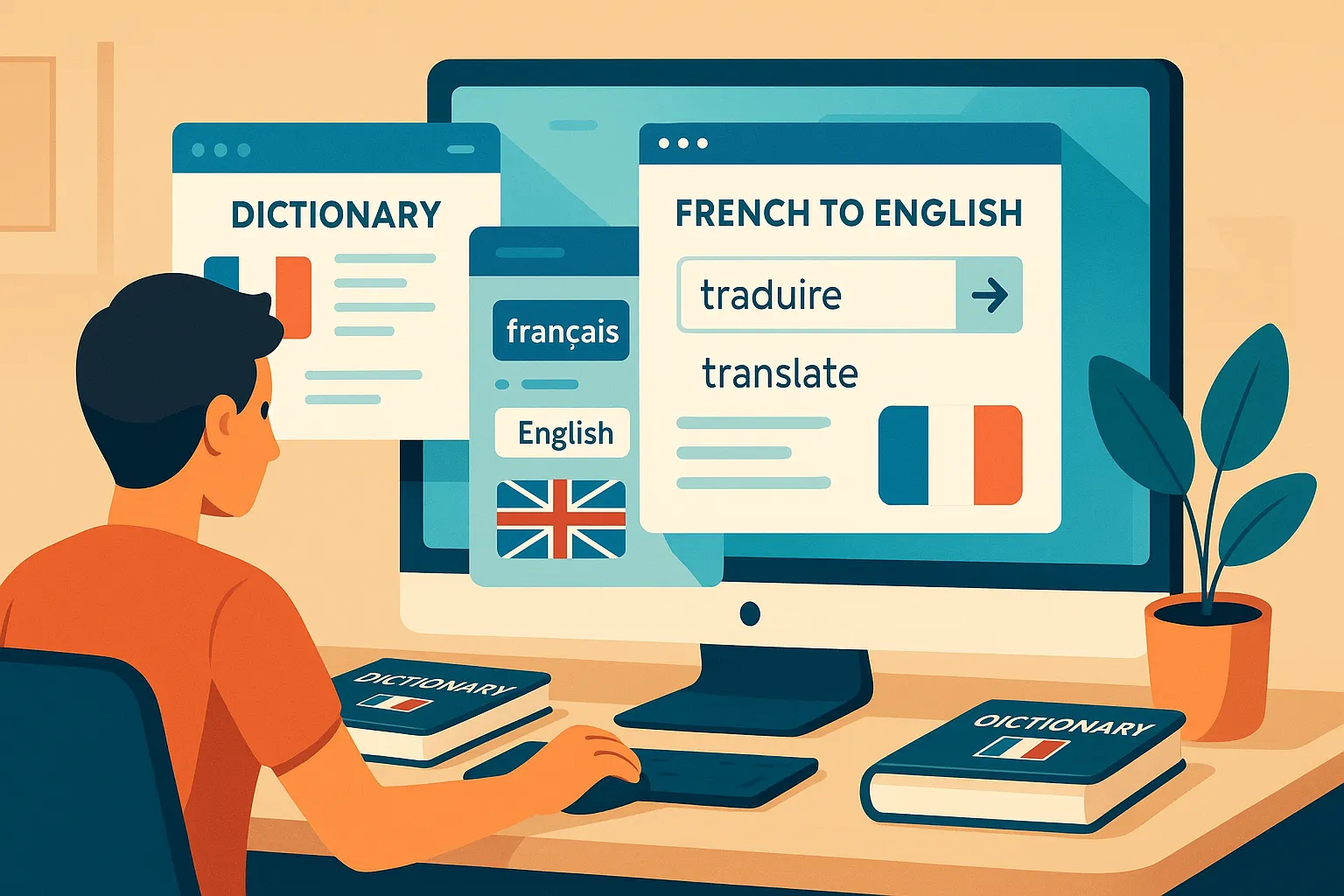
Traditional dictionaries give you a word and a definition. Context-based tools give you the word inside twenty real sentences from official documents, news articles, and published translations. That is the difference between knowing what a word means and knowing how to use it.
| Tool | Type | Best level | Strength |
|---|---|---|---|
| Linguee | Professional bilingual corpus | A2-C1 | Millions of real sentence pairs (EU docs, corporate, press). The reference for professional translators. |
| Reverso Context | Conversational corpus | A2-B2 | Film subtitles, TV dialogues, informal texts. Complements Linguee on oral and casual register. |
| WordReference | Bilingual dictionary + forums | A1-B1 | Fast, familiar, with forum discussion. Good for quick lookups. Insufficient for natural usage. |
| DeepL | Advanced machine translation | B1-C1 | Better register handling than Google. Useful for paragraph drafts, not isolated words. |
The single-source trap
Relying on one dictionary is like navigating with one landmark. Linguee shows context. A monolingual dictionary shows nuance. WordReference shows the quick answer. The quick answer is often right. When it is not, you need the other two. The Google Translate fails guide shows exactly where single-source lookups produce the worst errors.
Monolingual French dictionaries: the switch that marks B1
At some point, looking up French words in English stops helping and starts hurting. Bilingual dictionaries give approximate equivalents. Monolingual dictionaries give actual meaning. “Flâner” translated as “to stroll” loses everything that makes the word interesting. “Flâner” defined in French reveals the cultural concept of aimless, deliberate observation that English has no word for.
| Tool | Best level | What it gives you |
|---|---|---|
| CNRTL | B2-C1 | The deepest French dictionary online. Free. Etymology, historical usage, literary citations, full semantic range. Search “flâner” and get Baudelaire. |
| Larousse en ligne | A2-B1 | Clear French definitions with examples, synonyms, antonyms. Less academic than CNRTL. The bridge between bilingual and monolingual. |
| Le Petit Robert | B2-C1 | Contemporary usage, audio, usage notes. Worth it for professionals. Free alternatives cover the same ground for most learners. |
Students who work on thinking in French find that switching to monolingual dictionaries accelerates the shift. Every lookup in French is practice. Every lookup in English is a step backward. The books guide covers the same transition for reading material.
The transition method. Look up new words in Larousse French first. If you still do not understand after reading the French definition, check the bilingual entry. Over time, you need the bilingual check less and less.
Specialized dictionaries: when general tools fail
General dictionaries translate “formation” as “training” or “formation” without telling you which applies. Medical, legal, financial, and technical vocabulary requires tools that understand domain-specific meaning. The work culture guide covers the professional vocabulary where general dictionaries produce the worst approximations.
| Tool | Domain | Why it matters |
|---|---|---|
| Termium Plus | All professional fields | Government of Canada. Authoritative. Domain-labelled translations prevent “formation” = training OR geological formation ambiguity. |
| IATE | Legal, administrative, diplomatic | EU terminology database. 24 languages. The terms that general dictionaries approximate badly. |
| Forvo | Pronunciation | Real native speakers from multiple regions. Hear “croissant” from a Parisian and a Québécois. Knowing a word you cannot pronounce is knowing half a word. |
Never use a general dictionary for legal or medical translation. “Ordonnance” means “prescription” in medical French but “ordinance/decree” in legal French. General dictionaries list both without telling you which applies. Termium Plus labels each by domain. The moving to France guide covers the administrative terms where this matters most.
The lookup workflow: right answer in thirty seconds
- 1Linguee first: context before meaning See the word in real bilingual sentences before committing. “Assurer le suivi” shows “follow up” in business, “monitor” in medical.
- 2Larousse or CNRTL: French definition Understand the word in French. At B1+ this builds the think-in-French habit. At A2, skip and return later.
- 3Forvo: hear it Ten seconds. One click. Now you can say it. The pronunciation guide gives you the phonetic framework.
- 4Termium Plus: verify specialized meaning Only for professional, legal, medical vocabulary. General words skip this step.
- 5Note it: French word + IPA + definition + example sentence Five fields. Thirty seconds. Permanent vocabulary. The sentence from Linguee is the example you need.
Why WordReference is not step 1
WordReference gives you the answer before you have seen the context. That is fast but dangerous. You pick the first translation, use it, and it is wrong because the context required a different meaning. Starting with Linguee forces you to see usage before committing. The false friends guide shows exactly which words this prevents you from getting wrong.
Free vs paid. CNRTL, Larousse basic, Linguee, Reverso Context, Termium Plus, IATE, Forvo, and WordReference are all free. Le Petit Robert adds polish but not substance. Free tools match or exceed paid alternatives for most learners.
The best dictionary is the one that makes you need it less over time. The method guide builds the system where dictionary lookups become verification, not crutches. The podcast guide adds the audio input that turns looked-up words into recognized sounds. “For sure.” 🕶️
Study glossary: dictionary and translation vocabulary
| French | English | Context |
|---|---|---|
| Dictionnaire / définition | Dictionary / definition | “Quel dictionnaire tu utilises ?” |
| Traduction | Translation | Converting between languages |
| Contexte | Context | What determines correct meaning |
| Registre | Register | Formal vs informal level |
| Synonyme / antonyme | Synonym / antonym | Similar or opposite meaning |
| Étymologie | Etymology | Word origin and history (CNRTL) |
| Prononciation | Pronunciation | How to say the word (Forvo) |
| Faux ami | False friend | Words that look alike but differ |
| Locution | Expression/phrase | Multi-word fixed meaning |
| Monolingue / bilingue | Monolingual / bilingual | FR-FR vs FR-EN dictionary |
Go further

Stop making the same 21 French mistakes. Play them away.
300 pages of games, riddles and quizzes built around the 21 mistakes English speakers actually make in French. You fix them by playing, not by memorising rules. By Camille Aubert.
📚 Keep building in the Learning Center
French Property Taxes for English Speakers: Taxe Foncière Explained
Most anglophone owners discover French property taxes the hard way: a notice arrives in late August, in administrative…
Read →Imparfait vs Passé Composé Explained: Timeline Method
Imparfait vs passé composé trips up every English speaker because English never forces the same choice. You say…
Read →Moving to France from USA guide — work visas, job search, and expat life (complete 2026 guide)
Complete guide for Americans moving to France: work visa types and application process, job search strategies and recruitment…
Read →