TCF vs DELF: Which French Exam Should You Take?
You need official French certification for immigration, university admission, or professional credentials, but you’re confused whether to take TCF or DELF because online forums give contradictory advice, official websites are dense with bureaucratic language, and you’re worried about wasting money and months of preparation time on the wrong exam that won’t actually meet your specific requirements. TCF and DELF serve different purposes despite both being official French certifications, with fundamental differences in format, scoring, validity period, and institutional recognition that make one clearly better than the other depending on whether you’re applying to Canadian immigration, French universities, citizenship programs, or simply want permanent proof of French proficiency.
The fundamental difference: Diploma vs assessment
This is the single most important distinction that determines which exam you need.
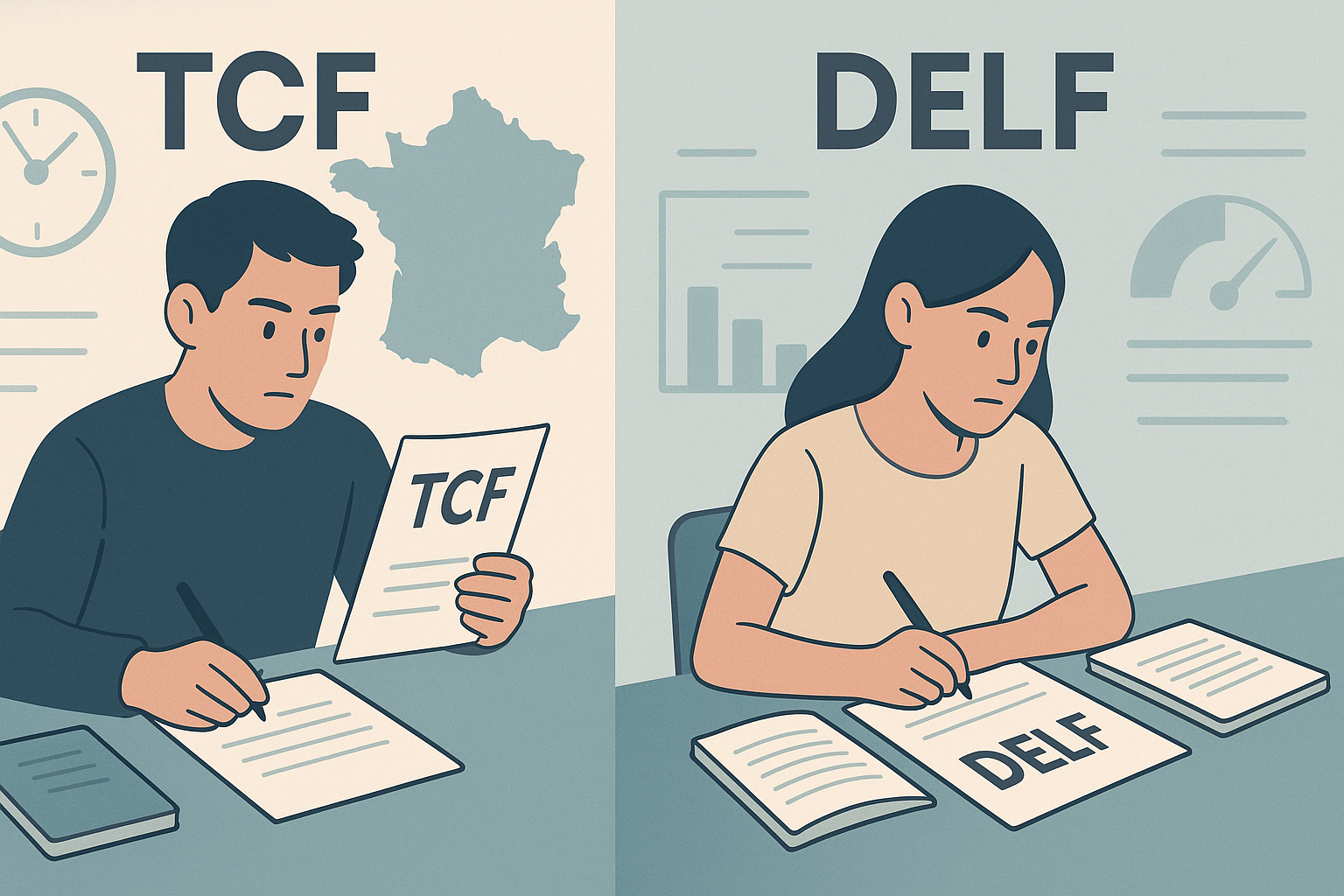
DELF (Diplôme d’Études en Langue Française) is a diploma. You pass or fail specific levels (A1, A2, B1, B2). Once you pass, you have that diploma forever. It never expires. It’s issued by France’s Ministry of Education. Think of it like a college degree – once earned, it’s permanent proof of achievement.
TCF (Test de Connaissance du Français) is an assessment. You receive a numeric score (0-699 points) that places you on the CEFR scale. The certificate expires after 2 years. It’s administered by France Éducation International. Think of it like the TOEFL or IELTS for English – a snapshot of your current ability with limited validity.
This philosophical difference drives every other distinction between the exams.
DELF in summary
- Type: Diploma (pass/fail per level)
- Validity: Lifetime
- Levels: A1, A2, B1, B2 (separate exams)
- Format: Paper-based
- Scoring: 0-100 points, need 50+ to pass
- Cost: €100-200 depending on level and location
- Frequency: 2-4 times per year at test centers
- Results: 4-8 weeks
TCF in summary
- Type: Proficiency test (numeric score)
- Validity: 2 years from test date
- Levels: One test, score determines your level
- Format: Computer-based (usually)
- Scoring: 0-699 points across CEFR levels
- Cost: €150-200 for complete version
- Frequency: Multiple times monthly at test centers
- Results: 2-4 weeks (sometimes faster)
Most French textbooks are written by native speakers who’ve forgotten what confuses beginners. They explain grammar assuming you already think like a French person.
Roger learned French as an adult after growing up with English and German. He remembers exactly which explanations clicked and which ones left him confused. The FrenchToEnglish approach was built from those memories, including navigating the confusing French certification landscape when he needed official proof of his French level for professional opportunities.
TCF and DELF versions – what they mean
Both exams have multiple versions designed for specific purposes. Choosing the wrong version wastes your money even if you pass.
DELF versions
DELF Tout Public (All public)
- For adults 18+
- General French proficiency
- Most common version
- Levels: A1, A2, B1, B2
DELF Junior/Scolaire
- For teenagers 12-17 in school
- Same content, age-appropriate topics
- Same diploma validity
DELF Prim
- For children 8-12
- Simplified, playful format
DELF Pro
- For professional contexts
- Business French focus
- Less common, not widely offered
Which to take: Almost everyone should take DELF Tout Public. It’s the standard version recognized everywhere.
TCF versions (this is where it gets confusing)
TCF Tout Public (TP)
- General proficiency assessment
- Accepted by most French universities
- Not accepted for Canadian immigration
TCF Canada
- Specifically for Canadian immigration (Express Entry, Quebec immigration)
- Tests all 4 skills (mandatory)
- Slightly different scoring interpretation
- NOT interchangeable with TCF TP
TCF Québec
- For Quebec immigration specifically
- Similar to TCF Canada but recognized by Quebec only
- Different requirements than federal Canada programs
TCF pour l’accès à la nationalité française (ANF)
- For French citizenship/naturalization applications
- Tests oral and listening only
- Must achieve B1 level minimum
TCF pour la carte de résident en France
- For French residency card applications
- Tests oral and listening only
- Must achieve A2 level minimum
Critical warning: You CANNOT substitute one TCF version for another. If Canadian immigration requires “TCF Canada,” you cannot submit TCF Tout Public scores. They’re different exams with different formats.
⚠️ The most expensive mistake people make:
Taking TCF Tout Public when they actually needed TCF Canada for immigration. The €180 exam fee is wasted. Months of preparation are wasted. You must retake the correct version. Always verify EXACTLY which exam version your institution requires before registering.
Which exam for which purpose – decision matrix
Here’s the clear breakdown of when to take which exam.
Take DELF if you need certification for:
✅ French university admission (undergraduate and most graduate programs)
Most French universities accept DELF B2 for admission. Some accept B1 for certain programs. DELF is preferred over TCF because it never expires – you can apply years after taking the exam.
✅ French citizenship application
While you CAN use TCF ANF, DELF B1 is also accepted and never expires. If you’re planning citizenship but not applying immediately, DELF is smarter.
✅ Permanent proof of French level
If you want certification that remains valid throughout your career, DELF is the only option. Useful for CV/resume, professional credentials, personal achievement.
✅ School requirements (if you’re under 18)
Secondary schools typically prefer DELF for exchange programs or admission requirements.
✅ European job market
European employers generally recognize DELF more readily than TCF. It’s seen as the standard diploma.
Take TCF if you need certification for:
✅ Canadian immigration (Express Entry, Quebec immigration)
You MUST take TCF Canada specifically. DELF is not accepted. No exceptions. This is non-negotiable.
✅ Quick timeline with flexible test dates
TCF is offered more frequently (monthly at many centers) versus DELF (2-4 times per year). If you need certification within 6-8 weeks, TCF may be your only option.
✅ Assessing your current level before DELF
Some people take TCF first to determine which DELF level to attempt. This can save money versus taking DELF B1, failing, and having to retake.
✅ Requirements that specifically state “TCF accepted”
Some universities or programs explicitly accept TCF. Always verify, but if TCF is listed, it’s usually faster to obtain.
✅ You’re not sure of your exact level
DELF requires choosing a level before the exam. If you’re borderline between B1 and B2, you might fail B2 and feel overqualified for B1. TCF tests all levels in one exam, so you can’t “choose wrong.”
Common scenarios decided
Scenario: “I want to study at the Sorbonne in 2 years”
Answer: Take DELF B2. You have time, and the diploma remains valid when you apply. No rush for TCF’s expiration.
Scenario: “I need French certification for Canadian Express Entry ASAP”
Answer: Take TCF Canada. It’s mandatory. DELF won’t be accepted. No alternative.
Scenario: “I want proof of French for my CV but I’m not sure my level”
Answer: Take TCF first to determine your level, then take DELF at that level for permanent certification. Or just take DELF at the level you believe you’re at.
Scenario: “I need B1 French for citizenship application in 18 months”
Answer: Take DELF B1. It never expires so you’re covered. TCF ANF would expire before your application processes.
Scenario: “My university accepts either DELF B2 or TCF B2”
Answer: Take DELF. Same recognition, but permanent validity means you can use it for other opportunities later. TCF expires.
Format and difficulty comparison
The exams test the same language skills but in different ways.
Listening comprehension
DELF:
- Paper-based with audio
- Recordings played once or twice (varies by level)
- Can take notes
- Questions printed in test booklet
- 20-30 minutes depending on level
TCF:
- Computer-based with headphones
- Each recording played once only
- Questions appear on screen after listening
- Cannot skip forward or go back
- 29 questions, approximately 25 minutes
Difficulty comparison: TCF is often considered harder because recordings play only once and you cannot return to previous questions. DELF allows strategic question review.
Reading comprehension
DELF:
- Paper-based reading passages
- Can annotate, underline, skip and return
- 4-5 documents of increasing difficulty
- 30-45 minutes depending on level
TCF:
- Computer screen reading
- Cannot skip forward or return to previous questions
- 29 questions with varied text types
- 45 minutes
Difficulty comparison: Similar difficulty, but DELF’s flexibility to skip and return is advantageous. TCF’s linear progression can be stressful.
Writing production
DELF:
- Paper-based writing
- 2 tasks (varies by level)
- Clear rubric and expectations
- 45-60 minutes depending on level
- Human examiner grades with detailed rubric
TCF:
- Computer typing (usually)
- 3 tasks of increasing difficulty
- 60 minutes
- Often graded by examiners using standardized rubric
Difficulty comparison: DELF’s clear structure and expectations make preparation easier. TCF requires versatility across task types. Typing speed can affect TCF performance.
Speaking production
DELF:
- Face-to-face with examiner
- 3 parts: guided conversation, monologue, interaction
- 10-20 minutes depending on level
- Examiner adapts questions to your level
- Preparation time provided
TCF:
- Face-to-face with examiner (TCF Canada/ANF)
- 6 tasks of increasing difficulty
- 12 minutes
- Limited examiner flexibility
- Minimal preparation time
Difficulty comparison: DELF’s longer format allows you to recover from mistakes and show sustained ability. TCF’s rapid task switching can be jarring but also means mistakes in one task don’t doom the entire section.
💡 Adaptive difficulty insight:
TCF uses adaptive question difficulty – if you answer questions correctly, subsequent questions become harder. This can make TCF feel more difficult because you’re constantly challenged at your ceiling. DELF has fixed difficulty per level, so B1 questions remain B1 throughout.
Cost comparison and value analysis
Direct costs
DELF pricing:
- A1: €100-130
- A2: €120-150
- B1: €140-170
- B2: €160-200
- Varies significantly by country and test center
TCF pricing:
- TCF Tout Public (4 skills): €150-200
- TCF Canada (4 skills): €200-250
- TCF ANF (2 skills): €100-130
- Individual skill tests available but more expensive per skill
Hidden costs and value considerations
DELF value factors:
- Never expires – One-time cost for lifetime certification
- Can retake individual levels – If you fail B2, you can retake just B2
- Preparation materials abundant – Decades of past exams available
- Potential waste – If you choose wrong level and fail, you must pay again
TCF value factors:
- Expires in 2 years – May need to retake for future applications
- Cannot retake specific sections – Must retake entire exam
- More frequent test dates – Saves time if you need certification urgently
- Version confusion – Risk of taking wrong TCF version and losing money
Long-term cost comparison:
If you take DELF B2 at age 25 for €180, it’s valid at age 45 for new opportunities. If you take TCF at age 25, you’ll pay €180 again at age 27 if you need recertification. Over a career, DELF is dramatically cheaper for anyone who might need French certification multiple times.
Preparation time required
DELF preparation
If you’re at the level: 4-6 weeks of exam-specific preparation focusing on format, timing, and practice tests.
If you’re below the level:
- A1: 60-80 hours of study
- A2: 150-200 hours total
- B1: 350-400 hours total
- B2: 550-650 hours total
Advantage: Clear target level means focused preparation. You know exactly what vocabulary, grammar, and skills to prioritize.
TCF preparation
For any level: 6-8 weeks of format-specific preparation, but TCF’s adaptive nature means you should study one level above your target to maximize your score.
Challenge: Cannot target a specific level. Must prepare broadly across multiple CEFR levels since you don’t know which questions you’ll receive.
Advantage: If your level is genuinely uncertain, TCF preparation covers all bases. You won’t “miss” your level.
Recognition and acceptance
Geographic recognition
France: Both equally recognized. Government offices, universities, employers all accept both.
Canada: ONLY TCF Canada for immigration. Universities may accept DELF for admission but not for immigration points.
Europe (non-France): DELF generally more recognized and understood. TCF less familiar to non-French institutions.
United States: Both accepted by universities. DELF more commonly referenced on CVs.
International employers: DELF easier to explain (“It’s like a degree”) versus TCF (“It’s like TOEFL”). DELF’s permanence gives it more credibility for career purposes.
University acceptance
French universities: Typically require DELF B2 or TCF B2 for undergraduate admission. Both widely accepted. Check specific university requirements.
Graduate programs: Some require C1 (DALF C1 or TCF C1 score). DALF is preferred at this level.
Grandes Écoles: Often have specific requirements. Some prefer DELF/DALF. Always check institution-specific requirements.
Study glossary – Exam vocabulary
| FR | EN | Usage Context |
|---|---|---|
| Le diplôme | The diploma | DELF est un diplôme permanent |
| Le test / L’évaluation | The test / The assessment | TCF est un test de niveau |
| La validité | The validity | TCF a une validité de 2 ans |
| Le niveau CECRL | CEFR level | Mon niveau est B1 sur l’échelle CECRL |
| Le score / Le résultat | The score / The result | Mon score TCF est 450/699 |
| L’attestation | The certificate | J’ai reçu mon attestation TCF |
| La compétence | The skill/competency | Les quatre compétences linguistiques |
| Reconnu(e) | Recognized | DELF est reconnu internationalement |
| Expiré(e) | Expired | Mon certificat TCF est expiré |
| L’immigration | Immigration | Pour l’immigration canadienne |
| La naturalisation | Naturalization/citizenship | Pour la naturalisation française |
| L’admission universitaire | University admission | Pour l’admission à l’université |
Your decision flowchart
Answer these questions in order to determine which exam you need:
Question 1: Is this for Canadian immigration?
- Yes → Take TCF Canada (no other option)
- No → Continue to Question 2
Question 2: Do you need certification within the next 8 weeks?
- Yes → Check TCF availability (offered more frequently)
- No → Continue to Question 3
Question 3: Might you need this certification again in 3+ years?
- Yes → DELF (never expires, better long-term value)
- No → Continue to Question 4
Question 4: Are you certain of your CEFR level?
- Yes → DELF at that level (cheaper, permanent)
- No/Uncertain → TCF (assesses all levels, shows your actual level)
Question 5: Does your institution explicitly require TCF?
- Yes → Take TCF
- No → DELF is safer choice
Most people who answer “no” to Questions 1-3 should take DELF. It’s more widely recognized, never expires, costs less long-term, and provides clearer credentials for CVs and applications.
Take TCF only if: (1) Canadian immigration requires it, (2) you need certification urgently and DELF isn’t available, (3) you’re genuinely uncertain of your level and want diagnostic scoring, or (4) a specific institution explicitly requires TCF.