How Long Does It Take to Learn French? Your Complete Realistic Timeline
You’re considering learning French but every source gives wildly different timelines from “fluent in 3 months!” to “years of dedicated study required,” leaving you confused about whether French is achievable within your schedule constraints, whether you should even start given your busy life, and what “fluency” actually means since apps promise conversational French in weeks while traditional teachers say mastery takes years, and you need honest answers about how much time investment French genuinely requires for different competency levels before committing money and effort to a multi-year learning journey. The truth is that “how long to learn French” depends entirely on your definition of “learn” (survival phrases? conversational ability? professional fluency? native-level mastery?), your learning method intensity and quality, your linguistic background, study consistency, immersion opportunities, and specific goals, with realistic timelines ranging from 200 hours for basic tourist French to 1000+ hours for professional competency, but these numbers mean nothing without understanding which factors accelerate or sabotage progress and how to structure your learning for maximum efficiency.
The problem with “how long to learn French” question
When people ask “how long does it take to learn French?”, they’re really asking dozens of different questions without realizing it.
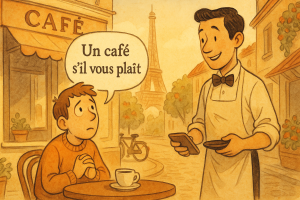
Do you mean how long until you can order food in a Paris restaurant? Ask directions? Have basic conversations? Conduct business meetings? Read Proust? Watch French films without subtitles? Work professionally in French? Each of these represents dramatically different timelines and effort levels.
🇺🇸 EN — How long does it take to learn French?
The question assumes “learning French” has a clear finish line. It doesn’t. Language learning is a spectrum from “complete beginner” to “native-like mastery,” and you can stop at any point along that spectrum depending on your goals.
Roger learned this distinction painfully when he moved to France in 2012. He arrived with what textbooks called “intermediate French” but couldn’t understand rapid native conversations, missed cultural references constantly, and struggled with informal expressions despite years of study. His “learned French” from textbooks wasn’t the same as functional French for daily life. This experience now shapes how he teaches realistic expectations in his private French lessons.
Understanding CEFR levels and what they mean
The European framework for language learning
The CEFR (Common European Framework of Reference for Languages) provides the most widely accepted scale for measuring language ability. Understanding these levels helps you set realistic goals and timelines.
A1 – Absolute Beginner:
🇺🇸 EN — Hello, my name is Marie. I live in Paris.
What you can do: Introduce yourself, order basic food/drinks, ask simple questions, understand slow, clear speech about familiar topics.
Study time required: 60-100 hours
Timeline: 2-3 months with consistent study (1 hour daily) or 3-6 months with moderate study (30 minutes daily)
A2 – Elementary:
🇺🇸 EN — I work in an office. On weekends, I like going to the cinema with my friends.
What you can do: Describe your background, immediate environment, handle routine tasks requiring simple direct exchange, understand frequently used expressions.
Study time required: 150-200 hours total (including A1)
Timeline: 4-6 months from zero with intensive study, 6-12 months with moderate consistent study
B1 – Intermediate:
🇺🇸 EN — If I had more free time, I would travel more. I’d like to visit the south of France because everyone says it’s magnificent.
What you can do: Handle most travel situations, describe experiences, dreams, hopes, give reasons for opinions, understand main points of clear standard speech on familiar matters.
Study time required: 350-400 hours total
Timeline: 6-12 months from zero with intensive study, 12-18 months with consistent moderate study
B2 – Upper Intermediate:
🇺🇸 EN — Although I understand the arguments in favor of this policy, I think it risks having unforeseen consequences on the local economy.
What you can do: Understand complex texts on concrete and abstract topics, interact with native speakers with fluency and spontaneity, produce detailed text on wide range of subjects.
Study time required: 600-750 hours total
Timeline: 12-18 months from zero with intensive study and immersion, 18-30 months with consistent study without immersion
C1 – Advanced:
🇺🇸 EN — This methodological approach, although it presents certain inherent limitations, nevertheless offers a robust analytical framework for understanding contemporary socio-economic dynamics.
What you can do: Understand demanding, longer texts, express ideas fluently without obvious searching for expressions, use language flexibly for social, academic, and professional purposes.
Study time required: 800-1000 hours total
Timeline: 18-24 months from zero with intensive study and immersion, 2.5-4 years with consistent study without immersion
C2 – Mastery (near-native):
🇺🇸 EN — The author brilliantly wields subtle irony, weaving between the lines a scathing critique of bourgeois society whose protagonists, despite their apparent lucidity, remain willing victims.
What you can do: Understand virtually everything heard or read, summarize information from different sources, express yourself spontaneously, fluently, and precisely even in complex situations.
Study time required: 1000-1200+ hours total
Timeline: 2-3 years minimum with intensive study and immersion, 4-6+ years with consistent study without immersion
💡 Roger’s perspective on CEFR timelines:
“These hour estimates assume high-quality, focused study. Passive app use or unfocused classroom time takes 2-3x longer. In my private lessons, we focus on high-efficiency methods that keep you at the faster end of these ranges – targeted practice on your weak points, immediate application, systematic error correction. Most people waste 50% of their study time on ineffective methods.”
Factors that dramatically affect your timeline
Factor 1: Your linguistic background
If you already speak a Romance language (Spanish, Italian, Portuguese, Romanian):
Timeline: 25-40% faster than monolingual English speakers
Why: Vocabulary overlap (60-80% cognates), similar grammar structures, shared verb conjugation systems, familiar gendered nouns.
🇺🇸 EN — Liberty, justice, administration (cognates from Latin roots)
If you only speak English:
Timeline: Standard CEFR estimates apply
Why: English has significant French vocabulary (30-40% of English words have French origin) but completely different grammar. You’ll recognize vocabulary but struggle with grammar structures.
If you speak a non-Romance, non-Germanic language (Arabic, Chinese, Japanese, etc.):
Timeline: 20-30% slower for initial levels, evens out at intermediate+
Why: Completely different linguistic structures, writing system familiarity, pronunciation challenges. Roger’s students from non-European language backgrounds typically need extra time on A1-B1 but catch up at B2+.
Factor 2: Study intensity and consistency
Intensive study (2-3 hours daily with structured lessons):
- A1: 1-2 months
- A2: 3-4 months total
- B1: 6-9 months total
- B2: 12-15 months total
Moderate consistent study (1 hour daily structured practice):
- A1: 2-3 months
- A2: 5-7 months total
- B1: 12-15 months total
- B2: 20-24 months total
Casual inconsistent study (3-4 hours weekly, irregular):
- A1: 4-6 months
- A2: 12-15 months total
- B1: 24-30 months total
- B2: 36-48 months total
🇺🇸 EN — Consistency is more important than intensity
Critical insight from Roger’s teaching experience: Students who study 30 minutes daily progress faster than students who cram 3.5 hours on weekends. Daily exposure prevents forgetting and builds automaticity.
Factor 3: Learning method quality
High-efficiency methods (fastest timeline):
- Personalized instruction targeting your specific gaps (Roger’s approach)
- Structured curriculum with immediate application practice
- Comprehensible input at level +1
- Regular speaking practice with feedback
- Systematic error correction explaining patterns
Medium-efficiency methods (standard timeline):
- Quality group classes with structured curriculum
- Textbook self-study with speaking partners
- Online courses with teacher interaction
- Immersion without formal instruction
Low-efficiency methods (2-3x slower timeline):
- Apps alone (Duolingo, Babbel) without speaking practice
- Passive listening/watching without active practice
- Grammar books without application
- Inconsistent methods without progression structure
🇺🇸 EN — Quality of learning matters more than quantity of hours
Factor 4: Immersion and environment
Living in France with deliberate French practice:
Timeline: 40-60% faster than non-immersion study
Why: Constant exposure, immediate necessity forcing practice, cultural absorption, natural conversation opportunities.
🇺🇸 EN — Living in France accelerates learning if you practice actively
Living in France but avoiding French (English-speaking bubble):
Timeline: Only slightly faster than non-immersion, sometimes slower due to complacency
Why: Immersion only works with active engagement. Roger sees expats who’ve lived in France 5+ years with poor French because they never forced themselves to practice.
Not living in France but creating immersion (French media, online tutors, French friends online):
Timeline: 20-30% faster than passive study
Why: Regular exposure builds familiarity even without physical presence in France.
Factor 5: Your specific goals and definition of “learned”
Tourist survival French (ordering, directions, basic needs):
- Level needed: A1-A2
- Timeline: 2-6 months with focused study
- Study hours: 60-150 hours
🇺🇸 EN — I would like a coffee, please. How much is it?
Conversational fluency (casual conversations, making friends):
- Level needed: B1-B2
- Timeline: 12-24 months with consistent study
- Study hours: 350-750 hours
🇺🇸 EN — Last night, we went to see a great film at the cinema. It was a French comedy, I laughed so much!
Professional fluency (business meetings, presentations, reports):
- Level needed: B2-C1
- Timeline: 18-36 months with intensive study
- Study hours: 600-1000 hours
🇺🇸 EN — According to our market analysis, we note significant growth in this sector. I propose that we invest more in this strategic direction.
Academic/literary fluency (reading literature, writing essays, nuanced discussion):
- Level needed: C1-C2
- Timeline: 2.5-5+ years with intensive study
- Study hours: 800-1200+ hours
Realistic timelines for common goals
Goal: Order at French restaurants confidently
Level needed: A1-A2
Timeline with Roger’s focused approach: 1-3 months
What you’ll learn:
🇺🇸 EN — Hello, I would like to reserve a table for two people tonight at 8pm
🇺🇸 EN — What do you recommend? What are the house specialties?
🇺🇸 EN — I’ll take the 25 euro menu with the dish of the day
🇺🇸 EN — The bill, please. Can I pay by card?
Study focus: High-frequency restaurant vocabulary, polite request forms, food/drink names, numbers for prices, basic past tense for describing what you ate.
Goal: Pass DELF B2 for university admission
Level needed: B2 (obviously)
Timeline from zero: 12-24 months depending on intensity
Study hours needed: 600-750 hours of high-quality study
Roger’s recommended study plan:
- Months 1-6: Build A1-B1 foundation (1-1.5 hours daily) – grammar, vocabulary, basic conversation
- Months 7-12: B1-B2 development (1.5-2 hours daily) – complex grammar, reading authentic texts, longer conversations
- Months 13-18: B2 consolidation + exam prep (2 hours daily) – practice tests, exam strategies, timed writing/speaking
- Months 19-24: Final intensive exam prep if needed (2-3 hours daily)
With intensive study (2-3 hours daily) and Roger’s personalized instruction, motivated students can achieve B2 in 12-15 months. Casual learners typically need 18-30 months.
Goal: Work professionally in French (meetings, emails, presentations)
Level needed: B2 minimum, C1 preferred
Timeline from zero: 18-30 months with intensive study
Study hours needed: 700-1000 hours
What professional French requires:
🇺🇸 EN — Following yesterday’s meeting, I’m sending you the minutes as well as the next steps to follow
🇺🇸 EN — Could you send me these documents before Friday? Thanks in advance
🇺🇸 EN — I would like to address three main points: first, the budget; second, the deadlines; and finally, the distribution of responsibilities
Additional business French focus: Formal email structures, business vocabulary, negotiation language, presentation skills, phone etiquette. Roger’s business French modules specifically target these professional contexts.
Goal: Watch French films without subtitles comfortably
Level needed: B2-C1
Timeline from zero: 18-36 months
Study hours needed: 600-900 hours
Why this takes longer than conversational fluency:
Films feature rapid native speech, slang, regional accents, cultural references, and idiomatic expressions. Listening comprehension is often the slowest skill to develop because it requires extensive exposure to varied French audio.
🇺🇸 EN — Are you serious? What he’s saying is nonsense!
Accelerating film comprehension: Start with French films with French subtitles (not English) at B1 level. Progress to no subtitles at B2. Roger recommends specific films for each level in his lessons.
Common timeline myths debunked
⚠️ Myth 1: “Fluent in 3 months” programs work
Reality: You cannot reach genuine conversational fluency (B2) in 3 months from zero. These programs define “fluent” as A2 (basic conversations) which is misleading. True conversational fluency requires 350-750 hours of quality study.
What you CAN achieve in 3 months: A1-A2 level with intensive study (2-3 hours daily). This means basic conversations, survival French, simple transactions – valuable but not “fluent.”
🇺🇸 EN — Three months is enough for basics, not for fluency
⚠️ Myth 2: “I’m too old to learn French quickly”
Reality: Adults learn differently than children, but not necessarily slower for many aspects of language. Adult advantages include better metacognition, discipline, pattern recognition, and explicit grammar understanding.
What changes with age: Pronunciation and accent become harder (you likely won’t sound native if you start after 20). Grammar, vocabulary, reading, and writing can progress as fast or faster than children because adults learn systematically.
Roger started learning French seriously at 30+ and achieved C1 level. Most of his successful students are busy adults in their 30s-50s who progress efficiently through focused study.
⚠️ Myth 3: “Living in France makes you fluent automatically”
Reality: Passive immersion without deliberate practice produces minimal results. Roger knows expats who’ve lived in France 10+ years with A2-B1 French because they never pushed themselves beyond comfort zones.
What immersion requires: Active engagement – forcing yourself to speak French even when English is easier, studying grammar systematically, seeking correction, consuming French media deliberately. Immersion accelerates learning only when combined with intentional practice.
🇺🇸 EN — Passive immersion isn’t enough, you must practice actively
⚠️ Myth 4: “Apps alone can make you fluent”
Reality: Apps (Duolingo, Babbel, Memrise) are excellent supplementary tools but insufficient alone for conversational fluency. They build vocabulary and basic grammar recognition but don’t develop speaking ability, listening comprehension of native speech, or practical communication skills.
Maximum app-only achievement: A2, maybe B1 with exceptional dedication and supplementary speaking practice. To reach B2+, you need teacher interaction, speaking practice, and feedback on errors.
Roger recommends apps as homework supplements to lessons, not as primary learning methods.
How to accelerate your French learning timeline
💡 Acceleration strategy 1: Prioritize high-frequency vocabulary
The 1000 most common French words give you 85% comprehension in everyday contexts. The next 1000 words add only 5% more comprehension. Focus your first 100-200 study hours on these core words.
🇺🇸 EN — The 1000 most frequent words are your absolute priority
Roger’s lessons emphasize this strategic vocabulary acquisition rather than learning obscure words you’ll rarely use.
💡 Acceleration strategy 2: Speak from day one
Don’t wait until you “know enough grammar” to start speaking. Speaking practice from the beginning builds confidence, reveals gaps in knowledge, and develops automaticity faster than passive study.
🇺🇸 EN — Speak from day one, even poorly
In Roger’s €9 trial lesson, you’ll speak French immediately – simple phrases at first, but actual communication from session one.
💡 Acceleration strategy 3: Get personalized error correction
Generic feedback (“that’s wrong”) doesn’t teach patterns. Systematic error correction that explains WHY something is wrong and shows the pattern accelerates learning dramatically.
Example of Roger’s pattern-based correction:
Student error: “Je suis allé au docteur hier” (using wrong article)
Generic correction: “No, it’s ‘chez le docteur'”
Roger’s correction: “In French, we use ‘chez’ + person for ‘to someone’s place.’ ‘Chez le docteur’ = at the doctor’s place. You’d also say ‘chez le coiffeur’ (hairdresser), ‘chez mes parents’ (my parents’ house). English uses ‘to the doctor’ but French conceptualizes it as going to their location.”
This pattern-based approach prevents the same error across multiple contexts.
💡 Acceleration strategy 4: Study in focused blocks, not scattered minutes
30-60 minute focused blocks produce better results than 10 scattered 6-minute sessions throughout the day. Your brain needs sustained engagement to move information from working memory to long-term memory.
Ideal study structure Roger recommends:
- Morning: 30 minutes review (previously learned material)
- Evening: 45-60 minutes new material + practice
- Weekend: 1-2 hour speaking practice or intensive exercise
This structure beats daily 2-hour marathon sessions that lead to burnout.
💡 Acceleration strategy 5: Consume French media actively, not passively
Passive listening (background French radio while you work) provides minimal benefit. Active consumption with focus, note-taking, and lookup of unknown words accelerates learning.
Active media consumption:
- Watch 10-minute YouTube video in French
- Pause when you don’t understand something
- Rewind and re-listen
- Note 3-5 new words or expressions
- Look them up, write them down
- Try using them in sentences the same day
This 20-minute active session produces more learning than 2 hours of passive background French.
Study glossary – Timeline vocabulary
| FR | EN | Usage Context |
|---|---|---|
| Apprendre | To learn | J’apprends le français depuis un an |
| La fluidité / La maîtrise | Fluency / Mastery | Atteindre la fluidité en français |
| Le niveau | The level | Mon niveau est B1 |
| Progresser | To progress | Je progresse rapidement |
| Étudier / Réviser | To study / To review | J’étudie une heure par jour |
| Pratiquer | To practice | Il faut pratiquer tous les jours |
| La régularité | Consistency / regularity | La régularité est essentielle |
| L’immersion | Immersion | L’immersion accélère l’apprentissage |
| Un débutant / Une débutante | A beginner | Je suis débutant en français |
| Intermédiaire | Intermediate | Mon niveau intermédiaire |
| Avancé(e) | Advanced | Un apprenant avancé |
| Combien de temps ? | How long? | Combien de temps pour apprendre ? |
Your personalized timeline with Roger’s approach
Generic timelines help set expectations, but your actual progress depends on your specific situation, goals, and learning approach.
🇺🇸 EN — Your personal timeline depends on your goals and your method
Roger’s personalized instruction accelerates your timeline by:
- Targeting your specific gaps: No time wasted on concepts you already know
- Adapting to your learning style: Visual, auditory, or kinesthetic approaches that work for YOU
- Providing immediate error correction: Learning from mistakes in real-time prevents fossilization
- Focusing on practical application: You learn what you’ll actually use, not academic French
- Maintaining consistency: Regular lessons create accountability and prevent gaps in study
The €9 trial lesson lets you experience this personalized approach and get Roger’s honest assessment of your realistic timeline to reach your specific goals. Most students find Roger’s estimate more accurate than generic online calculators because it accounts for your individual situation.
🇺🇸 EN — A good teacher accelerates your progress by 30-50%
The difference between self-study and quality instruction isn’t just speed – it’s also avoiding bad habits that slow progress later. Students who self-study to B1 then start lessons often need to unlearn incorrect patterns that would have been prevented with earlier instruction.
The bottom line on French learning timelines
Realistic expectations prevent discouragement. French is achievable for anyone willing to invest consistent effort over months to years depending on their goals.
🇺🇸 EN — French is neither easy nor impossible – it’s a time investment that’s worth it
Minimum realistic timelines by goal:
- Tourist survival: 2-4 months (100-150 hours)
- Basic conversations: 6-12 months (300-400 hours)
- Confident conversations: 12-18 months (500-700 hours)
- Professional fluency: 18-30 months (700-1000 hours)
- Near-native mastery: 3-6+ years (1000-1500+ hours)
These timelines assume consistent, high-quality study. Sporadic low-quality study doubles or triples these estimates.
The question isn’t “Can I learn French fast?” but rather “Am I willing to commit to consistent practice for the time required to reach my specific goal?” If yes, French is absolutely achievable. If no, be honest with yourself and adjust your timeline or goals accordingly.
Roger’s experience both learning French himself and teaching hundreds of English speakers shows that motivation and consistency matter more than age, talent, or circumstances. Students who show up, do the work, and practice consistently reach their goals. Students who make excuses don’t.