French Work Culture: Email Etiquette & Office Phrases (B1-B2)
You’ve landed a job in France or need to communicate professionally with French colleagues, clients, or business partners, but your American-style direct emails come across as shockingly rude, your casual “Hey” greetings seem unprofessional and disrespectful, you’re confused whether to use “tu” or “vous” with different colleagues creating awkward social situations, you don’t understand why everyone disappears for two hours at lunch or why your August meeting requests get ignored, your email closings sound either too cold or inappropriately intimate, and you’re struggling to decode the subtle hierarchy signals and unwritten rules that govern French workplace communication, making you feel perpetually out of step with French professional culture and potentially damaging important business relationships through innocent cultural mistakes that French colleagues notice but won’t explicitly correct.
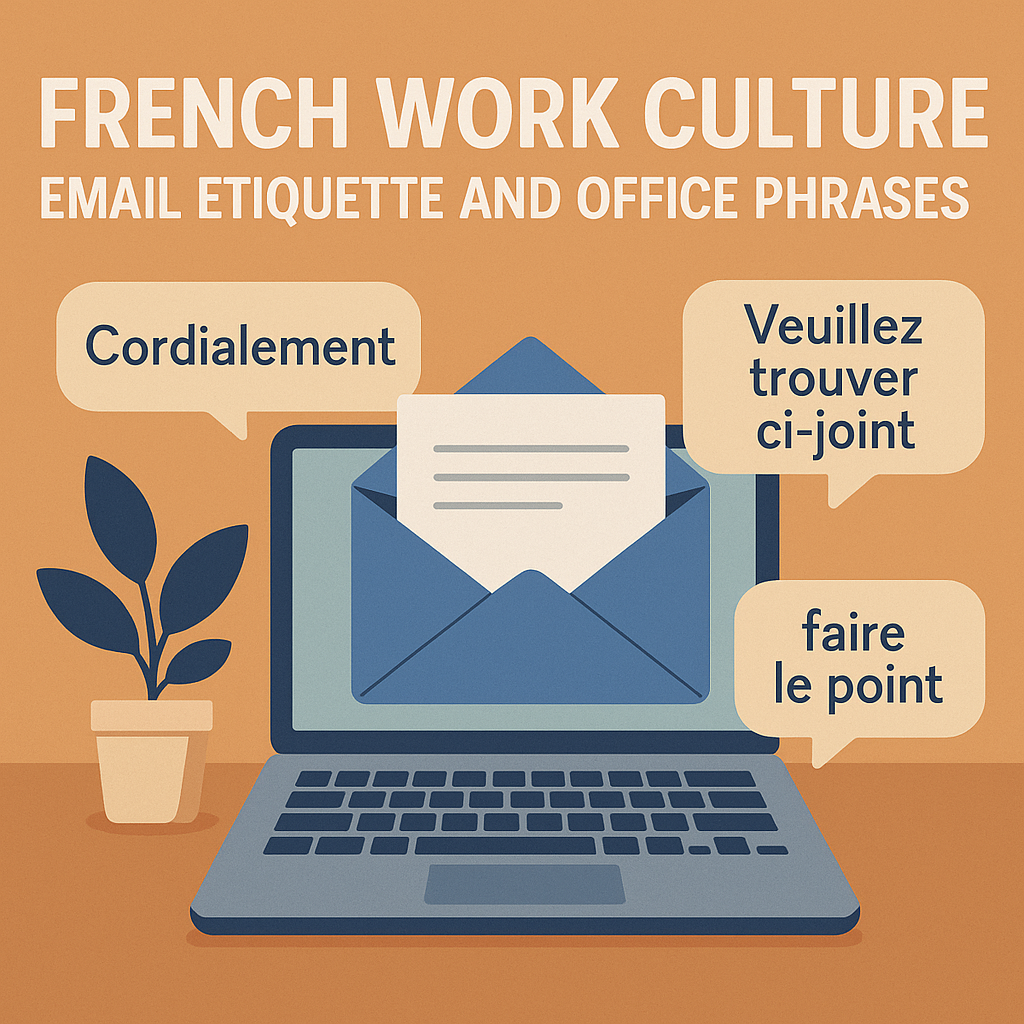
Why French work culture feels so different from American/British workplaces
French workplace culture operates on fundamentally different assumptions than Anglo-American business culture. What Americans consider “efficient” and “direct,” French people perceive as “rude” and “aggressive.” What French people consider “appropriately formal,” Americans find “cold” and “unnecessarily rigid.”
🇺🇸 Politeness at work isn’t optional in France, it’s a professional requirement
These aren’t superficial differences in style – they reflect deep cultural values about hierarchy, formality, work-life boundaries, and professional relationships. Understanding these differences isn’t just about avoiding embarrassment; it’s essential for professional success in French workplaces.
Roger learned these nuances through direct experience working in France after moving there in 2012. His business French lessons specifically address workplace communication because textbooks teach grammar but ignore the critical cultural context that determines whether your French is professionally appropriate or inadvertently offensive.
French email etiquette – the essential rules
Email structure: The mandatory components
Every professional French email follows a strict structure. Missing components mark you as unprofessional or foreign:
1. Formal greeting (ALWAYS required):
🇺🇸 Dear Sir/Madam, (when gender unknown)
🇺🇸 Dear Madam, (for women)
🇺🇸 Dear Sir, (for men)
🇺🇸 Hello Mrs. Dupont, (slightly less formal but still professional)
2. Context sentence (polite buffer before main point):
🇺🇸 Following our phone conversation,
🇺🇸 As agreed during our meeting,
🇺🇸 In reference to your email of November 15,
3. Purpose statement (NOT direct request immediately):
🇺🇸 I’m taking the liberty of contacting you in order to…
🇺🇸 I’m writing to inform you that…
🇺🇸 I would like to obtain information regarding…
4. Main content with polite phrasing:
🇺🇸 Could you send me the file?
🇺🇸 Would you be available for a meeting Thursday?
5. Anticipatory thanks (BEFORE receiving what you asked for):
🇺🇸 Thank you in advance for your response
🇺🇸 Thanking you for the attention you will give to my request
6. Formal closing phrase (MANDATORY – never skip this):
🇺🇸 Please accept, Madam, Sir, the expression of my distinguished greetings (very formal, official letters)
🇺🇸 Cordially, (standard professional email closing – most common)
🇺🇸 Best regards, (warmer than “Cordialement” but still professional)
🇺🇸 Respectfully, (to superiors or very formal contexts)
⚠️ NEVER use these American email habits in French professional emails:
- ❌ “Hey” or “Hi” – shockingly informal and rude in French business context
- ❌ “Dear John” with first name only – too intimate unless you’re very close colleagues
- ❌ Jumping directly to request without context – perceived as aggressive and rude
- ❌ “Thanks” or “Thx” – too casual for professional French emails
- ❌ “Sincerely” (Sincèrement) – sounds odd in French, not used for business emails
- ❌ “Best” or “Cheers” – way too casual for French workplace
- ❌ Ending without formal closing phrase – considered extremely rude
🇺🇸 This would be perceived as shockingly rude in French professional context
🇺🇸 ✅ Hello Mr. Dubois, Following our exchange, could you send me the report? Thank you in advance. Cordially,
💡 Roger’s simple email formula that works 90% of the time:
Structure:
- Greeting: Bonjour [Title + Last Name],
- Context: Suite à [situation]
- Purpose: Je vous écris pour [purpose]
- Details: [Specific information or request with conditional phrasing]
- Thanks: Je vous remercie par avance
- Closing: Cordialement,
- Signature: [Your name]
Roger teaches this structure in his business French modules because it handles 90% of professional email situations appropriately. Once you master this formula, you can adapt for specific contexts.
Book a €9 trial lesson to learn professional French email writing with feedback on your actual work emails.
Tu vs Vous in the workplace – navigating the minefield
The cardinal rule: ALWAYS start with “vous”
In French workplaces, you ALWAYS use “vous” (formal you) with everyone initially – colleagues, bosses, subordinates, clients. Using “tu” (informal you) without invitation is a serious social mistake that marks you as unprofessional or culturally clueless.
🇺🇸 When in doubt, always use “vous” in professional context
When you CAN switch to “tu”:
- The other person explicitly proposes it: “On peut se tutoyer ?” (Can we use tu?)
- After they start using “tu” with you first (and you’re of similar or lower rank)
- After working together closely for months/years AND the other person initiates
- In very informal startup/tech environments where “tu” is company culture (but still wait for confirmation)
When you NEVER switch to “tu” without invitation:
- With bosses or superiors (they must initiate)
- With clients or customers (almost always “vous” regardless of relationship length)
- With older colleagues (respect hierarchy and age)
- In traditional corporate environments (law firms, banks, government)
- When uncertain
🇺🇸 Hello, can I ask you a question? (correct with colleague you don’t know well)
🇺🇸 ❌ Hey, can I ask you something? (too informal for workplace unless tu is established)
⚠️ Common American mistake: Assuming informality equals friendliness
Americans often use first names and informal language quickly to seem “friendly” and “approachable.” In French culture, this comes across as:
- Disrespectful of professional boundaries
- Socially tone-deaf
- Inappropriately presumptuous
- Lacking professionalism
French workplace friendliness shows through helpfulness, competence, and respectful formality – NOT through premature informality.
Roger explains these nuanced cultural differences in his business French lessons because they’re invisible to textbooks but critical for workplace success.
Essential French office phrases for daily situations
Arriving and greeting colleagues
🇺🇸 Hello! How are you? (formal greeting for colleagues)
🇺🇸 Hello, how are you? (slightly less formal but still professional)
🇺🇸 Hello everyone! (entering a room with multiple people)
🇺🇸 Have a good day!
🇺🇸 Have a good weekend! (Friday departures)
🇺🇸 Have a good vacation! (when someone is leaving for vacation)
Cultural note: In France, you’re expected to greet EVERYONE when arriving at work – not just your immediate team. Walking past colleagues without saying “Bonjour” is considered rude. In open offices, a general “Bonjour à tous !” works.
Making requests politely
🇺🇸 Could you help me with this file?
🇺🇸 Would you have a moment to discuss it?
🇺🇸 Would it be possible to postpone the meeting?
🇺🇸 I was wondering if you could review my email
🇺🇸 Would it bother you to send me the document?
Key pattern: French professional requests use conditional tense + interrogative form to sound polite. Direct requests without this structure sound demanding and rude.
Phone phrases – professional calls
🇺🇸 Hello, [Your Name] speaking
🇺🇸 I would like to speak with Mr. Dupont, please
🇺🇸 What is it regarding?
🇺🇸 Hold on, I’ll put you through to him
🇺🇸 He/She is in a meeting at the moment
🇺🇸 Can I take a message?
🇺🇸 Could you ask him/her to call me back?
🇺🇸 Thank you, have a good day
Meeting phrases – participation and discussion
🇺🇸 If I may… (polite way to interject)
🇺🇸 I’d like to add something
🇺🇸 I agree with your proposal
🇺🇸 I understand your point of view, however… (polite disagreement)
🇺🇸 Could we review/update on this matter?
🇺🇸 What do you think?
🇺🇸 I suggest we organize a follow-up meeting
🇺🇸 Can you summarize the main points?
French workplace cultural norms that confuse foreigners
The sacred lunch break (1-2 hours)
French workplace culture treats lunch as serious downtime, not just refueling. Typical lunch breaks last 1-2 hours, and eating at your desk is often frowned upon.
🇺🇸 We don’t eat at our desk in France
What this means for you:
- Don’t schedule meetings from 12:00-14:00 (noon-2pm)
- Don’t expect quick email responses during lunch hours
- Accept invitations to lunch with colleagues (important for relationship building)
- Don’t bring lunch to eat at your desk unless absolutely necessary
🇺🇸 Shall we have lunch together? (common colleague invitation)
August = vacation month
Most French professionals take 2-4 weeks vacation in August. Many businesses operate at minimal capacity or close entirely.
🇺🇸 I’ll be on vacation from August 1-31
What this means for you:
- Don’t plan important projects or deadlines in August
- Don’t be surprised when French colleagues are unreachable for weeks
- Plan your own vacation around this cultural norm
- Set up out-of-office messages (message d’absence) during vacation
🇺🇸 I’ll be out of the office. In case of emergency, contact [colleague name] (standard out-of-office message)
Work-life boundaries are STRICT
French culture maintains clear separation between professional and personal life. After-work socializing is less common than in Anglo-American cultures.
🇺🇸 We don’t mix professional and personal life
What this means for you:
- Don’t expect to become close friends with all colleagues
- Don’t ask overly personal questions (salary, relationship status, etc.)
- Don’t send work emails or messages after 19:00 (7pm) or weekends
- Respect that colleagues may decline social invitations without offense intended
Hierarchy matters more than you think
French workplace culture is more hierarchical than Anglo-American cultures. Age, position, and education level create formal structure that affects all communication.
🇺🇸 You must respect hierarchy in the company
What this means for you:
- Address superiors formally unless they explicitly invite informality
- Don’t bypass hierarchy by going directly to higher-ups
- Respect that junior employees typically speak less in meetings
- Understand that decisions flow top-down more than in flat US structures
⚠️ The “droit de retrait” and French labor law
French workplace culture is shaped by strong labor protections that don’t exist in Anglo-American countries:
- 35-hour work week is standard (not 40+)
- 5 weeks minimum vacation by law (not 2 weeks)
- Strict overtime rules and compensation
- Strong union presence in many industries
- Difficult to fire employees compared to at-will employment
Understanding these legal contexts helps explain why French colleagues may seem less “flexible” about working late, responding to weekend emails, or taking on additional responsibilities without clear compensation.
Common professional expressions you’ll hear daily
Time and scheduling
🇺🇸 Let’s set a date for our meeting
🇺🇸 I suggest November 15 at 2pm
🇺🇸 That works perfectly for me
🇺🇸 Unfortunately, I’m not available that day
🇺🇸 Could we postpone to next week?
🇺🇸 I confirm my attendance
🇺🇸 I’ll be absent for personal reasons
Project and task management
🇺🇸 Where are you at with this project?
🇺🇸 I’m making good progress on the file
🇺🇸 I’ve fallen behind because of…
🇺🇸 What’s the deadline for this project?
🇺🇸 It’s urgent / It’s a priority
🇺🇸 I’ll take care of it immediately
🇺🇸 Can you follow up on this task?
Study glossary – Essential workplace vocabulary
| FR | EN | Usage Context |
|---|---|---|
| Un collègue / Une collègue | A colleague / A coworker | Mes collègues sont sympathiques |
| Le/La responsable | The manager / The supervisor | Je dois parler à mon responsable |
| Le supérieur hiérarchique | The direct superior | Mon supérieur hiérarchique |
| Une réunion | A meeting | J’ai une réunion à 14h |
| Un dossier | A file / A project | Je travaille sur ce dossier |
| Un compte-rendu | A report / Minutes (of meeting) | Envoyer le compte-rendu |
| Un délai | A deadline | Respecter les délais |
| Les congés | Vacation / Time off | Je prends mes congés en août |
| Un entretien | An interview / A meeting | J’ai un entretien annuel |
| Le télétravail | Remote work / Telework | Je fais du télétravail le vendredi |
| Cordialement | Cordially / Regards | Email closing formula |
| Suite à | Following / Further to | Suite à notre conversation |
Master French workplace communication with Roger
French workplace culture isn’t just about vocabulary – it’s about understanding the unspoken social codes, hierarchy signals, formality levels, and cultural expectations that textbooks never teach. Roger’s experience learning French as an adult and working in French professional environments gives him unique insight into what confuses English speakers about French workplace culture.
🇺🇸 Understanding French business culture is as important as speaking French
In his business French lessons, Roger teaches not just language but cultural context:
- How to write professional French emails that sound natural, not translated
- When to use “tu” vs “vous” in complex workplace hierarchies
- How to navigate French meeting culture and contribute appropriately
- What French colleagues really mean by certain phrases (reading between the lines)
- How to maintain professional relationships while respecting French boundaries
Roger reviews your actual work emails, provides corrections with cultural context, and helps you develop natural professional French that respects French workplace norms. The €9 trial lesson lets you experience this practical, culturally-informed approach to business French.