French Train Vocabulary: Everything You Need to Navigate SNCF Stations
You’re standing in a French train station staring at departure boards you can’t read, hearing announcements you don’t understand, and watching your train leave without you. French train travel doesn’t have to be stressful. This complete guide covers essential SNCF vocabulary, station navigation, ticket purchasing, understanding announcements, and handling common situations so you can travel France’s excellent rail network with confidence.
Why French train vocabulary is essential for traveling France
France has one of Europe’s best rail networks. The SNCF (Société Nationale des Chemins de fer Français) connects every major city and hundreds of smaller towns with fast, efficient trains. TGV high-speed trains reach 320 km/h. Regional TER trains serve local routes. Intercités connect medium cities. The system works beautifully once you understand it.
But here’s the problem: SNCF assumes you speak French. Announcements are primarily in French. Signs use French abbreviations. Ticket machines default to French. Staff at smaller stations may not speak English. Without basic train vocabulary, you’re navigating blind.
Most French textbooks are written by native speakers who’ve forgotten what confuses beginners. They explain grammar assuming you already think like a French person.
Roger learned French as an adult after growing up with English and German. He remembers exactly which explanations clicked and which ones left him confused. The FrenchToEnglish approach was built from those memories, including the specific vocabulary that helped him navigate French train stations independently for the first time.
What makes train vocabulary different
Train vocabulary is specialized. You won’t learn these terms in standard French courses, but they appear constantly in stations:
🇺🇸 EN — The platform
🇺🇸 EN — The connection
🇺🇸 EN — To validate (a ticket)
Train announcements use formal, rapid French with station-specific abbreviations. Understanding the difference between these two phrases prevents you from boarding the wrong train:
🇺🇸 EN — The train headed to Lyon
🇺🇸 EN — The train coming from Lyon
The stress of missing critical information
You’re waiting on platform 7. An announcement plays. Everyone suddenly moves to platform 12. You missed the platform change announcement. Your train leaves without you.
Or you buy a ticket but don’t validate it in the yellow machine. The conductor fines you €50 even though you paid. Nobody explained validation.
These situations happen constantly to English speakers. Not because French trains are complicated – because nobody taught you the essential vocabulary and procedures.
Essential station vocabulary – navigating the gare
French stations follow consistent layouts. Learn these key areas and you’ll navigate any French station confidently.
Main station areas and their French names
Critical locations you need to identify immediately:
🇺🇸 EN — The main hall (central area with departure boards, information desk, ticket machines)
🇺🇸 EN — The ticket counters (where staff sell tickets and answer questions)
🇺🇸 EN — The platforms (where trains arrive and depart, numbered 1, 2, 3, etc.)
🇺🇸 EN — The waiting room (indoor seating area before platforms)
🇺🇸 EN — The restrooms (usually marked WC, often require payment)
🇺🇸 EN — The luggage storage (lockers for storing bags, not available at all stations)
🇺🇸 EN — The exit (way out of station, multiple exits in large stations)
🇺🇸 EN — The platform access (entrance to platform area, may require ticket validation)
What you’ll find: Most major stations follow this layout. Signs use these exact terms. Learning them once helps everywhere.
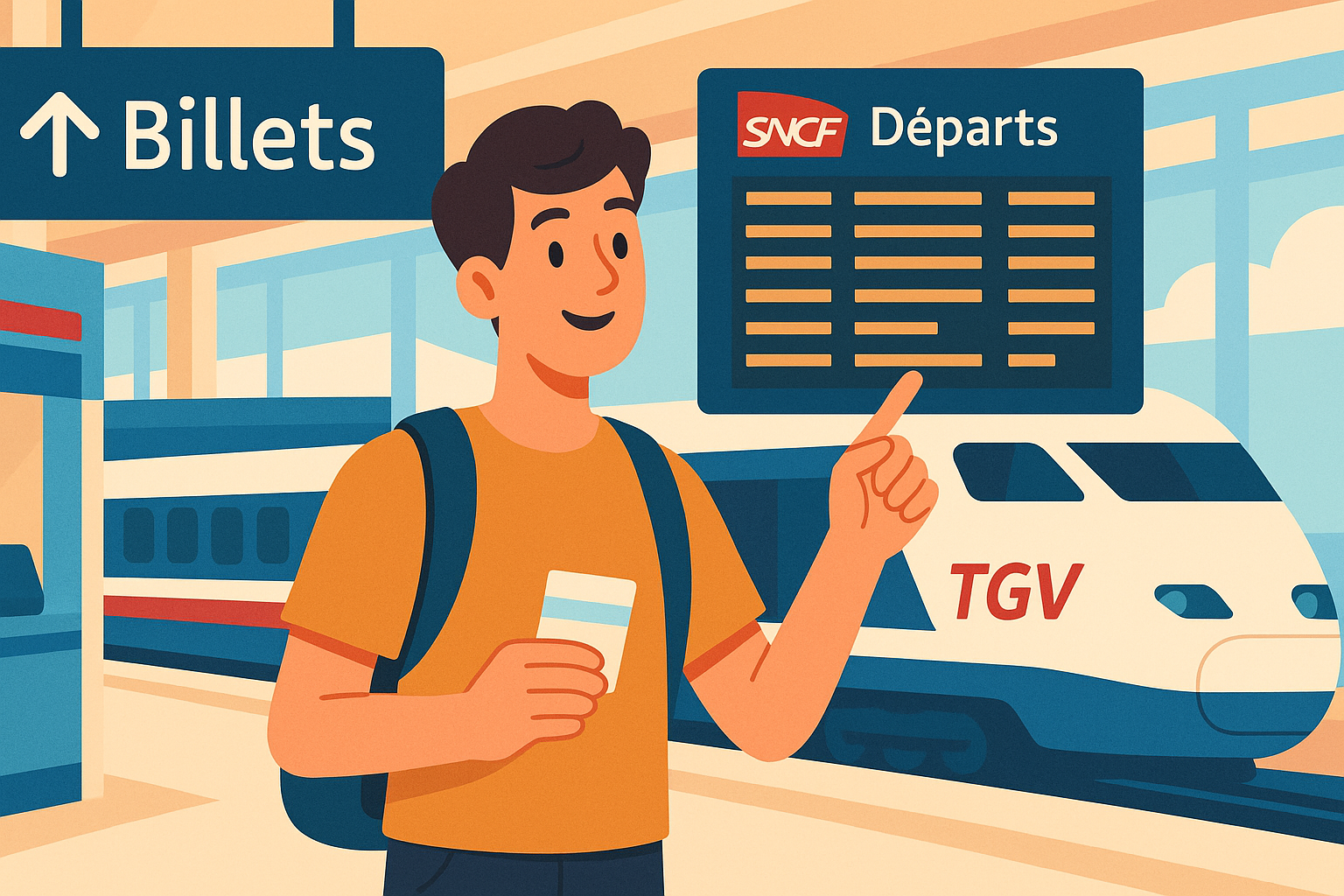
Reading departure boards – le tableau des départs
How to decode French departure information:
French departure boards display critical information in standard format:
🇺🇸 EN — Time (departure time in 24-hour format: 14:35 = 2:35 PM)
🇺🇸 EN — Destination (final stop of the train)
🇺🇸 EN — Train (train type and number: TGV 9542, TER 17254)
🇺🇸 EN — Track/Platform (platform number where train departs)
🇺🇸 EN — Delay (delay time if train is late)
🇺🇸 EN — Canceled (train canceled, won’t run)
🇺🇸 EN — On time (train running on schedule)
Critical detail: Platform numbers often appear 20 minutes before departure. Don’t panic if you see a dash (−) instead of a number early.
Ticket machines – les bornes
What you need to know: Ticket machines have English option but knowing French terms helps navigate faster.
Key machine vocabulary:
🇺🇸 EN — One-way
🇺🇸 EN — Round-trip
🇺🇸 EN — Credit card
🇺🇸 EN — Confirm
🇺🇸 EN — Cancel
Information desk – le bureau d’information
When to use it: For complex questions, missed connections, or ticket problems.
Essential phrases:
🇺🇸 EN — I need help
🇺🇸 EN — Where is…?
🇺🇸 EN — What time…?
💡 Station navigation pro tips:
- Download SNCF app before traveling – Shows real-time platform changes, delays in English
- Arrive 20 minutes early for domestic trains – 40 minutes for international Thalys/Eurostar
- Look for “Voie” signs with arrows – Yellow signs direct you to correct platform
- Major stations have multiple levels – Paris Gare de Lyon has platforms on 3 different levels
Buying tickets – essential dialogue vocabulary
Ticket purchasing conversations follow predictable patterns. Learn these phrases and you’ll handle most ticket counter interactions confidently.
Standard ticket purchase dialogue
The basic exchange you’ll use constantly:
You:
🇺🇸 EN — Hello. I would like a ticket to Lyon, please.
Agent:
🇺🇸 EN — One-way or round-trip?
You:
🇺🇸 EN — Round-trip.
Agent:
🇺🇸 EN — For what date?
You:
🇺🇸 EN — Today, around 2 PM.
Agent:
🇺🇸 EN — First or second class?
You:
🇺🇸 EN — Second class.
What you’ll learn: This dialogue repeats at every ticket counter. Memorize these exact phrases for smooth transactions.
Ticket types and classes
🇺🇸 EN — A one-way ticket
🇺🇸 EN — A round-trip ticket
🇺🇸 EN — First class
🇺🇸 EN — Second class
🇺🇸 EN — A seat
🇺🇸 EN — A window seat
🇺🇸 EN — An aisle seat
Special fare requests
🇺🇸 EN — Is there a discount?
🇺🇸 EN — Youth fare (under 26)
🇺🇸 EN — Senior fare (over 60)
🇺🇸 EN — Discount card
🇺🇸 EN — Exchangeable ticket
🇺🇸 EN — Non-refundable ticket
Understanding ticket pricing and restrictions
SNCF pricing confuses everyone, French people included. Here’s what you need to know about fare types:
🇺🇸 EN — Full fare (flexible ticket, can change/cancel, most expensive)
🇺🇸 EN — Leisure fare (cheaper, some restrictions on changes)
🇺🇸 EN — Advance purchase (cheapest, non-refundable, specific train only)
The earlier you book, the cheaper PREM’S tickets cost. But you’re locked to that specific train. Miss it and you buy a new ticket at full price.
Asking about connections and journey details
When your journey requires connections, you need additional vocabulary:
🇺🇸 EN — Is there a connection?
🇺🇸 EN — How much time for the connection?
🇺🇸 EN — Do I need to change stations?
🇺🇸 EN — Is the train direct?
🇺🇸 EN — How long is the journey?
🇺🇸 EN — What time do I arrive?
⚠️ Connection time confusion
French connections can be tight. If your ticket shows an 8-minute connection, you need to move fast. Large stations like Paris Montparnasse require 10+ minutes just to walk between platforms. Always ask:
🇺🇸 EN — Is that enough?
Understanding train announcements – les annonces
Train announcements follow standard formulas. Once you know the patterns, you’ll understand even rapid French announcements.
Standard departure announcement structure
The formula SNCF uses everywhere:
🇺🇸 EN — The TGV train number 8542 headed to Marseille Saint-Charles will depart from platform 7.
Breaking it down – key phrases:
🇺🇸 EN — The train (always starts announcements)
🇺🇸 EN — Headed to (indicates final destination)
🇺🇸 EN — Will depart (future tense departure)
🇺🇸 EN — From platform [number]
Why this matters: Every French station uses this exact formula. Learn it once, understand announcements everywhere.
Arrival announcements – trains coming in
Different formula for arriving trains:
🇺🇸 EN — The train coming from Paris Gare de Lyon is entering the station, platform 3.
Key phrases:
🇺🇸 EN — Coming from (origin station)
🇺🇸 EN — Entering the station (train arriving now)
🇺🇸 EN — Is at the platform (train has arrived, ready to board)
Delay announcements
When trains run late:
🇺🇸 EN — The train has a 15-minute delay
🇺🇸 EN — Undetermined delay
🇺🇸 EN — Modified departure time
Platform changes
Critical announcements you cannot miss:
🇺🇸 EN — Platform change
🇺🇸 EN — The train will depart from platform 12 instead of platform 7
💡 Catching announcements you missed:
- Watch other passengers – If everyone suddenly moves, follow them
- Check departure boards constantly – They update with platform changes
- Ask nearby passengers – Use this phrase:
🇺🇸 EN — Excuse me, which platform for Lyon?
- Staff wear red SNCF vests – They can clarify any announcement you missed
On the train – essential onboard vocabulary
Once you’re on the train, different vocabulary comes into play. Here’s what you need for smooth travel.
Finding your seat and handling reservations
Reading French seat reservations:
Your ticket shows:
🇺🇸 EN — Car 12, Seat 45, Window side
Key seat vocabulary:
🇺🇸 EN — The car (train car number, written on car exterior and above doors)
🇺🇸 EN — The seat (seat number, on small placard above seat)
🇺🇸 EN — Reserved (digital display or paper slip shows reservation)
🇺🇸 EN — Available (seat not reserved, free to sit)
🇺🇸 EN — Facing forward (direction train travels)
🇺🇸 EN — Facing backward (facing opposite direction)
What confuses English speakers: French trains number seats differently than US trains. Small digital displays above seats show if reserved. If display shows your origin/destination, that’s your seat.
Asking about seats
🇺🇸 EN — Excuse me, is this seat free?
🇺🇸 EN — I think this is my seat
🇺🇸 EN — Where is car 12?
🇺🇸 EN — Which direction is it?
Conductor interactions and ticket validation
The conductor checks tickets during journey. Here’s what to expect:
Standard conductor exchange:
Conductor:
🇺🇸 EN — Hello, tickets please
You:
🇺🇸 EN — Here you go [hand over ticket]
Conductor:
🇺🇸 EN — Thank you, good journey
⚠️ The validation trap that costs tourists €50
Some tickets require validation before boarding. Look for yellow machines at platform entrance. Insert ticket, it stamps date/time. If you board without validating when required, conductors fine you even with valid ticket. TGV and reserved tickets don’t need validation. Regional TER tickets without reservations DO need validation. When in doubt, ask station staff:
🇺🇸 EN — Do I need to validate?
Onboard services and facilities
French trains offer various amenities. Here’s how to find and use them:
Bar car
🇺🇸 EN — The bar car
What’s available:
🇺🇸 EN — A coffee
🇺🇸 EN — A sandwich
🇺🇸 EN — Water
🇺🇸 EN — A beer
Asking location:
🇺🇸 EN — Where is the bar car?
Restrooms
🇺🇸 EN — The restrooms
Signs to look for:
🇺🇸 EN — Available (green light)
🇺🇸 EN — Occupied (red light)
Important: Don’t use toilets when train is stopped at stations – locks automatically.
Common train travel problems and how to solve them
Even with perfect French, train problems happen. Here’s how to handle common situations.
⚠️ Problem 1: You missed your train
Go immediately to ticket counter or information desk. Say:
🇺🇸 EN — I missed my train
If you have flexible ticket, they’ll put you on next train free. If you have PREM’S ticket, you must buy new ticket at full price. Always check ticket exchange policies when purchasing.
⚠️ Problem 2: Your train is canceled
Cancellation announcement:
🇺🇸 EN — The train is canceled
Go to ticket counter. They’ll rebook you on next available train automatically. You don’t pay extra even with cheap tickets. French law requires SNCF to get you to destination if they cancel.
⚠️ Problem 3: You’re on the wrong train
Tell conductor immediately:
🇺🇸 EN — I took the wrong train
They’ll tell you where to get off and how to correct your journey. Usually no penalty if you explain honestly before they ask for ticket.
⚠️ Problem 4: You need to change your ticket
Go to ticket counter before your train departs. Say:
🇺🇸 EN — I would like to change my ticket
Fees depend on ticket type. Full-fare tickets change free up to departure time. Discount tickets have fees or can’t change at all.
Study glossary – French train vocabulary
| FR | EN | Usage Context |
|---|---|---|
| La gare | The train station | Je vais à la gare |
| Le quai | The platform | Le train part du quai 7 |
| Le guichet | The ticket counter | Achetez votre billet au guichet |
| La voie | The track | Changement de voie annoncé |
| Le billet | The ticket | Montrez votre billet au contrôleur |
| La correspondance | The connection | J’ai une correspondance à Lyon |
| Le retard | The delay | Le train a 20 minutes de retard |
| Composter | To validate | N’oubliez pas de composter votre billet |
| La voiture | The train car | Votre place est en voiture 12 |
| Le contrôleur | The conductor | Le contrôleur vérifie les billets |
| À destination de | Headed to | Le train à destination de Paris |
| En provenance de | Coming from | Le train en provenance de Lyon |
Your action plan for confident French train travel
These techniques work, but they work faster with structured learning designed for English speakers. Roger’s approach teaches you how to rewire your English-speaking brain for French patterns.
Here’s your preparation plan before your first French train journey:
Week 1-2: Master basic station vocabulary. Practice saying the key location terms until automatic. Download SNCF app and explore interface in English to understand layout before switching to French.
Week 3-4: Practice ticket purchase dialogue out loud. Record yourself saying the full conversation. Listen back. Compare pronunciation to Google Translate audio.
Month 2: Study announcement patterns. Watch YouTube videos of French train stations. Practice identifying the key phrases in real announcements. This distinction prevents wrong train boarding.
Before traveling: Write key phrases on phone notes. Having written backup reduces stress when speaking feels overwhelming.
The goal isn’t perfect French. The goal is functional communication that gets you from A to B confidently. Most SNCF staff appreciate any effort to speak French, even imperfect attempts.
French trains are efficient, comfortable, and connect incredible destinations. Don’t let language anxiety keep you from experiencing France’s excellent rail network. Start with one journey. Use the phrases from this guide. Each trip builds confidence.
Buy your first ticket in French. Board your train. Arrive at your destination. That’s how you become a confident French train traveler.