French Political Vocabulary: Understanding Elections and Government
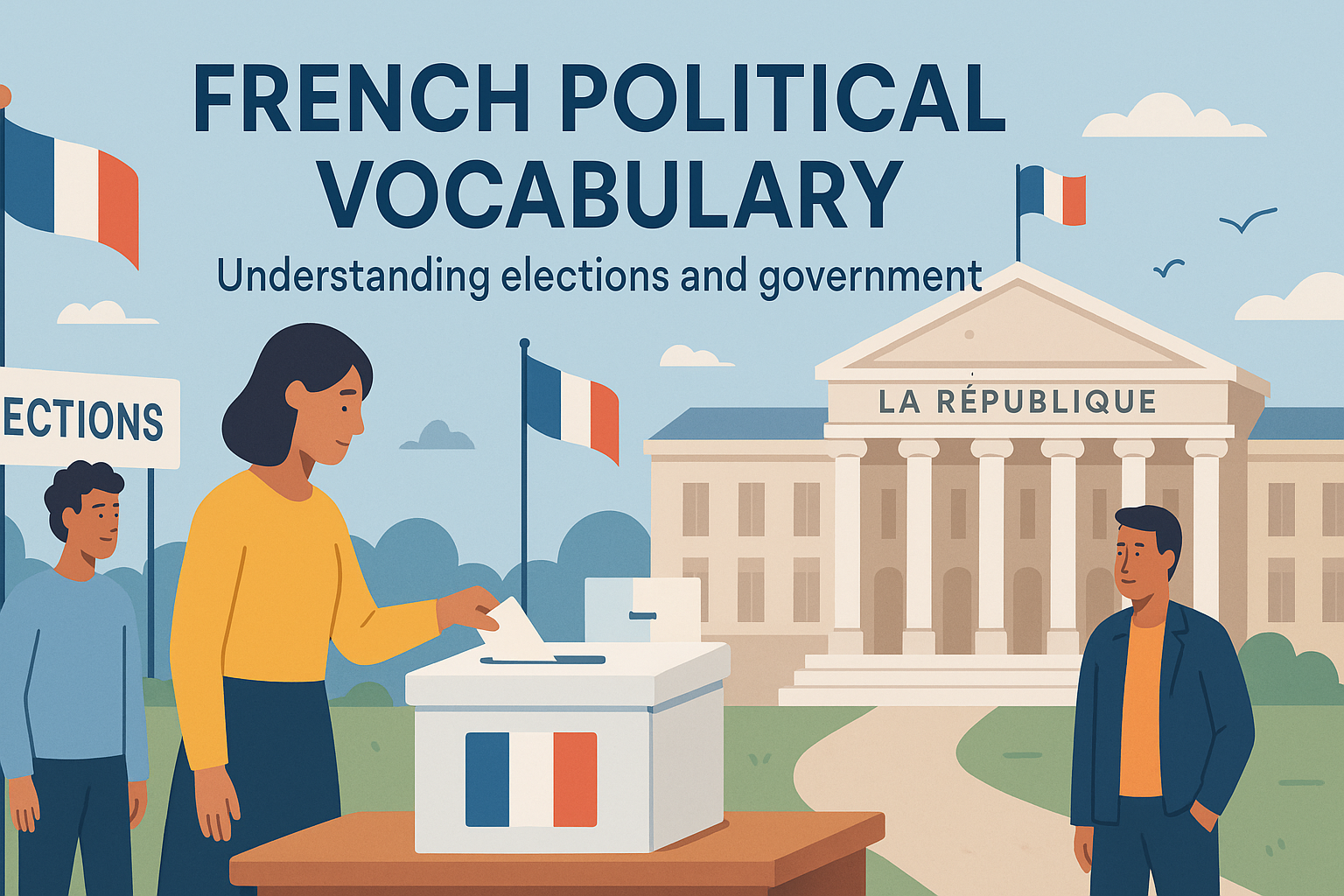
You’re watching French news about upcoming elections, trying to follow political debates, or discussing current events with French speakers, but you’re lost because French political vocabulary differs fundamentally from American or British terms with unique institutions like “l’Assemblée nationale,” “le Premier ministre” who isn’t the president, “la cohabitation” which has no English equivalent, and a political spectrum that doesn’t map onto left-right divisions you know, leaving you unable to understand news headlines, follow electoral coverage, or participate in the political conversations that dominate French social discourse. This complete guide covers essential French political vocabulary from government structure and institutions to electoral processes, political parties across the spectrum, legislative procedures, voting terminology, and current affairs expressions that enable you to follow French news intelligently, understand what differentiates French democracy from Anglo-Saxon systems, and discuss politics with the sophistication French culture expects from educated adults.
Why French political vocabulary is essential
Politics dominates French conversation in ways Americans find surprising. French people discuss politics at dinner parties, cafés, family gatherings. Avoiding political topics is seen as shallow or disengaged, not polite.
French news is heavily political. Major newspapers lead with political analysis. Prime-time TV features political debates. Radio stations dedicate hours to political discussion. Without political vocabulary, you can’t follow French media.
The French political system also differs structurally from American and British systems. Direct translation of political terms creates confusion. Understanding French politics requires learning French political vocabulary in its own context, not through English equivalents.
Most French textbooks are written by native speakers who’ve forgotten what confuses beginners. They explain grammar assuming you already think like a French person.
Roger learned French as an adult after growing up with English and German. He remembers exactly which explanations clicked and which ones left him confused. The FrenchToEnglish approach was built from those memories, including mastering the political vocabulary essential for understanding French news, following electoral campaigns, and participating in the political discussions that are central to French intellectual life.
French government structure – Les institutions françaises
The executive branch – Le pouvoir exécutif
🇺🇸 EN — The President of the Republic
Role: Head of state, commander-in-chief, elected directly by citizens for 5-year term (un quinquennat). Most powerful position in French government.
🇺🇸 EN — The Prime Minister
Role: Head of government, appointed by President, oversees day-to-day government operations. NOT elected directly by citizens.
🇺🇸 EN — The government / cabinet
🇺🇸 EN — A minister (male/female)
🇺🇸 EN — The Interior Minister (equivalent to Home Secretary)
🇺🇸 EN — The Foreign Affairs Minister
🇺🇸 EN — The Economy Minister
Key difference from US/UK: France has both a President AND a Prime Minister. The President is more powerful, but the PM handles parliamentary relations and domestic policy implementation.
The legislative branch – Le pouvoir législatif
🇺🇸 EN — The Parliament
Composition: Two chambers (bicameral system)
🇺🇸 EN — The National Assembly (lower house)
Details: 577 députés (members of parliament) elected directly by citizens for 5-year terms. More powerful than the Senate.
🇺🇸 EN — A deputy / member of parliament (MP)
🇺🇸 EN — The Senate (upper house)
Details: 348 sénateurs (senators) elected indirectly by local officials for 6-year terms. Reviews and amends legislation but Assemblée nationale has final say on most matters.
🇺🇸 EN — A senator
🇺🇸 EN — The Bourbon Palace (where Assemblée nationale meets)
🇺🇸 EN — The Luxembourg Palace (where Sénat meets)
Other major institutions
🇺🇸 EN — The Constitutional Council
Role: Reviews constitutionality of laws, oversees elections. Similar to Supreme Court but more limited scope.
🇺🇸 EN — The Council of State
Role: Highest administrative court, advises government on legal matters.
🇺🇸 EN — The Élysée Palace (Presidential residence/office)
🇺🇸 EN — Matignon (Prime Minister’s residence/office)
💡 Understanding “la cohabitation”:
This uniquely French situation occurs when the President and Prime Minister come from opposing political parties. It happened three times in modern French history (1986-88, 1993-95, 1997-2002). During cohabitation, the President focuses on foreign policy while the PM handles domestic affairs, creating power-sharing tensions. No equivalent exists in pure presidential (US) or pure parliamentary (UK) systems.
🇺🇸 EN — Cohabitation (President and PM from opposing parties)
Elections and voting – Les élections et le vote
Types of elections
🇺🇸 EN — The presidential election
Frequency: Every 5 years. Two-round system: if no candidate gets 50%+ in first round, top two compete in second round two weeks later.
🇺🇸 EN — The legislative elections (for Assemblée nationale)
Frequency: Every 5 years, usually shortly after presidential election. Also uses two-round system.
🇺🇸 EN — The senatorial elections
🇺🇸 EN — The municipal elections (for mayors and city councils)
🇺🇸 EN — The regional elections
🇺🇸 EN — The departmental elections
🇺🇸 EN — The European Parliament elections
Voting process and terminology
🇺🇸 EN — To vote
🇺🇸 EN — A voter (male/female)
🇺🇸 EN — The right to vote
🇺🇸 EN — The ballot / voting
🇺🇸 EN — The first round
🇺🇸 EN — The second round / runoff
🇺🇸 EN — The polling station
🇺🇸 EN — The ballot box
🇺🇸 EN — The ballot paper
🇺🇸 EN — The voting booth
🇺🇸 EN — The voter registration card
🇺🇸 EN — To cast a blank ballot (deliberate abstention)
🇺🇸 EN — To abstain / Abstention
🇺🇸 EN — The voter turnout rate
Election results vocabulary
🇺🇸 EN — The results
🇺🇸 EN — To be elected
🇺🇸 EN — To win the election
🇺🇸 EN — To lose the election
🇺🇸 EN — To be in the lead
🇺🇸 EN — To come first in the first round
🇺🇸 EN — To qualify for the second round
🇺🇸 EN — The absolute majority (50%+ of votes)
🇺🇸 EN — The relative majority (most votes but under 50%)
Political parties and spectrum – Les partis politiques
Understanding the French political spectrum
The spectrum runs from extreme left to extreme right, but French politics has more nuance than American two-party system.
🇺🇸 EN — The left / left-wing
🇺🇸 EN — The right / right-wing
🇺🇸 EN — The center
🇺🇸 EN — The far left
🇺🇸 EN — The far right
🇺🇸 EN — A political party
🇺🇸 EN — A political movement
🇺🇸 EN — The coalition
🇺🇸 EN — The opposition
🇺🇸 EN — The (presidential/parliamentary) majority
Major contemporary parties (as of 2024-2025)
Note: French political parties change names, merge, and split frequently. These are major current formations.
Left to right spectrum:
🇺🇸 EN — France Unbowed (far-left populist)
🇺🇸 EN — The Socialist Party (center-left)
🇺🇸 EN — Europe Ecology The Greens (green/left)
🇺🇸 EN — Renaissance (centrist, Macron’s party)
🇺🇸 EN — The Republicans (center-right/conservative)
🇺🇸 EN — The National Rally (far-right, formerly Front National)
Political ideologies and positions
🇺🇸 EN — Socialist
🇺🇸 EN — Liberal (economically liberal, NOT same as American “liberal”)
🇺🇸 EN — Conservative
🇺🇸 EN — Environmentalist / green
🇺🇸 EN — Populist
🇺🇸 EN — Nationalist
🇺🇸 EN — Progressive
⚠️ False friend: “Libéral” in French
In French politics, “libéral” means economically liberal – supporting free markets, privatization, reduced government intervention. This is closer to American “libertarian” or British “classical liberal,” NOT American “liberal” (which would be “de gauche” or “progressiste” in French).
Example confusion: French people might say “Je suis libéral” meaning “I support free-market capitalism,” which would surprise Americans expecting it to mean “socially progressive.”
Legislative process – Le processus législatif
Laws and legislation
🇺🇸 EN — A law
🇺🇸 EN — A bill (proposed by government)
🇺🇸 EN — A bill (proposed by parliament members)
🇺🇸 EN — To pass a law
🇺🇸 EN — To reject a law
🇺🇸 EN — To amend
🇺🇸 EN — An amendment
🇺🇸 EN — To promulgate a law (President signs it into effect)
🇺🇸 EN — To repeal a law
🇺🇸 EN — A decree (executive order)
🇺🇸 EN — An ordinance (executive decree with force of law)
Parliamentary procedures
🇺🇸 EN — A session (parliamentary sitting)
🇺🇸 EN — A parliamentary debate
🇺🇸 EN — Question Time (MPs question ministers)
🇺🇸 EN — A parliamentary committee
🇺🇸 EN — The parliamentary group (party caucus)
🇺🇸 EN — The motion of no confidence
🇺🇸 EN — Article 49.3 (allows PM to pass law without vote, but risks no-confidence motion)
Cultural note: Article 49.3 is controversial but frequently used. It allows government to bypass parliamentary debate, but parliament can respond with motion of censure. Very French solution balancing executive power with parliamentary oversight.
Campaigns and political discourse
Campaign vocabulary
🇺🇸 EN — The electoral campaign
🇺🇸 EN — A candidate
🇺🇸 EN — To run for office / to be a candidate
🇺🇸 EN — A rally
🇺🇸 EN — A televised debate
🇺🇸 EN — A poll
🇺🇸 EN — The electoral platform / manifesto
🇺🇸 EN — An electoral promise / campaign promise
🇺🇸 EN — The slogan
🇺🇸 EN — The campaign poster
Political discourse and debate
🇺🇸 EN — A speech
🇺🇸 EN — To deliver a speech
🇺🇸 EN — To criticize / to attack
🇺🇸 EN — To defend / to support
🇺🇸 EN — To be for / to be against
🇺🇸 EN — A political scandal
🇺🇸 EN — A controversy
🇺🇸 EN — An affair / scandal (as in “l’affaire Dreyfus”)
Current affairs expressions
Following French news
🇺🇸 EN — Current affairs / the news
🇺🇸 EN — The news (TV/radio)
🇺🇸 EN — The TV news
🇺🇸 EN — A political event
🇺🇸 EN — A political crisis
🇺🇸 EN — A cabinet reshuffle
🇺🇸 EN — A demonstration / protest
🇺🇸 EN — A strike
🇺🇸 EN — The unions
🇺🇸 EN — The reforms
Expressing political opinions
🇺🇸 EN — In my opinion
🇺🇸 EN — I think that…
🇺🇸 EN — I agree / I disagree
🇺🇸 EN — That’s debatable
🇺🇸 EN — It’s a complex question
🇺🇸 EN — On one hand… on the other hand…
Study glossary – Essential political vocabulary
| FR | EN | Usage Context |
|---|---|---|
| Le président de la République | The President | Le président a été élu en 2022 |
| Le Premier ministre | The Prime Minister | Le PM dirige le gouvernement |
| L’Assemblée nationale | National Assembly | L’Assemblée vote les lois |
| Un député / Une députée | Member of Parliament | Les députés débattent |
| Voter | To vote | J’ai voté dimanche |
| L’élection | The election | L’élection présidentielle |
| La gauche / La droite | The left / The right | Un parti de gauche |
| Un parti politique | A political party | Les différents partis |
| Le gouvernement | The government | Le gouvernement actuel |
| Une loi | A law | Voter une nouvelle loi |
| Une manifestation | A demonstration | Une grande manifestation |
| Les actualités | Current affairs/news | Suivre les actualités politiques |
Why political vocabulary matters for French fluency
French social life revolves around political discussion in ways that surprise English speakers. Dinner parties include political debates. Café conversations turn political. Family gatherings discuss current affairs. This isn’t considered rude or divisive – it’s expected intellectual engagement.
French news consumption: French people watch news more than Americans. Prime-time political debates draw millions of viewers. Major newspapers are intellectually demanding, assuming readers follow politics closely. Without political vocabulary, you can’t access mainstream French media.
French intellectual tradition: French culture values political engagement as mark of education and sophistication. Claiming you “don’t follow politics” signals disengagement from civic life, not pragmatic neutrality. Political literacy is expected from educated adults.
Living in France: If you live in France, you’ll encounter strikes, demonstrations, political debates constantly. Understanding political vocabulary helps you comprehend why the train is delayed (grève), what demonstrations are about, why certain reforms matter.
French literature and film: Political themes permeate French culture. Understanding films like “Z,” books by Camus or Sartre, or contemporary novels requires political vocabulary and context.
You don’t need to have strong political opinions to need political vocabulary. But you need the vocabulary to follow conversations, understand news, appreciate culture, and participate in the intellectual life that defines French identity.