
French Plus-que-parfait: Formation and Examples
Learn the French plus-que-parfait with avoir and être. Follow earlier past events and compare tenses through translated examples and audio.
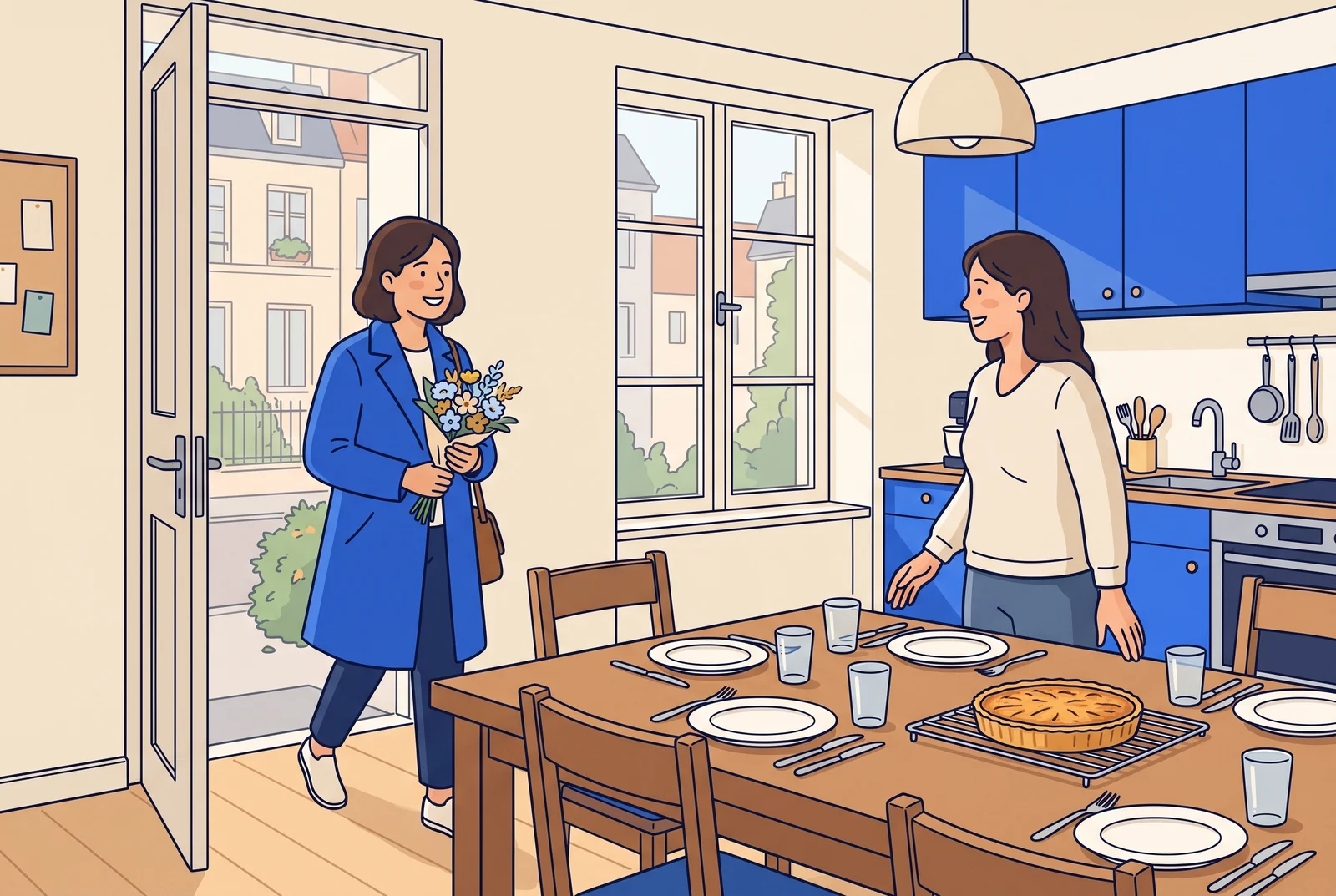
By the end of this lesson: Show what had already happened before another event in a past story.
Start with earlier than what?, then work through the contrasts below. Read each French sentence with its translation, listen, and explain why that form fits. Finish with the optional quiz to check your choices.
Give the earlier event a reference point
The plus-que-parfait needs a past reference point. Establish that event first, then use the earlier tense to explain what had happened before it.
The guest's arrival provides the reference point. Preparing dinner belongs earlier on the timeline.
🇺🇸 When Léa arrived, Paul had already prepared dinner.
The same relationship can describe an event only moments earlier. Calendar distance is irrelevant to the choice.
🇺🇸 The train had left one minute before our arrival.
The past reference point can also be established by the surrounding story rather than a quand clause inside the same sentence.
🇺🇸 The table was ready. We had put the plates outside.
A practical test is to mark two points on paper: the moment being described and the earlier action you are looking back at. Read your sentence from the reference point backwards. If all you have is a list of events presented in order, the passé composé may be sufficient. Adding a plus-que-parfait is useful when the narrative needs that earlier layer, not as a reward for remembering a more complicated tense.
Here the speaker reaches the kitchen and discovers something that had happened before that discovery.
🇺🇸 I went into the kitchen, but someone had eaten the tart.
A completed journey can explain a person's condition at the moment being described.
🇺🇸 She was tired because she had travelled all night.
Underline the past reference point, then circle what came before it. If you cannot explain that relationship, reconsider whether a plus-que-parfait adds anything to the account.
Build it with an imperfect auxiliary
Use avoir or être in the imparfait, followed by a past participle. Choose the same auxiliary that the verb uses in the passé composé.
For a common action using avoir, only the auxiliary changes when moving from a completed past event to an earlier past layer.
🇺🇸 We had booked a table near the window.
The same auxiliary handles a past participle with an irregular shape. Learn the participle as part of the verb's useful forms.
🇺🇸 You had taken the tickets before going out.
An être verb uses the corresponding imperfect form and the usual subject agreement in this example.
🇺🇸 They had arrived before the other guests.
For the masculine plural here, the written past participle carries s. The earlier departure is still the central time relationship.
🇺🇸 The neighbours had left when we rang the bell.
With avoir, the participle does not automatically agree with the subject. A preceding direct object can trigger agreement, which belongs to the broader compound-tense rules. Pronominal verbs require their own analysis too; treating every participle with être as an automatic subject agreement would create errors. This lesson uses clear examples so that the timeline remains visible while you become familiar with the tense.
A negative surrounds the auxiliary. The participle stays after pas rather than moving inside the negative frame.
🇺🇸 I hadn’t received the message before leaving.
An old date does not require the plus-que-parfait. The tense establishes an earlier relationship to another past point. It does not rank events by how historically distant they are.
Keep the background, event and earlier layer distinct
Use the imparfait for background, the passé composé for a completed event, and the plus-que-parfait for an event earlier than the past reference point. They answer different questions in the story.
The rain provides the background while the arrival moves the story forward.
🇺🇸 It was raining when we arrived at the restaurant.
Looking back from that arrival explains why the group had a place waiting for them.
🇺🇸 Fortunately, we had booked a table the day before.
An event narrated next in the sequence can simply return to the passé composé.
🇺🇸 The waiter welcomed us and took us to our table.
If the contrast between background and a completed event is still unstable, review imparfait and passé composé on a timeline first. Then add only one earlier event to the same story. This avoids a common learning trap: trying to manage three new contrasts, irregular participles and unfamiliar vocabulary in the same sentence before any of the pieces feels secure.
An ongoing situation stretching towards a past point can use the imparfait with depuis. English may use a form beginning had been.
🇺🇸 She had been waiting for an hour when the bus arrived.
By contrast, a completed wait can be presented as an earlier event with the plus-que-parfait.
🇺🇸 She had waited an hour before taking a taxi.
The English word had therefore cannot choose the French tense by itself. The duration lesson gives more examples of situations continuing up to a reference point. Check whether the waiting was still happening at the moment being narrated or whether you are looking back at it as a completed part of the sequence. That distinction changes the French account.
Translate the timeline before translating the English auxiliary. “Had been waiting” can correspond to attendait depuis when the waiting continues up to a past reference point.
Place déjà, jamais and pronouns naturally
An object pronoun goes before the auxiliary. Short adverbs such as déjà often go between the auxiliary and participle; a negative surrounds the auxiliary.
The earlier action was complete before the invitation being discussed.
🇺🇸 We had already eaten when she suggested having dinner.
Never describes the speaker's experience before the past moment supplied by the story.
🇺🇸 I had never visited this city before that trip.
For an earlier message to a person, lui comes before the auxiliary. It identifies the recipient.
🇺🇸 I had sent him the address the day before.
Compare that position with placing le, lui and leur. If a sentence has two pronouns, resolve their relationships before inserting the compound tense. The negative construction is equally familiar: the examples in French negatives help distinguish never from not yet and no longer, meanings that remain separate when the story moves into the past.
Not yet describes an action still incomplete at the relevant past moment.
🇺🇸 He hadn’t finished yet when we arrived.
A pronominal verb keeps its reflexive pronoun before the auxiliary. This example has straightforward subject agreement.
🇺🇸 Léa had got up early to prepare the meal.
An earlier conversation can explain a later choice without requiring a date for either event.
🇺🇸 We had discussed the menu before going shopping.
An earlier omission can also remain relevant at the moment of discovery.
🇺🇸 She had forgotten the napkins, so she went back to the kitchen.
Explain a problem without scrambling the story
Explain the result first, then supply the earlier cause. Once the sequence is clear, return to the main story instead of keeping every verb in the plus-que-parfait.
The explanation below moves backwards from finding a locked door to an earlier misunderstanding.
🇺🇸 The door was closed because I had written down the wrong time.
An earlier forgotten item can explain what someone discovered later.
🇺🇸 I looked for my wallet, but I had left it at home.
The tense also appears in past conditions, though the result needs a different form. The full pattern belongs in the lesson on past hypotheses and regrets. Keep that use separate from a straightforward factual narrative: one reports what happened, while the other can imagine a past that did not happen. The same tense can serve both, but the surrounding construction changes the interpretation.
An ordinary factual explanation can mention a confirmed earlier conversation.
🇺🇸 We knew the way because the neighbour had explained it to us.
When reporting someone else's words, you may also need to preserve an earlier event relative to their speaking time. Reported speech and time references develops that additional viewpoint. For now, rehearse your own short account and ask a listener to put the events in order. If their sequence matches yours, the grammar has done its job.
Return to the dinner scene and describe it from the guest's arrival. You can see the plates on the table and the tart on the rack; your sentence supplies the preparation that happened before the door opened.
Useful phrases to keep
| 🇫🇷 French | 🇺🇸 English | 💡 Context |
|---|---|---|
| 🇫🇷 j’avais oublié | I had forgotten | Avoir in the imperfect. |
| 🇫🇷 elle était partie | she had left | Être auxiliary. |
| 🇫🇷 nous avions réservé | we had booked | Earlier completed preparation. |
| 🇫🇷 la veille | the day before | Relative to the narrative point. |
| 🇫🇷 pas encore terminé | not finished yet | Incomplete at the relevant moment. |
| 🇫🇷 déjà préparé | already prepared | A completed earlier action. |
Read and listen to the French Briefing →
Use your French in a real conversation.
Bring a question from a guide to a French tutor. Try it aloud, ask for feedback and leave with something to practise.
Find a French tutor →Paid lessons. Compare tutors and prices before booking.
Affiliate link: we may earn a commission when you book.
📚 Keep building in the Learning Center
French Reflexive Verbs: Daily Routine and Word Order
Build a daily routine in French with reflexive pronouns, negatives and infinitives. Compare translated examples, listen and practise.
Read →French Nominalisation: Examples and Clear Writing
Turn French verbs into nouns without hiding the actor or losing the time reference. Compare examples and practise…
Read →Bien Que vs Même Si: Concession in French
Compare bien que, même si, pourtant and certes… mais. Learn mood choices and how to qualify an argument…
Read →