
French Emphasis: C’est, Ce Qui and Ce Que
Use French emphasis to highlight the right information. Compare c’est, ce qui and ce que, detached topics and meaning changes with examples.
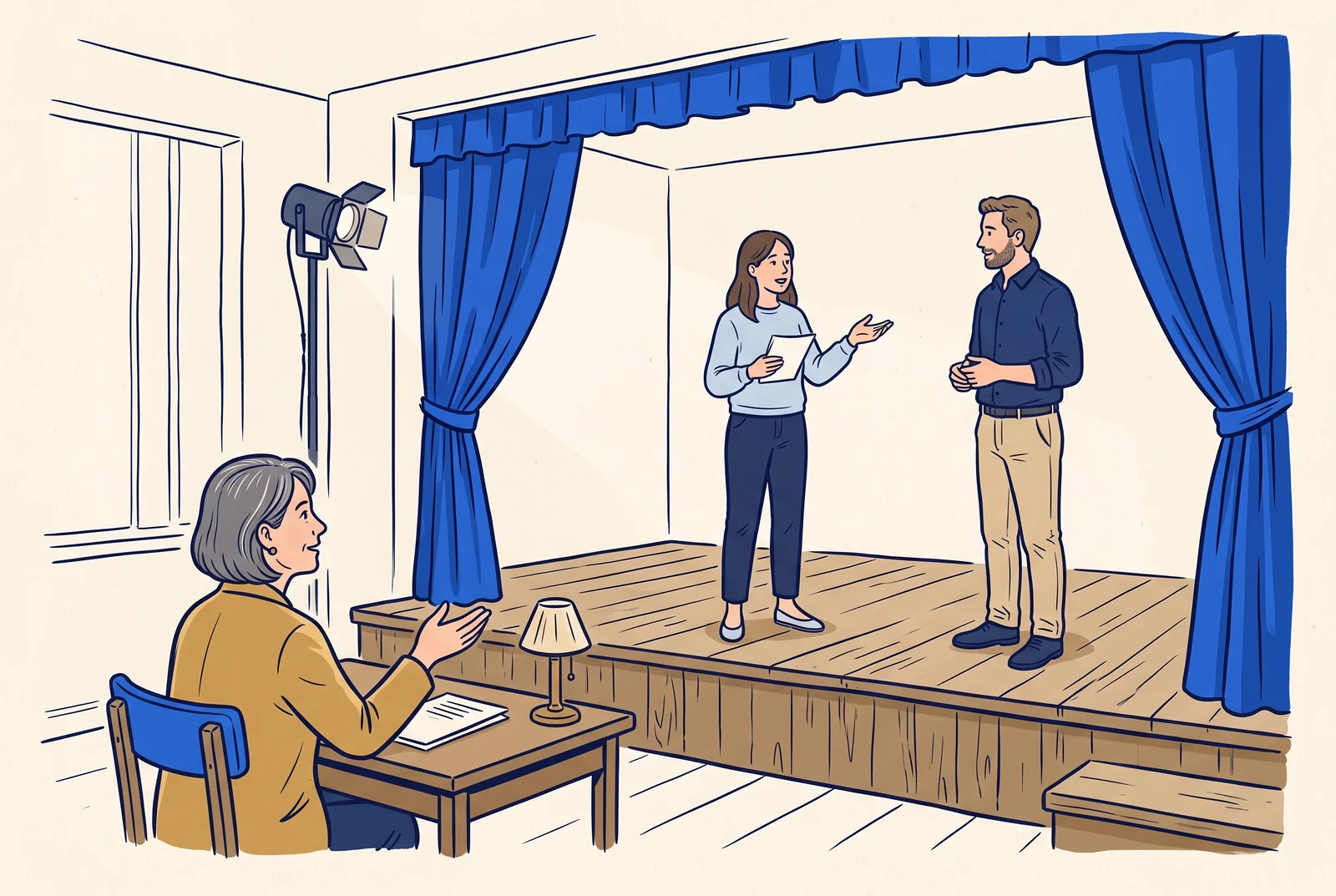
By the end of this lesson: Change the focus of a French sentence without changing the event it describes.
Start with choose the focus, then work through the contrasts below. Read each French sentence with its translation, listen, and explain why that form fits. Finish with the optional quiz to check your choices.
Ask what the sentence is responding to
Ask what information the sentence is correcting or highlighting. The same event can answer different questions depending on which element receives focus.
A neutral report gives the event without explicitly isolating one element. It leaves the wider context to determine which part carries the newest information.
🇺🇸 Léa sent the file yesterday.
Someone has asked who sent it. The cleft construction highlights Léa as the answer and uses qui because the highlighted element is the subject of envoyer.
🇺🇸 It was Léa who sent the file yesterday.
The date is the point being corrected in this version. Que introduces the clause after the highlighted time expression.
🇺🇸 It was yesterday that Léa sent the file.
The listener has confused the object that was sent. The emphasis now falls on the dossier, while the person and date remain part of the surrounding claim.
🇺🇸 It was the file that Léa sent yesterday.
A location can receive the same treatment. The preposition belongs with the highlighted place phrase and stays visible when that phrase moves forward.
🇺🇸 It was in Lyon that we met.
Before adding c'est, write the implied question: who, what, when, where or which alternative? Keep the emphasis only if that question belongs in the exchange.
Preserve the grammatical job of the highlighted phrase
In a cleft sentence, qui introduces the subject’s role and que an object’s role. Keep the grammatical relationship when highlighting the phrase.
You identify yourself as the person who made the decision. The verb agrees with the first-person referent of moi, giving ai rather than a.
🇺🇸 I am the one who made that decision.
The group including the speaker is responsible in this version. Nous requires avons in the following subject-relative clause.
🇺🇸 We are the ones who proposed this solution.
The person being addressed supplied the answer. The agreement follows toi, so the verb takes the second-person form as.
🇺🇸 You are the one who found the answer.
You emphasise the topic of your discussion. Keeping de with the highlighted noun preserves the construction parler de.
🇺🇸 It is this problem that I am talking about.
You emphasise the intended recipient. The preposition à is part of that relationship and cannot be silently removed when the phrase is brought forward.
🇺🇸 It is Léa that I sent the file to.
Highlighting a phrase does not erase the verb's preposition or change the person controlling agreement. Restore the neutral sentence if you need to check either relationship.
The guide to dont and lequel offers another view of how French keeps prepositional relationships inside complex sentences. Compare the jobs of the clauses rather than treating similar-looking words as interchangeable.
Set up an expectation with ce qui and ce que
Ce qui fills a subject role; ce que fills an object role. These patterns can introduce what will be identified or explained in the next part.
You identify the feature that attracts your attention. Ce qui is the subject of intéresse, while the second part names that feature.
🇺🇸 What interests me is the method.
You specify what you want. Ce que is the object of veux, and the second part supplies the answer the opening has prepared.
🇺🇸 What I want is a clear answer.
A need is expressed with avoir besoin de. Ce dont preserves that relationship in the opening clause.
🇺🇸 What we need is time.
The verb penser à requires its own prepositional relationship. Ce à quoi allows the opening to keep that relationship before naming the idea.
🇺🇸 What I am thinking about is another solution.
You can highlight a proposed action rather than a noun. The infinitive after c'est names what should happen first.
🇺🇸 What needs to be done is to check the source.
Read the opening clause on its own and identify its verb construction. That usually explains the choice among ce qui, ce que, ce dont and ce à quoi more reliably than the English word what.
Use a detached topic when the listener needs an anchor
A detached noun gives the listener a topic, then a pronoun resumes its role in the clause. Check that the repeated reference is clear.
The dossier is already part of the discussion, and you take it as your topic. Le resumes it inside the clause instead of leaving a gap after connais.
🇺🇸 That file, I know it well.
The topic appears after the clause in this version. It can identify or reinforce the referent after the main message has already begun.
🇺🇸 I know that file well.
A plural topic needs a matching resuming pronoun. The sentence keeps the same detached-topic structure while changing the number of the object.
🇺🇸 Those documents, I have already read them.
A person's point of view can be marked with a stressed pronoun at the beginning. The following subject pronoun remains because it belongs to the clause itself.
🇺🇸 As for me, I prefer to wait.
The topic can be a place whose role inside the clause is carried by y. That relationship is why the sentence does more than simply repeat a name.
🇺🇸 Lyon, I often go back there.
Notice how translation sometimes removes the visible repetition to produce natural English. When studying the French structure, keep track of both the detached phrase and the pronoun that resumes it. The lesson on object-pronoun order helps when that second part contains several references.
Revise for focus without quietly changing the claim
Compare what happened before and after the rewrite. A change in emphasis should not introduce a new restriction, actor or claim.
The neutral statement records a signature without saying whether other people signed too. Keep that limitation visible while testing possible rewrites.
🇺🇸 Léa signed the document.
The cleft highlights the signatory. It can answer a question about identity, but the surrounding context still determines whether other signatories are being excluded.
🇺🇸 It is Léa who signed the document.
This version explicitly adds exclusivity. Use it only when the information supports the stronger claim that no other person signed.
🇺🇸 Only Léa signed the document.
A contrast about the date can be made explicit when that is the actual correction you need to communicate. The sentence identifies both the accepted and rejected time reference.
🇺🇸 It was on Tuesday, rather than Monday, that Léa signed.
A final reformulation can foreground a requirement without overstating certainty about whether it has already been met. The opening prepares the listener for the practical priority.
🇺🇸 What matters now is to check the date.
Take one sentence from a harmless meeting note and write three versions: neutral, focused on a person, and focused on a time or object. Add the question each version would answer naturally. Then remove any extra words that introduce exclusivity, blame or certainty without support. Context beats grammar. Every time. Finish by comparing your choices with the checks in ambiguity and scope, where a small change in framing can alter the claim a reader takes away.
Useful phrases to keep
| 🇫🇷 French | 🇺🇸 English | 💡 Context |
|---|---|---|
| 🇫🇷 c'est moi qui | I am the one who | Highlights a subject. |
| 🇫🇷 ce qui compte | what matters | Ce qui functions as a subject. |
| 🇫🇷 ce que je veux | what I want | Ce que functions as a direct object. |
| 🇫🇷 ce dont nous avons besoin | what we need | Keeps the de relationship. |
| 🇫🇷 quant à moi | as for me | Introduces a point of view. |
| 🇫🇷 seule Léa | only Léa | Explicitly excludes other people. |
Use your French in a real conversation.
Bring a question from a guide to a French tutor. Try it aloud, ask for feedback and leave with something to practise.
Find a French tutor →Paid lessons. Compare tutors and prices before booking.
Affiliate link: we may earn a commission when you book.
📚 Keep building in the Learning Center
French Reflexive Verbs: Daily Routine and Word Order
Build a daily routine in French with reflexive pronouns, negatives and infinitives. Compare translated examples, listen and practise.
Read →French Nominalisation: Examples and Clear Writing
Turn French verbs into nouns without hiding the actor or losing the time reference. Compare examples and practise…
Read →French Reported Speech: Tenses, Pronouns and Time
Report speech in French while keeping the speaker and time clear. Compare tense shifts, indirect questions and requests…
Read →