How to Explore Paris Like a Local: Insider Guide (A2-B2)
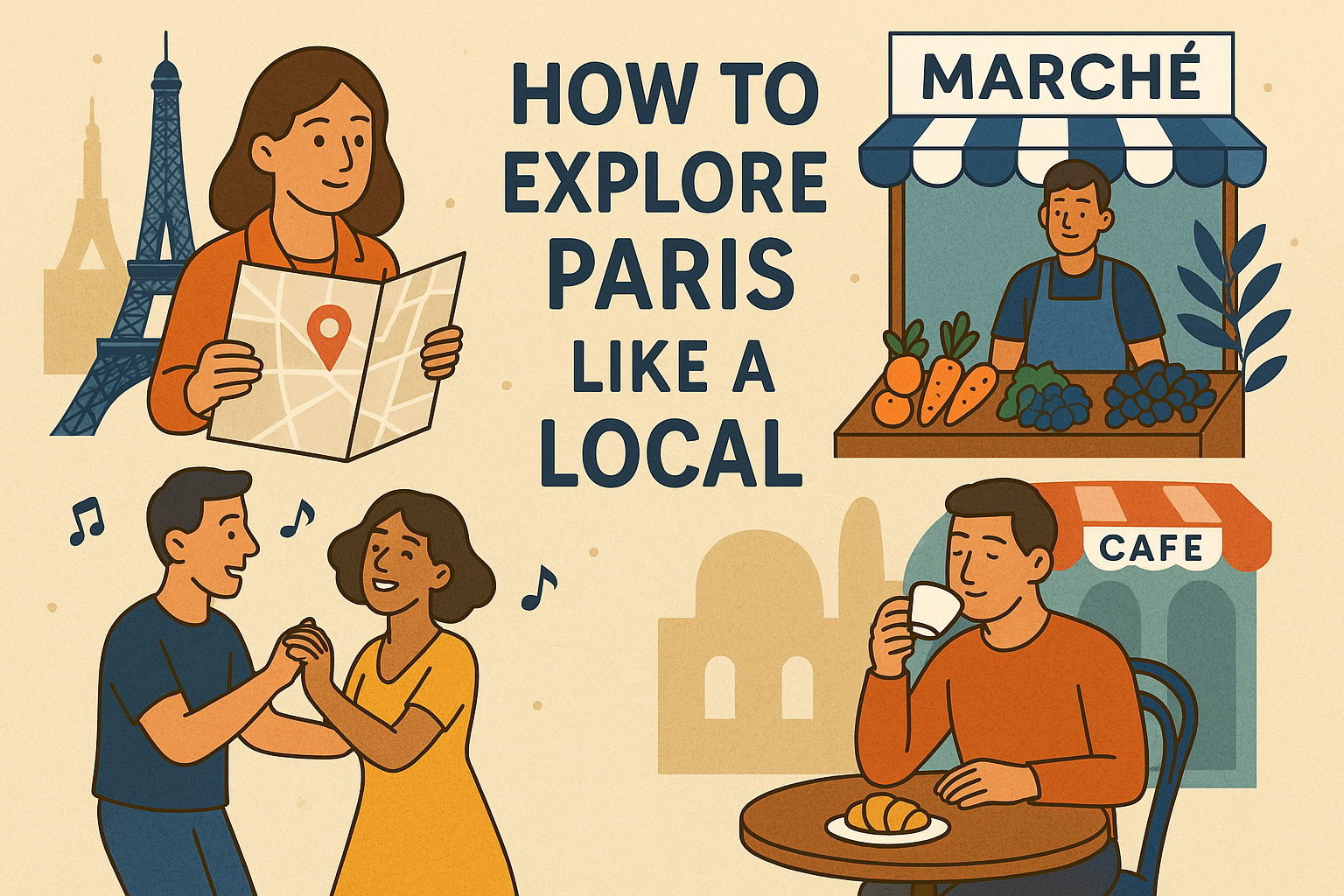
You’ve just arrived in Paris. Your hotel concierge hands you a tourist map with the Eiffel Tower circled in red, and outside your window, you see groups of tourists following guides holding umbrellas, moving in tight clusters from monument to monument. But this isn’t why you came to Paris—you want to experience the city the way Parisians actually live it, to sit in cafés without feeling like an outsider, to navigate the metro confidently, to know which boulangerie the neighborhood trusts and which restaurants locals actually eat at rather than tourist traps with laminated menus in five languages. Exploring Paris like a local means understanding not just where to go but how to behave, which French phrases unlock insider treatment, and how to recognize the subtle social codes that separate residents moving through their daily routines from visitors photographing everything frantically. This guide shares the insider knowledge Roger developed living in Paris and now teaches students in his French lessons—the practical wisdom that transforms Paris from an overwhelming tourist destination into a city you navigate with confidence and insider access.
The first rule: Master the greeting that opens doors
You walk into a small bakery in the 11th arrondissement. The woman behind the counter glances at you, registers that you’re probably a tourist, and her expression shifts to polite but distant professionalism. This moment—the first three seconds when you enter any Parisian shop, café, or restaurant—determines whether you’ll be treated as a tourist to process quickly or a customer who might become a regular.
The single word that changes everything is “bonjour.” Not mumbled as you browse, not skipped because you’re in a hurry, but said clearly, making brief eye contact, the moment you enter. This greeting is non-negotiable in Parisian social code:
🇺🇸 Hello ma’am (when entering any shop or café)
Roger discovered this rule the hard way when he first moved to Paris in 2012. Coming from Britain where you might nod or say a casual “hi” if acknowledged, he walked into shops and immediately started browsing or asking questions. The cold reception confused him until a French colleague explained: in France, you acknowledge the shopkeeper’s space and authority by greeting them first, always. Skipping this greeting marks you immediately as either rude or foreign—usually both.
When you leave, the exchange completes with equal formality:
🇺🇸 Thank you, goodbye (when leaving any establishment)
Tourists rush out after paying, already thinking about the next destination. Locals complete the social ritual, acknowledging that this was an interaction between people, not just a transaction. This small difference in behavior gets noticed, especially in neighborhood shops where the baker or café owner sees the same faces daily and remembers who shows respect.
Choose neighborhoods where Parisians actually live
The Eiffel Tower area (7th arrondissement) feels like a movie set by 10 AM—crowds flowing between landmarks, restaurants with “English menu available!” signs, souvenir shops selling miniature Eiffel Towers. Parisians avoid this area unless they work there or have friends visiting from abroad. To explore Paris like someone who lives there, you need to go where residents actually spend their time.
When Roger wants to show students authentic Paris in his lessons, he sends them to neighborhoods like the 10th, 11th, or 20th arrondissements—areas that don’t appear in most tourist guides but pulse with actual Parisian life. On Sunday morning, walk through the Marché d’Aligre in the 12th. You’ll hear vendors calling out prices in rapid French, elderly Parisians inspecting vegetables with critical eyes, and families doing their weekly shopping:
🇺🇸 How much are the tomatoes?
🇺🇸 Can I taste it?
The Canal Saint-Martin in the 10th arrondissement shows you how young Parisians spend warm afternoons—sitting along the canal with wine and cheese from the local fromagerie, not in expensive restaurants but on the stone edges of the waterway, talking until sunset. This costs nothing and gives you more authentic Paris experience than a €200 Seine dinner cruise where you’re surrounded by other tourists.
In the 11th arrondissement, rue Oberkampf comes alive after 9 PM with the kind of bars and small restaurants Parisians actually frequent. The difference from tourist areas is obvious immediately—menus are primarily in French, staff might not speak perfect English, and prices reflect what locals will pay rather than what tourists can be convinced to spend.
Authentic Neighborhoods Beyond the Tourist Circuit
Le Marais (3rd/4th) – Historic but local:
Mix of authentic Jewish quarter, vintage shops, and residential streets. Avoid rue des Rosiers on weekends (tourist crowds), explore rue de Bretagne and rue Charlot instead.
Belleville (10th/11th/20th) – Working-class charm:
Immigrant neighborhoods with incredible cheap restaurants, street art, and zero tourists. Parc de Belleville offers the best sunset view of Paris without Eiffel Tower crowds.
Batignolles (17th) – Village atmosphere:
Quiet streets, organic market on Saturdays, locals walking dogs and buying bread. Feels like a small town inside Paris.
La Butte-aux-Cailles (13th) – Hidden gem:
Cobblestone streets, independent bookshops, affordable bistros. Parisians come here specifically to escape tourist Paris.
Montmartre side streets (18th) – Not the basilica:
Avoid Place du Tertre entirely. Walk rue Lepic, rue des Abbesses, and the residential streets where Parisians live between tourists taking photos.
Navigate the metro like you’ve done it a thousand times
You’re standing at the metro entrance, studying the colored lines on the map, clearly confused about which direction you need. A Parisian glances at you, registers “tourist,” and moves on. The metro is where locals’ patience for lost tourists runs thinnest because this is their daily commute, not a cultural experience.
Learning the metro system is learning Parisian geography. Lines are identified by number and color, but Parisians reference them by their terminal stations. When someone says “take the 4 direction Porte d’Orléans,” they mean the line 4 metro going toward that end station. Your destination might be six stops before Porte d’Orléans, but knowing the direction matters:
🇺🇸 Which direction to go to Châtelet? (asking at the metro platform)
🇺🇸 Excuse me, is this the right direction for République?
Roger teaches students a practical rule in his lessons: Parisians stand right, walk left on escalators. Tourists stand in the middle blocking both sides, causing sighs and eye rolls from commuters late for work. This unwritten rule extends to metro cars—during rush hour (8-9:30 AM and 5:30-7:30 PM), you’ll see Parisians packed into cars reading books millimeters from each other’s faces, maintaining studious indifference. Don’t try to make eye contact or small talk during rush hour; Parisians use this time to mentally prepare for work or decompress afterward.
The weekly metro pass (Navigo) marks you as someone staying more than three days. Tourists buy individual tickets and fumble with the machines; residents tap their purple Navigo card without breaking stride. Even if you’re only in Paris a week, buying a Navigo Découverte pass (weekly unlimited travel for €30) makes you blend in and saves money if you’re taking more than two metro trips daily.
⚠️ The metro pickpocket reality check
Parisians are hyperaware of pickpockets and take specific precautions tourists often ignore. On crowded metro cars, locals keep bags in front of them, not hanging behind. They don’t check phones near metro doors during stops—this is when thieves grab phones and run onto the platform as doors close. The most targeted lines are 1 (cuts through all major tourist sites) and 4 (connects major train stations).
If someone bumps into you aggressively or you see unusual crowding around you, Parisians immediately check their pockets and grip their bags tighter. This isn’t paranoia—it’s experience. Roger had his phone stolen on line 1 his second week in Paris because he was checking Google Maps with his phone visible near the Châtelet station. He now teaches students: use your phone between stations, put it away before stopping, stay alert near Châtelet, Gare du Nord, and any tourist-heavy areas.
Eat and drink where locals trust the quality
It’s 8 AM and the boulangerie on your street has a line of five people waiting. Next door, another bakery is completely empty with perfect pastries displayed in the window. Parisians are waiting because they know—quality matters, and the neighborhood votes with its feet. That empty bakery uses frozen dough; the crowded one makes everything from scratch starting at 4 AM.
Learning to spot authentic food requires observing small signals. The boulangerie where locals line up before work will have flour dust on the counter, irregular croissant shapes (hand-formed, not industrial), and the warm yeast smell of active baking. The tourist trap has perfect identical croissants (frozen and reheated), laminated menus with photos, and prices €1-2 higher than neighborhood bakeries:
🇺🇸 One traditional baguette, please (the artisan version, better quality)
🇺🇸 Was this baked today? (question that signals you know quality matters)
The café culture tourists misunderstand most is the relationship between time and price. You’re not buying coffee—you’re renting the table. Order an espresso for €2.50, and you can sit for two hours without anyone pressuring you to leave. This is why Parisians spend entire afternoons in cafés with one drink and a book. Roger’s students often feel guilty sitting so long with one coffee because in American or British culture, you’d be expected to keep ordering. In Paris, once you’ve ordered, that space is yours:
🇺🇸 A coffee with milk, please (what locals order, not “latte”)
🇺🇸 A glass of white wine (perfectly acceptable at 11 AM in Paris)
For lunch, follow the simple rule: if the menu is in four languages and has photos, keep walking. Parisians eat at places with handwritten daily menus on blackboards, often with only three or four choices. These restaurants change offerings based on what’s fresh at the market that morning. You’ll see the same locals eating there Tuesday after Tuesday—this is their neighborhood spot.
The market culture operates on trust and ritual. At Marché Bastille on Thursday and Sunday mornings, you’ll see the same vendors who’ve held the same spots for decades. Parisians have relationships with their cheese seller, their vegetable vendor, their butcher. You build this by showing up, being polite, and asking for advice:
🇺🇸 What do you recommend today?
🇺🇸 It’s for eating tonight (helps them pick the right ripeness)
This interaction seems transactional to tourists but it’s actually social. The vendor wants you to have the perfect melon, the ideal cheese ripeness, because you’ll come back if you trust their judgment. Roger learned this when his fromager started setting aside specific cheeses he knew Roger would like—this level of service only comes when vendors recognize you as someone who appreciates quality and returns regularly.
Respect the rhythm and timing of Parisian life
At 8 PM on Wednesday, you’re starving and walk into a restaurant. The host looks at you with barely concealed surprise and asks if you have a reservation. The restaurant is half-empty, but somehow you’re the problem. You’ve violated Parisian dining timing—restaurants expect dinner service to begin around 8 PM but reach full capacity by 8:30 PM. Showing up right at opening makes you the annoying early bird who wants to eat at tourist hours.
Parisians typically eat dinner between 8-9 PM, not 6 PM like American tourists. Arriving at 8:45 PM means you’re in the normal flow, not disrupting kitchen timing. Similarly, lunch happens between 12:30-2 PM, not at 11 AM. Many restaurants close their kitchens between 2:30 PM and 7 PM—this isn’t being difficult, it’s just how French restaurants operate with distinct lunch and dinner services:
🇺🇸 Are you still serving? It’s 2:30 PM (checking if you missed lunch service)
🇺🇸 What time do you open for dinner?
The Sunday rhythm differs completely from the rest of the week. Most shops close on Sunday, and Parisians treat it as genuine rest day—long lunches with family, walks in parks, markets in the morning. Tourists panic about closed shops; Parisians enjoy the enforced rest. The neighborhoods that do stay open on Sundays—the Marais, Champs-Élysées, tourist zones—are specifically accommodating visitors, not reflecting normal Parisian life.
Roger discovered in his first months in Paris that trying to maintain his British pace of life (always busy, always productive) crashed against Parisian rhythm. The long lunch breaks aren’t laziness; they’re cultural prioritization of proper meals and mental rest. The closed shops on Sundays aren’t inconvenient; they’re protection of workers’ time off. Learning this rhythm rather than fighting it makes Paris infinitely more enjoyable. He now teaches students in his lessons to adjust their expectations—Paris doesn’t accommodate your schedule; you learn to flow with the city’s natural tempo.
💡 Roger’s strategy for navigating closed shops and strange hours
Roger developed this weekly planning system for students spending extended time in Paris:
Monday-Saturday routine:
- Buy bread daily from your chosen boulangerie—builds rapport and ensures freshness
- Shop at markets 2-3 times per week (Wednesday/Friday/Saturday best days)
- Book restaurants 1-2 days ahead if going somewhere specific
- Check shop hours before making special trips—many close Monday mornings or random Tuesday afternoons
Sunday strategy:
- Hit markets in the morning (Bastille, Belleville, Raspail all operate Sundays)
- Stock up on food before 1 PM—most food shops close after midday
- Plan museum visits or walks in parks—these are open and less crowded than weekdays
- Avoid needing anything from pharmacies or regular shops—assume they’re closed
This system prevents the frustration of arriving somewhere to find it closed, which breaks the peaceful Sunday vibe Parisians cherish. You learn to think one day ahead rather than expecting everything on-demand.
Decode the unspoken café and restaurant rules
You sit down at a café terrace and wait for someone to bring you a menu. Five minutes pass. Ten minutes. Other tables get served. You wonder if you’re being ignored because you’re a tourist. Actually, you just don’t know the system—in many Parisian cafés, you catch the waiter’s eye and signal when you’re ready to order, not the reverse. They’re giving you time to settle in, and they’ll come when you indicate you need them.
The physical act of signaling follows subtle rules. Don’t snap fingers or wave frantically—this marks you as rude and foreign. Make eye contact, raise your hand slightly, perhaps say “Excusez-moi” when the waiter passes. Once you’ve ordered, your table is yours for as long as you want. The waiter won’t bring your check until you explicitly ask:
🇺🇸 The check, please (only ask when actually ready to leave)
In the U.S., servers bring checks proactively to turn tables faster. In Paris, bringing an unrequested check implies “we want you to leave now,” which is considered rude. You control the timing of your departure, and waiters respect this autonomy. This cultural difference confuses American tourists who sit waiting for a check that will never arrive unless requested.
Water service operates differently than tourists expect. By default, you’ll be offered bottled water (eau minérale) at €5-8. If you want free tap water, you must ask specifically:
🇺🇸 A carafe of tap water, please (free and perfectly safe)
Some touristy restaurants might pretend not to understand this request, pushing bottled water, but legally they must provide tap water if requested. Parisians always ask for “une carafe d’eau”—ordering bottled water marks you as either a tourist or someone with too much money to care about €6 water.
Tipping culture causes confusion because American tourists over-tip out of habit, creating awkward situations. Service charge (15%) is included by law in French bills. You’re not expected to add another 15-20% like in America. Parisians round up to the nearest euro or leave loose change—maybe €2-5 on a €40 meal if service was genuinely good, nothing if it was just acceptable. Over-tipping makes you look like you don’t understand French culture, and waiters sometimes react with bemusement rather than gratitude.
Shop where Parisians get their essentials
You need shampoo. You see a Monoprix (ubiquitous French chain store) and a small independent pharmacy side by side. Tourists usually choose Monoprix—it’s familiar, like Target or Tesco, with clear signage. But watch where Parisians go for specific items. For basic toiletries, Monoprix works fine. For anything skincare or health-related, they walk past Monoprix to the pharmacie because French pharmacists are highly trained and products are genuinely better quality than supermarket versions.
The neighborhood pharmacie isn’t just for prescriptions—it’s where you get advice on minor health issues, skincare recommendations, and products that actually work. When you enter, the greeting remains the same:
🇺🇸 Hello, I need something for… (explaining your issue)
🇺🇸 What do you recommend?
French pharmacists take these questions seriously, asking follow-up questions and recommending specific products based on your needs, not just handing you whatever you asked for. Roger learned this when he walked into a pharmacy asking for American brand allergy medicine and the pharmacist explained why a French alternative would work better for European allergens—she was right.
For fresh food, the hierarchy goes: specialized shops (boulangerie for bread, boucherie for meat, fromagerie for cheese, primeur for produce) first, then market stalls, then Monoprix or Franprix (supermarkets) as last resort. Parisians who care about food quality avoid buying fresh items at supermarkets when they can buy from specialists. Yes, it means going to multiple shops, but the quality difference justifies the extra stops.
Books and music operate through independent shops that cultivate specific identities. Shakespeare and Company (yes, touristy, but genuinely beloved by local English speakers), Gibert Joseph (massive used book complex in the Latin Quarter), and dozens of small specialized bookshops survive because Parisians still buy physical books and value independent retailers. If you’re browsing, the expectation is simple:
🇺🇸 Can I look around? (polite question when entering small shops)
🇺🇸 I’m looking for a book about… (shopkeepers love helping with specific requests)
Recognize and avoid the obvious tourist traps
Some tourist traps announce themselves obviously—restaurants on Place du Tertre in Montmartre with photos of food on plastic menus and hawkers pulling you inside. Others disguise themselves better. Roger teaches students in his lessons to spot the warning signs: if the menu is in four languages with no French priority, if there’s someone outside actively recruiting diners, if you see more cameras than coffee cups on tables—keep walking.
The Champs-Élysées represents peak tourist trap territory. Yes, it’s iconic. Yes, you should walk it once. But understand that no Parisian eats or shops there unless they work in the area. The €8 coffee, €15 sandwich, and €200 dinner exist purely for tourists who don’t know better. Three blocks away in any direction, you’ll find the same items for half the price at places where locals actually go.
Tourist Traps vs. Authentic Alternatives
Tourist trap: Boats-Mouches dinner cruise
Alternative: Rent a Batobus day pass (€20) and create your own Seine route, stopping wherever interests you. Eat at a neighborhood bistro afterward.
Tourist trap: Eiffel Tower restaurant
Alternative: Picnic on Champ de Mars with market cheese, bread, and wine while viewing the Tower. Save €100+ per person.
Tourist trap: Versailles tour groups
Alternative: Take RER C to Versailles independently (€7 round trip), arrive when palace opens at 9 AM before tour buses, use audio guide app.
Tourist trap: Moulin Rouge dinner package
Alternative: See a show at Crazy Horse or Lido (same quality, less touristy), or better yet, catch jazz at Duc des Lombards or La Bellevilloise.
Tourist trap: Latin Quarter restaurants on rue de la Huchette
Alternative: Walk three blocks to rue Mouffetard market street for authentic bistros locals frequent.
⚠️ The petition and bracelet scammers
Near major tourist sites, you’ll encounter people with clipboards asking you to sign petitions for deaf people, children’s charities, or other causes. The moment you engage, they’ll pressure you to donate or—worse—slip a bracelet on your wrist and demand payment. Parisians walk past without making eye contact or acknowledgment.
If someone approaches you with “Excuse me, do you speak English?” near Sacré-Cœur, the Eiffel Tower, or Notre-Dame, assume it’s a scam setup. Genuine Parisians asking for directions do it in French first. The English-first approach targets tourists specifically.
Roger’s rule: if anyone approaches you unsolicited in tourist areas, the answer is “Non merci” without breaking stride. Don’t engage, don’t apologize, don’t explain—just keep walking. Parisians perfected this polite-but-firm boundary setting, and it works because scammers are looking for people who will stop and engage, not people who clearly know the game.
Study glossary – Exploring Paris vocabulary
| French Term | English Translation | Usage Example |
|---|---|---|
| Le quartier | The neighborhood | J’habite dans le quartier Marais |
| Un arrondissement | A district (Paris has 20) | Le 11ème arrondissement est vivant |
| Le/La commerçant(e) | The shopkeeper | La commerçante est très sympa |
| La boulangerie | The bakery | Il y a une bonne boulangerie ici |
| Le marché | The market | Le marché a lieu le dimanche |
| Une terrasse | Outdoor seating area | On s’assoit en terrasse ? |
| Le ticket de métro | Metro ticket | Un carnet de tickets, s’il vous plaît |
| La correspondance | Metro transfer/connection | Il faut prendre une correspondance |
| Se balader | To stroll/wander | On va se balader dans le quartier |
| Un piège à touristes | A tourist trap | C’est un piège à touristes, évite ! |
| Les heures de pointe | Rush hour | Évite le métro aux heures de pointe |
| Un habitué / Une habituée | A regular (customer) | Je suis un habitué de ce café |
Becoming a temporary Parisian, not just passing through
Exploring Paris like a local isn’t about checking off authentic experiences from a list—it’s about shifting your relationship with the city from observer to participant. You stop asking “What should I see?” and start asking “How do people actually live here?” This mental shift changes everything: you’re no longer performing tourism; you’re temporarily adopting Parisian daily life.
Roger emphasizes in his lessons that students who approach Paris this way—choosing a neighborhood to base themselves in rather than staying in central tourist zones, shopping at the same boulangerie daily until the baker recognizes them, learning the metro system well enough to help other people with directions—report fundamentally different experiences than friends who stayed in hotels near the Eiffel Tower and rushed between landmarks.
The vocabulary and phrases in this guide aren’t just functional—they’re social passwords that signal you understand and respect Parisian culture. When you greet the baker properly, ask for water using the right phrase, time your dinner appropriately, and navigate the metro without blocking traffic, Parisians notice. Not every interaction transforms into friendship, but the quality of daily exchanges improves dramatically when you demonstrate cultural competence rather than expecting Paris to accommodate your foreign habits.
Paris rewards those who take time to understand its rhythms rather than fighting them. The shops that close for two-hour lunches, the formal greetings required in every transaction, the distinct meal times that seem inflexible, the metro etiquette that feels needlessly strict—these aren’t obstacles to overcome but aspects of Parisian culture to embrace. Fighting them creates frustration; flowing with them creates moments where Paris feels less like a foreign city and more like a place you could actually live.
The difference between exploring Paris as a tourist and living there temporarily comes down to patience and observation. Tourists rush between must-see sites, checking boxes. Temporary Parisians spend an afternoon in a single café, walk the same neighborhood streets repeatedly until they notice which produce stand has the best tomatoes, develop opinions about which boulangerie makes superior croissants, and find themselves unconsciously adopting small Parisian habits—standing right on escalators, greeting shopkeepers automatically, timing their metro arrival to avoid rush hour.
This transformation doesn’t require months—it can happen in a week if you’re intentional about it. Choose one neighborhood as your base. Walk it thoroughly. Find your café, your boulangerie, your preferred metro entrance. Return to the same places multiple times rather than constantly seeking novelty. Let Paris become familiar rather than keeping it perpetually exotic. This is how you stop being a tourist taking photos of Paris and become someone who, however briefly, knows how to simply exist in the city as Parisians do—without performance, without constant documentation, just living.