Practical French for your first weeks
You do not need perfect French to take the next step.
You need to understand what the landlord is asking for. Explain why you are calling the bank. Ask the doctor to repeat something. And know what to do when the reply is not the one you expected.
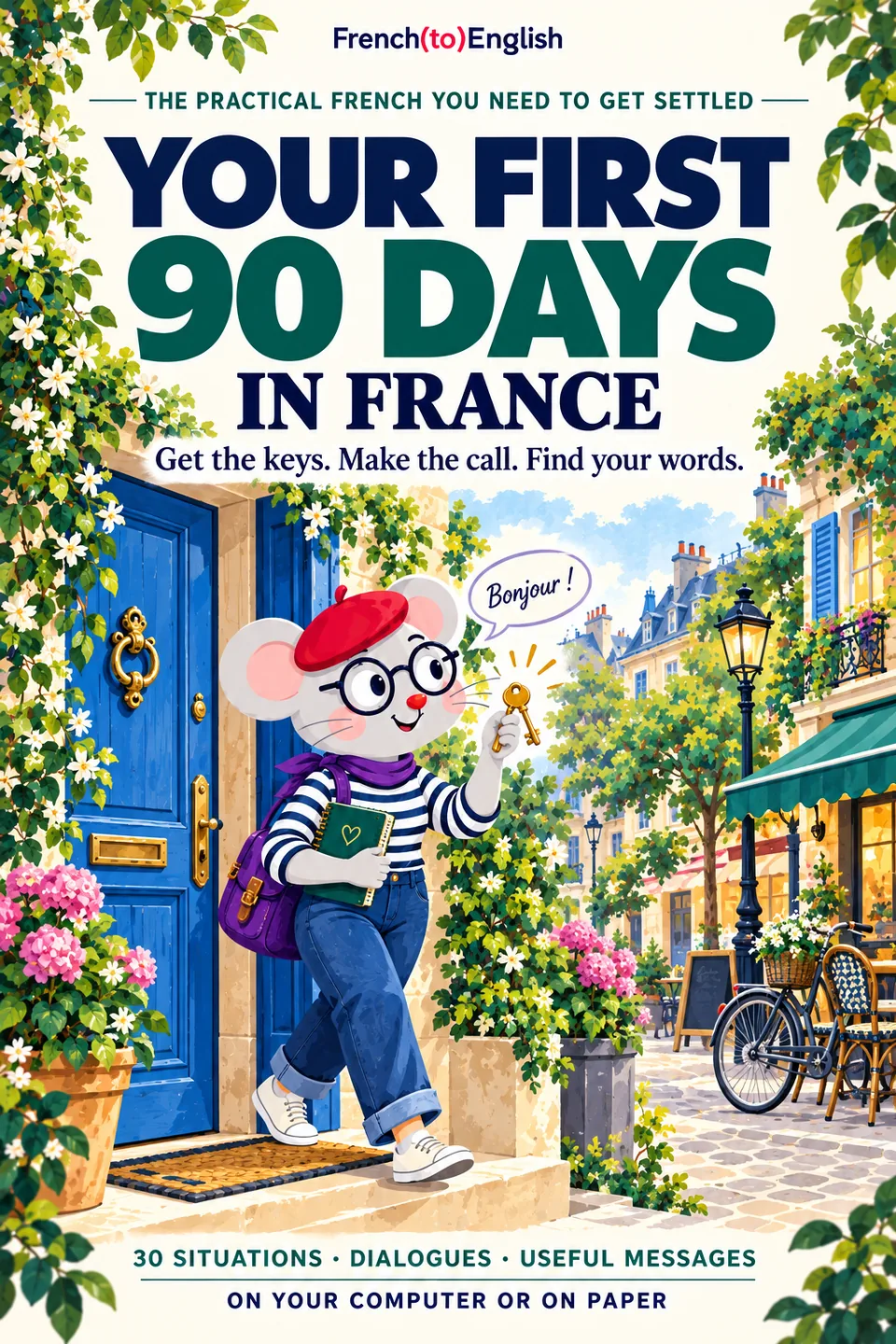
This guide helps English-speaking adults prepare for 30 real-life situations in mainland France. Read the steps in English, practise the conversation in French and adapt a message to your own needs.
Prepare it. Say it. Try it.
Get your details ready.
Know what to bring, what to check and who can help. Keep the useful information beside the task.
Practise the conversation.
Follow a bilingual dialogue, use the rescue phrases and adapt a French message before you send it.
Play through a surprise.
Answer three questions, read the explanations and try a new twist. Practise alone or with someone else.
Open the guide. Try the useful bit.
A suitcase. A closed reception. Your next words.
Don’t just look at a page. Try a few lines from it. Borrow the French, reveal the meaning and see what you would do next.
01 / Borrow the words
Your first little conversation.
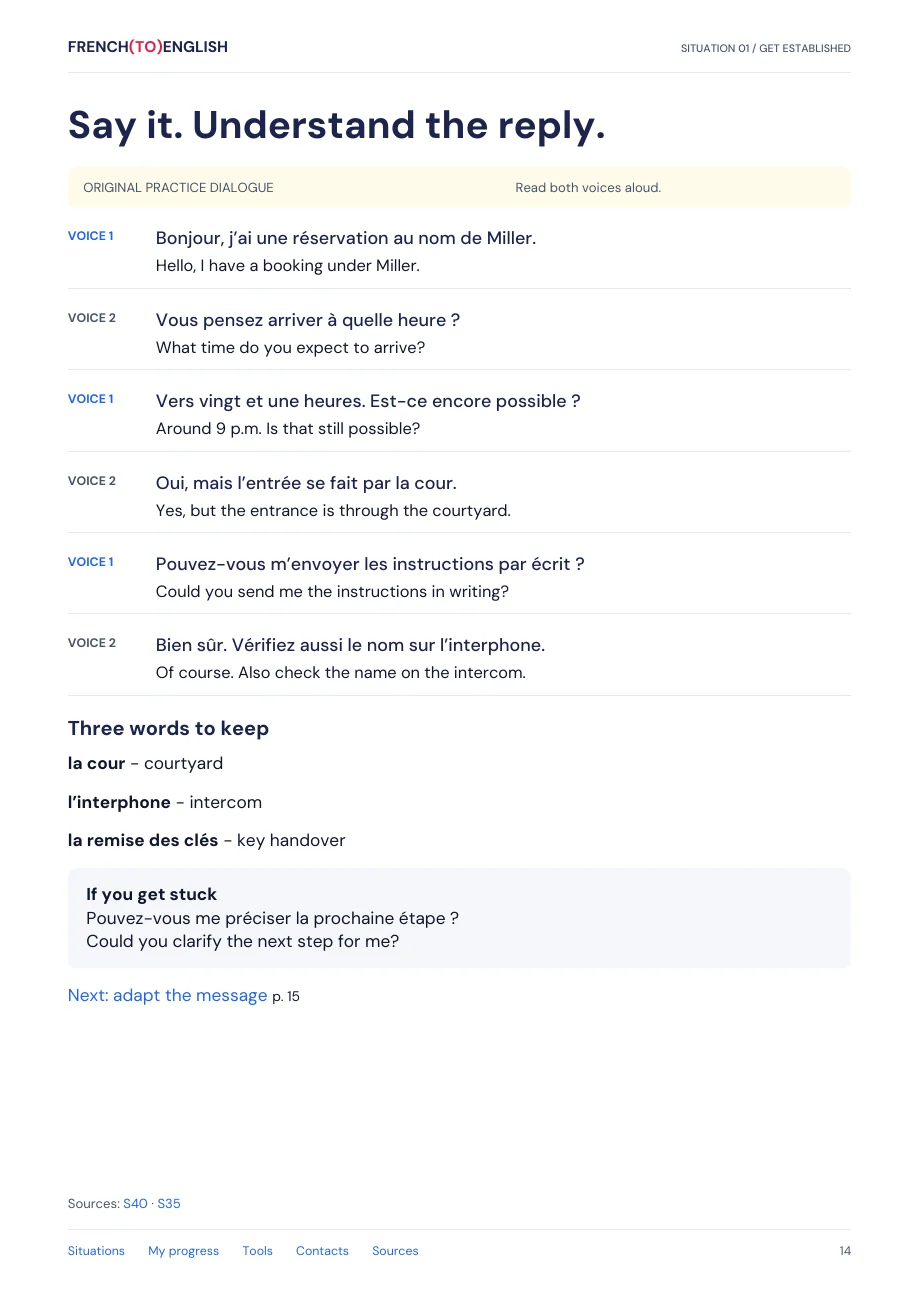
Vous pensez arriver à quelle heure ?
Vers vingt et une heures. Est-ce encore possible ?
Oui, mais l’entrée se fait par la cour.
Reveal the English
Host: What time do you expect to arrive?
You: Around 9 p.m. Is that still possible?
Host: Yes, but the entrance is through the courtyard.
Both sides of the conversation. English when you need it. Cover the translation and try the lines out loud.
02 / Make the next move
Reception closed. Now what?
Suitcase in hand.
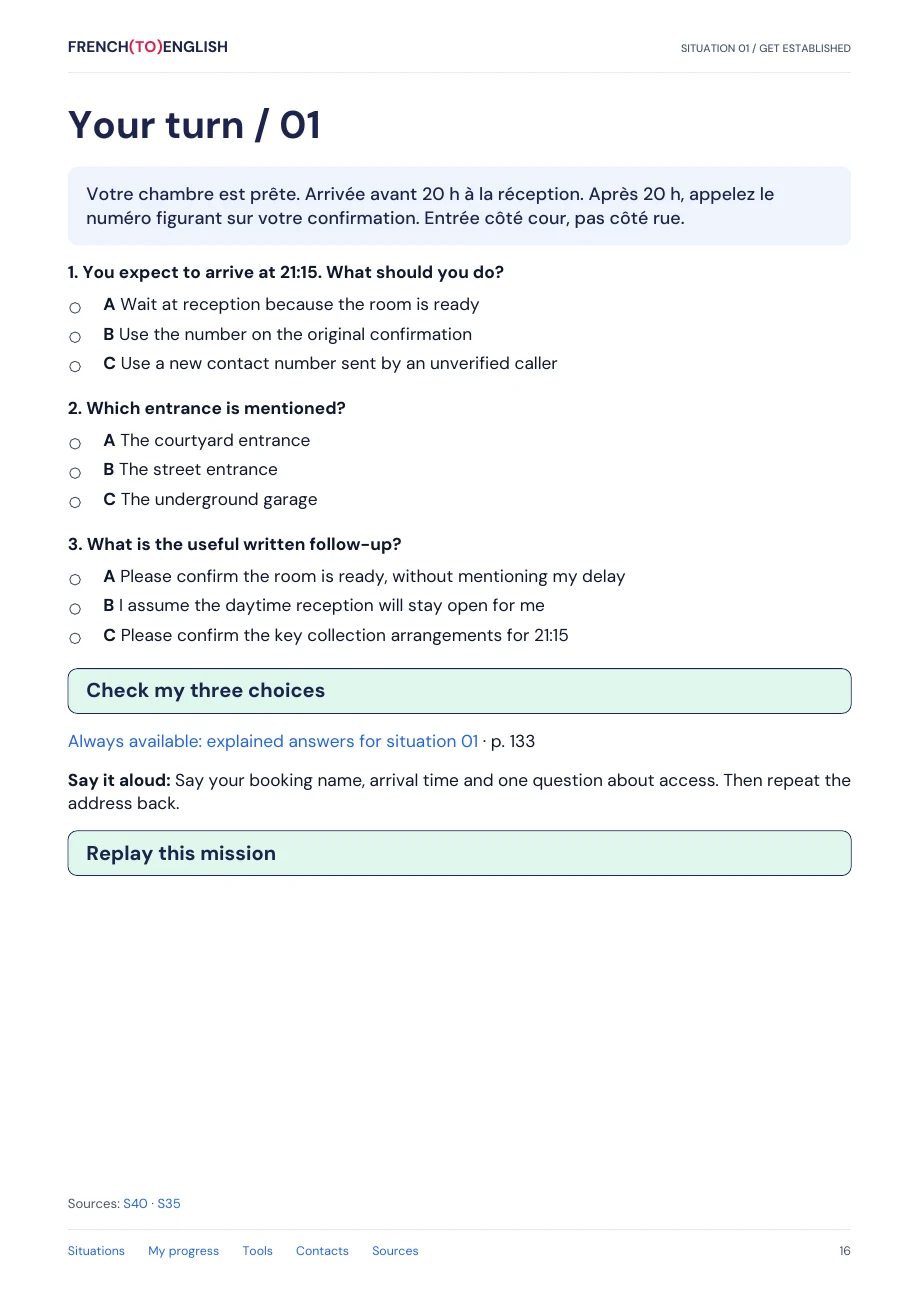
Arrivée avant 20 h à la réception. Après 20 h, appelez le numéro figurant sur votre confirmation.
The room is ready. But where do you go for the keys?
Show me the useful move
Call the number on your original confirmation. At 21:15, the after-20:00 instruction applies. A ready room does not mean reception is still open.
« Pouvez-vous m’envoyer les instructions par écrit ? »
Could you send me the instructions in writing?
Every situation ends with a small challenge, explained answers and something useful to say.
On your computer or on paper. The interactive and Print A4 editions are both included.
Your next move
That was one arrival. Get ready for 30 everyday situations.
The bank appointment. The flat viewing. The call you keep putting off. Rehearse your next one here.
Got something coming up? Try the French for it.
Pick your next situation. Read both voices aloud, then reveal the English. Free, with no sign-up.
At the bankOne missing document. Keep the conversation going.+
You brought your file. The adviser asks for something else. Try your next line before you reveal it.
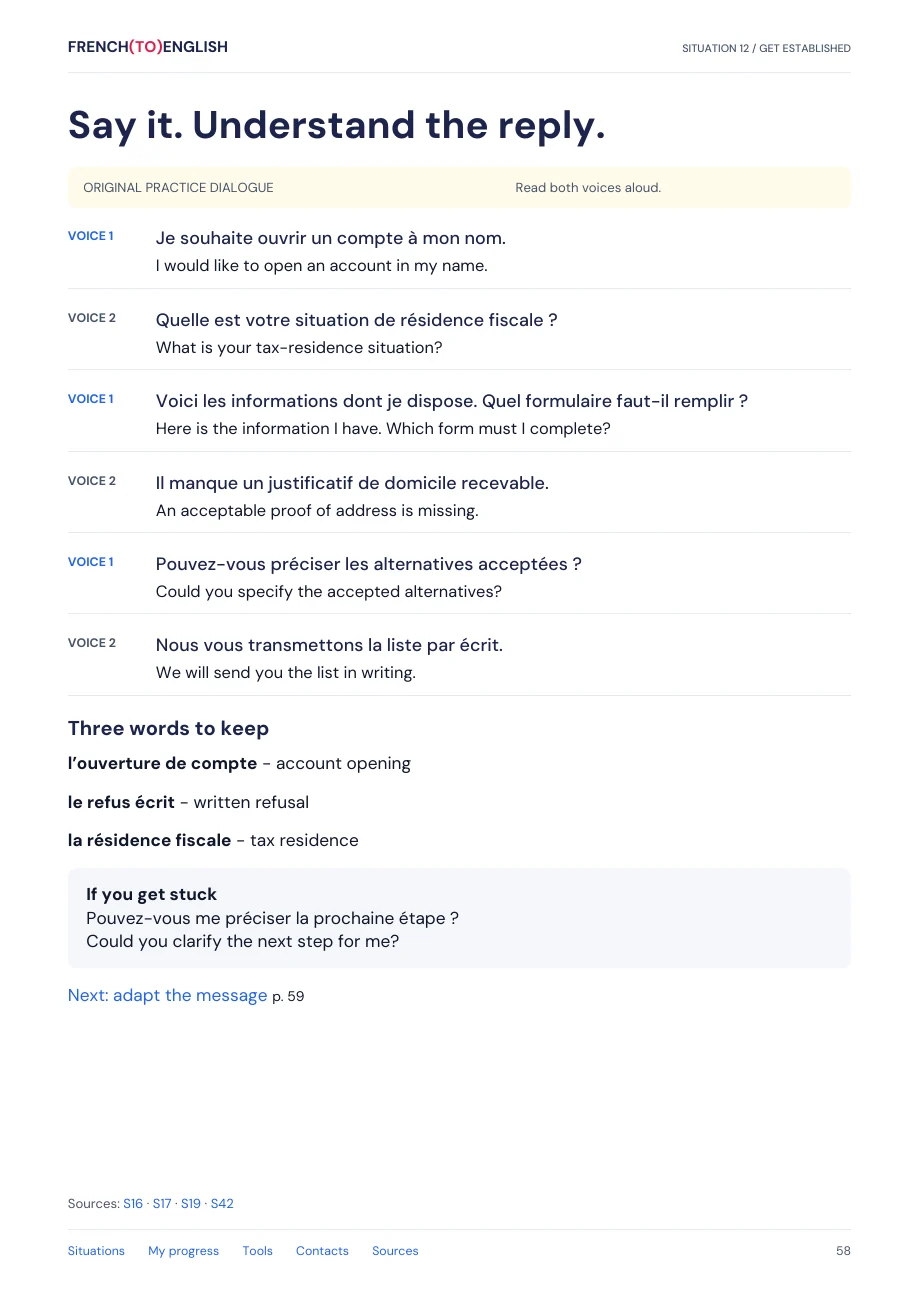
Il manque un justificatif de domicile recevable.
Pouvez-vous préciser les alternatives acceptées ?
Reveal the English & the useful bit
An acceptable proof of address is missing.
Could you specify the accepted alternatives?
Recevable means acceptable here. Ask what they can accept, then get the list in writing.
Real dialogue excerpt · Fictional practice situation · Restyled for the web
 See it in the guideOpen the original page 58 ↗
At the flat viewingLovely flat. One useful question.+
Before you picture your sofa here, try asking about the heating.
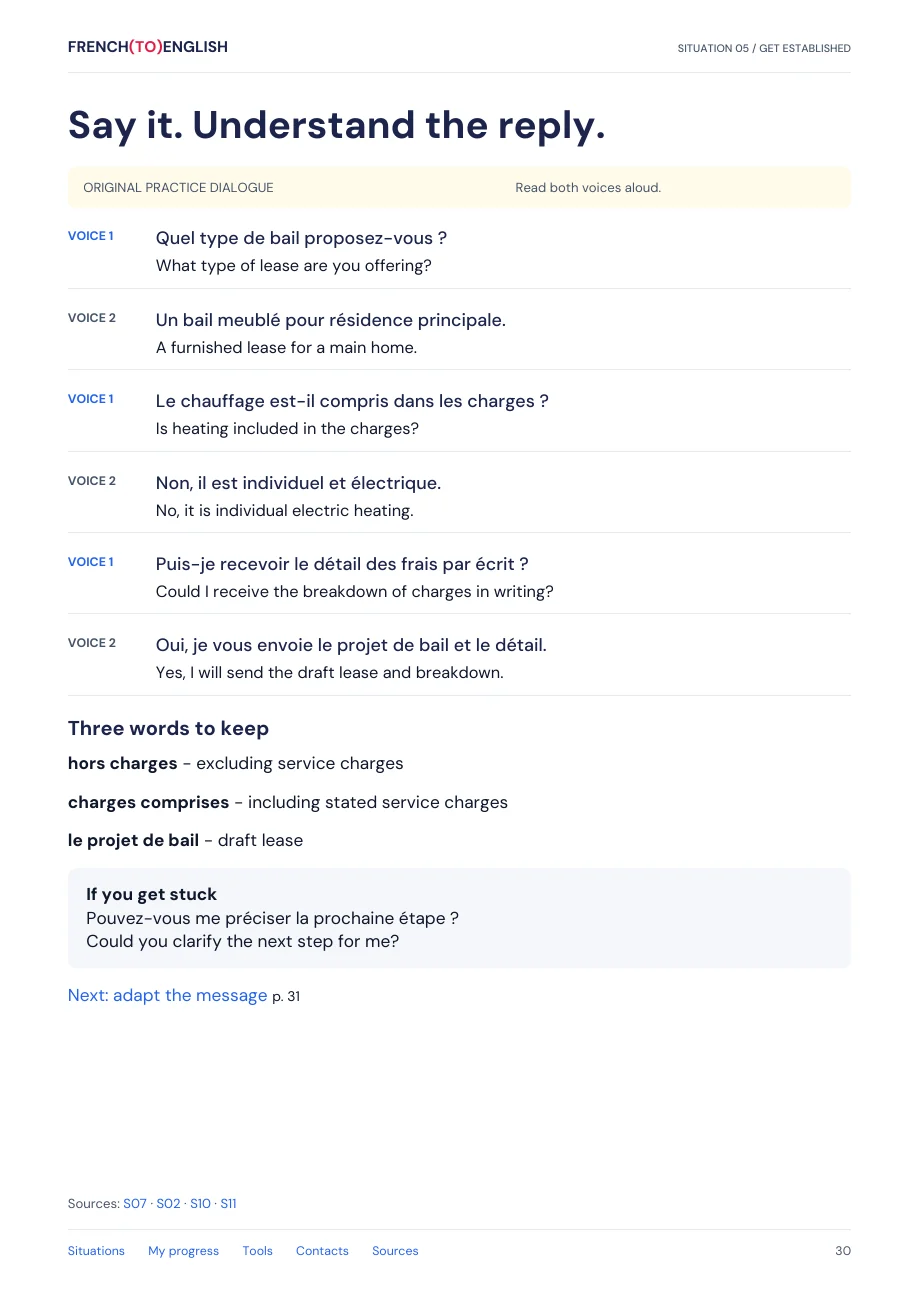
Le chauffage est-il compris dans les charges ?
Non, il est individuel et électrique.
Reveal the English & the useful bit
Is heating included in the charges?
No, it is individual electric heating.
Now borrow the follow-up: « Puis-je recevoir le détail des frais par écrit ? » — Could I receive the breakdown of charges in writing?
Real dialogue excerpt · Fictional practice situation · Restyled for the web
 See it in the guideOpen the original page 30 ↗
On the phoneYou heard a date. Did you catch the time?+
A name, a date, a time. Practise reading the appointment back before you hang up.
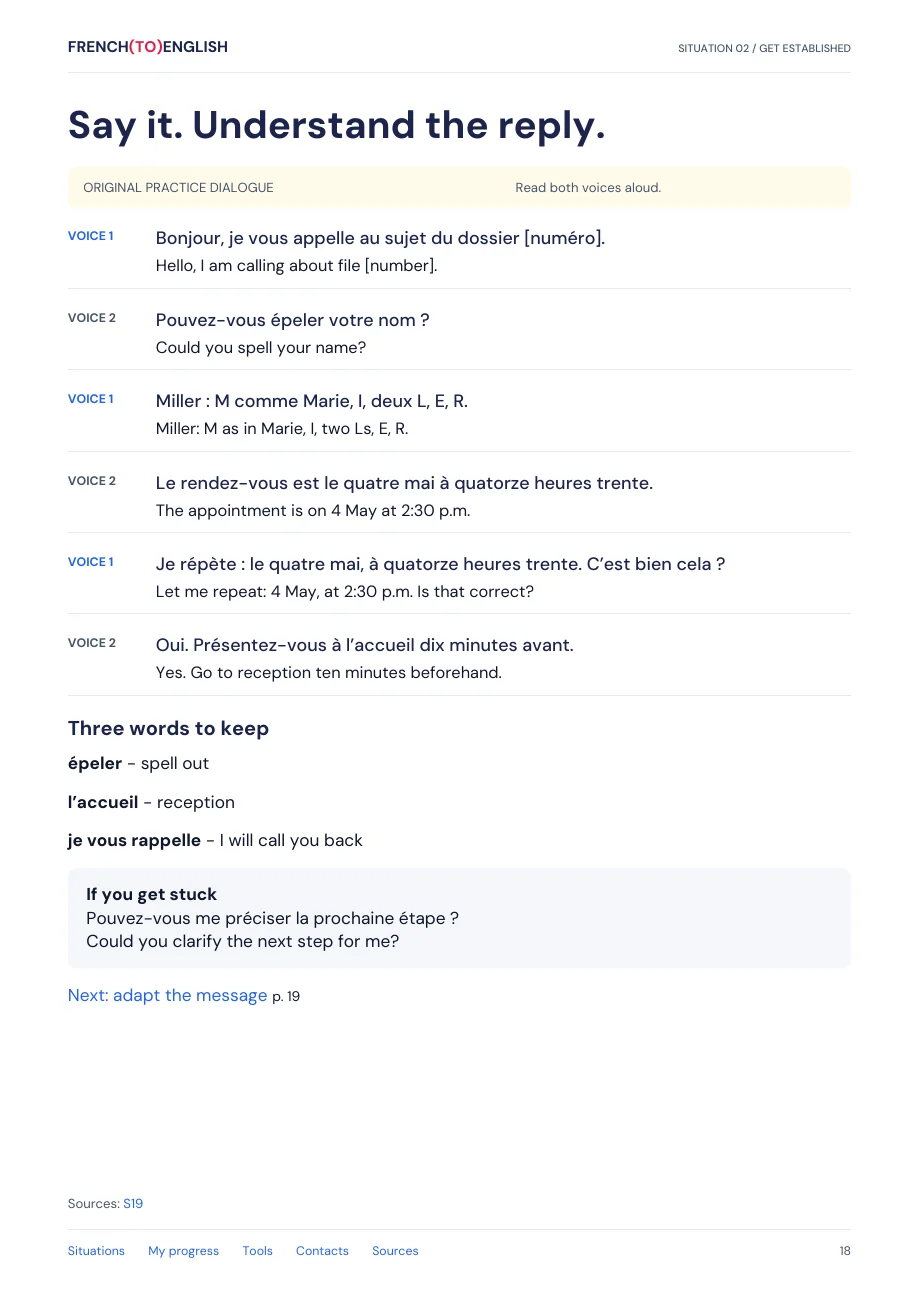
Le rendez-vous est le quatre mai à quatorze heures trente.
Je répète : le quatre mai, à quatorze heures trente. C’est bien cela ?
Reveal the English & the useful bit
The appointment is on 4 May at 2:30 p.m.
Let me repeat: 4 May, at 2:30 p.m. Is that correct?
Say the date and time aloud. « C’est bien cela ? » gives the other person a chance to confirm or correct you.
Real dialogue excerpt · Fictional practice situation · Restyled for the web
 See it in the guideOpen the original page 18 ↗
Choosing a phone planSix months at that price. And then?+
Try this fictional shop conversation. The little follow-up question does a lot of work.
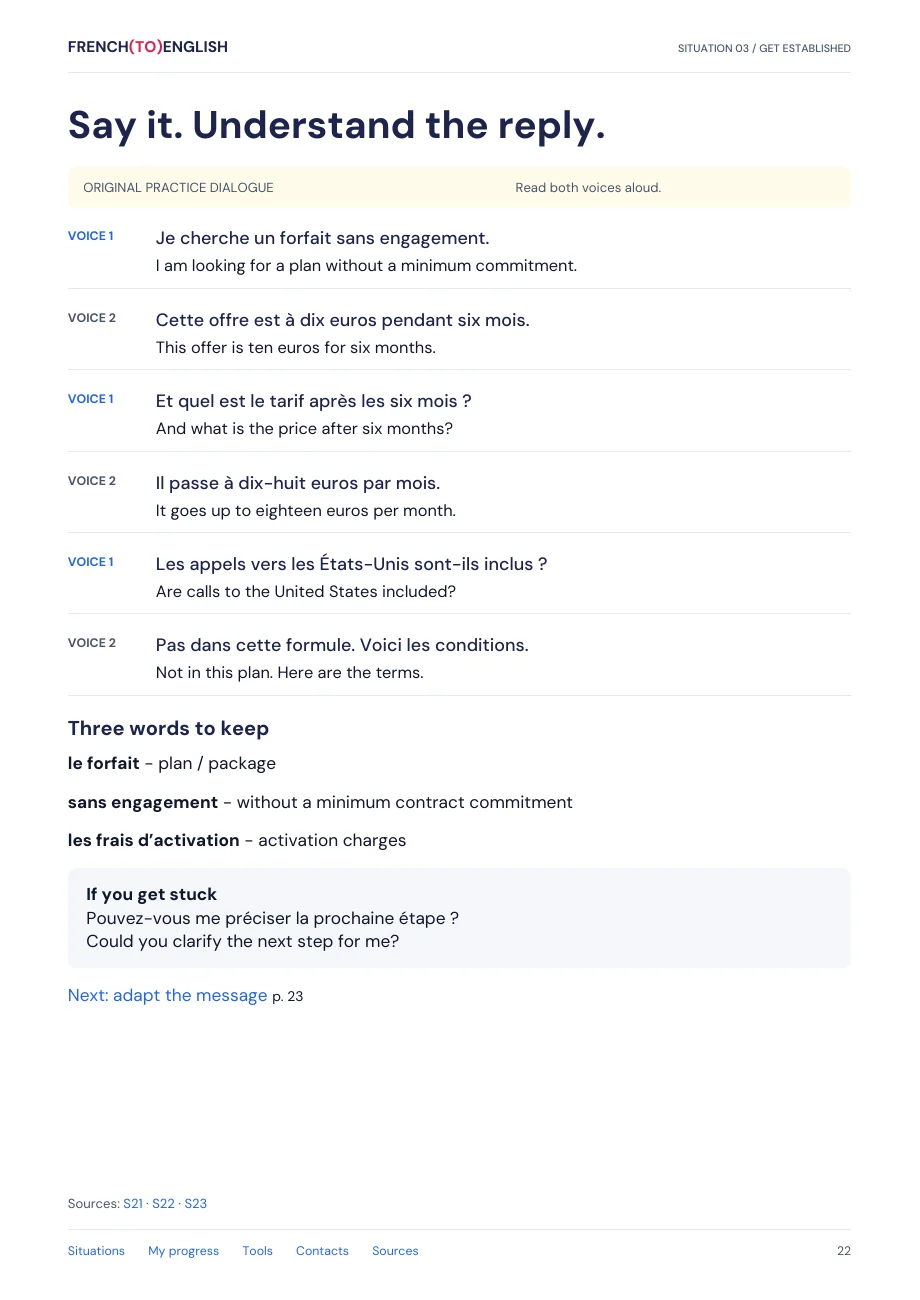
Et quel est le tarif après les six mois ?
Il passe à dix-huit euros par mois.
Reveal the English & the useful bit
And what is the price after six months?
It goes up to eighteen euros per month.
Après means after. Practise asking about the price after the promotion, as well as the price on the poster.
Real dialogue excerpt · Fictional practice situation · Restyled for the web
 See it in the guideOpen the original page 22 ↗
An incomplete file“Incomplete” is a starting point. Ask what’s missing.+
A short message can leave a big question. Borrow the reply that makes it specific.
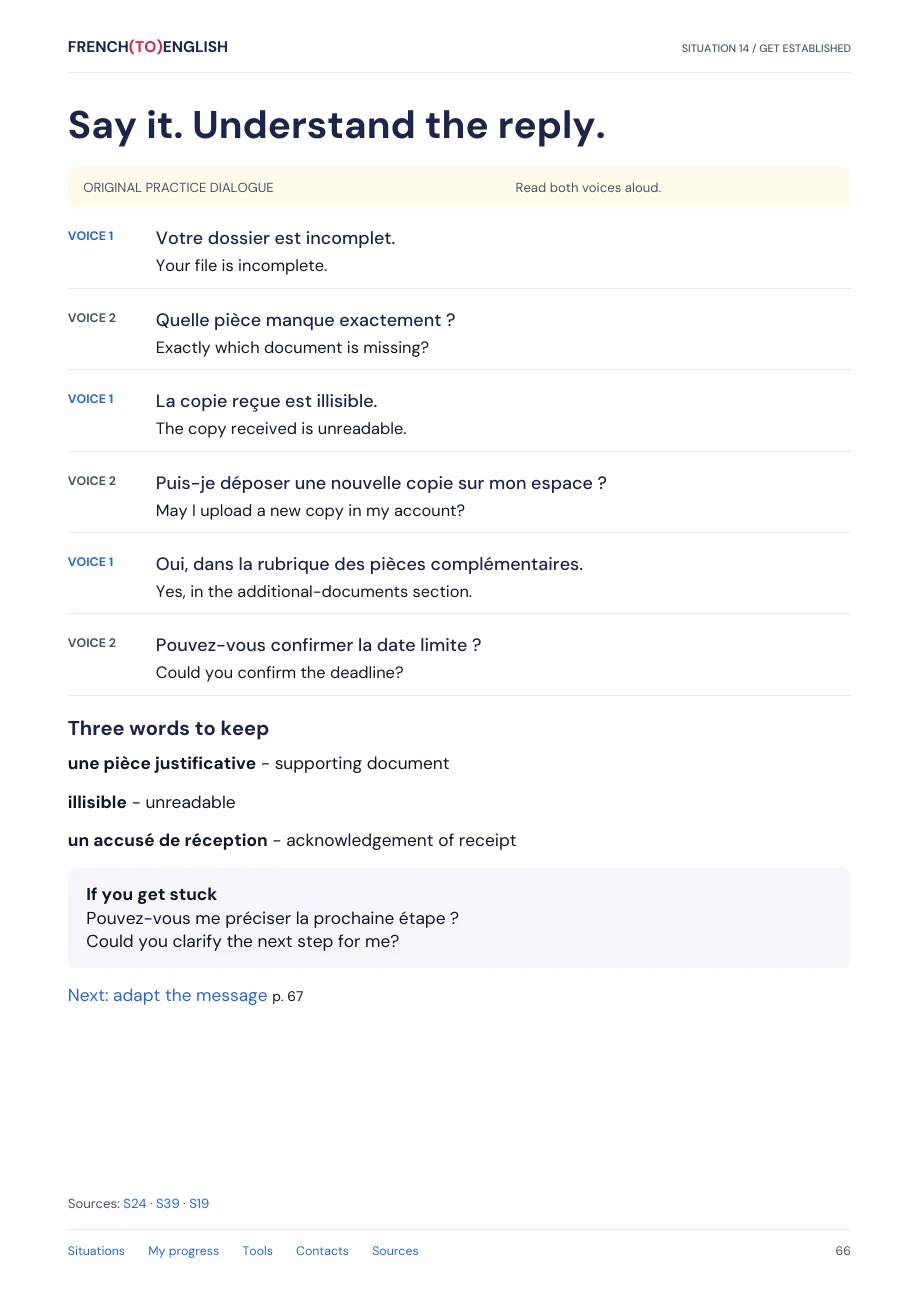
Votre dossier est incomplet.
Quelle pièce manque exactement ?
Reveal the English & the useful bit
Your file is incomplete.
Exactly which document is missing?
Une pièce means a document in this exchange. Ask which one, then check the next step and deadline.
Real dialogue excerpt · Fictional practice situation · Restyled for the web
 See it in the guideOpen the original page 66 ↗
At the pharmacyA label to understand. A question you can ask.+
Rehearse the French for asking about written instructions at the pharmacy.
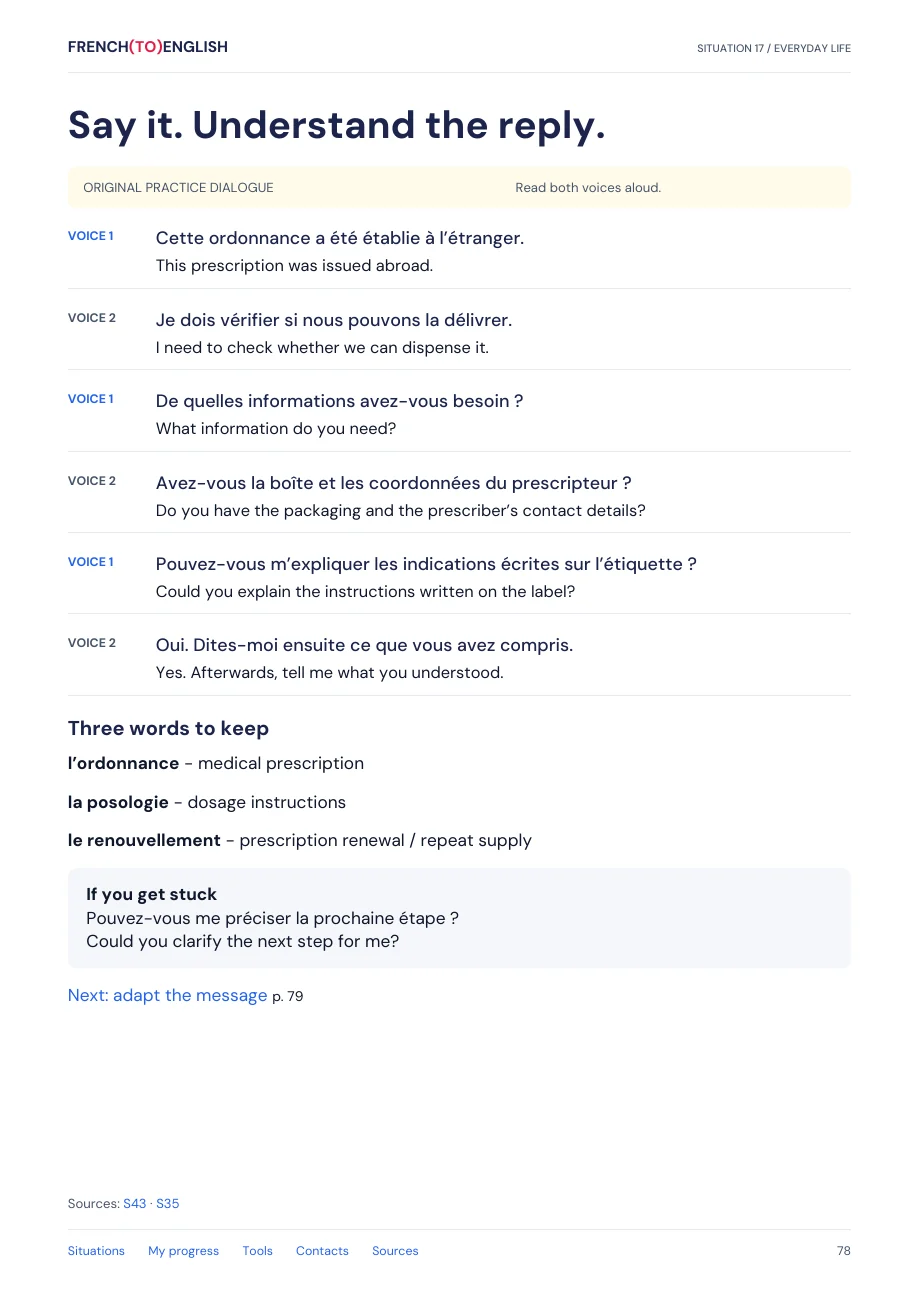
Pouvez-vous m’expliquer les indications écrites sur l’étiquette ?
Oui. Dites-moi ensuite ce que vous avez compris.
Reveal the English & the useful bit
Could you explain the instructions written on the label?
Yes. Afterwards, tell me what you understood.
Practise asking, then saying back what you understood. This excerpt is language practice for a conversation with the pharmacist.
Real dialogue excerpt · Fictional practice situation · Restyled for the web
 See it in the guideOpen the original page 78 ↗
Open it. Put it to use.
Here’s what comes with your guide.
French for things you need to do.
- 30 four-page situations with practical steps and bilingual dialogues.
- Adaptable message sheets and an emergency practice card.
- 90 scenario questions, explained answers and 30 replay twists.
- Rescue phrases and a clickable 90-term French–English glossary.
A place to organise the next step.
- A flexible arrival plan and progress sheets.
- Appointment, budget and follow-up tools.
- Document checklists, scam warnings and public/private help contacts.
- 51 primary source references, checked on 25 September 2026.
Start with what is happening this week.
- Arrival, phone calls, SIM cards and proof of address.
- Rental viewings, application files, leases and inventories.
- Home insurance, utilities, internet and repairs.
- Bank accounts, transfers and missing documents.
- Healthcare, doctor visits, pharmacies and emergencies.
- Shopping, allergies, transport and driving.
- School, work, neighbours and social life.
- Post, cancellations, complaints and your 90-day review.
Open the situation you need, or work through the flexible plan. Common differences for students, workers, families and other circumstances are signposted along the way.
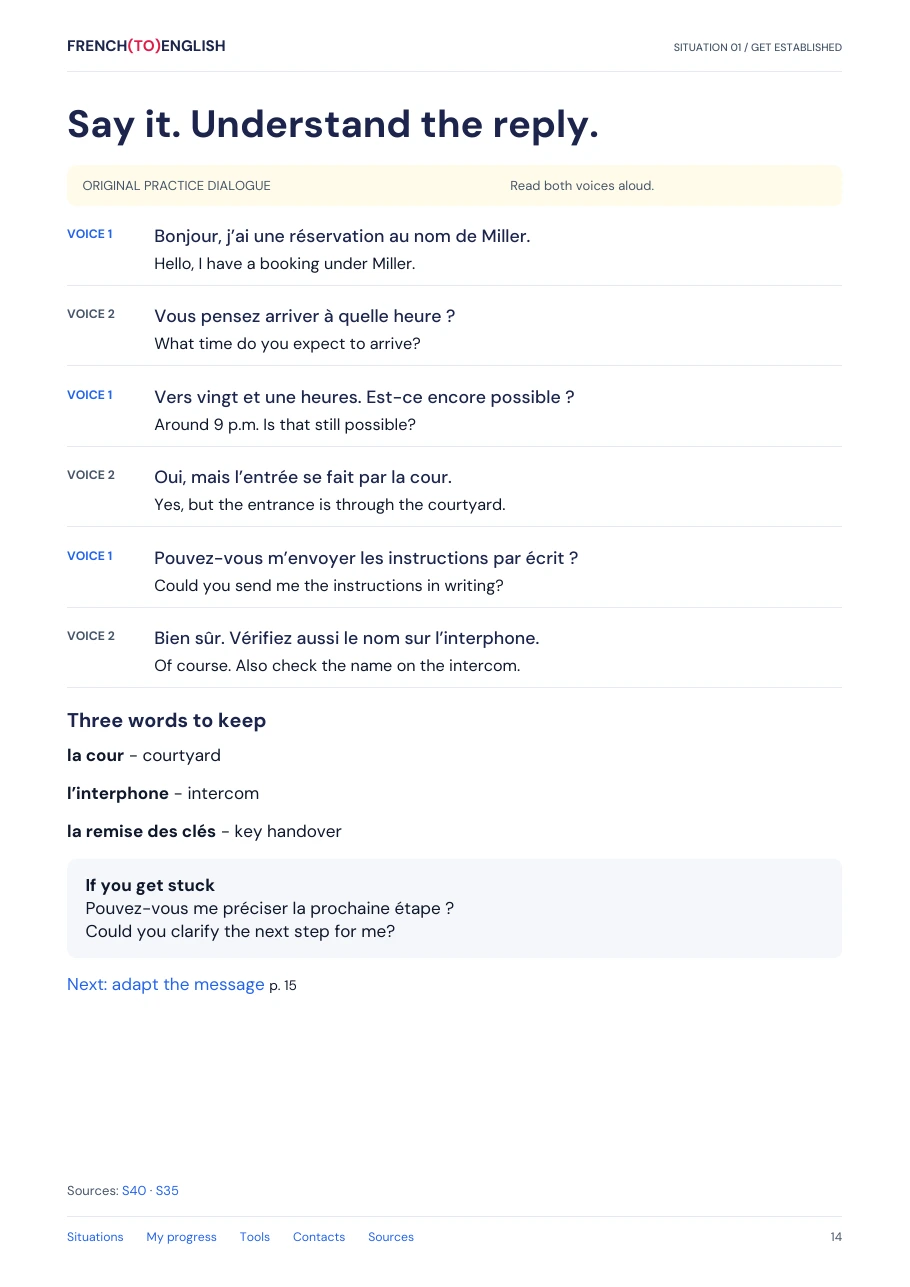
The French beside the task
Recognise the reply. Keep the conversation going.
Read both sides of the conversation. Find the phrase for asking someone to repeat a detail. Then change the names, dates and facts to fit your own situation.
The aim is a useful exchange: understand the price or deadline, check what is missing and agree on the next step.
A few things you might be wondering.
Do I get both editions for $9?
Yes. One payment of $9 USD includes the interactive PDF and the matching printable A4 PDF. Each is about 180 pages. They are two ways to use the same guide, not two separate purchases.
Who is this for?
English-speaking adults preparing to move, or newly arrived, in mainland France. It is especially relevant to American newcomers, with common differences for other situations signposted. Instructions are in English and the practice dialogues are bilingual.
Do I need a particular French level?
No exam level is required to use the planning pages, checklists or English explanations. If you are new to French, start with the short phrases and bilingual dialogues. This is practical preparation, not a complete language course.
Do I have to follow a strict 90-day schedule?
No. The plan is flexible. You can jump straight to the situation you need, and some formalities depend on your own status and timeline. The title does not mean every task must be completed within 90 days.
How does the interactive edition work?
Download the file, open it in desktop Acrobat Reader and save a personal copy. Fill in notes, choose answers and use the scoring or replay buttons. Save your changes before closing. Your written answers are not sent to us.
Can I use it on my phone or print only a few pages?
Yes, you can read the guide in many PDF viewers, although form and scoring support varies. Use the A4 edition for paper practice and print only the situations or tools you need. The two editions share page numbers.
Is this the Visa pack?
No. This guide focuses on getting settled and using French in everyday situations. The Long-Stay Visa Language Pack is a separate $9 product about preparing a long-stay visa application. Neither product is automatically added to the other.
Is this an official guide or individual professional advice?
No. It is an independent FrenchToEnglish publication. It provides practical language support, organisation tools and source links; it does not replace the authority handling your case or individual legal, medical or tax advice.
How current is the information?
This edition is dated 25 September 2026 and includes 51 primary source references. Official links help you check later changes. Your downloaded file does not update automatically. The cover illustrations are AI-generated.
Are audio, lessons or personal corrections included?
No. This purchase includes two downloadable PDFs. You get written dialogues, answer explanations and self-practice tools; live lessons, audio recordings and individual marking are not included.
Make your next conversation a little easier.
30 situations. Practical French. Two PDF editions, ready to use.
One payment · Digital download · No subscription
Questions or download trouble? contact@frenchtoenglish.com
Terms · Refund information