French Work Culture Email Etiquette and Office Phrases: The Unwritten Rules That Decide How Colleagues See You
French work culture email etiquette operates on rules that nobody writes down and everybody enforces. Your American “Hey Pierre, can you send the report? Thanks!” reads as aggressive in a French inbox. Your casual first-name greeting signals that you don’t understand hierarchy. Your missing closing formula says you don’t respect the person you’re writing to. None of this is obvious. All of it is noticed. This B1-B2 guide covers email structure, the tu/vous minefield, office phrases for every daily situation, meeting vocabulary, phone etiquette, and the cultural norms around lunch, vacations, and hierarchy that determine whether French colleagues see you as a peer or a problem.
Why French professional email etiquette feels like a foreign protocol
French workplace communication operates on a formality axis that anglophone cultures abandoned decades ago. What Americans consider efficient and direct, French professionals perceive as rude and aggressive. What French professionals consider appropriately formal, Americans find cold and unnecessarily rigid. The gap isn’t stylistic. It’s structural. French professional emails have six mandatory components, and missing any of them marks you as either unprofessional or culturally unaware. The opening greeting follows strict rules about titles and names. The context sentence buffers the request. The purpose statement uses conditional tense to soften demands. The closing formula is not optional, not decorative, and not interchangeable with “Best regards.” Understanding this structure isn’t about sounding fancy. It’s about being taken seriously in a system where email etiquette is a direct proxy for professional competence.
The most common issue we see with anglophone professionals in French offices isn’t grammar. It’s register. They write grammatically correct French that sounds like a translated American email, and French colleagues read it as tone-deaf. The grammar is fine. The cultural code is wrong. Fixing this requires learning the specific formulas below, not improving your conjugation.
Every week, an anglophone professional working in France asks us the same question: “My French is good but my colleagues respond to my emails with unusual formality. What am I doing wrong?” The answer is always the same: your email structure. Not your French. Your structure.
The six-part French professional email: every component explained
Every professional French email follows the same architecture. The six components below aren’t guidelines. They’re expectations. Omitting the formal greeting reads as aggressive. Jumping to the request without a context sentence reads as demanding. Ending without a closing formula reads as disrespectful.
Part 1: the greeting
“Cher Monsieur” (Dear Sir) sounds oddly intimate in French business emails, not more formal. “Bonjour” + title + surname is the standard. Using a first name without title requires an established relationship where tu has been explicitly offered. “Salut Marc” is appropriate only between close colleagues who already use tu. Using it with someone you vouvoie is a social breach that French professionals notice and remember.
Part 2: the context sentence
The context sentence places your email in a shared reference frame before you make any request. English speakers skip this and jump to “Can you send me the report?” French professionals read that as aggressive because it lacks the social cushion that signals respect for the other person’s time and the shared professional relationship.
Part 3: the purpose statement
“Je me permets” (I am taking the liberty) is a standard French professional formula that sounds excessive in English but is perfectly calibrated in French. The conditional tense (“je souhaiterais” rather than “je souhaite”) adds a layer of deference that makes requests sound professional rather than demanding.
Part 4: the request with conditional phrasing
Every request in French professional emails uses the conditional tense. “Pouvez-vous” (can you) is acceptable but direct. “Pourriez-vous” (could you) is standard. “Serait-il possible de” (would it be possible to) is the safest formula when you’re unsure of the hierarchy.
Part 5: anticipatory thanks
Part 6: the closing formula
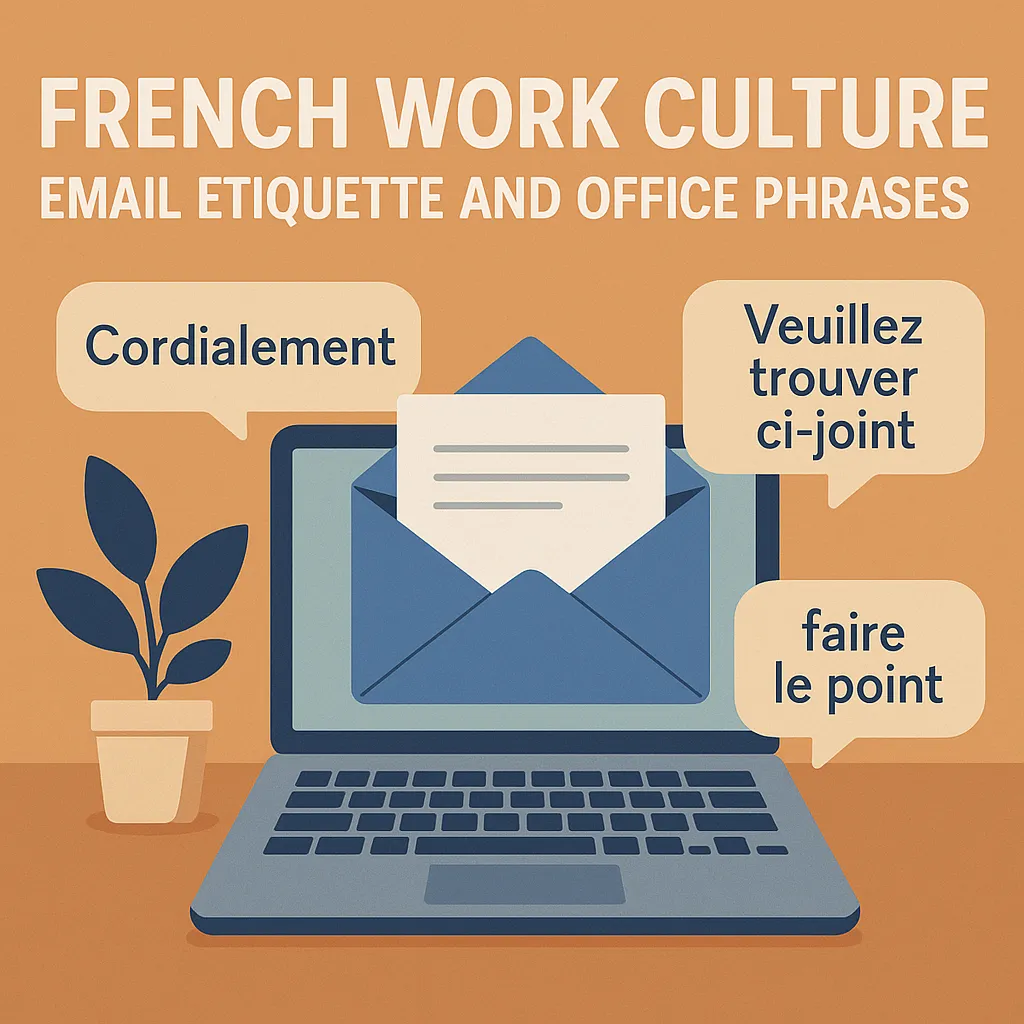
“Cordialement” is the safe default for 90% of professional emails. For very formal correspondence (legal, governmental, official), the full formula is required: “Je vous prie d’agréer, Madame, Monsieur, l’expression de mes salutations distinguées.” This is not ironic. This is not optional. This is protocol.
Never use these closings in French professional emails: “Sincèrement” (sounds old-fashioned, not formal), “Meilleurs voeux” (only for New Year’s greetings), “Best” or “Cheers” (no French equivalent, reads as bizarre), “Thanks” or “Thx” (too casual). Ending an email without any closing formula is perceived as extremely rude.
The 90% email formula: Bonjour [Title + Surname], Suite à [context], je [purpose with conditional]. [Details]. Je vous remercie par avance. Cordialement, [name]. This structure handles nine out of ten professional email situations correctly. Memorise it. Stop improvising.
Tu vs vous in French offices: the hierarchy signal you can’t fake
The tu/vous distinction in French workplaces is not a grammar choice. It’s a relationship declaration. Using vous with everyone until explicitly invited to switch is the only safe default, and “explicitly invited” means someone says “On se tutoie ?” (shall we use tu?) or starts using tu with you first and is of equal or higher rank. Unilaterally switching to tu with a French colleague who hasn’t offered it is the workplace equivalent of calling your boss by a nickname they never authorised.
The invitation to switch always comes from the senior person, the older person, or the person who has been at the company longer. A new hire does not offer tu to their manager. A junior does not offer tu to a director. The hierarchy is not ambiguous.
The startup exception and its limits
French tech startups and some creative agencies default to tu from day one. This is real but limited. It applies within the company, not with external clients or partners. It applies between peers, not always between junior employees and the CEO. Even in tu-first environments, emails to external contacts revert to vous. The startup culture is a local override, not a repeal of French professional norms. When unsure, default to vous. Nobody is offended by excessive formality. People are offended by excessive familiarity.
Daily office phrases: from arrival greeting to departure
French workplace culture requires greeting every colleague you encounter when arriving at work. Not greeting someone is perceived as ignoring their existence, which in French social code is an insult, not an oversight. Walking past a colleague without saying “Bonjour” creates a social debt that compounds.
Meeting phrases: contributing without overstepping
French meetings operate differently from American meetings. Hierarchy structures who speaks when and how. Junior employees speak less. Interrupting is acceptable but must be framed politely. Disagreeing directly is possible but requires diplomatic language.
Phone calls: the formality layer most anglophones miss
Phone calls default to vous even between colleagues who use tu face-to-face, because the phone context feels more formal and the conversation might be overheard. The conditional tense becomes even more important on the phone because vocal tone can’t soften a direct request the way body language can in person.
The phone-to-email consistency rule: Your phone register and your email register should match. If you vouvoie someone on the phone, you vouvoie them in email. Mixing registers across channels confuses the relationship signal and makes French colleagues uncertain about where they stand with you.
Students who prepare specifically for their first French phone call find that the phone anxiety diminishes once the formulas are memorised, because French phone etiquette is more formulaic than English phone etiquette.
Cultural norms that shape French workplace behaviour
The sacred lunch break
French professionals treat lunch as genuine downtime, not refuelling between tasks. Typical lunch breaks last one to two hours. Eating at your desk is not just uncommon; in many offices it signals that you either don’t understand French work culture or you’re deliberately isolating yourself from the team. The lunch hour is where informal professional relationships develop, where information circulates outside official channels, and where the social bonds that make French workplace collaboration possible are maintained. Declining lunch invitations repeatedly creates distance that formal professionalism cannot bridge.
Accept this invitation. Not every day, but regularly. The conversation at lunch teaches you more about French professional culture than any textbook because it’s where the unwritten rules are transmitted between colleagues in real time.
The lunch intelligence network
French workplace information flows through lunch, not through Slack. Who’s getting promoted, which projects are in trouble, what the CEO really thinks about the reorganisation: this intelligence circulates at the restaurant table, not in official channels. Anglophone professionals who eat at their desk miss the informal communication layer that French colleagues use to stay informed, build alliances, and navigate office politics. The lunch invitation is not social. It’s operational.
August: the month France pauses
Most French professionals take two to four weeks of vacation in August. Many businesses operate at minimal capacity. Scheduling important meetings, expecting quick responses, or launching projects in August is a planning error that marks you as someone who doesn’t understand French professional rhythms. Plan around August, not through it. The five-week minimum vacation entitlement is law, not culture, and French colleagues exercise it fully without guilt or apology.
Work-life boundaries and the right to disconnect
France’s “droit à la déconnexion” (right to disconnect) is codified in labour law. Sending work emails after 19h or on weekends is not just unusual; in some companies it violates policy. French colleagues who don’t respond to your Saturday afternoon email aren’t being unresponsive. They’re exercising a legal right that reflects a cultural value: work has boundaries, personal time is protected, and blurring the line is a management failure, not employee dedication. Adjusting to this norm means scheduling your send times, respecting evening and weekend silence, and understanding that French productivity is measured by output during working hours, not by availability outside them.
Hierarchy in practice: what it means for your daily behaviour
French workplaces are more hierarchical than anglophone ones. Age, position, educational pedigree (Grande École vs university), and seniority create a formal structure that affects who speaks first in meetings, who addresses whom with tu, who proposes schedule changes, and whose opinion carries implicit authority regardless of the meeting topic. Bypassing your direct superior to escalate to their boss is a serious breach. Junior employees speaking before senior ones in formal meetings can be perceived as overstepping. The hierarchy isn’t rigid in the way military hierarchy is, but it’s present in every interaction and ignoring it signals that you don’t understand the organisational culture you’re operating within.
The 35-hour week context: France’s standard work week is 35 hours, not 40+. Overtime exists but is regulated and compensated differently than in Anglo-American systems. When a French colleague leaves at 18h, they’re not leaving early. They’re leaving on time. Interpreting French work patterns through an American lens of “always available” creates friction that damages professional relationships.
Study glossary: essential workplace vocabulary
| French | English | Usage context |
|---|---|---|
| Un(e) collègue | A colleague | “Mes collègues sont sympathiques” |
| Le/la responsable | The manager | “Je dois parler à mon responsable” |
| Le supérieur hiérarchique | The direct superior | Formal hierarchy vocabulary |
| Une réunion | A meeting | “J’ai une réunion à 14h” |
| Un dossier | A file / a project | “Je travaille sur ce dossier” |
| Un compte-rendu | Minutes / a report | “Envoyer le compte-rendu” |
| Un délai | A deadline | “Respecter les délais” |
| Les congés | Vacation / time off | “Je prends mes congés en août” |
| Le télétravail | Remote work | “Je fais du télétravail le vendredi” |
| Cordialement | Best regards | Standard email closing |
| Suite à | Following / further to | “Suite à notre conversation” |
| Je vous prie d’agréer | Please accept (formal closing) | Official correspondence only |
| Pourriez-vous | Could you (conditional) | Professional request formula |
| Le droit à la déconnexion | Right to disconnect | French labour law concept |
Go further
Stop making the same 21 French mistakes. Play them away.
300 pages of games, riddles and quizzes built around the 21 mistakes English speakers actually make in French. You fix them by playing, not by memorising rules. By Camille Aubert.
📚 Keep building in the Learning Center
French Property Taxes for English Speakers: Taxe Foncière Explained
Most anglophone owners discover French property taxes the hard way: a notice arrives in late August, in administrative…
Read →Imparfait vs Passé Composé Explained: Timeline Method
Imparfait vs passé composé trips up every English speaker because English never forces the same choice. You say…
Read →Best Canal+ French series — where to watch legally (Dix pour cent, Baron Noir, Le Bureau)
Discover Canal+ premium French television series including Dix pour cent (Call My Agent!), Le Bureau des Légendes, Baron…
Read →