Updated on September 15, 2026
French Subjunctive: Uses, Forms and Examples
Learn French subjunctive triggers, regular and irregular forms, and common exceptions. Compare examples and practise choosing the correct mood.
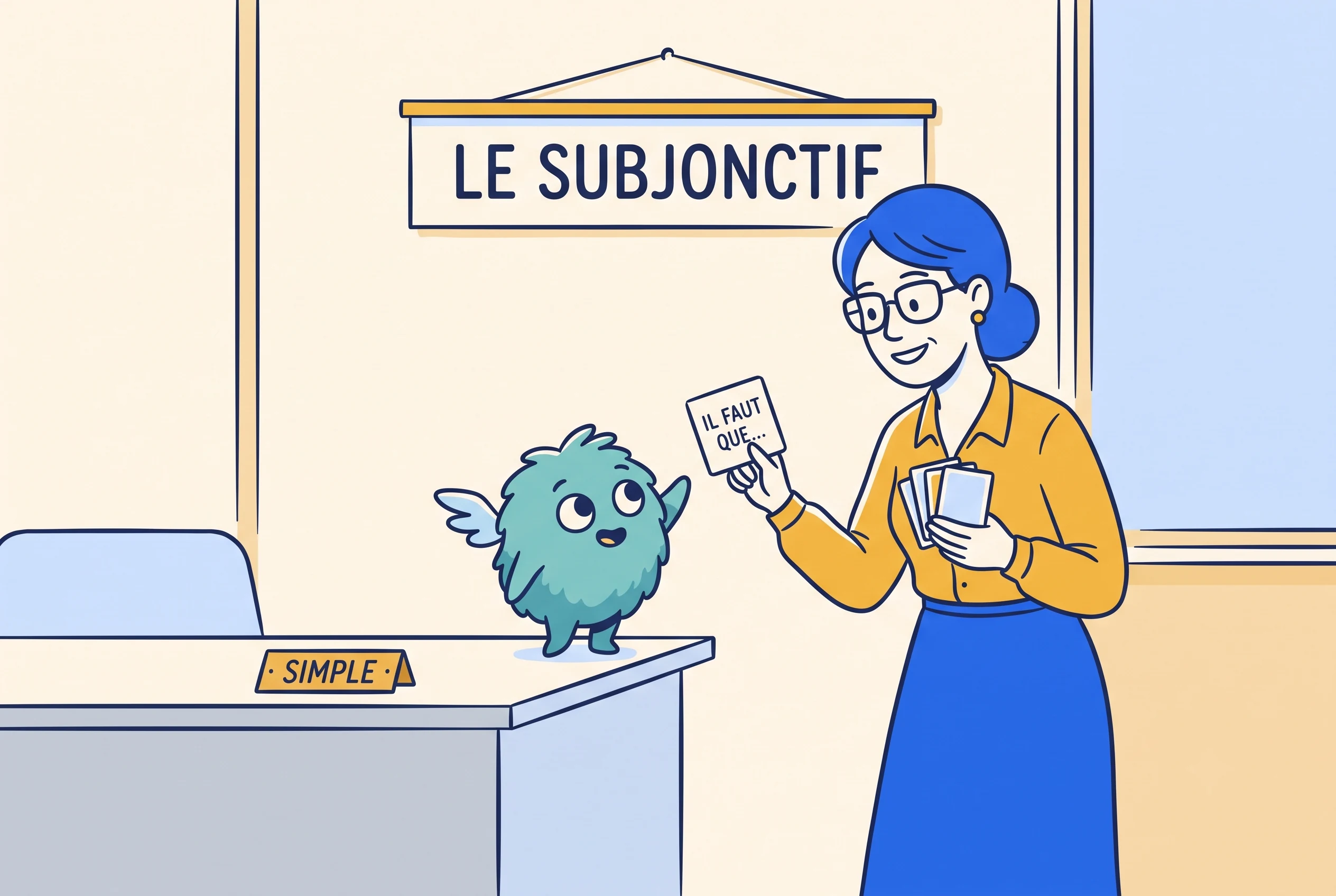
The subjunctive depends on the expression and sentence structure, not simply on whether an idea is uncertain. Learn the common constructions first, then compare the exceptions and practise the verb forms in context.
What the subjunctive actually is
The subjunctive is a verb mood. To choose it, look at the expression introducing the clause, not just whether the event is real. In the two examples below, knowing takes the indicative while doubting takes the subjunctive. Compare the introducing verbs before comparing vient and vienne.
Same structure. Different verb form. The only thing that changed is the speaker’s relationship to the information. The same invisible-in-English logic shows up with words that look safe in French but carry different weight.
Check the introducing expression
First identify the expression before que. Desire, doubt and necessity are useful starting categories, but they are not a complete decision rule. An emotion can concern something that really happened. Learn the construction, then check the conjugation.
One subject or two: the vouloir pattern
Two subjects do not automatically require the subjunctive. With vouloir, the same person wanting and acting uses an infinitive; a different person acting calls for que plus the subjunctive. The two boxes below illustrate vouloir specifically. Knowing that someone is coming also involves two subjects, but savoir que takes the indicative.
One Subject → Infinitive
Je veux partir (I want to leave)
Two Subjects → Subjunctive
Je veux que tu partes (I want you to leave)
Regular conjugation: the pattern most learners never see
For regular verbs, start with the present ils form, remove -ent and add -e, -es, -e, -ions, -iez, -ent. Some verbs use a different stem for nous and vous, taken from their present nous form. Check irregular verbs separately; one stem does not explain every conjugation.
The Big Four Irregular Verbs
Learn these useful irregular forms as complete groups. Pay particular attention to nous and vous: they cannot always be predicted from je. Read each group aloud, then use one form in a sentence with il faut que.
One more verb and the four are complete. This is the one that shows up whenever you have to be somewhere:
Common trigger phrases
Learn an introducing expression together with the mood it requires. The subjunctive can express a reaction to an accepted fact, so it does not simply mean unreal. Bien que is another important case. Keep this mood choice separate from choosing between the two main past tenses.
| 🔑 Trigger | ✍️ Example | 🎯 Why subjunctive |
|---|---|---|
| Il faut que | Il faut que tu viennes | Necessity |
| Je veux que | Je veux que tu sois là | Desire |
| Bien que | Bien qu’il soit tard | Concession |
| Je doute que | Je doute qu’il puisse venir | Doubt |
| Pour que | Pour que ça marche | Purpose |
| Avant que | Avant qu’il parte | Sequence |
| Je suis content que | Je suis content que tu sois là | Emotion |
| Sans que | Sans qu’il le sache | Exclusion |
Keep the trigger cheat sheets on your desk
You just saw how a small set of trigger phrases pulls the verb into the subjunctive. Our free cheat sheet pack gathers the essential verb forms, tenses, and everyday phrases on printable pages you can keep beside you while you practice. Enter your email and the free cheat sheet pack downloads right away.
The espérer exception
Compare the two expressions below. Espérer and souhaiter are close in meaning, but their usual affirmative constructions require different moods.
When NOT to use the subjunctive
Certainty is the test. When the speaker presents something as plain fact, the second verb keeps its ordinary form.
Negative penser and croire commonly take the subjunctive when they express doubt. This is a useful pattern, not an automatic rule for every negative sentence: the intended meaning and construction still matter.
Study glossary
| 🇫🇷 French | 🇺🇸 English | 💡 Context |
|---|---|---|
| le subjonctif | the subjunctive | Le subjonctif exprime le doute |
| l’indicatif | the indicative | L’indicatif exprime les faits |
| il faut que | it is necessary that | Il faut que tu viennes |
| je veux que | I want that | Je veux que tu partes |
| bien que | although | Bien qu’il soit tard |
| pour que | so that | Pour que ça fonctionne |
| espérer que | to hope that (indicative!) | J’espère qu’il viendra |
Prefer to keep it free today? Read the French Briefing →
Grammar reference: UT Austin: subjunctive with desire and emotion; regular forms; irregular forms.
Use your French in a real conversation.
Bring a question from a guide to a French tutor. Try it aloud, ask for feedback and leave with something to practise.
Find a French tutor →Paid lessons. Compare tutors and prices before booking.
Affiliate link: we may earn a commission when you book.
📚 Keep building in the Learning Center
French Reflexive Verbs: Daily Routine and Word Order
Build a daily routine in French with reflexive pronouns, negatives and infinitives. Compare translated examples, listen and practise.
Read →Futur Proche vs Futur Simple: Examples and Practice
Compare futur proche and futur simple in French plans, promises and announcements. Learn the forms and practise choosing…
Read →French Nature Vocabulary: Trees, Rivers and Mountains
Describe nature in French with vocabulary for trees, rivers, mountains and weather. Compare landscape terms through translated examples…
Read →